
BuddhistCatholicContemplativeEvangelicalGeneral ChristianHinduJewishLatter-day SaintMuslimNew VisionsProgressive Christian
Beliefs
- Buddhist
- Catholic
- Contemplative
- Evangelical
- General Christian
- Hindu
- Jewish
- Latter-day Saint
- More Voices
- Muslim
- New Visions
- Pagan
- Progressive Christian
Topics
- Religion News
- Food and Religion
- Sports and Religion
- Religious Art
- Religious Music and Entertainment
- Religious Events
- History and Religion
- Style and Religion
- Politics and Religion
- Women in Religion
- Recreation Outdoors and Religion
- Business Finance and Religion
- Careers Workplace and Religion
- Education and Religion
- Family Parenting and Religion
- Health Fitness and Religion
- Home and Religion
- Relationships and Religion
- Technology and Religion
- Travel and Religion
Columnists
- Buddhist Columnists
- Business Finance and Religion Columnists
- Careers Workplace and Religion Columnists
- Catholic Columnists
- Contemplative Columnists
- Education and Religion Columnists
- Evangelists Columnists
- Family Parenting and Religion Columnists
- General Christian Columnists
- Health Fitness and Religion Columnists
- Hindu Columnists
- History and Religion Columnists
- Home and Religion Columnists
- Jewish Columnists
- More Voices Columnists
- Latter Day Columnists
- Muslim Columnists
- New Visions Columnists
- Nonreligious Columnists
- Pagan Columnists
- Politics and Religion Columnists
- Progressive Columnists
- Recreation Outdoors and Religion Columnists
- Relationships and Religion Columnists
- Religion News Columnists
- Religious Art Columnists
- Religious Events Columnists
- Religious Music and Entertainment Columnists
- Sports and Religion Columnists
- Style and Religion Columnists
- Technology and Religion Columnists
- Travel and Religion Columnists
- Women in Religion Columnists
Resource Library
- 2026 Calendar
- Library of World Religions
- The 100 Most Holy Places on Earth
- Patheos Answers
- Podcasts
- Videos
- Faith Leaders Database
- Anglican Episcopalian
- Bahai
- Baptist
- Buddhism
- Christianity
- Confucianism
- Eastern Orthodoxy
- Hinduism
- Holiness and Pentecostal
- ISKCON
- Islam
- Judaism
- Lutheran
- Methodist
- The Church of Jesus Christ of Latter-day Saints
- New Age
- Paganism
- Presbytarian and Reformed
- Protestantism
- Religion Behind the Scenes
- Roman Catholic
- Scientology
- Shia Islam
- Sikhism
- Sufism
- Sunni Islam
- Taoism
- Zen
- See all religions
Research Tools
 Ad-Free & Subscriber Log-In Subscription Support
Ad-Free & Subscriber Log-In Subscription Support
Follow Patheos 

- Trending:
- Forgiveness
- |
- Marriage
- |
- Consciousness
- |
- Death Penalty
- |
- Election
- |
- Halloween
 Holyscapes
- Home
- Contemplative
- The Tower of Silence
The Tower of Silence
Last updated on: March 4, 2017 at 10:06 am by Jason M. Brown
The Tower of Silence 2017-03-04T10:06:28-08:00 Jason M. Brown
Patheos Explore the world's faith through different perspectives on religion and spirituality! Patheos has the views of the prevalent religions and spiritualities of the world.
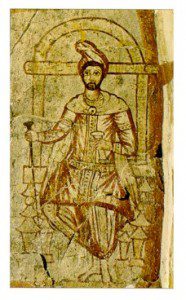
The Prophet Zoroaster Source: Wikipedia
I recently did an interview with three Zoroastrians who live here in Vancouver. As I was preparing for the interview, I learned the fascinating history of the death rituals practiced by ancient and some modern Zoroastrian communities.
Briefly, Zoroastrians are followers of the teachings of the prophet Zarathustra, or Zoroaster in Greek, who is thought to have lived some time between 1,500 and 650 BCE. They are probably the first monotheistic religions with a great reverence for the elements, especially fire, which is a kind of incarnation of wisdom.
However, because of a dualistic cosmology, with the forces of good and evil forever at odds, dead bodies are believed to be quickly tainted by evil spirits. Because the elements are holy, death must be dealt with in such a way that the elements are not tainted by the corpse. This means no burial, no cremation, or setting out to sea. Traditionally then, Zoroastrians have conducted what is often referred to as ‘sky burial.’ The corpse is taken to a place called a Tower of Silence, where carrion eaters such as vultures devour the corpse. The technical term for this is excarnation, and it is also practiced by certain sects of Tibetan Buddhism, and in Mongolia, Bhutan, and Nepal.

Mumbai Tower of Silence Entrance
Source: Wikipedia
One particular case that drew my attention, was the Zoroastrian community in Mumbai, whose Tower of Silence called the Doongerwadi, is surrounded by 54 acres of unmanaged forest, creating a small oasis. The Tower was built in the late 1600s, but is located in what is now an upper middle class neighborhood.
However, in the 1990s, the vulture population, which traditionally devoured the corpses in short order, collapsed due to the use of a drug administered to cattle, which was then ingested by the birds who had eaten the remains of treated cows. In some places, the vulture population was decreased by 99%.
This decrease in the vulture population, has meant that there are not enough birds to properly decompose the corpses of Mumbai’s Zoroastrian community, and there are worries about the public health implications of half decomposed corpses sitting around, even with the forest buffer.
In response, Zoroastrian activists have begun experimenting. There is a vulture breeding program in the works that is having some success, but others have began experimenting with solar concentrators which direct the suns heat onto the decomposing corpses which dries them out and speeds up decomposition time.
Sources
http://news.bbc.co.uk/2/hi/south_asia/1443789.stm
Previous Post

February 26, 2017
Homily: Living Symbols
Next Post

March 18, 2017 Lost in Lent
Browse Our Archives
Select a Category Anthropocene Camino de Santiago Catholicism Film Holyscapes Homily Liturgy Monk Nature New Monasticism New Story Pilgrimage Poetry Politics Prayer Religion and Spirituality Silence Spiritual Ecology Spring Spriritual Ecology Theology Uncategorized Walking Writing
Select a Month June 2020 May 2020 April 2020 March 2020 February 2020 January 2020 December 2019 November 2019 August 2019 June 2019 May 2019 April 2019 January 2019 December 2018 November 2018 October 2018 September 2018 August 2018 July 2018 June 2018 May 2018 April 2018 March 2018 February 2018 January 2018 November 2017 October 2017 September 2017 August 2017 July 2017 June 2017 May 2017 April 2017 March 2017 February 2017 January 2017 December 2016 November 2016 October 2016 September 2016 August 2016 July 2016 June 2016 May 2016 April 2016 March 2016 February 2016 January 2016 December 2015 November 2015
Follow Us!
TAKE THE
Religious Wisdom Quiz
True or False: Ezekiel saw a vision of a valley of dry bones that came to life.
Select your answer to see how you score.
FALSE TRUE
Related posts from Holyscapes




A Guide Book to America’s Sacred Groves: A...
TRENDING AT PATHEOS Contemplative

Handy Contemplative Practices for Political Spaces
A Spiritually Grounded Presence In order to bring a spiritually grounded presence...

Halloween: The Holiday of Loving Your Neighbor
All Hallows Eve Is Halloween the least Christian holiday in America, or...

Can Love Be Saved? Some Thoughts on the...
Happy Valentine's Day! I recently published a post on Patreon called Can...

"This Loving, Uniting Embrace": the Holy Ordinary
Today's guest post is by Mark Longhurst, author of The Holy Ordinary:...

How Are We Called to Live?: More About...
How Are We Called to Live? Many of us struggle with discerning...

A Spiritual Practice of Reading: Join Us Online
A Spiritual Practice of Reading A healthy spiritual practice of reading is...
view all Contemplative blogs
Ad-Free & Subscriber Log-In Subscription Support
- About Us
- 2026 Calendar
- Videos
- Podcasts
- Library of World Religions
- Faith In Media Tracker
- Advertise With Us
- Write for Us
- Privacy Policy
- Terms of Service
- Do Not Sell My Data
- Contact Us
- Radiant Digital
- Manage Newsletter Subscriptions
- Unsubscribe From Notifications
- Sitemap
Copyright 2008-2026, Patheos. All rights reserved.
Subscription Support Ad-Free & Subscriber Log-In
Follow Patheos