
BuddhistCatholicContemplativeEvangelicalGeneral ChristianHinduJewishLatter-day SaintMuslimNew VisionsProgressive Christian
Beliefs
- Buddhist
- Catholic
- Contemplative
- Evangelical
- General Christian
- Hindu
- Jewish
- Latter-day Saint
- More Voices
- Muslim
- New Visions
- Pagan
- Progressive Christian
Topics
- Religion News
- Food and Religion
- Sports and Religion
- Religious Art
- Religious Music and Entertainment
- Religious Events
- History and Religion
- Style and Religion
- Politics and Religion
- Women in Religion
- Recreation Outdoors and Religion
- Business Finance and Religion
- Careers Workplace and Religion
- Education and Religion
- Family Parenting and Religion
- Health Fitness and Religion
- Home and Religion
- Relationships and Religion
- Technology and Religion
- Travel and Religion
Columnists
- Buddhist Columnists
- Business Finance and Religion Columnists
- Careers Workplace and Religion Columnists
- Catholic Columnists
- Contemplative Columnists
- Education and Religion Columnists
- Evangelists Columnists
- Family Parenting and Religion Columnists
- General Christian Columnists
- Health Fitness and Religion Columnists
- Hindu Columnists
- History and Religion Columnists
- Home and Religion Columnists
- Jewish Columnists
- More Voices Columnists
- Latter Day Columnists
- Muslim Columnists
- New Visions Columnists
- Nonreligious Columnists
- Pagan Columnists
- Politics and Religion Columnists
- Progressive Columnists
- Recreation Outdoors and Religion Columnists
- Relationships and Religion Columnists
- Religion News Columnists
- Religious Art Columnists
- Religious Events Columnists
- Religious Music and Entertainment Columnists
- Sports and Religion Columnists
- Style and Religion Columnists
- Technology and Religion Columnists
- Travel and Religion Columnists
- Women in Religion Columnists
Resource Library
- 2026 Calendar
- Library of World Religions
- The 100 Most Holy Places on Earth
- Patheos Answers
- Podcasts
- Videos
- Faith Leaders Database
- Anglican Episcopalian
- Bahai
- Baptist
- Buddhism
- Christianity
- Confucianism
- Eastern Orthodoxy
- Hinduism
- Holiness and Pentecostal
- ISKCON
- Islam
- Judaism
- Lutheran
- Methodist
- The Church of Jesus Christ of Latter-day Saints
- New Age
- Paganism
- Presbytarian and Reformed
- Protestantism
- Religion Behind the Scenes
- Roman Catholic
- Scientology
- Shia Islam
- Sikhism
- Sufism
- Sunni Islam
- Taoism
- Zen
- See all religions
Research Tools
 Ad-Free & Subscriber Log-In Subscription Support
Ad-Free & Subscriber Log-In Subscription Support
Follow Patheos 

- Trending:
- Forgiveness
- |
- Marriage
- |
- Consciousness
- |
- Death Penalty
- |
- Election
- |
- Halloween
 Holyscapes
- Home
- Contemplative
- The Mighty Fraser
The Mighty Fraser
Last updated on: October 27, 2016 at 12:44 pm by Jason M. Brown
The Mighty Fraser 2016-10-27T12:44:11-08:00 Jason M. Brown
Patheos Explore the world's faith through different perspectives on religion and spirituality! Patheos has the views of the prevalent religions and spiritualities of the world.
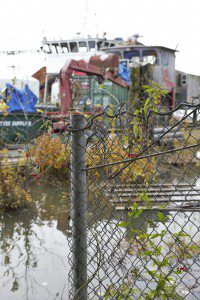
The Fraser River, near the Knight Street Bridge
Crossing a small pair of train tracks, the smell of fish grows stronger and the screech of gulls grows louder. I walk to the end of a small alley, and duck around an open fence where a tiny patch of green hides an even tinier stretch of river bank.
From what I could tell on Google Maps, this was the only place for miles that I could access the Fraser River on foot. Walking the 3.5 miles at a leisurely pace, through Vancouver’s charming suburbs, I had taken a more or less direct route south from my home in Cedar-Cottage. As I walked the quieter residential streets parallel to Knight Street, I said short Christian mantras softly to myself, and greeted Sikh men in turbans as they cleaned out gutters, or raked fallen leaves. One Chinese woman, was picking the leaves up by hand and pressing them to her chest, as if they were a set of precious documents, ducking up and down in quick motions. Trees large and small wore a spectrum of colors from defiant green, to surrendered yellows and reds. Small murders of crows picked at the lawns, and cracked acorns or horse chestnuts on the hard pavement.
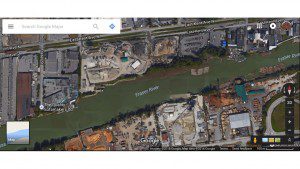
Google Maps Image from above
Standing on the narrow stretch of river bank, a cement factory to one side, and a seafood processing plant on the other, I could barely see across the river to the pulp mills on Mitchell Island. Along most of the southern border of Vancouver, the River had been sacrificed to industry, and I felt a mixture of sadness for the state of it, and adventurousness for having found it. A single hunched cottonwood tree, some lazy himalayan blackberry, and an assortment of weeds and grass gave the place a semblance of dignity, even though it was sandwiched between two industrial operations. I hesitantly reached down and touched the water, even though I felt like maybe that was a bad idea.
The Fraser is longest River in BC, and is know to Salish Peoples as the Sto:lo, Lhtakoh or ʔElhdaqox River. Its Anglo name is after Simon Fraser (1776-1862), an early explorer of British Columbia, and founder of the first European settlement in the Province. The River, drains an 85,000 square mile area, about the size of the state of Utah, but begins with a small spring at Fraser pass. From there it runs north and west past Mount Robson, through 180 miles of spectacular, narrow gorges in Fraser Canyon, on its way to the Fraser Valley and eventually to its mouth, braiding Vancouver, Richmond and Delta and into the Salish Sea. The mighty Fraser River meanders for 850 miles from headwaters to mouth.
Standing on the north bank of its lower reaches, I feel a pang of disappointment to see her in such a state, a state that feels moribund. Seeing the river like this, felt like seeing a relative in the hospital, their whole lives behind them, now emaciated and confused. When my grandmother was dying, I knew I wanted to see her, but each time, she seemed a little farther away. During one visit, about a week before her death, as we sat around speaking softly to her, unsure if she could hear us, she sat up and said, ‘Its ok, its going to be ok’, and laid back down in silence. I was glad that we were with her, and felt that our presence made some difference to her quality of dying. She was not alone.
In our society, we fear death, and confine its processes to medicalized and professionalized spaces. We fear seeing people when they are sick, because it reminds of our own mortality. The same can be said for the rest of Creation. When we perceive that a place is damaged, polluted, modified, developed, poisoned, we are hesitant to spend time there. I admit, I did not feel the same, standing on the banks of the Fraser, as I feel in a lush North Vancouver forest –peaceful, joyful, invigorated. But, in my anxiousness, it did feel important to me to simply be there. To visit her in all her degradation and distress. To mourn the loss of her body and the death of the beings that resided in her in greater numbers before we destroyed her.
The mighty Fraser may be close to death along this stretch, but there is hope that she may come back, in Creation, resurrection is always a possibility. Walking back, through the fish-stenched alley, I hoped that my presence on her banks, gave her just enough hope to hang on just a little bit longer.
Previous Post
October 14, 2016
Spiritual Ecology is not Always Natural Ecology
Next Post

October 29, 2016 The Young Lions of Standing Rock
Browse Our Archives
Select a Category Anthropocene Camino de Santiago Catholicism Film Holyscapes Homily Liturgy Monk Nature New Monasticism New Story Pilgrimage Poetry Politics Prayer Religion and Spirituality Silence Spiritual Ecology Spring Spriritual Ecology Theology Uncategorized Walking Writing
Select a Month June 2020 May 2020 April 2020 March 2020 February 2020 January 2020 December 2019 November 2019 August 2019 June 2019 May 2019 April 2019 January 2019 December 2018 November 2018 October 2018 September 2018 August 2018 July 2018 June 2018 May 2018 April 2018 March 2018 February 2018 January 2018 November 2017 October 2017 September 2017 August 2017 July 2017 June 2017 May 2017 April 2017 March 2017 February 2017 January 2017 December 2016 November 2016 October 2016 September 2016 August 2016 July 2016 June 2016 May 2016 April 2016 March 2016 February 2016 January 2016 December 2015 November 2015
Follow Us!
TAKE THE
Religious Wisdom Quiz
Which Christian denomination is most common in Russia?
Select your answer to see how you score.
Eastern Orthodox Baptist Methodist Catholic
Related posts from Holyscapes




A Guide Book to America’s Sacred Groves: A...
TRENDING AT PATHEOS Contemplative

Handy Contemplative Practices for Political Spaces
A Spiritually Grounded Presence In order to bring a spiritually grounded presence...

Halloween: The Holiday of Loving Your Neighbor
All Hallows Eve Is Halloween the least Christian holiday in America, or...

Can Love Be Saved? Some Thoughts on the...
Happy Valentine's Day! I recently published a post on Patreon called Can...

"This Loving, Uniting Embrace": the Holy Ordinary
Today's guest post is by Mark Longhurst, author of The Holy Ordinary:...

How Are We Called to Live?: More About...
How Are We Called to Live? Many of us struggle with discerning...

A Spiritual Practice of Reading: Join Us Online
A Spiritual Practice of Reading A healthy spiritual practice of reading is...
view all Contemplative blogs
Ad-Free & Subscriber Log-In Subscription Support
- About Us
- 2026 Calendar
- Videos
- Podcasts
- Library of World Religions
- Faith In Media Tracker
- Advertise With Us
- Write for Us
- Privacy Policy
- Terms of Service
- Do Not Sell My Data
- Contact Us
- Radiant Digital
- Manage Newsletter Subscriptions
- Unsubscribe From Notifications
- Sitemap
Copyright 2008-2026, Patheos. All rights reserved.
Subscription Support Ad-Free & Subscriber Log-In
Follow Patheos