
BuddhistCatholicContemplativeEvangelicalGeneral ChristianHinduJewishLatter-day SaintMuslimNew VisionsProgressive Christian
Beliefs
- Buddhist
- Catholic
- Contemplative
- Evangelical
- General Christian
- Hindu
- Jewish
- Latter-day Saint
- More Voices
- Muslim
- New Visions
- Pagan
- Progressive Christian
Topics
- Religion News
- Food and Religion
- Sports and Religion
- Religious Art
- Religious Music and Entertainment
- Religious Events
- History and Religion
- Style and Religion
- Politics and Religion
- Women in Religion
- Recreation Outdoors and Religion
- Business Finance and Religion
- Careers Workplace and Religion
- Education and Religion
- Family Parenting and Religion
- Health Fitness and Religion
- Home and Religion
- Relationships and Religion
- Technology and Religion
- Travel and Religion
Columnists
- Buddhist Columnists
- Business Finance and Religion Columnists
- Careers Workplace and Religion Columnists
- Catholic Columnists
- Contemplative Columnists
- Education and Religion Columnists
- Evangelists Columnists
- Family Parenting and Religion Columnists
- General Christian Columnists
- Health Fitness and Religion Columnists
- Hindu Columnists
- History and Religion Columnists
- Home and Religion Columnists
- Jewish Columnists
- More Voices Columnists
- Latter Day Columnists
- Muslim Columnists
- New Visions Columnists
- Nonreligious Columnists
- Pagan Columnists
- Politics and Religion Columnists
- Progressive Columnists
- Recreation Outdoors and Religion Columnists
- Relationships and Religion Columnists
- Religion News Columnists
- Religious Art Columnists
- Religious Events Columnists
- Religious Music and Entertainment Columnists
- Sports and Religion Columnists
- Style and Religion Columnists
- Technology and Religion Columnists
- Travel and Religion Columnists
- Women in Religion Columnists
Resource Library
- 2026 Calendar
- Library of World Religions
- The 100 Most Holy Places on Earth
- Patheos Answers
- Podcasts
- Videos
- Faith Leaders Database
- Anglican Episcopalian
- Bahai
- Baptist
- Buddhism
- Christianity
- Confucianism
- Eastern Orthodoxy
- Hinduism
- Holiness and Pentecostal
- ISKCON
- Islam
- Judaism
- Lutheran
- Methodist
- The Church of Jesus Christ of Latter-day Saints
- New Age
- Paganism
- Presbytarian and Reformed
- Protestantism
- Religion Behind the Scenes
- Roman Catholic
- Scientology
- Shia Islam
- Sikhism
- Sufism
- Sunni Islam
- Taoism
- Zen
- See all religions
Research Tools
 Ad-Free & Subscriber Log-In Subscription Support
Ad-Free & Subscriber Log-In Subscription Support
Follow Patheos 

- Trending:
- Forgiveness
- |
- Marriage
- |
- Consciousness
- |
- Death Penalty
- |
- Election
- |
- Halloween
 Holyscapes
- Home
- Contemplative
- Labyrinths within Labyrinths
Labyrinths within Labyrinths
Last updated on: June 27, 2016 at 11:35 am by Jason M. Brown
Labyrinths within Labyrinths 2016-06-27T11:35:44-08:00 Jason M. Brown
Patheos Explore the world's faith through different perspectives on religion and spirituality! Patheos has the views of the prevalent religions and spiritualities of the world.
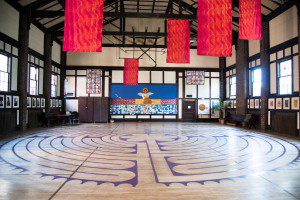
Saint Paul’s Anglican Church Labyrinth (From Saint Paul’s Website)
The soft staccato of a Celtic harp feels radically different from the bustling Friday night sounds of Davie Street. I sit, remove my shoes and socks and take a deep breath. I walk to the entrance of the labyrinth and center myself before taking short, slow and deliberate steps into the 11 course Labyrinth modeled after the famous Chartres Labyrinth in France. I am happy to be out of the hustle and noise of the city and to let my unhurried footsteps calm my heart and mind. I had just received news that my grandfather had just passed away and I would be heading back to California the next day, but I wanted to take a few moments before I left to pray.
Twice a month, Saint Paul’s Anglican Church on Jervis hosts this Labyrinth meditation. The Labyrinth is open other times during the week, but twice a month they invite a local musician to play while we walk the Labyrinth. I have found walking Labyrinths a good way to uncoil the stress and anxiety that I work myself into during the week.
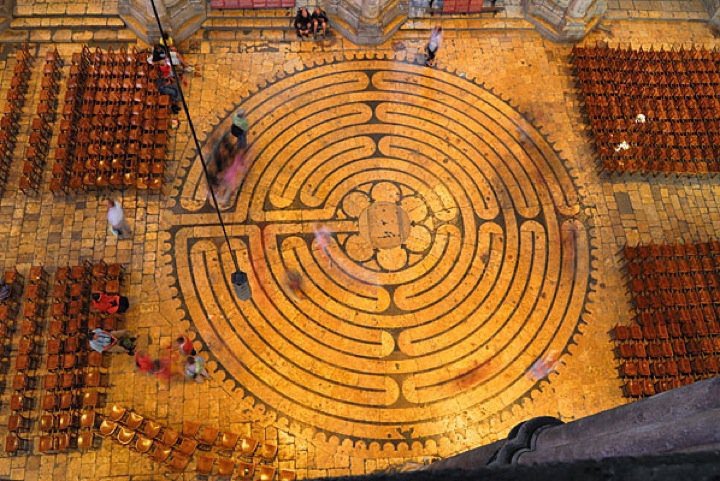
Chartres Labyrinth (From guerrillalabyrinths.wordpress.com)
Labyrinths appear to originate with the Greek myth of the artisan Daedalus who built the labyrinth for the King of Crete to contain the dreaded Minotaur, a creature with the head of a bull and the body of a human. Originally thought to be a multicursal like a maze with many paths, in its contemporary use, the Labyrinth is unicursal—one way in and one way out. The idea that a maze or labyrinth could contain evil spirits is common in ancient depictions. Labyrinths have been found in several 18th and 19th Scandinavian fishing villages, and the Topock Mazes in the California desert are claimed by the Mojave people to be road for the ancestors to the next world.
In the 1300s labyrinths began to be incorporated into sacred architecture and gardens, most notably the Chartres Cathedral in France. It is thought that perhaps they were a kind of sacred geometry, or aid in walking devotions. For those who could not make it all the way to the Holy Land, Labyrinths also served as a symbolic pilgrimage; and represent our journey to God. Contemporary use of Labyrinths focus on the kinesthetic practice of walking to aid in quieting the mind while doing contemplative prayer.
There were about five other people in various sections of labyrinth as I made my way to the center. I took my time and watched my breath and tried to feel my feet on the ground. I tried not to feel annoyed with the presence of other people and focus on my meditation. My mind would inevitably wander and I would come back to my breath, my feet and my prayer. Sometimes my awareness would come back and I would wonder if I was on the right path to the center. My mind would wander to the trip I had to make in the morning, wondering what buses I would take home tonight, what I still needed to get done before bed that night.
It occurred to me that the Labyrinth was not some separate spiritual practice that allowed me to more authentically connect to God, but rather was a kind of rehearsal for being present in all aspects of life. The buses and sidewalks that brought me here are Labyrinths. The faces and stories and lives I passed on the way here are Labyrinths. The sounds and smells and textures are all Labyrinths.
As I entered the middle of the Labyrinth, I closed my eyes and prayed in silence, resolving to take the Labyrinth with me when I left. As I walked onto the street from the quiet church, the sounds of the city overtook me. Keeping my attention on the breath, I walked slowly and deliberately toward Granville to catch a 4-Bus to the City Center Sky Train. I tried to acknowledge the diversity of faces I passed and hold eye contact for a little longer. I took in without craving or judgement storefront signs and window displays. I relished in the smells of food wafting from open patios. I touched the trunks of trees and watched the fluttering wings of doves, crows and pigeons that scuttled between rooftops to sidewalks.
I tend to feel as though my spiritual practices–prayer, meditation, yoga–are escapes from the day to day business of the world, and sometimes pause and escape are really important. But today, I realized that walking the Labyrinth is not just a de-stressing activity or a kind of body prayer, it is practice for the real work of being mindful to each moment and each encounter.
Previous Post
June 19, 2016
Reclaiming Sacred Spaces
Next Post

July 3, 2016 A Reluctant Critique of Adam Miller’s General Theory of Grace
Browse Our Archives
Select a Category Anthropocene Camino de Santiago Catholicism Film Holyscapes Homily Liturgy Monk Nature New Monasticism New Story Pilgrimage Poetry Politics Prayer Religion and Spirituality Silence Spiritual Ecology Spring Spriritual Ecology Theology Uncategorized Walking Writing
Select a Month June 2020 May 2020 April 2020 March 2020 February 2020 January 2020 December 2019 November 2019 August 2019 June 2019 May 2019 April 2019 January 2019 December 2018 November 2018 October 2018 September 2018 August 2018 July 2018 June 2018 May 2018 April 2018 March 2018 February 2018 January 2018 November 2017 October 2017 September 2017 August 2017 July 2017 June 2017 May 2017 April 2017 March 2017 February 2017 January 2017 December 2016 November 2016 October 2016 September 2016 August 2016 July 2016 June 2016 May 2016 April 2016 March 2016 February 2016 January 2016 December 2015 November 2015
Follow Us!
TAKE THE
Religious Wisdom Quiz
Who wrote many of the Psalms?
Select your answer to see how you score.
Peter Solomon David Paul
Related posts from Holyscapes




A Guide Book to America’s Sacred Groves: A...
TRENDING AT PATHEOS Contemplative

Handy Contemplative Practices for Political Spaces
A Spiritually Grounded Presence In order to bring a spiritually grounded presence...

Halloween: The Holiday of Loving Your Neighbor
All Hallows Eve Is Halloween the least Christian holiday in America, or...

Can Love Be Saved? Some Thoughts on the...
Happy Valentine's Day! I recently published a post on Patreon called Can...

"This Loving, Uniting Embrace": the Holy Ordinary
Today's guest post is by Mark Longhurst, author of The Holy Ordinary:...

How Are We Called to Live?: More About...
How Are We Called to Live? Many of us struggle with discerning...

A Spiritual Practice of Reading: Join Us Online
A Spiritual Practice of Reading A healthy spiritual practice of reading is...
view all Contemplative blogs
Ad-Free & Subscriber Log-In Subscription Support
- About Us
- 2026 Calendar
- Videos
- Podcasts
- Library of World Religions
- Faith In Media Tracker
- Advertise With Us
- Write for Us
- Privacy Policy
- Terms of Service
- Do Not Sell My Data
- Contact Us
- Radiant Digital
- Manage Newsletter Subscriptions
- Unsubscribe From Notifications
- Sitemap
Copyright 2008-2026, Patheos. All rights reserved.
Subscription Support Ad-Free & Subscriber Log-In
Follow Patheos