
BuddhistCatholicContemplativeEvangelicalGeneral ChristianHinduJewishLatter-day SaintMuslimNew VisionsProgressive Christian
Beliefs
- Buddhist
- Catholic
- Contemplative
- Evangelical
- General Christian
- Hindu
- Jewish
- Latter-day Saint
- More Voices
- Muslim
- New Visions
- Pagan
- Progressive Christian
Topics
- Religion News
- Food and Religion
- Sports and Religion
- Religious Art
- Religious Music and Entertainment
- Religious Events
- History and Religion
- Style and Religion
- Politics and Religion
- Women in Religion
- Recreation Outdoors and Religion
- Business Finance and Religion
- Careers Workplace and Religion
- Education and Religion
- Family Parenting and Religion
- Health Fitness and Religion
- Home and Religion
- Relationships and Religion
- Technology and Religion
- Travel and Religion
Columnists
- Buddhist Columnists
- Business Finance and Religion Columnists
- Careers Workplace and Religion Columnists
- Catholic Columnists
- Contemplative Columnists
- Education and Religion Columnists
- Evangelists Columnists
- Family Parenting and Religion Columnists
- General Christian Columnists
- Health Fitness and Religion Columnists
- Hindu Columnists
- History and Religion Columnists
- Home and Religion Columnists
- Jewish Columnists
- More Voices Columnists
- Latter Day Columnists
- Muslim Columnists
- New Visions Columnists
- Nonreligious Columnists
- Pagan Columnists
- Politics and Religion Columnists
- Progressive Columnists
- Recreation Outdoors and Religion Columnists
- Relationships and Religion Columnists
- Religion News Columnists
- Religious Art Columnists
- Religious Events Columnists
- Religious Music and Entertainment Columnists
- Sports and Religion Columnists
- Style and Religion Columnists
- Technology and Religion Columnists
- Travel and Religion Columnists
- Women in Religion Columnists
Resource Library
- 2026 Calendar
- Library of World Religions
- The 100 Most Holy Places on Earth
- Patheos Answers
- Podcasts
- Videos
- Faith Leaders Database
- Anglican Episcopalian
- Bahai
- Baptist
- Buddhism
- Christianity
- Confucianism
- Eastern Orthodoxy
- Hinduism
- Holiness and Pentecostal
- ISKCON
- Islam
- Judaism
- Lutheran
- Methodist
- The Church of Jesus Christ of Latter-day Saints
- New Age
- Paganism
- Presbytarian and Reformed
- Protestantism
- Religion Behind the Scenes
- Roman Catholic
- Scientology
- Shia Islam
- Sikhism
- Sufism
- Sunni Islam
- Taoism
- Zen
- See all religions
Research Tools
 Ad-Free & Subscriber Log-In Subscription Support
Ad-Free & Subscriber Log-In Subscription Support
Follow Patheos 

- Trending:
- Forgiveness
- |
- Marriage
- |
- Consciousness
- |
- Death Penalty
- |
- Election
- |
- Halloween
 Holyscapes
- Home
- Contemplative
- What’s in a Name: ‘We do not Name Places, Places Name Themselves’
What’s in a Name: ‘We do not Name Places, Places Name Themselves’
Last updated on: May 5, 2016 at 7:31 am by Jason M. Brown
What’s in a Name: ‘We do not Name Places, Places Name Themselves’ 2016-05-05T07:31:58-08:00 Jason M. Brown
Patheos Explore the world's faith through different perspectives on religion and spirituality! Patheos has the views of the prevalent religions and spiritualities of the world.
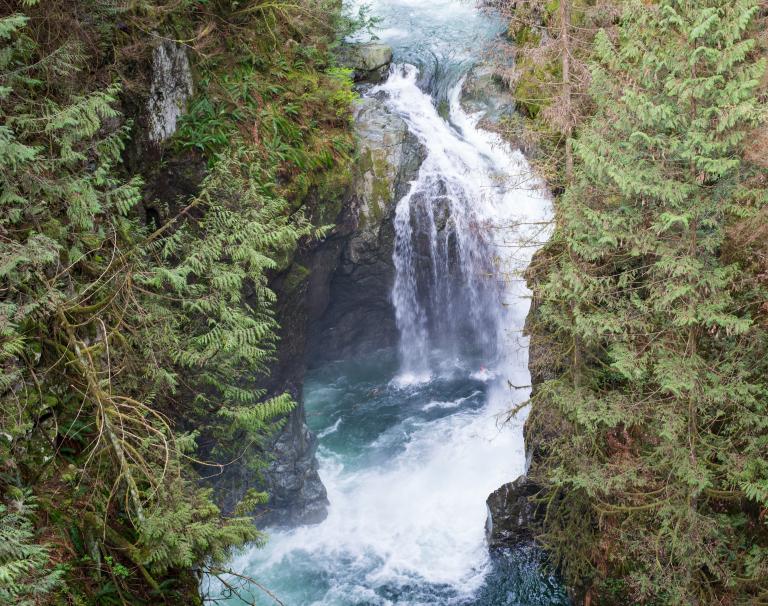
Lynn Creek, BC
At a recent workshop I gave on Spiritual Ecology in the Salish Sea, the participants had just gone outside for a mindful walk and we were sharing our experiences. The idea of place names came up. A white male lamented that the Euro-American place names did not seem to reflect the deep cultural knowledge of the First Peoples who had dwelled with the land for several thousand years before white settlers arrived. We discussed the importance of naming, and returning to some sense of indigeneity and connection to our places.
I mentioned that most indigenous place names were not all that elaborate, that they are mostly descriptive of a feature or an activity, like these Squamish Place names: ‘Place of Smelt’ or ‘Good Land.’ Taking Mount Baker as another example, the Lummi people called it the “White Sentinel” or mountain, and surrounding people’s had similar names for the glaciated volcano. When the Spanish were exploring the area in 1790, they named it after Mount Carmel in Palestine. English explorer George Vancouver, exploring around the same time, named it after his 3rd Lieutenant, Joseph Baker. My point being that perhaps our naming was not all that different. That it was more the experiences and stories and myths that accumulate around these place names that differ and that make holy. That if we are to decolonize ourselves and move toward indigeneity, we need to not only recognize the spiritual ecologies that First Peoples permit us to know, but create some of our own. Regardless of whether white place names were mostly explorers and their friends, it is the experiences that we have there that make a place name meaningful. I continued by pointing out that place names can also be plural, because the worlds of those who experience them are plural. First Peoples had variations on common stories associated with similar place names, and sometimes different names all together.
Feeling smart, I turned it back to the participants. A wonderful young indigenous college student studying clam gardens in the Pacific Northwest, smiled and spoke up with a calm and collected demeanor. She was apparently used to humoring whites with good intentions and loved sharing her knowledge with us. She said: we do not name the places, or plants or animals like Adams in the Bible. The places themselves gave us their names; they told us what their names were. The conversation continued, but her point was like a bolt of lightning. It totally shifted my view of the possibilities.
The idea that place names are layers that we impose on the land strips them of their agency. The notion that place name themselves brings to the fore the very real participation of places in the lives of people seemed totally obvious. Even my more phenomenological approach was a constructivist model, that put all of the agency within human hands. Her perspective has been knocking around in my mind ever since. Even the names we give to places and other creatures can perhaps obscure the names they might subtly propose that we call them. Imagine someone walking up to you and just calling you by a name that is not yours! Perhaps this is why the land does not speak to us in the same way that it speaks to indigenous peoples, we do not even know its name!
Previous Post
April 23, 2016
Wrestling God on the Chama River
Next Post
May 7, 2016 Circumnavigating a Vortex: Fierce Landscapes are not Your Emotional Playground
Browse Our Archives
Select a Category Anthropocene Camino de Santiago Catholicism Film Holyscapes Homily Liturgy Monk Nature New Monasticism New Story Pilgrimage Poetry Politics Prayer Religion and Spirituality Silence Spiritual Ecology Spring Spriritual Ecology Theology Uncategorized Walking Writing
Select a Month June 2020 May 2020 April 2020 March 2020 February 2020 January 2020 December 2019 November 2019 August 2019 June 2019 May 2019 April 2019 January 2019 December 2018 November 2018 October 2018 September 2018 August 2018 July 2018 June 2018 May 2018 April 2018 March 2018 February 2018 January 2018 November 2017 October 2017 September 2017 August 2017 July 2017 June 2017 May 2017 April 2017 March 2017 February 2017 January 2017 December 2016 November 2016 October 2016 September 2016 August 2016 July 2016 June 2016 May 2016 April 2016 March 2016 February 2016 January 2016 December 2015 November 2015
Follow Us!
TAKE THE
Religious Wisdom Quiz
What does 1 Peter say believers are being built into?
Select your answer to see how you score.
Living stones God's temple A spiritual house A holy nation
Related posts from Holyscapes




A Guide Book to America’s Sacred Groves: A...
TRENDING AT PATHEOS Contemplative

Handy Contemplative Practices for Political Spaces
A Spiritually Grounded Presence In order to bring a spiritually grounded presence...

Halloween: The Holiday of Loving Your Neighbor
All Hallows Eve Is Halloween the least Christian holiday in America, or...

Can Love Be Saved? Some Thoughts on the...
Happy Valentine's Day! I recently published a post on Patreon called Can...

"This Loving, Uniting Embrace": the Holy Ordinary
Today's guest post is by Mark Longhurst, author of The Holy Ordinary:...

How Are We Called to Live?: More About...
How Are We Called to Live? Many of us struggle with discerning...

A Spiritual Practice of Reading: Join Us Online
A Spiritual Practice of Reading A healthy spiritual practice of reading is...
view all Contemplative blogs
Ad-Free & Subscriber Log-In Subscription Support
- About Us
- 2026 Calendar
- Videos
- Podcasts
- Library of World Religions
- Faith In Media Tracker
- Advertise With Us
- Write for Us
- Privacy Policy
- Terms of Service
- Do Not Sell My Data
- Contact Us
- Radiant Digital
- Manage Newsletter Subscriptions
- Unsubscribe From Notifications
- Sitemap
Copyright 2008-2026, Patheos. All rights reserved.
Subscription Support Ad-Free & Subscriber Log-In
Follow Patheos