
BuddhistCatholicContemplativeEvangelicalGeneral ChristianHinduJewishLatter-day SaintMuslimNew VisionsProgressive Christian
Beliefs
- Buddhist
- Catholic
- Contemplative
- Evangelical
- General Christian
- Hindu
- Jewish
- Latter-day Saint
- More Voices
- Muslim
- New Visions
- Pagan
- Progressive Christian
Topics
- Religion News
- Food and Religion
- Sports and Religion
- Religious Art
- Religious Music and Entertainment
- Religious Events
- History and Religion
- Style and Religion
- Politics and Religion
- Women in Religion
- Recreation Outdoors and Religion
- Business Finance and Religion
- Careers Workplace and Religion
- Education and Religion
- Family Parenting and Religion
- Health Fitness and Religion
- Home and Religion
- Relationships and Religion
- Technology and Religion
- Travel and Religion
Columnists
- Buddhist Columnists
- Business Finance and Religion Columnists
- Careers Workplace and Religion Columnists
- Catholic Columnists
- Contemplative Columnists
- Education and Religion Columnists
- Evangelists Columnists
- Family Parenting and Religion Columnists
- General Christian Columnists
- Health Fitness and Religion Columnists
- Hindu Columnists
- History and Religion Columnists
- Home and Religion Columnists
- Jewish Columnists
- More Voices Columnists
- Latter Day Columnists
- Muslim Columnists
- New Visions Columnists
- Nonreligious Columnists
- Pagan Columnists
- Politics and Religion Columnists
- Progressive Columnists
- Recreation Outdoors and Religion Columnists
- Relationships and Religion Columnists
- Religion News Columnists
- Religious Art Columnists
- Religious Events Columnists
- Religious Music and Entertainment Columnists
- Sports and Religion Columnists
- Style and Religion Columnists
- Technology and Religion Columnists
- Travel and Religion Columnists
- Women in Religion Columnists
Resource Library
- 2026 Calendar
- Library of World Religions
- The 100 Most Holy Places on Earth
- Patheos Answers
- Podcasts
- Videos
- Faith Leaders Database
- Anglican Episcopalian
- Bahai
- Baptist
- Buddhism
- Christianity
- Confucianism
- Eastern Orthodoxy
- Hinduism
- Holiness and Pentecostal
- ISKCON
- Islam
- Judaism
- Lutheran
- Methodist
- The Church of Jesus Christ of Latter-day Saints
- New Age
- Paganism
- Presbytarian and Reformed
- Protestantism
- Religion Behind the Scenes
- Roman Catholic
- Scientology
- Shia Islam
- Sikhism
- Sufism
- Sunni Islam
- Taoism
- Zen
- See all religions
Research Tools
 Ad-Free & Subscriber Log-In Subscription Support
Ad-Free & Subscriber Log-In Subscription Support
Follow Patheos 

- Trending:
- Forgiveness
- |
- Marriage
- |
- Consciousness
- |
- Death Penalty
- |
- Election
- |
- Halloween
 Holyscapes
- Home
- Contemplative
- Of Lions and Lambs: The Ecology of Things
Of Lions and Lambs: The Ecology of Things
Last updated on: March 7, 2016 at 12:23 pm by Jason M. Brown
Of Lions and Lambs: The Ecology of Things 2016-03-07T12:23:22-08:00 Jason M. Brown
Patheos Explore the world's faith through different perspectives on religion and spirituality! Patheos has the views of the prevalent religions and spiritualities of the world.
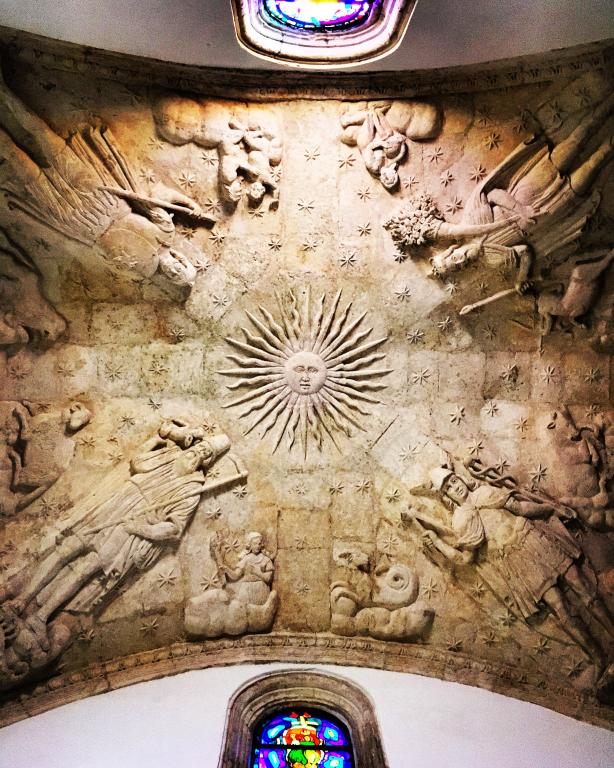
Chapel ceiling in the Dominican convent, Santo Domingo
In a recent blog post at A Rocha, an International Christian organization that does amazing work around the globe, the author discussed their dismay at the violence and predation that inevitably occurs within ecological systems. They asked how this reality could reflect the character of an all loving God that made His creation “Good.” There were three possible explanations:
- The “Fall” as described in the book of Genesis was an historical event; resulting in the entrance of evil and suffering into an otherwise vegetarian existence.
- God as the creator is “wilder and perhaps more scary than we thought;” and thus violence and predation are part of His ultimate plan.
- Suffering and violence are temporary realities that will be transformed in the Eschaton.
The first seems an obvious Agrarian etiology that crept into Genesis surrounding the demands of an agricultural and pastoral life. The second is fascinating, and I think some contemporary theo-poetics, especially John D. Caputo, takes this notion into some interesting terrain. However, I want to focus on the third possibility which was the blog author’s proposed synthesis. The conclusion that the author comes to is that while suffering, predation, parasitism and death are an integral part of ecological systems now, “the suffering which science tells us is inevitable in our current world is not God’s best or final plan.” While we must continue to protect all aspects of ecological diversity (without, for example, attempting to eradicate predator-prey relationships ourselves through ecological or even genetic engineering), as Christians we must hold space and hope for a future where this suffering will be transformed by God into the Peaceable Kingdom. Paraphrasing Christian writer Ryan McLaughlin the author suggests that “a lion is more than a carnivore, just as a human is more than a walking ape…Just as Jesus can be resurrected as immortal and beyond suffering without losing his identity as human, so also could a lion be resurrected as vegetarian without losing its identity as lion.” Referring to the famous passage in Isaiah 11:6 where the Prophet-poet proclaims that the lion will lie down with the lamb, the blog author suggests that this promise shows us what this Peaceable Kingdom will look like. Here the resurrection takes on the image of a kind of post-mortal assembly of the created order in perfected form. Humans look like humans, lions like lions, etc.
However, leaving criticisms of literal expectations of a post-mortal existence, resurrection or a second coming aside, I think an escatological interpretation of Isaiah is unfounded. Lions and lambs are not in a ‘natural’ predator-prey relationship. When Isaiah claims that the lion will lie down with the lamb, he is making a promise to the shepherd not the sheep.
Now, taking the idea of an eschaton for granted, what is wrong with a resurrected lion? As Paul writes “creation has been groaning as in the pains of child birth up to the present time” (Romans 8:22, NIV). This has been suggested by theologian Sallie McFague to mean that “creation is the place of salvation, salvation is the direction of creation” (McFague, 180). If we are made up of star stuff, and organic evolution is the process and logic by which our bodies take shape, then there is no point at which one form or another merits a final perfection. To talk of a resurrected lion is to assume that creation is made up of individual creatures and their surroundings, created in a single spurt of creative energy; that the locus of personhood for people and lions and wombats and worms is in their current forms.
Yet, cosmology suggests we live in a far more complex reality; one that is not static but unfolding. Nor does this harmonize with the findings of ecology; ecology is not a thing, but the space between things. Lastly, this does not harmonize with the mystery of a Triune God, toward whom salvation steadily moves. God is not three separate persons in relationship like a lion with its prey, or two lovers. The Trinity is relationship itself. Or said another way; “God IS love” (1 John 4:8). This is why Catholic priest and palaeontologist Teilhard de Chardin wrote that “The physical structure of the universe is love,” and Orthodox theologian John Zizoulas writes about Being as Communion. The lion and the lamb make great symbols in sacred literature to talk about God’s power to save and to subvert expectation of both social and ecological systems. But the eschaton toward which we are all moving spiritual-material as it is, bodily as it surely must be, will not be made up of beings in relation but the relation of Being.
McFague, Sallie (1993) The Body of God: An Ecological Theology. Minneapolis: Fortress Press, viii and 180
Previous Post
February 29, 2016
Sacred Groves and Clear Cuts
Next Post
March 14, 2016 Divine Union: Notes on possible Catholic/Mormon Dialogue
Browse Our Archives
Select a Category Anthropocene Camino de Santiago Catholicism Film Holyscapes Homily Liturgy Monk Nature New Monasticism New Story Pilgrimage Poetry Politics Prayer Religion and Spirituality Silence Spiritual Ecology Spring Spriritual Ecology Theology Uncategorized Walking Writing
Select a Month June 2020 May 2020 April 2020 March 2020 February 2020 January 2020 December 2019 November 2019 August 2019 June 2019 May 2019 April 2019 January 2019 December 2018 November 2018 October 2018 September 2018 August 2018 July 2018 June 2018 May 2018 April 2018 March 2018 February 2018 January 2018 November 2017 October 2017 September 2017 August 2017 July 2017 June 2017 May 2017 April 2017 March 2017 February 2017 January 2017 December 2016 November 2016 October 2016 September 2016 August 2016 July 2016 June 2016 May 2016 April 2016 March 2016 February 2016 January 2016 December 2015 November 2015
Follow Us!
TAKE THE
Religious Wisdom Quiz
True or False: According to Hebrews, faith is the substance of things hoped for and the evidence of things not seen.
Select your answer to see how you score.
TRUE FALSE
Related posts from Holyscapes




A Guide Book to America’s Sacred Groves: A...
TRENDING AT PATHEOS Contemplative

Handy Contemplative Practices for Political Spaces
A Spiritually Grounded Presence In order to bring a spiritually grounded presence...

Halloween: The Holiday of Loving Your Neighbor
All Hallows Eve Is Halloween the least Christian holiday in America, or...

Can Love Be Saved? Some Thoughts on the...
Happy Valentine's Day! I recently published a post on Patreon called Can...

"This Loving, Uniting Embrace": the Holy Ordinary
Today's guest post is by Mark Longhurst, author of The Holy Ordinary:...

How Are We Called to Live?: More About...
How Are We Called to Live? Many of us struggle with discerning...

A Spiritual Practice of Reading: Join Us Online
A Spiritual Practice of Reading A healthy spiritual practice of reading is...
view all Contemplative blogs
Ad-Free & Subscriber Log-In Subscription Support
- About Us
- 2026 Calendar
- Videos
- Podcasts
- Library of World Religions
- Faith In Media Tracker
- Advertise With Us
- Write for Us
- Privacy Policy
- Terms of Service
- Do Not Sell My Data
- Contact Us
- Radiant Digital
- Manage Newsletter Subscriptions
- Unsubscribe From Notifications
- Sitemap
Copyright 2008-2026, Patheos. All rights reserved.
Subscription Support Ad-Free & Subscriber Log-In
Follow Patheos