
BuddhistCatholicContemplativeEvangelicalGeneral ChristianHinduJewishLatter-day SaintMuslimNew VisionsProgressive Christian
Beliefs
- Buddhist
- Catholic
- Contemplative
- Evangelical
- General Christian
- Hindu
- Jewish
- Latter-day Saint
- More Voices
- Muslim
- New Visions
- Pagan
- Progressive Christian
Topics
- Religion News
- Food and Religion
- Sports and Religion
- Religious Art
- Religious Music and Entertainment
- Religious Events
- History and Religion
- Style and Religion
- Politics and Religion
- Women in Religion
- Recreation Outdoors and Religion
- Business Finance and Religion
- Careers Workplace and Religion
- Education and Religion
- Family Parenting and Religion
- Health Fitness and Religion
- Home and Religion
- Relationships and Religion
- Technology and Religion
- Travel and Religion
Columnists
- Buddhist Columnists
- Business Finance and Religion Columnists
- Careers Workplace and Religion Columnists
- Catholic Columnists
- Contemplative Columnists
- Education and Religion Columnists
- Evangelists Columnists
- Family Parenting and Religion Columnists
- General Christian Columnists
- Health Fitness and Religion Columnists
- Hindu Columnists
- History and Religion Columnists
- Home and Religion Columnists
- Jewish Columnists
- More Voices Columnists
- Latter Day Columnists
- Muslim Columnists
- New Visions Columnists
- Nonreligious Columnists
- Pagan Columnists
- Politics and Religion Columnists
- Progressive Columnists
- Recreation Outdoors and Religion Columnists
- Relationships and Religion Columnists
- Religion News Columnists
- Religious Art Columnists
- Religious Events Columnists
- Religious Music and Entertainment Columnists
- Sports and Religion Columnists
- Style and Religion Columnists
- Technology and Religion Columnists
- Travel and Religion Columnists
- Women in Religion Columnists
Resource Library
- 2026 Calendar
- Library of World Religions
- The 100 Most Holy Places on Earth
- Patheos Answers
- Podcasts
- Videos
- Faith Leaders Database
- Anglican Episcopalian
- Bahai
- Baptist
- Buddhism
- Christianity
- Confucianism
- Eastern Orthodoxy
- Hinduism
- Holiness and Pentecostal
- ISKCON
- Islam
- Judaism
- Lutheran
- Methodist
- The Church of Jesus Christ of Latter-day Saints
- New Age
- Paganism
- Presbytarian and Reformed
- Protestantism
- Religion Behind the Scenes
- Roman Catholic
- Scientology
- Shia Islam
- Sikhism
- Sufism
- Sunni Islam
- Taoism
- Zen
- See all religions
Research Tools
 Ad-Free & Subscriber Log-In Subscription Support
Ad-Free & Subscriber Log-In Subscription Support
Follow Patheos 

- Trending:
- Forgiveness
- |
- Marriage
- |
- Consciousness
- |
- Death Penalty
- |
- Election
- |
- Halloween
 Holyscapes
- Home
- Contemplative
- The Iconography of Climate Change
The Iconography of Climate Change
Last updated on: January 16, 2016 at 11:12 am by Jason M. Brown
The Iconography of Climate Change 2016-01-16T11:12:44-08:00 Jason M. Brown
Patheos Explore the world's faith through different perspectives on religion and spirituality! Patheos has the views of the prevalent religions and spiritualities of the world.
The God of Nature is in trouble; the Nature of God is in doubt. In an era of apocalyptic Climate Change, the imminent death of God and Nature are inducing the birth pangs of the Anthropocene.
Climate Change is not an entity, not a disturbance from outside the system. Climate Change is a force of humanized Nature. It is not the meaningless Natural object onto which we project our faith and doubt.
Timothy Morton suggests that Climate Change, like other phenomenon in the modern world is a ‘Hyperobject’, because it is “massively distributed in time and space relative to humans.”[i] The Hyperobject of Climate Change encompasses a gap between “phenomenon and thing”[ii]–between climate and weather, global average temperature and local changes. And yet, because of its pervasiveness, we cannot transcend the hyperobject to observe it objectively, which means as Morton puts it, “Hyperobjects force us to acknowledge the immanence of thinking to the physical.”[iii]
In the Anthropocene, Hyperobjects juxtapose with the Meta-agencies of modernism such as God, the Market, Ideology, and Nature in a trend away from grand narratives. Certainly one consequence of this trend is that the assumed jurisdictions between familiar dualisms such as culture and nature, sacred and profane are being blurred. Invasive species, GMOs, Novel Ecosystems, Biotechnology, all pose ethical challenges to our moral landscapes.
It is within this emerging context of the Hyperobject that I wish to argue for an Iconography of Climate Change. By Icon, I do not mean merely a symbol (a sign among signs); but rather, following the work of Eduardo Kohn, that Climate Change both points to and participates in the redefining of the human place in the world, and in worldly realities yet to be fully realized.
When asked what he did without a set of scriptures, it is said that the Desert Hermit Saint Anthony replied, “My book is the nature of created things; whenever I want to read the Word of God, it is always there before me.”[v] This idea, that God wrote two books, the Book of Scripture and the Book of Nature, runs the entire length of Christian history, and was even repeated by Galileo to justify his scientific interests.
Western science could be said to have started as the quest to discern the meaning of the Words of God written over the pages of the Universe. In addition to being Words of God, mystics and theologians have long ruminated over what it means to be created in the Image of God as described in Genesis 1. Conservative theologians reserve this privileged status for humanity alone, but the mystics often saw every creature as a unique manifestation of God. Saint John Damascene wrote that “Nature is the icon of the face of God,” and Mount Athos Orthodox monk, Elder Paisios, reflected,“This grass is an icon, this stone is an icon, and I can kiss it or venerate it, because it is filled with God’s grace.”[vi]
At first glance, the idea of an icon does not help us move beyond our traditional notions of God and Nature. In traditional Western literature, an Icon is a symbol invested with meaning. The Icon points to something else: signified and signifier. In its most protestant reading, Nature points to God because it was made by Him, not because he is present within it. Yet, in Edward Kohn’s How Forests Think his use of Charles Pierce’s semiotics takes Iconography into the Post-Structural realm of Immanence. Pierce begins by distinguishing between Iconic, Indexical and Symbolic Signs. To define each briefly, an Icon must resemble in some way the thing it represents; an Index points to the thing it represents; and a Symbol references a thing within an already existing system of other signs. So in Kohn’s ethnography, when he goes out to hunt monkeys with his informants, the noise that Maxi makes to imitate the sound of chopping a tree that will scare the monkey out of its hiding place is an Icon. The sound the tree makes when it falls is Indexical to the monkey because it points to unseen danger. And the layered and metaphorical meaning of the words they use to talk about a successful hunt are Symbolic.
In arguing for a post-human anthropology, Kohn asserts that all living things make use of these Iconic and Indexical signs. Kohn pushes back on dualistic and cognitive theories of perception when he writes that, “The fact that signs always mediate does not mean that they also necessarily exist in some separate domain inside (human) minds and cut off from the entities they stand for.”[vii] In the same way that, for Morton, Climate Change as Hyperobject shows us that thinking is embedded in physical reality; for Kohn, signs are equally embedded in the processes of life. Thus “Life is constitutively semiotic…life is, through and through, the product of sign processes.[viii]
Climate Change then, can be viewed not, as Mike Hulme writes, a physical phenomenon onto which multiple cultural views are projected. But rather, as writers such as Bruno Latour and Candice Callison have shown, as an arti-fact, a Hybrid of culture-nature.[ix] Callison writes about this hybridity when she claims that Climate Change “must promiscuously inhabit the spaces of ethics, morality, and other community-specific rationales for actions while resting on scientific methodology and institutions that prize objectivity and detachment from politics, religion, and culture.”[x]
If both God and Nature are immanent to the World, Climate Change as Hyperobject emerges as an icon for participation in the World, while simultaneously pointing to the future possible of human becoming through that World.
Climate Change is iconic because it manifests the Universal in the Particular. Despite recent critiques of place, particularity remains relevant in an era when some places are being impacted differently or more intensely by Climate Change. We all know of many examples, but just briefly, in the Arctic, the recorded temperatures are warming at twice the rate of the rest of the planet because of Arctic amplification. And in the recent talks in Paris, some Island Nations who drove the agenda were negotiating for their right to continue existing in the face of sea level rise. Additionally, these places most impacted by Climate Change happen to be the dwelling of the most vulnerable and poor among us. And for Christians, the poor are themselves Icons of the unseen Christ (again, not pointing to Christ, but actually participating in Him).
Some authors have dismissed place as being unhelpful in the overall project of responding to Climate Change and moving beyond Nature. For Timothy Morton our ideas about place are misplaced because we have crafted them from a longing for a bygone, stable object that is no longer woven through our daily lives. Place is an illusion, place becomes stand in for Nature.
For Whitney Bauman, “We need ‘a sense of planet’ more than we need a ‘sense of place.’”[xi] Bauman compares sense of place to monogamy, because he believes that “monogamous love of place can be quite detrimental to planetary flows of life.[xii]” For Bauman, a ‘polyamory of place’ is more in line with our current situation, a nomadism that fosters a global ethic.
Climate Change as Icon, would not force us to choose between the Universal and the Particular. A polyamory of place, I would argue, is susceptible to the same folly as monogamy. Romanticism of places is most often perpetuated by urbanites who do not have to live off the land in the first place. We can certainly love more than one person or place at a time, but we cannot be in more than one place at a time. While the entire world con-spires to make this moment, this conference possible, my breath, my vision, my attention are here; my feet are on this ground.
The abandonment of place for the nomadism of the digital age would be subject to its own folly by encouraging us to seek out places that satisfy desires rather than cultivate relationships that endures. A polyamory of place is vulnerable to the ‘shifting baselines’ of places degraded by development, inhabited by people who have no memory of what it was like before, and who never invest enough in places to imagine what they might be like in the future. What comes to mind when I think of polyamory of place or nomadism are the tourists that tear through Yosemite each year to take a few pictures and move on. This is the difference perhaps between the Icon and the Advertisement. While the advertisement is meant to be consumed and discarded, the Icon is returned to again and again, and participates with the percept through growth and change.
Climate Change also Iconic because it is a call calling from the future of human possibility. Scientists present us with a series of possible futures. These graphs challenge us to imagine what might happen if we do not drastically cut carbon emissions. Climate Change then could also be described as what Pierce calls an Indexical Sign, in that it indicates something that may happen. As Kohn writes, “[T]he lives of signs, and of the selves that come to interpret them, are not just located in the present, or in the past. They partake in a mode of being that extends into the future possible as well.”[xiii] Climate Change is provoking massive human response to realities yet to be fully realized.
For theologian Richard Kearney, traditional ideas about God’s promised return highlight this God of possibility. Like Caputo, the possibility of God relies on human actions, “Without us, no Word can be made flesh.”[xiv] God “possiblizes” the world from the future. In the same way, Climate Change is both a threat and a promise that calls from a million possible futures that are already seeds among us. As Sufi poet Rumi wrote “We are the mirror as well as the face in it.”
Shifting toward an imminent God and Nature shows that Icons too point inward. As the cliché goes, ‘we are the ones we have been waiting for.’ Thus as Caputo suggests, “The role of human beings is not one of utter passivity but one of co-operation with and remaining “open” to being’s advent.”[xv] Again, this is what Kohn’s semiotics implies about this New Iconography: a sign always participates in the making of its own meaning. Climate Change as Icon is not blank object onto which we project meaning, nor disturbance to the system; it is not a symbol that points to some transcendent reality. Climate Change participates in and mirrors the possibilities of our own becoming.
If climate change is the Icon of the future-possible, its impacts are the Icon of the future-present. Our response to Climate Change, to injustice, to the world around us, to the poor, is a response to a call calling from a million possible futures. I like to think that God is in that call, and that grace fills every moment of our ability to choose. Grace is the ground of our being in the world, the world is a free gift and every expression of faith, every act of compassion, every place loved, makes the call of God a little stronger in the world.
NOTES
[i] Timothy Morton, Hyper Objects, 2
[ii] Morton Hyper Objects, 2
[iii] Morton, Hyper Objects 2
[iv] Morton 2009, Ecology without Nature, 125
[v] Belden Lane 1998, Landscapes of the Sacred, 165
[vi] Elder Paisios. Through creation to the creator
[vii] Eduardo Kohn, How Forests Think 30
[viii] Eduardo Kohn, 9
[ix] Bruno Latour and Woolgar 1986, Labratory Life: The Construction of Scientific Facts
[x] Candice Callison 2014, How Climate Change Comes to Matter, 2
[xi] Whitney Bauman 2014, Religion and Ecology: Toward a Planetary Ethic, 140
[xii] Whitney Bauman 2014, 131
[xiii] Kohn 66
[xiv] Richard Kearney 2001, The God who May be, 4
[xv] John Caputo The Persistence of God: A theology of Perhaps, 2006
Previous Post
January 10, 2016
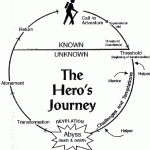
Review: The Revenant: The Hero's Journey and White Saviors

Browse Our Archives
Select a Category Anthropocene Camino de Santiago Catholicism Film Holyscapes Homily Liturgy Monk Nature New Monasticism New Story Pilgrimage Poetry Politics Prayer Religion and Spirituality Silence Spiritual Ecology Spring Spriritual Ecology Theology Uncategorized Walking Writing
Select a Month June 2020 May 2020 April 2020 March 2020 February 2020 January 2020 December 2019 November 2019 August 2019 June 2019 May 2019 April 2019 January 2019 December 2018 November 2018 October 2018 September 2018 August 2018 July 2018 June 2018 May 2018 April 2018 March 2018 February 2018 January 2018 November 2017 October 2017 September 2017 August 2017 July 2017 June 2017 May 2017 April 2017 March 2017 February 2017 January 2017 December 2016 November 2016 October 2016 September 2016 August 2016 July 2016 June 2016 May 2016 April 2016 March 2016 February 2016 January 2016 December 2015 November 2015
Follow Us!
TAKE THE
Religious Wisdom Quiz
What city's name means "house of God" and was the place of Jacob's dream?
Select your answer to see how you score.
Bethel Shiloh Bethlehem Nazareth
Related posts from Holyscapes




A Guide Book to America’s Sacred Groves: A...
TRENDING AT PATHEOS Contemplative

Handy Contemplative Practices for Political Spaces
A Spiritually Grounded Presence In order to bring a spiritually grounded presence...

Halloween: The Holiday of Loving Your Neighbor
All Hallows Eve Is Halloween the least Christian holiday in America, or...

Can Love Be Saved? Some Thoughts on the...
Happy Valentine's Day! I recently published a post on Patreon called Can...

"This Loving, Uniting Embrace": the Holy Ordinary
Today's guest post is by Mark Longhurst, author of The Holy Ordinary:...

How Are We Called to Live?: More About...
How Are We Called to Live? Many of us struggle with discerning...

A Spiritual Practice of Reading: Join Us Online
A Spiritual Practice of Reading A healthy spiritual practice of reading is...
view all Contemplative blogs
Ad-Free & Subscriber Log-In Subscription Support
- About Us
- 2026 Calendar
- Videos
- Podcasts
- Library of World Religions
- Faith In Media Tracker
- Advertise With Us
- Write for Us
- Privacy Policy
- Terms of Service
- Do Not Sell My Data
- Contact Us
- Radiant Digital
- Manage Newsletter Subscriptions
- Unsubscribe From Notifications
- Sitemap
Copyright 2008-2026, Patheos. All rights reserved.
Subscription Support Ad-Free & Subscriber Log-In
Follow Patheos