
BuddhistCatholicContemplativeEvangelicalGeneral ChristianHinduJewishLatter-day SaintMuslimNew VisionsProgressive Christian
Beliefs
- Buddhist
- Catholic
- Contemplative
- Evangelical
- General Christian
- Hindu
- Jewish
- Latter-day Saint
- More Voices
- Muslim
- New Visions
- Pagan
- Progressive Christian
Topics
- Religion News
- Food and Religion
- Sports and Religion
- Religious Art
- Religious Music and Entertainment
- Religious Events
- History and Religion
- Style and Religion
- Politics and Religion
- Women in Religion
- Recreation Outdoors and Religion
- Business Finance and Religion
- Careers Workplace and Religion
- Education and Religion
- Family Parenting and Religion
- Health Fitness and Religion
- Home and Religion
- Relationships and Religion
- Technology and Religion
- Travel and Religion
Columnists
- Buddhist Columnists
- Business Finance and Religion Columnists
- Careers Workplace and Religion Columnists
- Catholic Columnists
- Contemplative Columnists
- Education and Religion Columnists
- Evangelists Columnists
- Family Parenting and Religion Columnists
- General Christian Columnists
- Health Fitness and Religion Columnists
- Hindu Columnists
- History and Religion Columnists
- Home and Religion Columnists
- Jewish Columnists
- More Voices Columnists
- Latter Day Columnists
- Muslim Columnists
- New Visions Columnists
- Nonreligious Columnists
- Pagan Columnists
- Politics and Religion Columnists
- Progressive Columnists
- Recreation Outdoors and Religion Columnists
- Relationships and Religion Columnists
- Religion News Columnists
- Religious Art Columnists
- Religious Events Columnists
- Religious Music and Entertainment Columnists
- Sports and Religion Columnists
- Style and Religion Columnists
- Technology and Religion Columnists
- Travel and Religion Columnists
- Women in Religion Columnists
Resource Library
- 2026 Calendar
- Library of World Religions
- The 100 Most Holy Places on Earth
- Patheos Answers
- Podcasts
- Videos
- Faith Leaders Database
- Anglican Episcopalian
- Bahai
- Baptist
- Buddhism
- Christianity
- Confucianism
- Eastern Orthodoxy
- Hinduism
- Holiness and Pentecostal
- ISKCON
- Islam
- Judaism
- Lutheran
- Methodist
- The Church of Jesus Christ of Latter-day Saints
- New Age
- Paganism
- Presbytarian and Reformed
- Protestantism
- Religion Behind the Scenes
- Roman Catholic
- Scientology
- Shia Islam
- Sikhism
- Sufism
- Sunni Islam
- Taoism
- Zen
- See all religions
Research Tools
 Ad-Free & Subscriber Log-In Subscription Support
Ad-Free & Subscriber Log-In Subscription Support
Follow Patheos 

- Trending:
- Forgiveness
- |
- Marriage
- |
- Consciousness
- |
- Death Penalty
- |
- Election
- |
- Halloween
 Holyscapes
- Home
- Contemplative
- Worlds Less Visible
Worlds Less Visible
Last updated on: December 4, 2015 at 3:28 pm by Jason M. Brown
Worlds Less Visible 2015-12-04T15:28:09-08:00 Jason M. Brown
Patheos Explore the world's faith through different perspectives on religion and spirituality! Patheos has the views of the prevalent religions and spiritualities of the world.
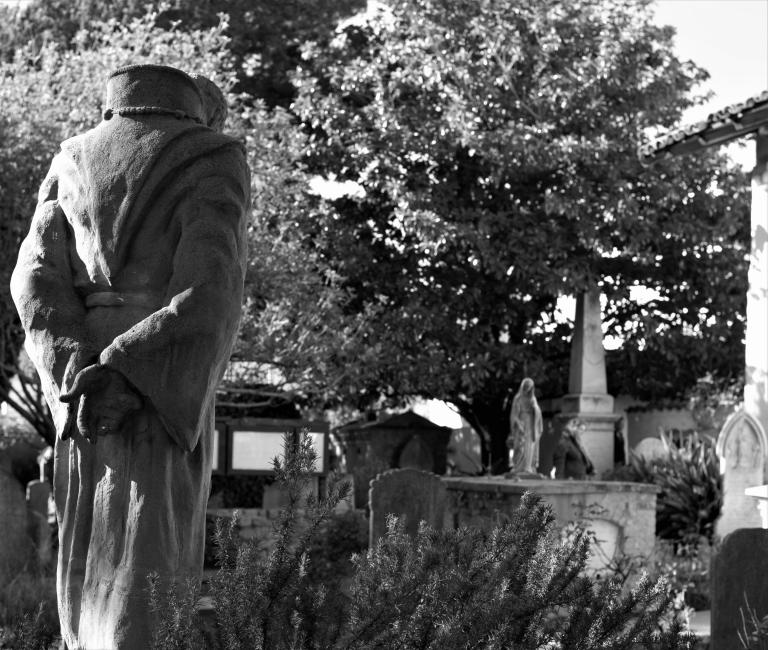
Statue of Junipero Serra
As we entered the turnstiles of the Mission San Francisco de Assisi, we were told by the Docents who spoke with well-rehearsed enthusiasm, that the chapel is the oldest building in San Francisco, and is also known as Mission Dolores, because the Mission was founded on the Feast Day devoted to Our Lady of Sorrows (Dolor means sorrow in Spanish). I am particularly grateful for the legacy of Saint Francis, and the work of his current namesake Pope Francis, but like my visit at the Grotto where I related the sorrows of Mary to the sorrows of Mother Earth, I could not help but pause on the sorrows of the indigenous peoples whose traditional territory this was for the thousands of years before Franciscan missionaries arrived. Walking into the baroque chapel feels like walking back in time. It has survived all the major San Francisco earthquakes. And there is something noteworthy about it being up of original adobe bricks laid in the 1776 the year as the US Declaration of Independence.
When white North Americans like myself see historic sites on the landscape, we read them as a story about ourselves. We feel gratitude for the sacrifices and hard work our ancestors did to give us a better life. We read a story about the hand of inevitable providence and progress. And for many of us these stories ring true.
What is hard to deal with is that that same hand dealt ruin to the Native peoples we displaced. What we read as a story of success, can be equally read as a story of destruction. Not only is there a different interpretation of our story on the land, but there are all together other stories on the landscape that we are unable to, or perhaps unwilling to read. These are the stories associated with the sacred sites and sacred species that made up the Holyscapes of the Coast Miwok peoples who dwelt here.
The Coast Miwok peoples have not only struggled to keep their Holyscapes alive, they have struggled to exist. They were forcibly removed from their lands, and were not officially recognized as a people until the year 2000. Today they are officially named the Federated Indians of Granton Rancheria of which there are now only 500 members, drawing from several kin groups from the region. And yet they remain. They have lost much, but continue to pass on their stories. Greg Sarris, the current chair of the Federated Indians of Granton Rancheria, calls these lands his “homescape.” But as Sarris recalls, “Much of our landscape and seascape has now been demolished. Our Bible, if you will, has been destroyed, only a page remaining here, a page remaining there.”[1] These stories tell how Coyote sent Turtle into the depths of the ocean to bring up mud to make land; and how Silver Fox and Coyote create humans from the feathers of birds, mud and sticks. They tell of the adventures of Raven and Coyote, and of places where important events happened that teach the Miwok how to live rightly on the land.
The Christian Spanish brought the Biblical and Christian landscape with them from Europe. So, they began to name the un-storied landscape after their own cherished Faith. Today the mostly secular California coast is a litany of Saint names, Feast Days and Catholic sacred concepts. The Coast Miwok on the other hand, like most indigenous peoples, saw the landscape itself as a sacred text. Sarris continues: “For Coast Miwok people, like all indigenous peoples of central California, the landscape was nothing less than a richly layered text, a sacred book; each ocean cove, even the smallest seemingly unassuming rock, or tract of open grassland–each feature of the natural world a mnemonic peg on which individuals could see a story connected to other stories and thus know and find themselves home.”[2]
I am often horrified by stories of ISIS destroying Pagan and Christian sacred and historic sites as they rampage across Iraq and Syria; but then I remember that Christian missionaries did the same thing when they entered Europe. And to a large extent, Spanish and English colonists did similar things in North America. (Where there were no structures to destroy, they simply outlawed the speaking of Indigenous languages, or the performance of ceremony). One example is Mount Tamalpais, which is sacred to virtually all Native peoples of this region. It represents life, and living water, and centers their worlds. Unfortunately, during WWII and later the cold war, it was used by the US military as a base and nuclear deterrent station. A large portion of the peak was levelled to make room for radio towers, barracks and headquarters, with many of these structures later being abandoned and condemned. Once a symbol of life, Mount Tamalpais became a reminder of the power of humanity to extinguish life with the press of a button.[3]
Despite all this, there is much room for reconciliation, forgiveness and hope. Point Reyes National Seashore has created a replica village, a Miwok culture interpretive trail, and maintains a strong relationship with the tribe, who have been very supportive of the Park’s efforts to restore ecological integrity and historic species like the Tule Elk. Another group recently protested the canonization of Junipero Serra by embarking on a pilgrimage that stopped at each of the 21 California Missions, to raise awareness of the brutal treatment Indigenous peoples received at the hands of the Spanish missions. It is a step in the right direction, and part of the broader movement to restore Native peoples’ rights, titles, place-names and stories to the Holyscapes of their traditional territories. And to demand that the Catholic Church rescind the Papal Bull, still on the books, that proclaimed these lands to be ‘Terra Nullis’, or empty land.
Without romanticizing, essentializing or appropriating, white people have much to learn from Native peoples and their relationships with the landscape. In fact, what we have to learn from them is that we do not have a relationship with the landscape at all, we are a relationship with the landscape. The land is not an object to which we bring meaning, it is a co-creator of that meaning; and we do not carry a Worldview around in our minds, we fashion a World with our lives.
On your way out of the Mission, there is a peaceful cemetery. In the center is a statue of Junipero Serra; however, unlike many statues of Serra in which he is looking triumphantly into the distance, in this statue his arms are clasped behind his back, and he is looking at the ground. He looks ambivalent about his legacy as the great Christian missionary who began the era of colonization in Western North America, and embodies my own ambivalence toward the heritage of Christianity. But Christianity, like Mount Tamalpais, runs deeper than what we can do to it in a few short centuries. Both the mountain and the religion have been used for insidious ends, but both are fully capable of being restored to elegant simplicity as symbol of life, peace and the Holiness of the world. And both are capable of embodying a new story about our relationship to the landscape and each other.
[1] https://baynature.org/articles/point-reyes-fidels-place/
[2] https://baynature.org/articles/point-reyes-fidels-place/
[3] There is a an excellent short film about the history and restoration of Mount Tamalpais here: https://vimeo.com/84477950
Previous Post

November 28, 2015
Praying with the Elements for Advent: Week 1: Fire
Browse Our Archives
Select a Category Anthropocene Camino de Santiago Catholicism Film Holyscapes Homily Liturgy Monk Nature New Monasticism New Story Pilgrimage Poetry Politics Prayer Religion and Spirituality Silence Spiritual Ecology Spring Spriritual Ecology Theology Uncategorized Walking Writing
Select a Month June 2020 May 2020 April 2020 March 2020 February 2020 January 2020 December 2019 November 2019 August 2019 June 2019 May 2019 April 2019 January 2019 December 2018 November 2018 October 2018 September 2018 August 2018 July 2018 June 2018 May 2018 April 2018 March 2018 February 2018 January 2018 November 2017 October 2017 September 2017 August 2017 July 2017 June 2017 May 2017 April 2017 March 2017 February 2017 January 2017 December 2016 November 2016 October 2016 September 2016 August 2016 July 2016 June 2016 May 2016 April 2016 March 2016 February 2016 January 2016 December 2015 November 2015
Follow Us!
TAKE THE
Religious Wisdom Quiz
I rebuilt the walls in just 52 days despite opposition from Sanballat and Tobiah. Who am I?
Select your answer to see how you score.
Ezra Nehemiah Joshua Zerubbabel
Related posts from Holyscapes




A Guide Book to America’s Sacred Groves: A...
TRENDING AT PATHEOS Contemplative

Handy Contemplative Practices for Political Spaces
A Spiritually Grounded Presence In order to bring a spiritually grounded presence...

Halloween: The Holiday of Loving Your Neighbor
All Hallows Eve Is Halloween the least Christian holiday in America, or...

Can Love Be Saved? Some Thoughts on the...
Happy Valentine's Day! I recently published a post on Patreon called Can...

"This Loving, Uniting Embrace": the Holy Ordinary
Today's guest post is by Mark Longhurst, author of The Holy Ordinary:...

How Are We Called to Live?: More About...
How Are We Called to Live? Many of us struggle with discerning...

A Spiritual Practice of Reading: Join Us Online
A Spiritual Practice of Reading A healthy spiritual practice of reading is...
view all Contemplative blogs
Ad-Free & Subscriber Log-In Subscription Support
- About Us
- 2026 Calendar
- Videos
- Podcasts
- Library of World Religions
- Faith In Media Tracker
- Advertise With Us
- Write for Us
- Privacy Policy
- Terms of Service
- Do Not Sell My Data
- Contact Us
- Radiant Digital
- Manage Newsletter Subscriptions
- Unsubscribe From Notifications
- Sitemap
Copyright 2008-2026, Patheos. All rights reserved.
Subscription Support Ad-Free & Subscriber Log-In
Follow Patheos