
BuddhistCatholicContemplativeEvangelicalGeneral ChristianHinduJewishLatter-day SaintMuslimNew VisionsProgressive Christian
Beliefs
- Buddhist
- Catholic
- Contemplative
- Evangelical
- General Christian
- Hindu
- Jewish
- Latter-day Saint
- More Voices
- Muslim
- New Visions
- Pagan
- Progressive Christian
Topics
- Religion News
- Food and Religion
- Sports and Religion
- Religious Art
- Religious Music and Entertainment
- Religious Events
- History and Religion
- Style and Religion
- Politics and Religion
- Women in Religion
- Recreation Outdoors and Religion
- Business Finance and Religion
- Careers Workplace and Religion
- Education and Religion
- Family Parenting and Religion
- Health Fitness and Religion
- Home and Religion
- Relationships and Religion
- Technology and Religion
- Travel and Religion
Columnists
- Buddhist Columnists
- Business Finance and Religion Columnists
- Careers Workplace and Religion Columnists
- Catholic Columnists
- Contemplative Columnists
- Education and Religion Columnists
- Evangelists Columnists
- Family Parenting and Religion Columnists
- General Christian Columnists
- Health Fitness and Religion Columnists
- Hindu Columnists
- History and Religion Columnists
- Home and Religion Columnists
- Jewish Columnists
- More Voices Columnists
- Latter Day Columnists
- Muslim Columnists
- New Visions Columnists
- Nonreligious Columnists
- Pagan Columnists
- Politics and Religion Columnists
- Progressive Columnists
- Recreation Outdoors and Religion Columnists
- Relationships and Religion Columnists
- Religion News Columnists
- Religious Art Columnists
- Religious Events Columnists
- Religious Music and Entertainment Columnists
- Sports and Religion Columnists
- Style and Religion Columnists
- Technology and Religion Columnists
- Travel and Religion Columnists
- Women in Religion Columnists
Resource Library
- 2026 Calendar
- Library of World Religions
- The 100 Most Holy Places on Earth
- Patheos Answers
- Podcasts
- Videos
- Faith Leaders Database
- Anglican Episcopalian
- Bahai
- Baptist
- Buddhism
- Christianity
- Confucianism
- Eastern Orthodoxy
- Hinduism
- Holiness and Pentecostal
- ISKCON
- Islam
- Judaism
- Lutheran
- Methodist
- The Church of Jesus Christ of Latter-day Saints
- New Age
- Paganism
- Presbytarian and Reformed
- Protestantism
- Religion Behind the Scenes
- Roman Catholic
- Scientology
- Shia Islam
- Sikhism
- Sufism
- Sunni Islam
- Taoism
- Zen
- See all religions
Research Tools
 Ad-Free & Subscriber Log-In Subscription Support
Ad-Free & Subscriber Log-In Subscription Support
Follow Patheos 

- Trending:
- Forgiveness
- |
- Marriage
- |
- Consciousness
- |
- Death Penalty
- |
- Election
- |
- Halloween
 Holyscapes
- Home
- Contemplative
- Fallow Deer and Vedanta
Fallow Deer and Vedanta
Last updated on: November 28, 2015 at 6:30 pm by Jason M. Brown
Fallow Deer and Vedanta 2015-11-28T18:30:03-08:00 Jason M. Brown
Patheos Explore the world's faith through different perspectives on religion and spirituality! Patheos has the views of the prevalent religions and spiritualities of the world.
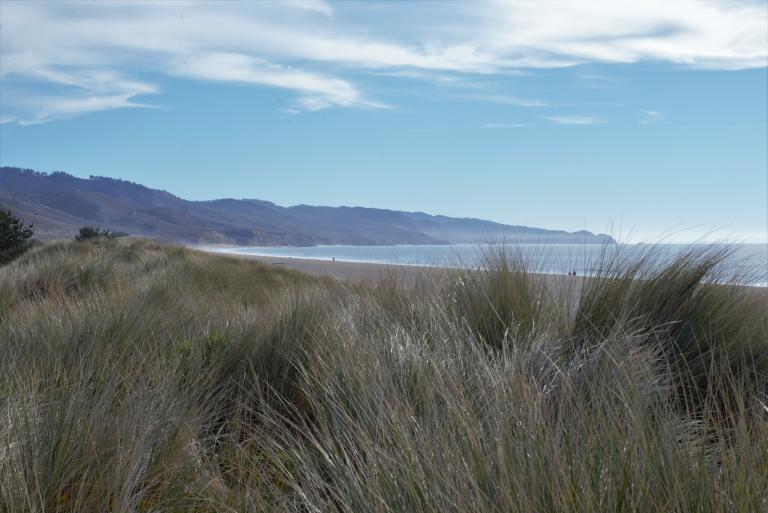
Point Reyes National Seashore
After my long drive through the Pacific Northwest, I arrived in Point Reyes National Seashore. I have been to here many times to visit my cousin who works for the park, participating in his annual tradition: a New Year’s Midnight Polar Bear dip in Pacific. This weekend, the weather held just enough for some good beach-side hiking and a kayaking trip in Drake’s Estero. We spent time with the local residents of Point Reyes: river otters, elephant seals, harbor seals, hawks, raptors, thousands of ducks and other shorebirds, and a brigade of circling turkey vultures.
Point Reyes National Seashore, located on a sharp peninsula at the western end of Marin County, captures all the charm of California’s rolling hills, but is far enough north to sustain stately Redwood trees (Sequoia sempervirens) which take their place among sun-spattered and sweet smelling groves of Bishop Pine (Pinus muricata), Coast Live Oak (Quercus agrifolia), Buckeye (Aesculus californica) and California Bay (Umbellularia californica). It is the traditional territory of the Miwok and Pomo peoples, and the area sustained several hundred small villages before European conquest. After the mission and colonial periods, it was proposed as a National Park in the 1960s, yet once established, the park allowed several historic cattle, dairy and oyster operations to continue within park boundaries.
To my knowledge, Point Reyes is one of the few places in the US Park Service that maintains this kind of balance between agriculture and ecological preservation. This can lead to conflict. For example, the thriving population of Tule Elk (Cervus canadensis nannodes) that was reintroduced to the Peninsula in the 1970s, often clash with farmers’ cattle over grazing space, sparking controversy over whether or not to cull from the elk herd. In addition, the park continues to monitor the impact cattle have on water quality which may be one of many factors that has seen the Peninsula’s salmon runs come to the brink of extirpation, but progress is being made to restore salmon numbers and reduce impacts on creeks and streams. All things considered, Point Reyes National Seashore is an example of a place where because development pressure is checked due to the park’s protected status, human beings can make a living on the land, and not entirely marginalize the myriad nonhumans that have called this place home for thousands of years. Yet, despite their tolerance of exotic ungulates (cows), there are some exotics that have not benefited from this harmonious model. I’ll explain.
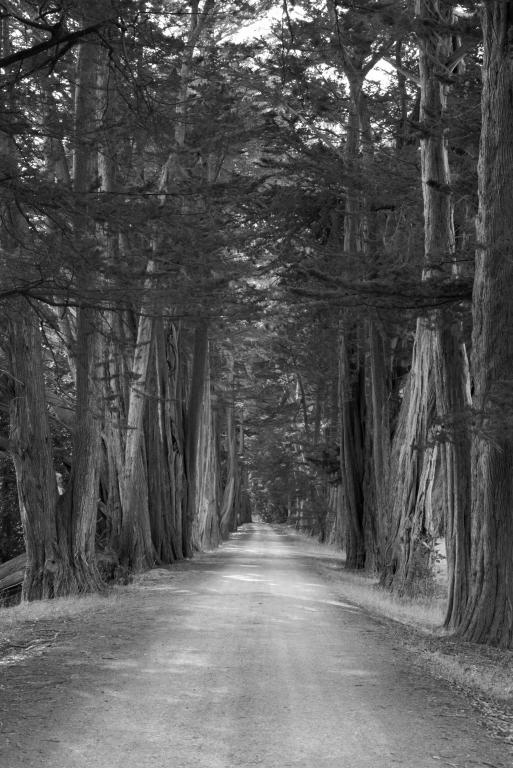
Cypress and Eucalyptus Trees line the entrance of the Vedanta Retreat Center
On my way out of the park, I decided to stop at the 2,200 acre Vedanta Retreat Center and see if I could talk to anyone. As I entered the driveway I was greeted by a long corridor of old growth Monterey Cypress (Hesperocyparis macrocarpa) and Eucalyptus (Eucalyptus globulus) trees. Finding myself face-to-face with a friendly monk that appeared at the ring of a doorbell, I told him I had stopped by to learn about the place. The pony-tailed man with bright eyes and a few day beard gestured with his hands as he told me that the property was purchased in 1946 for a small group of monks, which eventually opened it to retreatants who make up the bulk of visitors to the Center.
The monks are members of the Ramakrishnan Order, which was founded by the famed Hindu mystic Sri Ramakrishna. In 1894, Ramakrishna’s disciple Swami Vivekananda helped found the Vedanta Society which was one of the first organizations to introduce Hinduism and Vedanta Philosophy to North America. Having just attended the Parliament of the World’s Religions, I was pleased to hear that Swami Vivekananda spoke at the very first Parliament in 1893 to rave reviews.
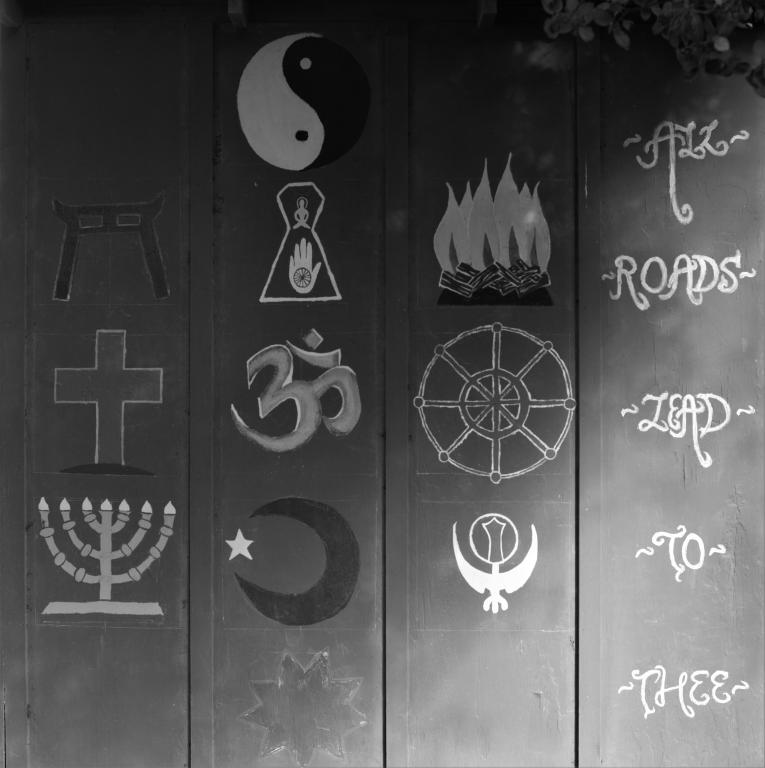
Interfaith Mural on Retreat Center Barn
Briefly, Vedanta is an umbrella term for a branch of Hindu philosophy and practice that focuses on interpreting the Hindu scriptures called the Upanishads (which translates as ‘sitting at the feet of’). Vedanta focuses on questions surrounding the relationship between the human soul and the Divine (Atman and Brahman). In its most nondual approach, there is no difference between Atman and Brahman, and all things can be seen as participating in God. The world itself is an embodiment of the Divine.
This is where the unfortunate ungulates come in. The Retreat Center maintains a good relationship with the park. However, as the monk told me, about ten years ago the park decided to exterminate two exotic deer species that had been introduced in the 1940s. These fallow deer (Dama dama and Axis axis), originally from India themselves, were the target of aggressive management by the park who saw the need to eradicate any species that “threaten to alter natural ecosystems.” There was a firestorm of controversy with many locals, including the monks, objecting. The Humane Society even wrote its own recommendations to the park to focus on sterilization. In the end, the park ended up culling most of the deer. However, the monks requested that no deer be killed on their property. For this reason, the park decided move forward with sterilizing the small number that remained. The deer now spend most of their time at the retreat center. Because all living things are seen as an embodiment of the Divine, to kill any living being, even if it is negatively affecting the native species and ecological integrity of Point Reyes was anathema.
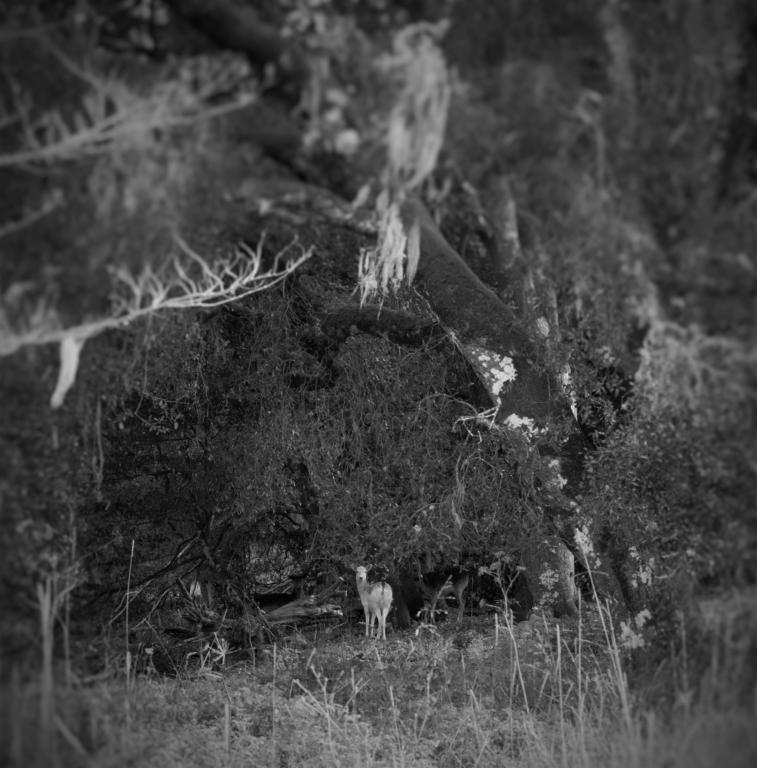
Fallow Deer in Clearing
After speaking with the monk for several minutes, he excused himself and invited me to walk the grounds. Passing a large bull pen housing several vocal and muscular bull, I walked to the top of a small hill and clearing. To my left I saw a small herd of the feral deer the monk had told me about, all wearing tracking collars. Some of them looked like you might expect deer to look like, but about a dozen were pure white, and had a mystical quality to them as they stared stock still in my direction, taking in my scent. They were beautiful, and when they finally spooked I followed them into the nearby woods and watched them for a little while before heading back to my truck.
I find the words of the monk challenging. If everything is an embodiment of the Divine, can a species ever be out of place? Certainly the ‘Divinity’ embodied by a given creature does not increase or decrease depending on its location with relation to its evolutionary origins. Is there a kind of religious fundamentalism in the park’s approach to exotic species? I wouldn’t go that far, but the monks’ approach to the exotic species certainly throws an interesting light on questions of nativity, Divinity, and ecological integrity. Certainly there is value in restoring intact ecosystems that flourished without us for thousands of years. However, the park does not include the participation of indigenous peoples, who also occupied this land for thousands of years, and were then brutally expropriated from it so that I could eventually go hiking on the weekends. These are all important questions that I am taking with me as I travel the West Coast of California, a place that is known for the fertile ground it has provided for eastern spiritual traditions, unfortunately eastern ungulates have not been quite so lucky.
Previous Post

November 23, 2015
Paris, the Dalai Lama and Prayer
Next Post
November 28, 2015 Praying with the Elements for Advent: Week 1: Fire
Browse Our Archives
Select a Category Anthropocene Camino de Santiago Catholicism Film Holyscapes Homily Liturgy Monk Nature New Monasticism New Story Pilgrimage Poetry Politics Prayer Religion and Spirituality Silence Spiritual Ecology Spring Spriritual Ecology Theology Uncategorized Walking Writing
Select a Month June 2020 May 2020 April 2020 March 2020 February 2020 January 2020 December 2019 November 2019 August 2019 June 2019 May 2019 April 2019 January 2019 December 2018 November 2018 October 2018 September 2018 August 2018 July 2018 June 2018 May 2018 April 2018 March 2018 February 2018 January 2018 November 2017 October 2017 September 2017 August 2017 July 2017 June 2017 May 2017 April 2017 March 2017 February 2017 January 2017 December 2016 November 2016 October 2016 September 2016 August 2016 July 2016 June 2016 May 2016 April 2016 March 2016 February 2016 January 2016 December 2015 November 2015
Follow Us!
TAKE THE
Religious Wisdom Quiz
What did God tell Isaiah to do for three years as a sign against Egypt and Cush?
Select your answer to see how you score.
Drink only water Sleep outside Walk barefoot and naked Eat bread only
Related posts from Holyscapes




A Guide Book to America’s Sacred Groves: A...
TRENDING AT PATHEOS Contemplative

Handy Contemplative Practices for Political Spaces
A Spiritually Grounded Presence In order to bring a spiritually grounded presence...

Halloween: The Holiday of Loving Your Neighbor
All Hallows Eve Is Halloween the least Christian holiday in America, or...

Can Love Be Saved? Some Thoughts on the...
Happy Valentine's Day! I recently published a post on Patreon called Can...

"This Loving, Uniting Embrace": the Holy Ordinary
Today's guest post is by Mark Longhurst, author of The Holy Ordinary:...

How Are We Called to Live?: More About...
How Are We Called to Live? Many of us struggle with discerning...

A Spiritual Practice of Reading: Join Us Online
A Spiritual Practice of Reading A healthy spiritual practice of reading is...
view all Contemplative blogs
Ad-Free & Subscriber Log-In Subscription Support
- About Us
- 2026 Calendar
- Videos
- Podcasts
- Library of World Religions
- Faith In Media Tracker
- Advertise With Us
- Write for Us
- Privacy Policy
- Terms of Service
- Do Not Sell My Data
- Contact Us
- Radiant Digital
- Manage Newsletter Subscriptions
- Unsubscribe From Notifications
- Sitemap
Copyright 2008-2026, Patheos. All rights reserved.
Subscription Support Ad-Free & Subscriber Log-In
Follow Patheos