
BuddhistCatholicContemplativeEvangelicalGeneral ChristianHinduJewishLatter-day SaintMuslimNew VisionsProgressive Christian
Beliefs
- Buddhist
- Catholic
- Contemplative
- Evangelical
- General Christian
- Hindu
- Jewish
- Latter-day Saint
- More Voices
- Muslim
- New Visions
- Pagan
- Progressive Christian
Topics
- Religion News
- Food and Religion
- Sports and Religion
- Religious Art
- Religious Music and Entertainment
- Religious Events
- History and Religion
- Style and Religion
- Politics and Religion
- Women in Religion
- Recreation Outdoors and Religion
- Business Finance and Religion
- Careers Workplace and Religion
- Education and Religion
- Family Parenting and Religion
- Health Fitness and Religion
- Home and Religion
- Relationships and Religion
- Technology and Religion
- Travel and Religion
Columnists
- Buddhist Columnists
- Business Finance and Religion Columnists
- Careers Workplace and Religion Columnists
- Catholic Columnists
- Contemplative Columnists
- Education and Religion Columnists
- Evangelists Columnists
- Family Parenting and Religion Columnists
- General Christian Columnists
- Health Fitness and Religion Columnists
- Hindu Columnists
- History and Religion Columnists
- Home and Religion Columnists
- Jewish Columnists
- More Voices Columnists
- Latter Day Columnists
- Muslim Columnists
- New Visions Columnists
- Nonreligious Columnists
- Pagan Columnists
- Politics and Religion Columnists
- Progressive Columnists
- Recreation Outdoors and Religion Columnists
- Relationships and Religion Columnists
- Religion News Columnists
- Religious Art Columnists
- Religious Events Columnists
- Religious Music and Entertainment Columnists
- Sports and Religion Columnists
- Style and Religion Columnists
- Technology and Religion Columnists
- Travel and Religion Columnists
- Women in Religion Columnists
Resource Library
- 2026 Calendar
- Library of World Religions
- The 100 Most Holy Places on Earth
- Patheos Answers
- Podcasts
- Videos
- Faith Leaders Database
- Anglican Episcopalian
- Bahai
- Baptist
- Buddhism
- Christianity
- Confucianism
- Eastern Orthodoxy
- Hinduism
- Holiness and Pentecostal
- ISKCON
- Islam
- Judaism
- Lutheran
- Methodist
- The Church of Jesus Christ of Latter-day Saints
- New Age
- Paganism
- Presbytarian and Reformed
- Protestantism
- Religion Behind the Scenes
- Roman Catholic
- Scientology
- Shia Islam
- Sikhism
- Sufism
- Sunni Islam
- Taoism
- Zen
- See all religions
Research Tools
 Ad-Free & Subscriber Log-In Subscription Support
Ad-Free & Subscriber Log-In Subscription Support
Follow Patheos 

- Trending:
- Forgiveness
- |
- Marriage
- |
- Consciousness
- |
- Death Penalty
- |
- Election
- |
- Halloween
 Holy Rover
- Home
- New Visions
- Pondering Life & Death in the Templo Mayor in Mexico City
Pondering Life & Death in the Templo Mayor in Mexico City
Last updated on: April 18, 2017 at 8:40 pm by Lori Erickson
Pondering Life & Death in the Templo Mayor in Mexico City 2017-04-18T13:26:30-06:00 Lori Erickson
Patheos Explore the world's faith through different perspectives on religion and spirituality! Patheos has the views of the prevalent religions and spiritualities of the world.

The remains of the Aztec’s Templo Mayor are located next to Mexico City’s Metropolitan Cathedral. (Bob Sessions photo)
Part 2 of my series on Mexico City:
Today the remains of the Templo Mayor, the main religious center for the Aztecs, lie next to Mexico’s largest cathedral (in Mexico, as in many other places around the world, religious landmarks from different eras are often layered upon each other). The sprawling archeological site covers several city blocks in Mexico City, a hodgepodge of stone walls, plazas, and ruins.
The Templo Mayor was once the heart of Tenochtitlan, the Aztec capital. On top of its main pyramid were two temples, one to the god of rain and one to the god of war—-the very spot that I knew had been dedicated with 80,000 human sacrifices (see The Aztecs: The Worst Neighbors in the World). It was hard to reconcile the peaceful scene before me with the carnage that had once taken place here.
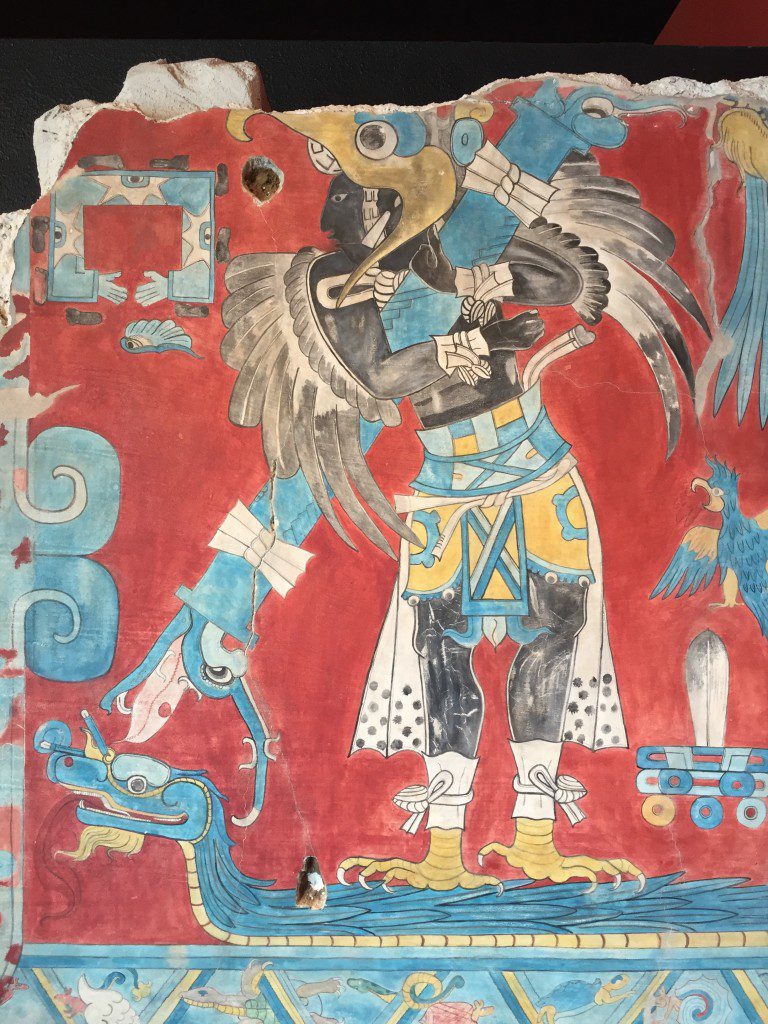
A painting of an Eagle Warrior in Mexico City’s National Museum of Anthropology (Bob Sessions photo)
As I ventured further into the ruins, one place in particular fascinated me: the House of the Eagles, which was a sacred precinct for the elite members of Aztec society. It was here that the statue of Mictlantecuhtli, the god of death that I encountered in the museum, had been found. A marker near the ruin described the rituals that had taken place here. Traces of blood are still detectible on the stones even after centuries, it said, words that triggered a shiver of distaste in me.
I pride myself on being able to appreciate religious expression in many forms, but the Aztecs stretched my tolerance to its limits. Just how much of a true-believer do you have to be to extract a beating heart from a victim and hold it up to your god? (I know, I know–religious history, alas, is full of people behaving badly, but this is a particularly terrible example of this tendency.)
If much of our contemporary society tries to ignore death altogether, the Aztecs had the opposite problem: for them, death was strangely, inexplicably seductive.
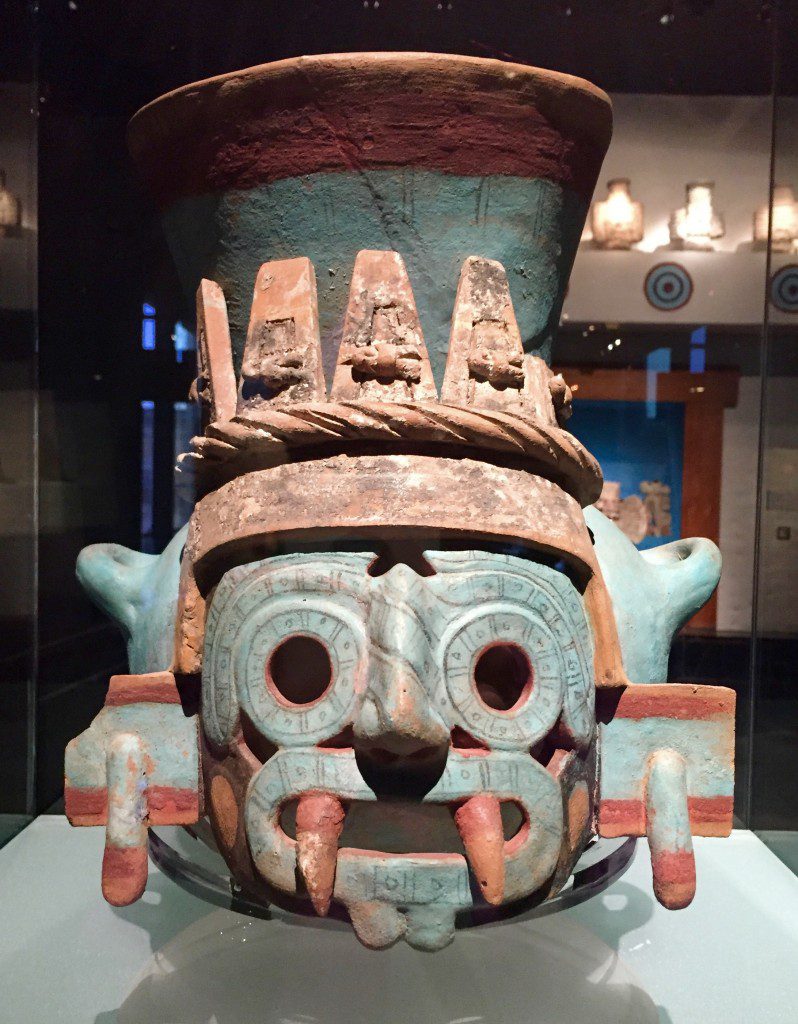
In the Templo Mayor Museum, a ceramic pot bears the image of Tlaloc, the god of rain. (Bob Sessions photo)
In the Templo Mayor Museum, I learned that for the Aztecs, people’s fate after death was determined not on the basis of how they lived, but rather on how they died. Most souls ended up in Mictlan, the nine-layer underworld, a dark, damp, and miserable place ruled over by Mictlantecuhtli, the god with the dangling liver, and his consort, the equally unattractive Mictlancihuatl.
The one good thing about being in Mictlan was that once a year you could return to the world of the living during August, when ceremonies honoring the dead were held, with dancing, feasting, and dressing up in costumes.
Some people were fortunate enough to escape Mictlan entirely, including warriors who were killed in battle, women who died during childbirth, and captives who were sacrificed in a religious ritual (perhaps this belief made it a little easier for them as they walked up the steps of those temples). Instead these lucky souls ended up in Tlalocan, a paradise of eternal spring.
The Aztecs, along with other Mesoamerican cultures, even incorporated death into their sporting events. Throughout the region, a game was played on an I-shaped court with sloping sides. The goal was to put a heavy ball through a ring, a difficult task since players could use only their hips, elbows, head, and knees. The game re-enacted part of the sacred mythology of the Aztecs, recalling the perpetual struggle between good and evil, light and darkness, and the god Quetzalcoatl and his rival brother Tezcatlipoca. And here’s the quintessentially Aztec kicker: the losers were killed.
Say what you will about the Aztecs, they did face death with a certain joie de vivre. To them it was an essential part of the inherent duality of the universe: male and female, hot and cold, day and night. And life and death, the most significant duality of all.
When Hernando Cortez led the final decisive battle against the Aztecs in 1521, he and his soldiers were joined by more than 200,000 natives who were eager to get rid of their troublesome neighbors. And once the Aztecs were defeated, the Catholic missionaries arrived.
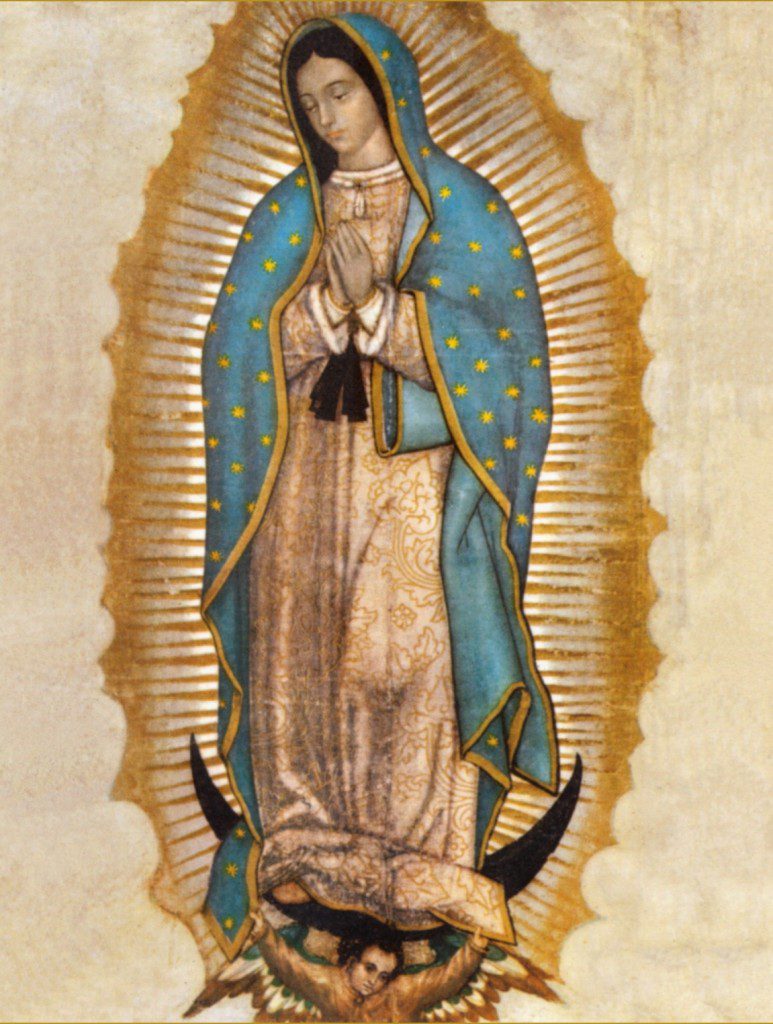
Our Lady of Guadalupe is the patroness of the Americas. (Wikimedia Commons image)
Their work was made easier by the fact that Christianity also had a sense for the sacredness of blood (though for Christians, it was the blood of Jesus on the cross, of course, as well as the wine-turned-to-blood of the Eucharist).
It also helped that there were similarities between Jesus and the plumed serpent god Quetzalcoatl, another wise and kindly deity who was going to return to earth at some at some unspecified point in the future.
Through the next centuries, the two traditions intertwined. Many of the Christian saints became linked with Aztec and Mayan gods: the rain god Tlaloc was worshipped in the form of St. John the Baptist, for example, another religious figure associated with water.
And when a peasant named Juan Diego had a vision on a hill near a shrine dedicated to the goddess Tonantzin, the brown-skinned woman he saw became known as Our Lady of Guadalupe. The vision confirmed the fact that the Virgin Mary loved the native peoples of Mexico as much as the Spaniards (more on Our Lady of Guadalupe in a later post, of course!).
Given all of this, it’s not surprising that when the newly converted Aztecs wanted to honor their dead, their traditional August celebration was moved to the Christian holidays of All Saints and All Souls Days in November. Elements of these earlier rituals were incorporated into the Catholic celebration, including music, dancing, offerings of food to the dead, the ubiquitous images of skulls and skeletons, and also marigolds, which in Spanish are known as cempasúchil, the flowers of the dead.
Next Post: Mexico’s Teotihuacan, One of the World’s Greatest Archeological Sites
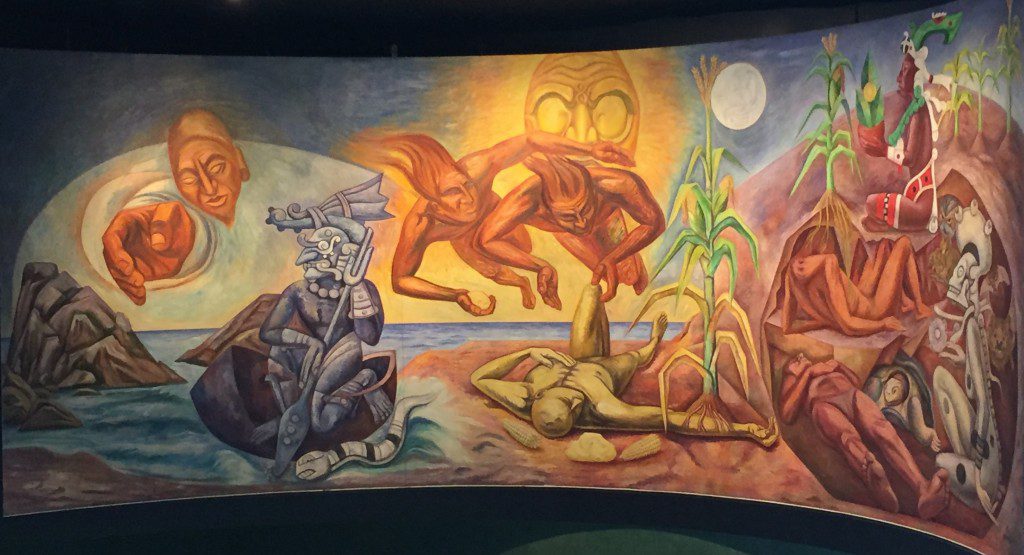
A mural at Mexico City’s National Museum of Anthropology uses death motifs from several pre-Columbian cultures. (Bob Sessions photo)
Stay in touch! Like Holy Rover on Facebook:
Previous Post
April 4, 2017
The Aztecs: The Worst Neighbors in the World
Next Post
April 25, 2017 Mexico City's Teotihuacan: The City of the Gods
Browse Our Archives
Select a Category Aging & Spirituality Amish Anabaptists Animals Apocalypse Archeological sites Art and Spirituality Awards Belgian Holy Sites birds Blessings Books Buddhism Business & Spirituality Callings Cats Celtic Cemeteries Children Christianity church Colorado Creation Death Desert Spirituality Easter Economics Education & Spirituality Egypt Episcopal Church Faith Fear Films First Nations Food Forgiveness Germany God Good & Evil Good Friday Grace Gratitude Happiness Healing Hildegard of Bingen Hinduism History Holy Rover blog Holy Sites Holy Week Horses Iceland Illness Images of God Indigenous Spiritualilty Interfaith Interfaith Dialogue Iowa Islam Israel Japan Judaism LDS Church Lent Machu Picchu Martin Luther Media Meditation Monasteries Museums Music Music and Spirituality Musings Mysticism Native American Nature New Age New Zealand Norse History/Culture/Spirituality Orthodox Paradox Paranormal Peru Philosophy Pilgrimage Poetry Politics Pop Culture Pilgrimage Sites Prayers sermons Silence Social Media Spiritual writers Spirituality and Food Spirituality and Social Media Stone Circles Thomas Merton Turkey Uncategorized Unconventional Holy Sites Utopian communities Videos Virgin Mary Wicca Work World War I Writing Zen
Select a Month August 2017 July 2017 June 2017 May 2017 April 2017 March 2017 February 2017 December 2016 November 2016 October 2016 September 2016 August 2016 July 2016 June 2016 May 2016 April 2016 March 2016 February 2016 January 2016 December 2015 July 2015 June 2015 May 2015 April 2015 March 2015 February 2015 January 2015 December 2014 November 2014 October 2014 September 2014 August 2014 July 2014 June 2014 May 2014 April 2014 March 2014 February 2014 January 2014 December 2013 October 2013 September 2013 August 2013 July 2013 June 2013 May 2013 April 2013 March 2013 February 2013 January 2013 December 2012 November 2012 October 2012 September 2012 August 2012 July 2012 June 2012 May 2012 April 2012 March 2012 February 2012 January 2012 December 2011 November 2011 October 2011 September 2011 August 2011 July 2011 June 2011 May 2011 April 2011 March 2011 February 2011 January 2011 December 2010 November 2010
Follow Us!
TAKE THE
Religious Wisdom Quiz
Which prophet spoke God's judgment against Edom?
Select your answer to see how you score.
Joel Jonah Ezekiel Obadiah
Related posts from Holy Rover
Mexico City's Teotihuacan: The City of the Gods
The Aztecs: The Worst Neighbors in the World

Finding the Holy In a Tradition Not My...
TRENDING AT PATHEOS New Visions

Did Prayer Cure His Cancer? Or Was It...
At 4 AM one morning, Joshua W. Brown’s wife awoke to a...

8 Ways a Near-Death Experience Rewires the Soul
Does Consciousness Survive Physical Death? After 50 Years of Research, Dr. Raymond...

Holy Longing: What Our Restlessness Is Telling Us
“One can find so many pains when the rain is falling.” -John...

What this is NOT about. This blog is definitely not about...

Who said the Israelites were God’s chosen? That’s right, they did. Who...

The Spirit World Is the Real World: God...
A Monk’s Wisdom on Body and Spirit I sit with Brother Martin...
view all New Visions blogs
Ad-Free & Subscriber Log-In Subscription Support
- About Us
- 2026 Calendar
- Videos
- Podcasts
- Library of World Religions
- Faith In Media Tracker
- Advertise With Us
- Write for Us
- Privacy Policy
- Terms of Service
- Do Not Sell My Data
- Contact Us
- Radiant Digital
- Manage Newsletter Subscriptions
- Unsubscribe From Notifications
- Sitemap
Copyright 2008-2026, Patheos. All rights reserved.
Subscription Support Ad-Free & Subscriber Log-In
Follow Patheos