
BuddhistCatholicContemplativeEvangelicalGeneral ChristianHinduJewishLatter-day SaintMuslimNew VisionsProgressive Christian
Beliefs
- Buddhist
- Catholic
- Contemplative
- Evangelical
- General Christian
- Hindu
- Jewish
- Latter-day Saint
- More Voices
- Muslim
- New Visions
- Pagan
- Progressive Christian
Topics
- Religion News
- Food and Religion
- Sports and Religion
- Religious Art
- Religious Music and Entertainment
- Religious Events
- History and Religion
- Style and Religion
- Politics and Religion
- Women in Religion
- Recreation Outdoors and Religion
- Business Finance and Religion
- Careers Workplace and Religion
- Education and Religion
- Family Parenting and Religion
- Health Fitness and Religion
- Home and Religion
- Relationships and Religion
- Technology and Religion
- Travel and Religion
Columnists
- Buddhist Columnists
- Business Finance and Religion Columnists
- Careers Workplace and Religion Columnists
- Catholic Columnists
- Contemplative Columnists
- Education and Religion Columnists
- Evangelists Columnists
- Family Parenting and Religion Columnists
- General Christian Columnists
- Health Fitness and Religion Columnists
- Hindu Columnists
- History and Religion Columnists
- Home and Religion Columnists
- Jewish Columnists
- More Voices Columnists
- Latter Day Columnists
- Muslim Columnists
- New Visions Columnists
- Nonreligious Columnists
- Pagan Columnists
- Politics and Religion Columnists
- Progressive Columnists
- Recreation Outdoors and Religion Columnists
- Relationships and Religion Columnists
- Religion News Columnists
- Religious Art Columnists
- Religious Events Columnists
- Religious Music and Entertainment Columnists
- Sports and Religion Columnists
- Style and Religion Columnists
- Technology and Religion Columnists
- Travel and Religion Columnists
- Women in Religion Columnists
Resource Library
- 2026 Calendar
- Library of World Religions
- The 100 Most Holy Places on Earth
- Patheos Answers
- Podcasts
- Videos
- Faith Leaders Database
- Anglican Episcopalian
- Bahai
- Baptist
- Buddhism
- Christianity
- Confucianism
- Eastern Orthodoxy
- Hinduism
- Holiness and Pentecostal
- ISKCON
- Islam
- Judaism
- Lutheran
- Methodist
- The Church of Jesus Christ of Latter-day Saints
- New Age
- Paganism
- Presbytarian and Reformed
- Protestantism
- Religion Behind the Scenes
- Roman Catholic
- Scientology
- Shia Islam
- Sikhism
- Sufism
- Sunni Islam
- Taoism
- Zen
- See all religions
Research Tools
 Ad-Free & Subscriber Log-In Subscription Support
Follow Patheos 

- Trending:
- Advent
- |
- Forgiveness
- |
- Thanksgiving
- |
- Election
- |
- Seasonal Holidays
- |
- Marriage
 Holy Rover
- Home
- New Visions
- The Mayan Mysteries of Palenque
The Mayan Mysteries of Palenque
Last updated on: February 20, 2017 at 9:42 am by Lori Erickson
The Mayan Mysteries of Palenque 2017-02-20T09:42:25-06:00 Lori Erickson
Patheos Explore the world's faith through different perspectives on religion and spirituality! Patheos has the views of the prevalent religions and spiritualities of the world.
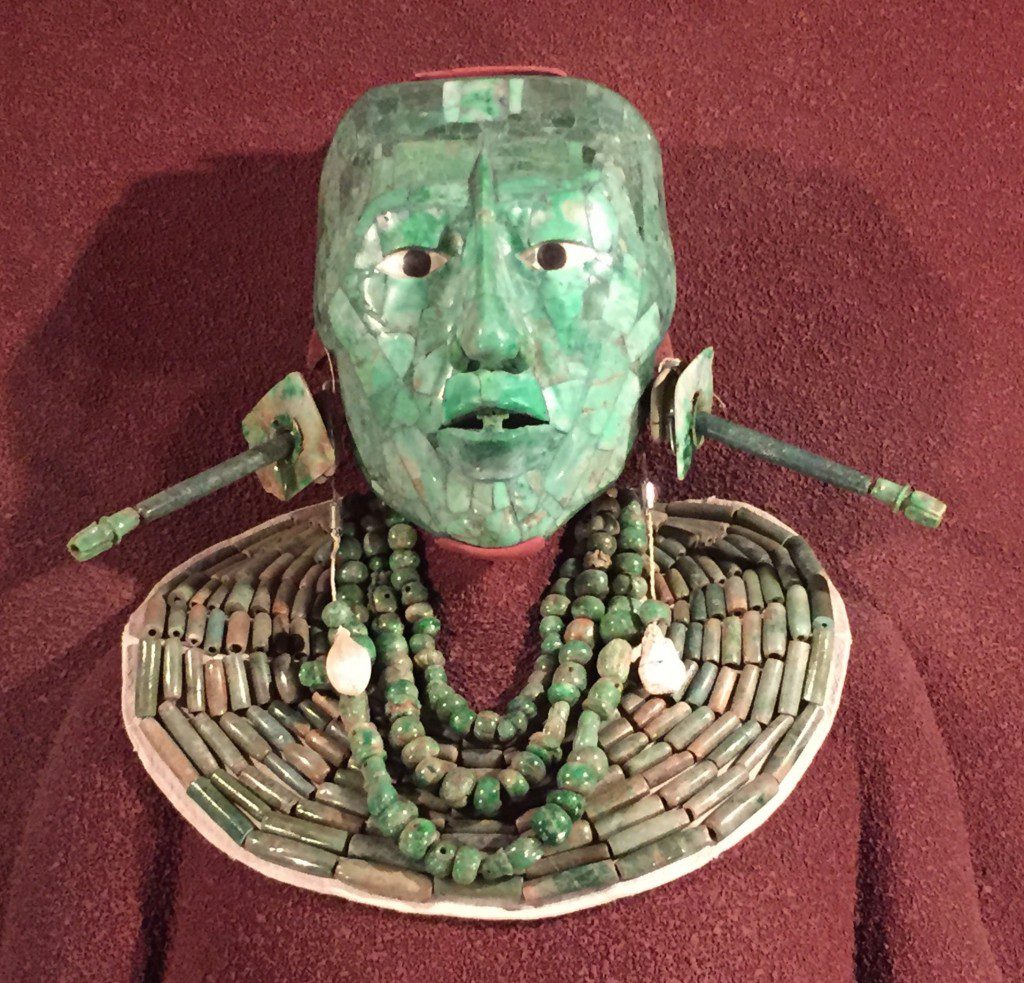
The Mayan ruler Pakal was buried with richly ornamented and highly symbolic finery. (Bob Sessions photo)
Striking, isn’t it?
And maybe a bit unsettling?
I came upon this figure at the National Museum of Anthropology in Mexico City. Bob and I and our friend Brian spent several days in Mexico City before starting our Maya Temples of Transformation tour with Sacred Earth Journeys. Our time at this museum—one of the world’s greatest—gave us an invaluable background for what we would later see on our Maya trip.
Of all the marvels we saw at the museum, the figure pictured above most intrigued me. The jade mask and jewelry were found on the body of a Mayan leader named Pakal, who ruled the city-state of Palenque for almost 70 years in the seventh century. Every part of his elaborate burial finery had symbolic significance, from the number of strands in his necklace to those peculiar ear pieces that jut out from his head. Note, too, that the mask has crossed eyes, which were considered beautiful in Mayan culture.
I stood transfixed by this mask for quite some time, though I wasn’t sure why. Maybe it was the sheer weirdness of it, as well as the beauty of its craftsmanship. There was a haunting quality about it as well, something that seemed to speak in words I couldn’t understand about a culture very different from my own.
A few days later, I stood in front of Palenque’s Temple of Inscriptions, the place where this mask was found.
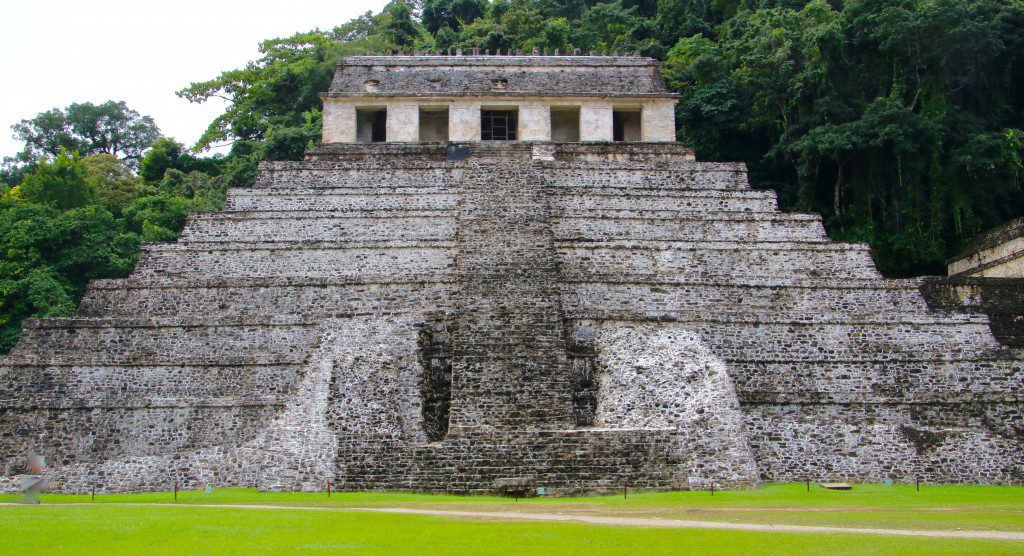
The Temple of the Inscriptions at Palenque is one of the masterpieces of Mayan architecture. (Bob Sessions photo)
Located in the Mexican state of Chiapas, Palenque was founded around the year 100 BCE. It reached its height between 600-800 CE, and then declined in the early 10th century, for unknown reasons. Today it’s one of the most studied of all the Mayan sites. Though smaller in size than Chichen Itza or Tikal, it has exquisite architecture and carvings. Only a small fraction of Palenque has been excavated, but what’s there is marvelous indeed.
As at all Mayan sites, the temples here were likely built to align with astronomical phenomena. Working without telescopes, the Mayan nevertheless had an amazingly sophisticated knowledge of astronomy and mapped the movements of the stars and planets with great accuracy. They also kept multiple calendars geared to various celestial cycles and developed complex writing and mathematical notation systems.
As soon as I entered Palenque, the Temple of the Inscriptions immediately drew my gaze. It’s the largest of the many buildings at the site, with steps arranged in nine levels. Built during Pakal’s reign, it’s named after the hundreds of glyphs located on the temple walls at its top. Originally it was painted red, with its carvings detailed in bright colors. But even with its present appearance of weathered, gray limestone, it’s a exquisite building, perfectly proportioned, beautifully designed.
In 1952, Alberto Ruz Lhuillier made a remarkable discovery atop this temple: he uncovered the beginnings of a stairway that led down through the center of the structure. After four years of excavation, he at last came to Pakal’s tomb, one of the greatest treasures of pre-Columbian archeology. This is the New World equivalent of the discovery of King Tut’s tomb in Egypt.
And while the jade mask in the museum was stunning, I was even more amazed when I learned what covered Pakal’s sarcophagus (see below).
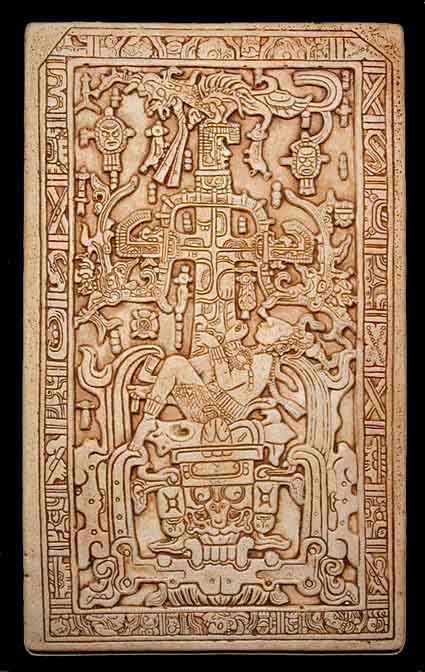
The sarcophagus of the ruler Pakal is a roadmap to the complexities of Mayan spirituality. (Wikimedia Commons image)
This massive lid of limestone, 12 x 7 feet in size, is covered with an intricate, carved design that people have been trying to interpret ever since it was discovered. The image shows a man either descending or ascending a World Tree, a symbol that has roots in the underworld, a trunk in this world, and its branches in paradise. The man is wearing garments similar to those of the Mayan Maize God, and surrounding him are sacred symbols of many kinds.
If this all looks vaguely familiar, it’s because you might have seen it on a late-night TV program on ancient aliens. The craze started with a 1968 book by Erich von Daniken called Chariots of the Gods. When he looked at this image, he saw a space man being propelled by a rocket ship, a theory that’s been giving anthropologists headaches ever since. “No! No! Don’t believe him!” they collectively say, pointing out that Mayan culture was perfectly capable of creating its many wonders all on its own without the help of overlords from the stars.
Thankfully, you don’t have to buy the ancient aliens thesis to appreciate this remarkable work of art (which we saw only in pictures, since you can’t get inside the tomb without special permission). But there is indeed something otherworldly about this image, which shows a spiritual transformation of some sort, a movement between realms.
Today Pakal’s body rests underneath the Temple of Inscriptions, while most of the items found in his tomb are safely ensconced in the Museum of Anthropology in Mexico City. I felt fortunate to have seen those treasures, because it made me fully experience what I experienced at Palenque.
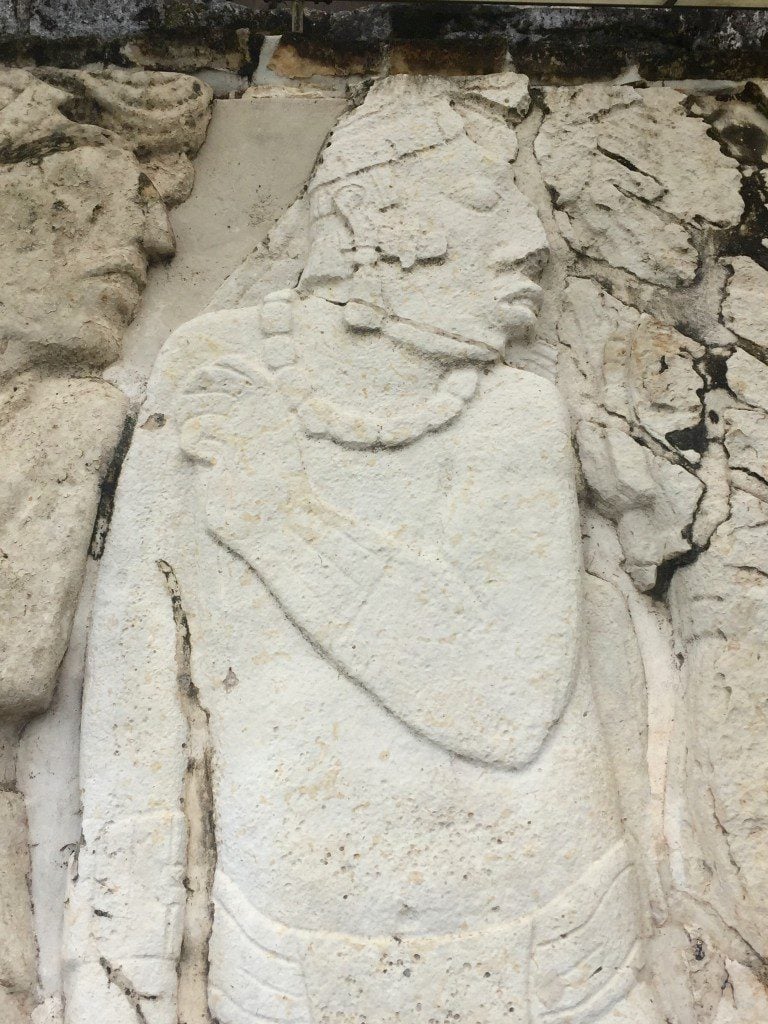
Reliefs in the Palace courtyard at Palenque bring us face to face with the Mayan world. (Bob Sessions photo)
On our tour of Palenque, I also greatly appreciated the fact that we were given time simply to be. Too often tours try to cover so much information and territory that you’re left exhausted. But if you’re going to truly experience a sacred site, you need some time to settle in. I was grateful to spend much of the afternoon wandering on my own amid the temples, climbing up steep steps to perch on platforms overlooking the green lushness of the surrounding jungle, drinking in the vistas.
Here’s a curious thing, one that I’m a little embarrassed to admit. Our group had arranged to meet back at the entrance gate late in the afternoon, and I stretched out my time at Palenque as long as I could. Nearing the departure time, I realized I needed to hurry.
A shortcut led through a dimly lit tunnel that we’d walked through before as a group, a passageway that wound through the ruins of the palace. I started to enter it, and then stopped.
The light had shifted from earlier in the day, and it seemed darker than I remembered. There were no people around, not even voices in the distance. And I realized that I was scared to go into the passageway. I didn’t fear other humans, but instead I wasn’t entirely sure that spirits weren’t hovering around. Something about the way the walls loomed high around me, perhaps. Or maybe it was just an over-active imagination. But I took the long way back to the entrance, even though it entailed much more walking.
I smile when I think back to that moment now, because it sums up to me the essence of Palenque. This is a place that exudes the Mysteries of the Maya. Palenque is both dead and alive. No one lives there, and yet perhaps they do.
Next post: Yachxilan, where I learn about Mayan ceremonies.
Stay in touch! Like Holy Rover on Facebook:
Maya Temples of Transformation
Previous Post
February 9, 2017
Exploring Sacred Mayan Sites in Mexico and Guatemala
Next Post
February 22, 2017 A Ceremony Amid Sun-Dappled Mayan Ruins
Browse Our Archives
Select a Category Aging & Spirituality Amish Anabaptists Animals Apocalypse Archeological sites Art and Spirituality Awards Belgian Holy Sites birds Blessings Books Buddhism Business & Spirituality Callings Cats Celtic Cemeteries Children Christianity church Colorado Creation Death Desert Spirituality Easter Economics Education & Spirituality Egypt Episcopal Church Faith Fear Films First Nations Food Forgiveness Germany God Good & Evil Good Friday Grace Gratitude Happiness Healing Hildegard of Bingen Hinduism History Holy Rover blog Holy Sites Holy Week Horses Iceland Illness Images of God Indigenous Spiritualilty Interfaith Interfaith Dialogue Iowa Islam Israel Japan Judaism LDS Church Lent Machu Picchu Martin Luther Media Meditation Monasteries Museums Music Music and Spirituality Musings Mysticism Native American Nature New Age New Zealand Norse History/Culture/Spirituality Orthodox Paradox Paranormal Peru Philosophy Pilgrimage Poetry Politics Pop Culture Pilgrimage Sites Prayers sermons Silence Social Media Spiritual writers Spirituality and Food Spirituality and Social Media Stone Circles Thomas Merton Turkey Uncategorized Unconventional Holy Sites Utopian communities Videos Virgin Mary Wicca Work World War I Writing Zen
Select a Month August 2017 July 2017 June 2017 May 2017 April 2017 March 2017 February 2017 December 2016 November 2016 October 2016 September 2016 August 2016 July 2016 June 2016 May 2016 April 2016 March 2016 February 2016 January 2016 December 2015 July 2015 June 2015 May 2015 April 2015 March 2015 February 2015 January 2015 December 2014 November 2014 October 2014 September 2014 August 2014 July 2014 June 2014 May 2014 April 2014 March 2014 February 2014 January 2014 December 2013 October 2013 September 2013 August 2013 July 2013 June 2013 May 2013 April 2013 March 2013 February 2013 January 2013 December 2012 November 2012 October 2012 September 2012 August 2012 July 2012 June 2012 May 2012 April 2012 March 2012 February 2012 January 2012 December 2011 November 2011 October 2011 September 2011 August 2011 July 2011 June 2011 May 2011 April 2011 March 2011 February 2011 January 2011 December 2010 November 2010
Follow Us!
TAKE THE
Religious Wisdom Quiz
Who said, "To obey is better than sacrifice"?
Select your answer to see how you score.
Samuel Solomon David Isaiah
Related posts from Holy Rover
Mexico City's Teotihuacan: The City of the Gods
Pondering Life & Death in the Templo Mayor...
The Aztecs: The Worst Neighbors in the World
TRENDING AT PATHEOS New Visions

Did Prayer Cure His Cancer? Or Was It...
At 4 AM one morning, Joshua W. Brown’s wife awoke to a...

8 Ways a Near-Death Experience Rewires the Soul
Does Consciousness Survive Physical Death? After 50 Years of Research, Dr. Raymond...

Holy Longing: What Our Restlessness Is Telling Us
“One can find so many pains when the rain is falling.” -John...

What this is NOT about. This blog is definitely not about...

Who said the Israelites were God’s chosen? That’s right, they did. Who...

The Spirit World Is the Real World: God...
A Monk’s Wisdom on Body and Spirit I sit with Brother Martin...
view all New Visions blogs
Ad-Free & Subscriber Log-In Subscription Support
- About Us
- 2026 Calendar
- Videos
- Podcasts
- Library of World Religions
- Faith In Media Tracker
- Advertise With Us
- Write for Us
- Privacy Policy
- Terms of Service
- Do Not Sell My Data
- Contact Us
- Radiant Digital
- Manage Newsletter Subscriptions
- Unsubscribe From Notifications
- Sitemap
Copyright 2008-2026, Patheos, part of the Radiant Digital network of media brands. All rights reserved.
Subscription Support Ad-Free & Subscriber Log-In
Follow Patheos