
BuddhistCatholicContemplativeEvangelicalGeneral ChristianHinduJewishLatter-day SaintMuslimNew VisionsProgressive Christian
Beliefs
- Buddhist
- Catholic
- Contemplative
- Evangelical
- General Christian
- Hindu
- Jewish
- Latter-day Saint
- More Voices
- Muslim
- New Visions
- Pagan
- Progressive Christian
Topics
- Religion News
- Food and Religion
- Sports and Religion
- Religious Art
- Religious Music and Entertainment
- Religious Events
- History and Religion
- Style and Religion
- Politics and Religion
- Women in Religion
- Recreation Outdoors and Religion
- Business Finance and Religion
- Careers Workplace and Religion
- Education and Religion
- Family Parenting and Religion
- Health Fitness and Religion
- Home and Religion
- Relationships and Religion
- Technology and Religion
- Travel and Religion
Columnists
- Buddhist Columnists
- Business Finance and Religion Columnists
- Careers Workplace and Religion Columnists
- Catholic Columnists
- Contemplative Columnists
- Education and Religion Columnists
- Evangelists Columnists
- Family Parenting and Religion Columnists
- General Christian Columnists
- Health Fitness and Religion Columnists
- Hindu Columnists
- History and Religion Columnists
- Home and Religion Columnists
- Jewish Columnists
- More Voices Columnists
- Latter Day Columnists
- Muslim Columnists
- New Visions Columnists
- Nonreligious Columnists
- Pagan Columnists
- Politics and Religion Columnists
- Progressive Columnists
- Recreation Outdoors and Religion Columnists
- Relationships and Religion Columnists
- Religion News Columnists
- Religious Art Columnists
- Religious Events Columnists
- Religious Music and Entertainment Columnists
- Sports and Religion Columnists
- Style and Religion Columnists
- Technology and Religion Columnists
- Travel and Religion Columnists
- Women in Religion Columnists
Resource Library
- 2026 Calendar
- Library of World Religions
- The 100 Most Holy Places on Earth
- Patheos Answers
- Podcasts
- Videos
- Faith Leaders Database
- Anglican Episcopalian
- Bahai
- Baptist
- Buddhism
- Christianity
- Confucianism
- Eastern Orthodoxy
- Hinduism
- Holiness and Pentecostal
- ISKCON
- Islam
- Judaism
- Lutheran
- Methodist
- The Church of Jesus Christ of Latter-day Saints
- New Age
- Paganism
- Presbytarian and Reformed
- Protestantism
- Religion Behind the Scenes
- Roman Catholic
- Scientology
- Shia Islam
- Sikhism
- Sufism
- Sunni Islam
- Taoism
- Zen
- See all religions
Research Tools
 Ad-Free & Subscriber Log-In Subscription Support
Ad-Free & Subscriber Log-In Subscription Support
Follow Patheos 

- Trending:
- Forgiveness
- |
- Marriage
- |
- Consciousness
- |
- Death Penalty
- |
- Election
- |
- Halloween
 Holy Rover
- Home
- New Visions
- Sick Cats, Grumpy Grandmothers, and Unanswered Prayers
Sick Cats, Grumpy Grandmothers, and Unanswered Prayers
Last updated on: October 7, 2016 at 5:50 am by Lori Erickson
Sick Cats, Grumpy Grandmothers, and Unanswered Prayers 2016-10-07T05:50:52-06:00 Lori Erickson
Patheos Explore the world's faith through different perspectives on religion and spirituality! Patheos has the views of the prevalent religions and spiritualities of the world.
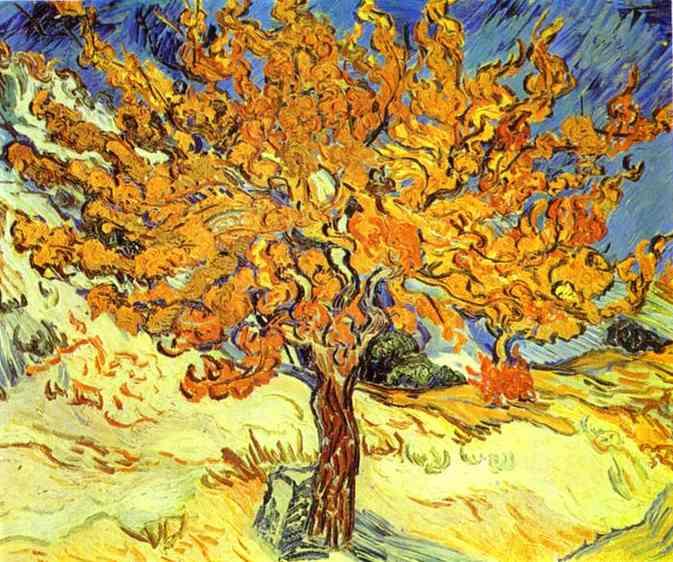
“Mulberry Tree” by Vincent van Gough (Wikimedia Commons image)
Today’s post is adapted from a sermon I gave on Sunday at New Song Episcopal Church in Iowa.
In the Gospel reading this morning, we heard another in a long line of seemingly impossible statements Jesus makes about faith. This morning, it was that if we have faith the size of a mustard seed, we could say to a mulberry tree, be uprooted and planted in the sea and it would obey us. At other times, Jesus tells us that faith can move mountains. It can heal the blind, cure the sick, and make the lame walk. All we need to do is ask and it will be given to us.
Frankly, these are the sort of promises that made many of Jesus’ contemporaries think he was crazy. And they are stumbling blocks for us as well. For it seems very clear, once we start looking around, that faith does not fix everything. Many people of great faith and great goodness have terrible things happen to them. They’ve prayed and prayed and prayed. And yet their faith didn’t move mountains or fix what was broken in their lives.
So what are we to do with this paradox? Who do we believe, Jesus or our own eyes?
It’s an appropriate Sunday to talk about prayer, for a couple of reasons. One is that today is the anniversary of the founding of New Song—22 years ago, a lot of people’s prayers were answered when this church held its first services. The second is that this morning we’re dedicating a new addition to our church: a prie-dieu, which is a French word I’m only going to say once because I know I’m pronouncing it wrong. At New Song we’re going to call it a prayer desk. Starting this Sunday, after receiving communion people can go over to the prayer desk and kneel. A healing minister will ask what they want to pray for, will offer a prayer on their behalf, and then will anoint them with oil.
When I was a deacon at Trinity we launched a similar ministry, and during my years there I grew to love serving as a Healing Minister on Sunday mornings. During those brief interludes in the middle of a service, I remember getting many glimpses into the private lives of parishioners. Sometimes people would come with thanksgivings, but most of the time they came because they were in need. On their behalf I prayed for upcoming surgeries, for siblings struggling with addictions, and for marriages that were crumbling. Kids would often bring prayers that made me smile: we prayed for sick cats and grumpy grandmothers, for a win in that day’s soccer game and upcoming vacations. I remember once being asked by a five-year-old to pray for a new car because he was tired of the old one. I did so, happily.
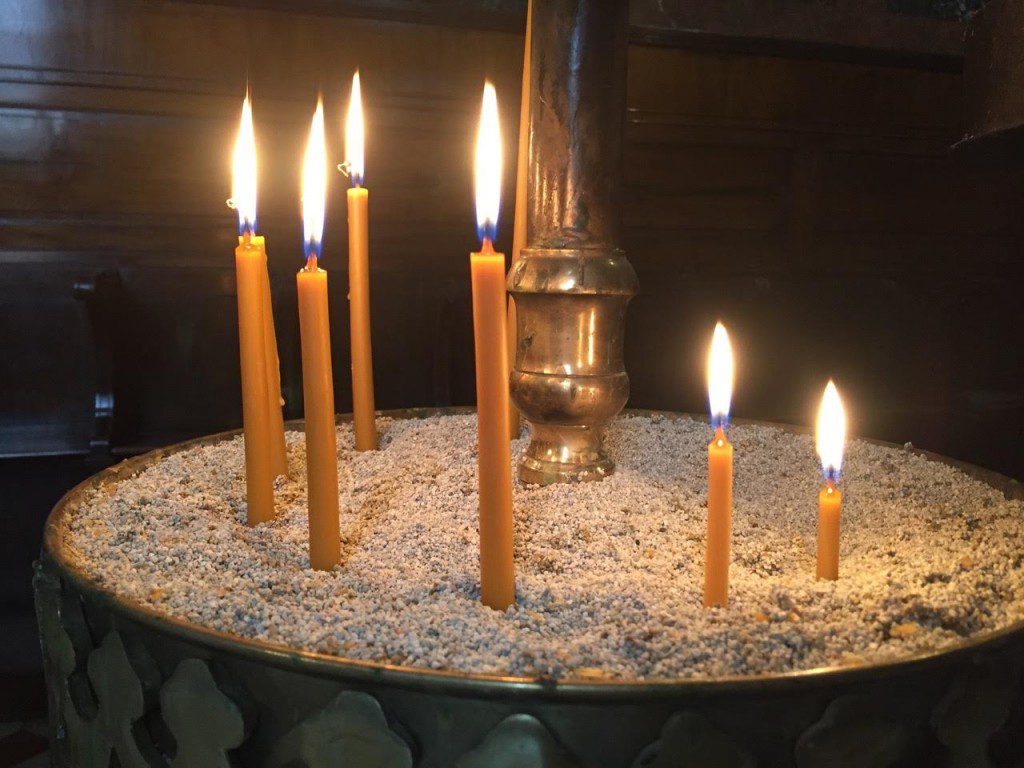
I loved these candles in a prayer alcove in a church in Vienna (Lori Erickson photo)
What I loved is how trusting people were when they came to the prayer alcove. It’s so easy to get cynical in this world, because we all get disappointed again and again. But in those few minutes while we’re kneeling, everything seems possible. The cancer will go into remission. The lost will find their way. The mountain will move.
Prayers like this say to the universe, “I’m going to hit pause on my worrying. Just for this time, I’m going to believe that my life can be different, that the world can be different.”
When Jesus says to us, “Come to me, all you who are burdened and weary, and I will give you rest,” I think he’s talking about prayer. Because goodness knows most of the time, following him means a lot of work and a lot of trouble. But not in prayer. In prayer we get to lay our burdens down.
Over the years, one of the things I’ve come to appreciate about prayer is how varied it is. I think we sometimes forget about all the types of prayers available to us. There are complex prayers and simple prayers, prayers of the breath and prayers of the intellect, prayers when we say a single word over and over again and others that can take hours and require candles and clouds of incense and many people wearing fancy robes.
One of my favorite prayers is so gloriously complicated and convoluted that it’s hard to understand the first time you hear it. It’s also so Roman Catholic that you probably won’t like it if you’re more low church in your leanings. But I love it, in part because of its first word: Remember. In fact, it’s called the Memorare, which is Latin for Remember. It’s addressed to the Virgin Mary. It’s really a nagging sort of prayer, reminding her of what she needs to do, though it’s couched in the most flowery of language. It goes like this:
Remember, O most gracious Virgin Mary, that never was it known that anyone who fled to thy protection, implored thy help, or sought thine intercession was left unaided.
Inspired by this confidence, I fly unto thee, O Virgin of virgins, my mother; to thee do I come, before thee I stand, sinful and sorrowful. O Mother of the Word Incarnate, despise not my petitions, but in thy mercy hear and answer me.
When I say this prayer, I feel like I’ve prayed.
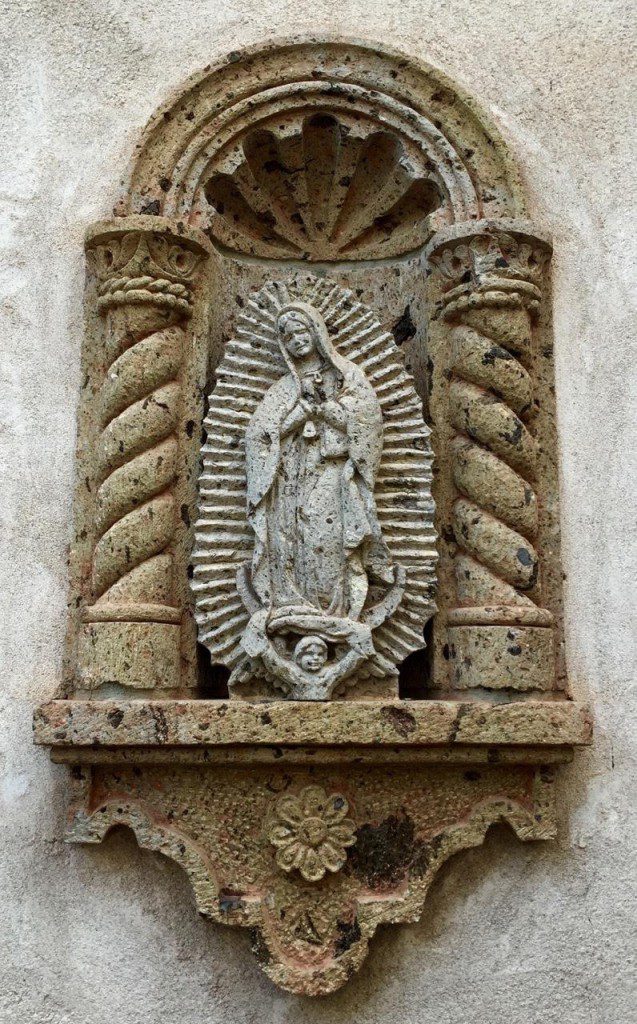
Image of Mary from Sedona, Arizona (Bob Sessions photo)
But the wonderful thing about prayer is that you can pretty much say anything. You can rage at God. You can use swear words. You can just sit there and cry. It’s all prayer. It’s all a variation of saying, “I can’t do this on my own. I need help.”
Anne Lamott wrote a wonderful book about prayer called Help, Thanks, Wow: The Three Essential Prayers. Most prayers, she writes, are just variations of these three. Help. Thanks. Wow. In it she writes:
Prayer is talking to something or anything with which we seek union, even if we are bitter or insane or broken. (In fact, these are probably the best possible conditions under which to pray.) Prayer is taking a chance that against all odds and past history, we are loved and chosen, and do not have to get it together before we show up. The opposite may be true: We may not be able to get it together until after we show up in such miserable shape.
I’m going to pick on Bob next, but I’m married to him and he loves me so I know I can get away with it. When asked him what he thinks about prayer, he said that he thinks intercessory prayer—that is, praying for something specific—is a lesser form of prayer, and that prayer at its best is contemplation, a resting in the divine presence, not asking anything.
Now this is just the sort of thing a philosopher would say, isn’t it?
Looking for additional inspiration, I asked my friend Mary Beth about prayer, and her take was different. She said that prayers find her. By this I think she means that most of the time she’s just going about her business, doing all her ordinary routines, and then prayer interrupts. Look at that sunset, it says. Or on a walk it prods her to notice the beautiful baby going by in a stroller, the one being pushed a mother who looks exhausted. Or there’s a ping on her phone that gives news of a friend in trouble.
I like that sense of prayer interrupting our daily routines. For prayer is indeed a call to attention. I remember being moved the first time I traveled in a Muslim country and heard the call to prayer while walking down a street in Egypt. It’s not that everyone dropped everything and went to the mosque. But in the midst of all the honking taxis and the bustling crowds, it was a reminder of the divine. Remember. Memorare.
One of the things Anne Lamott says in her book is that the difference between us and God is that God never thinks he’s us. But we think we’re God. We too often think that if we just work hard enough and long enough, we can solve all of our problems and all the problems of the world. And if we can’t, it’s our fault because we didn’t work hard enough.
So that’s another reason to pray, I think. To remind ourselves that we’re not in control.
Now I’ve got some good news and some bad news about the prayer desk. I’ll give you the bad news first. On any given Sunday, people are going to come to the prayer desk and ask for things that aren’t going to happen. You may pray for a healing of your relationship with your mother, and she’s still going to drive you crazy the next time you talk to her. You may pray for a job in Iowa City, and instead get one in Chicago.
But let me give you some good news, too. I think that if we come to the prayer desk with an open heart, the world may not get changed, but we will get changed. We’ll go back to our daily lives a little lighter and a little less anxious. And we can face whatever happens, knowing we can lean on the everlasting arms, in the words of the old spiritual.
All of this makes me think of an old Garth Brooks song (one of the signs that I’m getting older is that I’m starting to see theological truths embedded in country music songs). Maybe you know it: it’s the one with a refrain that says some of God’s greatest gifts are unanswered prayers. In the first verse he meets an old girlfriend at a football game, and he remembers all the times he prayed that they’d get married. But they didn’t, and he married someone else, and his life turned out to be wonderful. My guess is that his old girlfriend looked really mean and hard and nasty, and there he was sitting next to his loving wife, who was holding his hand, and he looked at her and couldn’t believe his good fortune.
https://www.youtube.com/watch?v=9GuA5PZx3K4
For we just don’t know, do we? We don’t know what the larger story is, and what part we’re playing in it. Maybe it’s vitally important that we get disappointed this time, that the job goes to someone else, that we get our hearts broken. Maybe it’s all part of some larger plan, and eventually we’ll be at a party and we’ll see someone who reminds us of that unanswered prayer and then we won’t be able to get that Garth Brooks song out of our heads.
Or maybe this is true: maybe the awful thing that happened to us wasn’t part of God’s plan at all, and maybe he’s just as outraged as we are by what happened. But despite that, he can turn the bad into good, and he can take the broken pieces and make them into a mosaic, one that is all the more beautiful because of all the cracks.
All I can say is this: when you come to this prayer desk, you can pray for anything. If you’re Bob, you’re going to try to enter a state of serene, Platonic contemplation. If you’re a child, you can pray that you’ll get a guinea pig, even though your mom has told you that this is not, under any circumstances, going to happen. If your heart is breaking, you can pray about that too.
Because the promise of God is that all of those petitions are important, all of them are heard, and all of them are wrapped in love. You can pray them anywhere, anytime. Including at our new prayer desk on Sunday mornings.
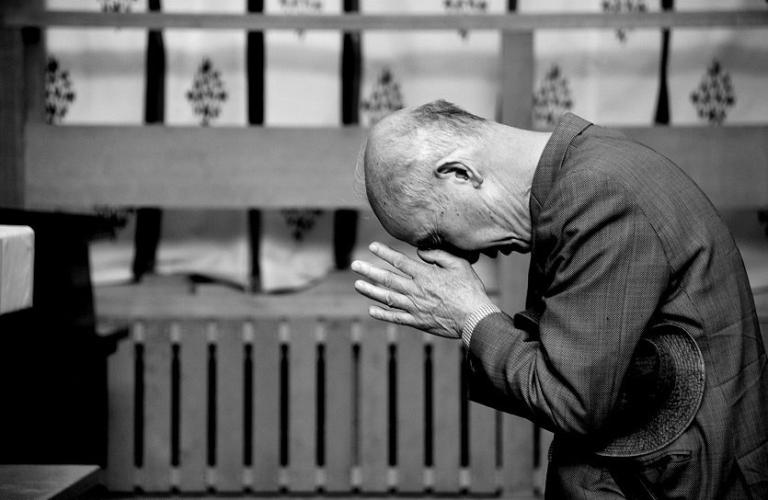
(photo licensed under Creative Commons)
Stay in touch! Like Holy Rover on Facebook:
Previous Post
September 13, 2016
The Surprising Spiritual Mecca of Crestone, Colorado
Next Post
October 24, 2016 The Thriving Arab American Community of Dearborn, Michigan
Browse Our Archives
Select a Category Aging & Spirituality Amish Anabaptists Animals Apocalypse Archeological sites Art and Spirituality Awards Belgian Holy Sites birds Blessings Books Buddhism Business & Spirituality Callings Cats Celtic Cemeteries Children Christianity church Colorado Creation Death Desert Spirituality Easter Economics Education & Spirituality Egypt Episcopal Church Faith Fear Films First Nations Food Forgiveness Germany God Good & Evil Good Friday Grace Gratitude Happiness Healing Hildegard of Bingen Hinduism History Holy Rover blog Holy Sites Holy Week Horses Iceland Illness Images of God Indigenous Spiritualilty Interfaith Interfaith Dialogue Iowa Islam Israel Japan Judaism LDS Church Lent Machu Picchu Martin Luther Media Meditation Monasteries Museums Music Music and Spirituality Musings Mysticism Native American Nature New Age New Zealand Norse History/Culture/Spirituality Orthodox Paradox Paranormal Peru Philosophy Pilgrimage Poetry Politics Pop Culture Pilgrimage Sites Prayers sermons Silence Social Media Spiritual writers Spirituality and Food Spirituality and Social Media Stone Circles Thomas Merton Turkey Uncategorized Unconventional Holy Sites Utopian communities Videos Virgin Mary Wicca Work World War I Writing Zen
Select a Month August 2017 July 2017 June 2017 May 2017 April 2017 March 2017 February 2017 December 2016 November 2016 October 2016 September 2016 August 2016 July 2016 June 2016 May 2016 April 2016 March 2016 February 2016 January 2016 December 2015 July 2015 June 2015 May 2015 April 2015 March 2015 February 2015 January 2015 December 2014 November 2014 October 2014 September 2014 August 2014 July 2014 June 2014 May 2014 April 2014 March 2014 February 2014 January 2014 December 2013 October 2013 September 2013 August 2013 July 2013 June 2013 May 2013 April 2013 March 2013 February 2013 January 2013 December 2012 November 2012 October 2012 September 2012 August 2012 July 2012 June 2012 May 2012 April 2012 March 2012 February 2012 January 2012 December 2011 November 2011 October 2011 September 2011 August 2011 July 2011 June 2011 May 2011 April 2011 March 2011 February 2011 January 2011 December 2010 November 2010
Follow Us!
TAKE THE
Religious Wisdom Quiz
Who fell from a window and died while Paul was preaching, then was raised back to life?
Select your answer to see how you score.
Eutychus Timothy Tychicus Erastus
Related posts from Holy Rover

On Christmas Eve, Thinking about Holsteins and the...

TRENDING AT PATHEOS New Visions

Did Prayer Cure His Cancer? Or Was It...
At 4 AM one morning, Joshua W. Brown’s wife awoke to a...

8 Ways a Near-Death Experience Rewires the Soul
Does Consciousness Survive Physical Death? After 50 Years of Research, Dr. Raymond...

Holy Longing: What Our Restlessness Is Telling Us
“One can find so many pains when the rain is falling.” -John...

What this is NOT about. This blog is definitely not about...

Who said the Israelites were God’s chosen? That’s right, they did. Who...

The Spirit World Is the Real World: God...
A Monk’s Wisdom on Body and Spirit I sit with Brother Martin...
view all New Visions blogs
Ad-Free & Subscriber Log-In Subscription Support
- About Us
- 2026 Calendar
- Videos
- Podcasts
- Library of World Religions
- Faith In Media Tracker
- Advertise With Us
- Write for Us
- Privacy Policy
- Terms of Service
- Do Not Sell My Data
- Contact Us
- Radiant Digital
- Manage Newsletter Subscriptions
- Unsubscribe From Notifications
- Sitemap
Copyright 2008-2026, Patheos. All rights reserved.
Subscription Support Ad-Free & Subscriber Log-In
Follow Patheos