
BuddhistCatholicContemplativeEvangelicalGeneral ChristianHinduJewishLatter-day SaintMuslimNew VisionsProgressive Christian
Beliefs
- Buddhist
- Catholic
- Contemplative
- Evangelical
- General Christian
- Hindu
- Jewish
- Latter-day Saint
- More Voices
- Muslim
- New Visions
- Pagan
- Progressive Christian
Topics
- Religion News
- Food and Religion
- Sports and Religion
- Religious Art
- Religious Music and Entertainment
- Religious Events
- History and Religion
- Style and Religion
- Politics and Religion
- Women in Religion
- Recreation Outdoors and Religion
- Business Finance and Religion
- Careers Workplace and Religion
- Education and Religion
- Family Parenting and Religion
- Health Fitness and Religion
- Home and Religion
- Relationships and Religion
- Technology and Religion
- Travel and Religion
Columnists
- Buddhist Columnists
- Business Finance and Religion Columnists
- Careers Workplace and Religion Columnists
- Catholic Columnists
- Contemplative Columnists
- Education and Religion Columnists
- Evangelists Columnists
- Family Parenting and Religion Columnists
- General Christian Columnists
- Health Fitness and Religion Columnists
- Hindu Columnists
- History and Religion Columnists
- Home and Religion Columnists
- Jewish Columnists
- More Voices Columnists
- Latter Day Columnists
- Muslim Columnists
- New Visions Columnists
- Nonreligious Columnists
- Pagan Columnists
- Politics and Religion Columnists
- Progressive Columnists
- Recreation Outdoors and Religion Columnists
- Relationships and Religion Columnists
- Religion News Columnists
- Religious Art Columnists
- Religious Events Columnists
- Religious Music and Entertainment Columnists
- Sports and Religion Columnists
- Style and Religion Columnists
- Technology and Religion Columnists
- Travel and Religion Columnists
- Women in Religion Columnists
Resource Library
- 2026 Calendar
- Library of World Religions
- The 100 Most Holy Places on Earth
- Patheos Answers
- Podcasts
- Videos
- Faith Leaders Database
- Anglican Episcopalian
- Bahai
- Baptist
- Buddhism
- Christianity
- Confucianism
- Eastern Orthodoxy
- Hinduism
- Holiness and Pentecostal
- ISKCON
- Islam
- Judaism
- Lutheran
- Methodist
- The Church of Jesus Christ of Latter-day Saints
- New Age
- Paganism
- Presbytarian and Reformed
- Protestantism
- Religion Behind the Scenes
- Roman Catholic
- Scientology
- Shia Islam
- Sikhism
- Sufism
- Sunni Islam
- Taoism
- Zen
- See all religions
Research Tools
 Ad-Free & Subscriber Log-In Subscription Support
Ad-Free & Subscriber Log-In Subscription Support
Follow Patheos 

- Trending:
- Forgiveness
- |
- Marriage
- |
- Consciousness
- |
- Death Penalty
- |
- Election
- |
- Halloween
 Holy Rover
- Home
- New Visions
- With the God Mithras at Carnuntum
With the God Mithras at Carnuntum
Last updated on: August 22, 2016 at 7:48 am by Lori Erickson
With the God Mithras at Carnuntum 2016-08-22T07:48:43-06:00 Lori Erickson
Patheos Explore the world's faith through different perspectives on religion and spirituality! Patheos has the views of the prevalent religions and spiritualities of the world.
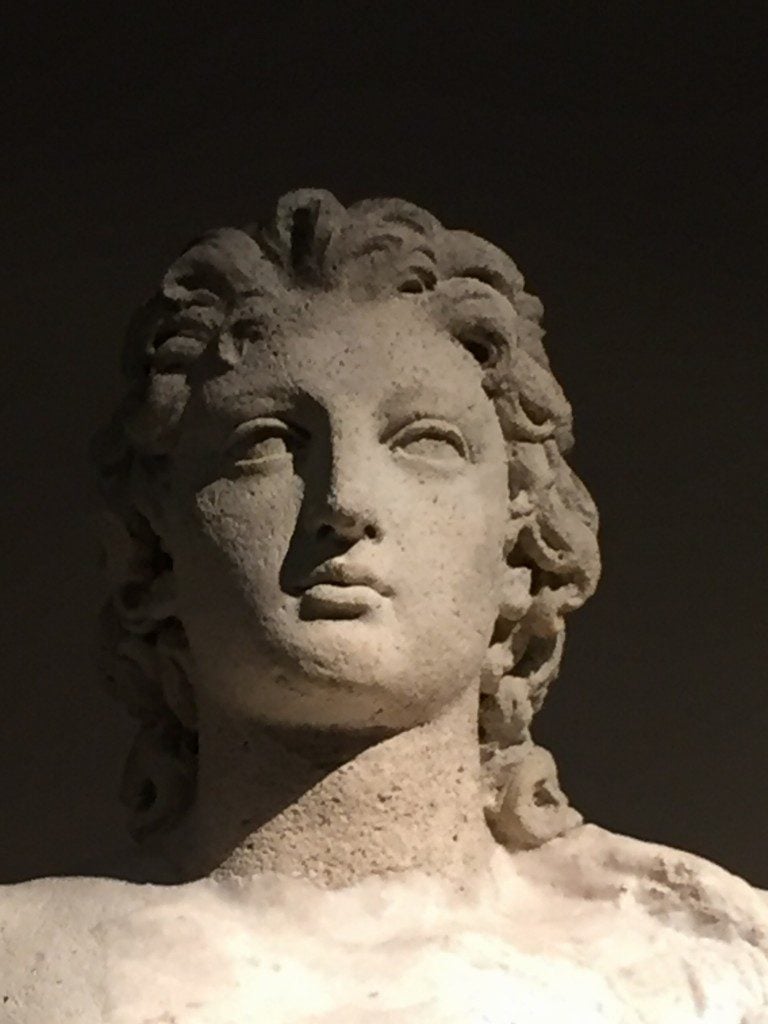
A statue on display at Carnuntum, an archeological site in Austria. (Lori Erickson photo)
In the seven years I’ve been writing my Holy Rover blog (my goodness, has it been that long?), I’ve explored hundreds of spiritual sites from many different faith traditions. But today marks the first time I’ve ever written about spirituality in ancient Rome—in particular, about the worship of the Roman god known as Mithras.
I didn’t expect to encounter the Romans on our recent trip to Austria. But at Carnuntum, an attraction on the border between Austria and Slovakia, I encountered the most amazing archeological site I’ve ever visited.
I’ve been to quite a few Roman sites over the years, but to be honest, it took a lot of imagination to make them into anything more than just a pile of rocks. Carnuntum, in contrast, was like stepping into a time machine.
For at Carnuntum, they don’t have just ruins: they’ve rebuilt some of what once was there.
Carnuntum was founded as a military camp by Tiberius (who later became emperor) in 6 A.D. By the second century it had grown into the wealthy capital of a Roman province that covered what is now much of Austria and the Balkans. At its height, 50,000 people lived here, a mix of Roman soldiers and officials and natives of the region. There were two amphitheaters (one for the Roman city and the other for the civilian city) and a school for gladiators.
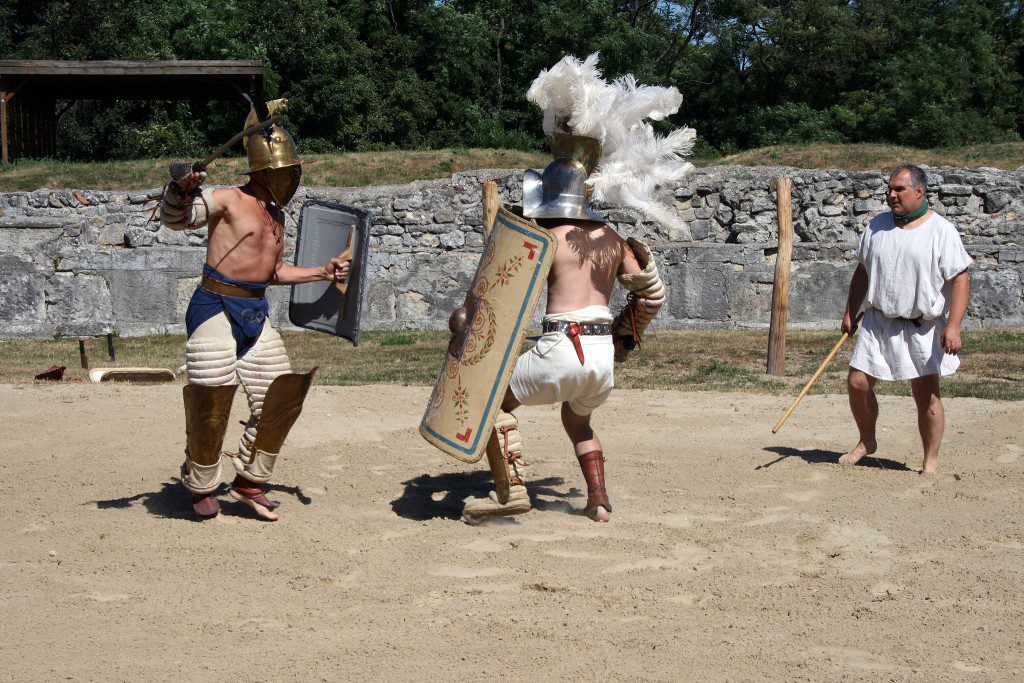
Re-enactors demonstrate the training of gladiators at Carnuntum. (photo used with permission of Carnuntum, (c) Atelier Olschinsky)
The most famous resident of the city was the philosopher-king Marcus Aurelius, author of the Stoic classic Meditations. It’s believed he wrote part of this book while he was stationed in Carnuntum.
Carnuntum’s glory came to an end in the fifth century, when the city was attacked by barbarians and left abandoned. But by a happy accident of history, the ruins here were not covered over by construction in subsequent centuries. Unlike almost all major Roman settlements, Carnuntum was left largely undisturbed—making it a treasure trove for archeologists.
With 1600 acres, Carnuntum is one of the largest archeological parks in Europe. It’s a sprawling complex that includes remains from the military and civilian cities and a museum full of artifacts.
If you’re a history buff like me, you probably have certain eras that fascinate you and others that don’t. Take Elizabethan England, for example. Try as I might, I can’t muster up much interest in it. But Rome? Oh, my gracious. I love Roman history (it must be a past life thing).
And so walking through the reconstructed buildings of Carnuntum was the fulfillment of a wish I’ve long had—to travel back in time to Rome.
There are four main buildings in Carnuntum that have been rebuilt in their original locations, using ancient techniques and reconstructed Roman tools. The first to be done was a home once owned by a merchant. It was the equivalent of a middle class home, perfectly comfortable even by today’s standards, especially if you don’t mind cooking over a fireplace.
Look at the bedroom/sitting room below. Is this nicer than your bedroom at home? It’s certainly nicer than mine.
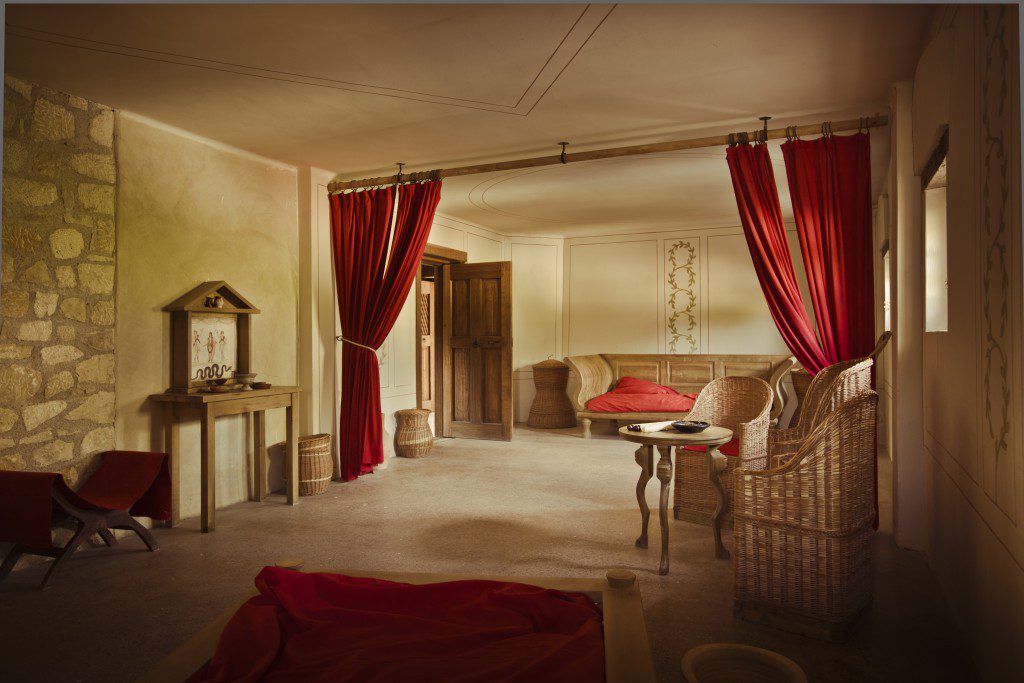
One of the reconstructions at Carnuntum is of a home owned by a merchant. (photo used with permission of Carnuntum, (c) Atelier Olschinsky)
The crown jewel of Carnuntum is its reconstruction of a villa owned by a member of the upper class. Even though Carnuntum was in the hinterlands of the empire, this home was likely comparable to the wealthy mansions of Rome.
It had an ingenious underfloor heating system that warmed it in the winter, and thick walls and wide overhangs that kept it cool in the summer. Its elegantly proportioned rooms were decorated with beautiful painted stucco designs. All of these elements have been carefully reconstructed, with the result shown below—a home that looks quite similar to one in an upper-crust subdivision of an American city.
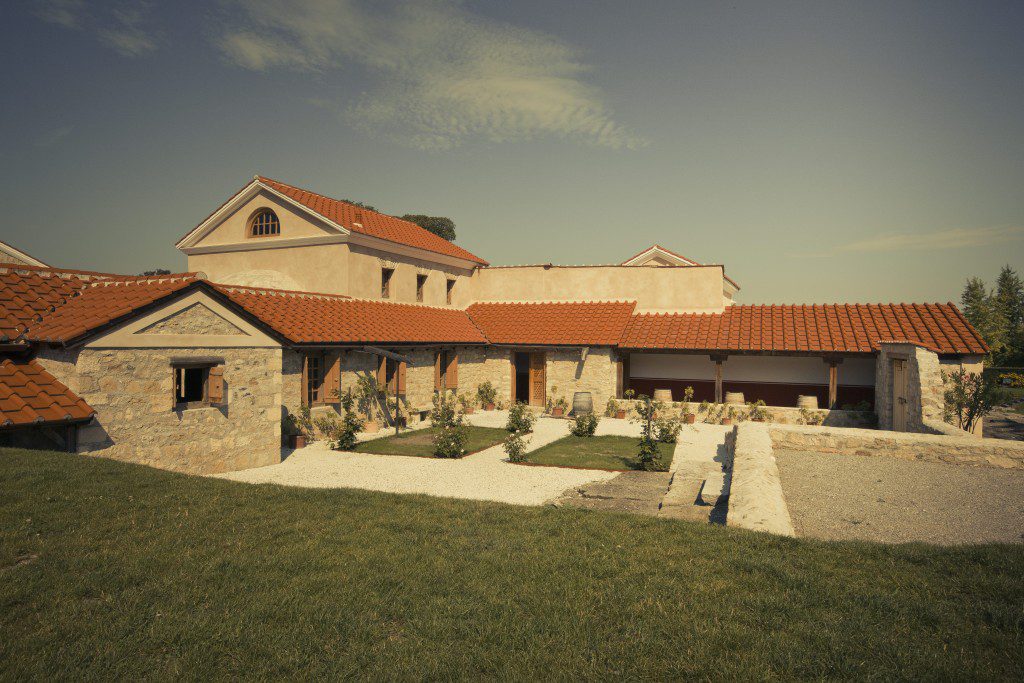
A reconstructed villa at Carnuntum shows the lifestyle enjoyed by a wealthy Roman citizen. (photo used with permission of Carnuntum, (c) Atelier Olschinsky)
And as if all of this luxury wasn’t enough, right next door was a public bath, which has also been reconstructed.
Visiting such baths was a central part of Roman life. Different rooms had pools of different temperatures: the frigidarium, tepidarium, and caldarium (aren’t those great names?). The baths at Carnuntum also included a central assembly room where people could socialize before or after their baths.
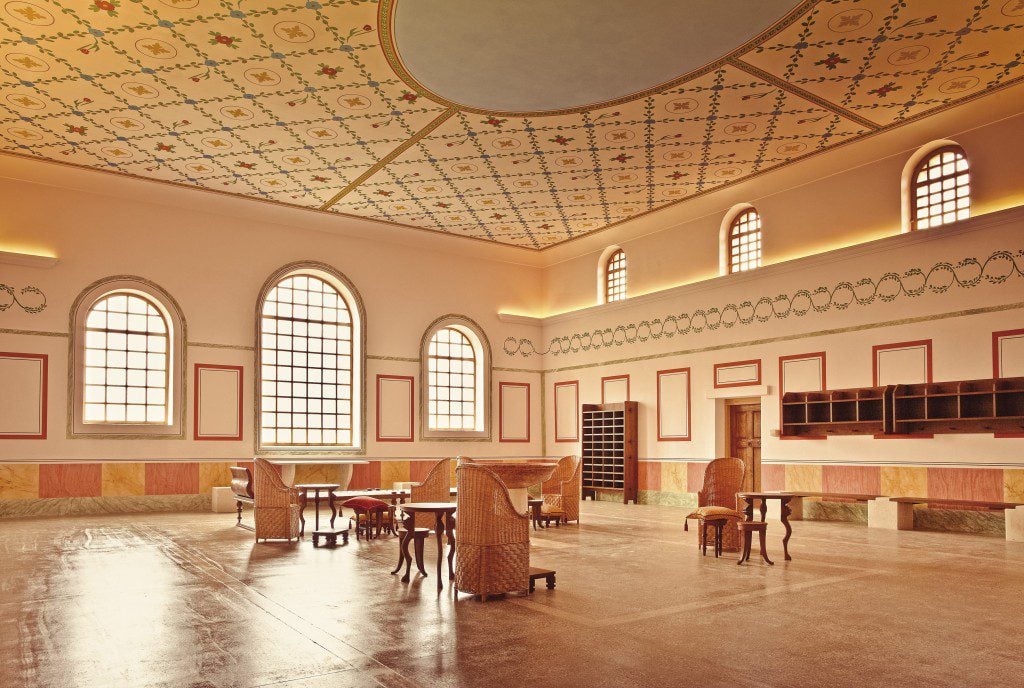
The reconstructed bath house at Carnuntum includes this spacious assembly room. (photo used with permission of Carnuntum, (c) Atelier Olschinsky)
By the time we finished our tour of the Roman city, I was ready to sell my house in Iowa and move in.
We next visited an additional treasure: a museum filled with artifacts excavated from Carnuntum. On display were statues and household goods, weapons of war and farming implements.
But by far the most intriguing to me was a Mithraeum, an underground grotto where the god Mithras was once worshipped.
I first encountered Mithras in the historical novels of Mary Renault, and he has intrigued me ever since. The sun god Mithra originated in Persia. During the second century his cult became very popular in the Roman Empire, especially among soldiers in the military. He was born on the day of the winter solstice, which was December 25 according to the Julian calendar—the date that in the fourth century the Christian Church chose to celebrate as Jesus’ birthday. (Many historians have pointed out similarities between the rituals of Mithras and those of Christianity, but that’s a topic for another day.)
Archeologists have found six Mithraeum at Carnuntum, which gives an indication of how widespread the worship of Mithras was here. The Mithraeum in the museum is a recreation of one of these sites, using original carvings found nearby.
The Mithreaeum’s central focus is an image of Mithras slaying a bull. The image below is a little fuzzy because the colors are actually projected onto the stone, not painted, so as not to damage the surface. But they show how brightly colored the carved relief once was. The scene is a key part of the creation myth associated with the god and has been found in virtually all the grottos associated with the worship of Mithras.
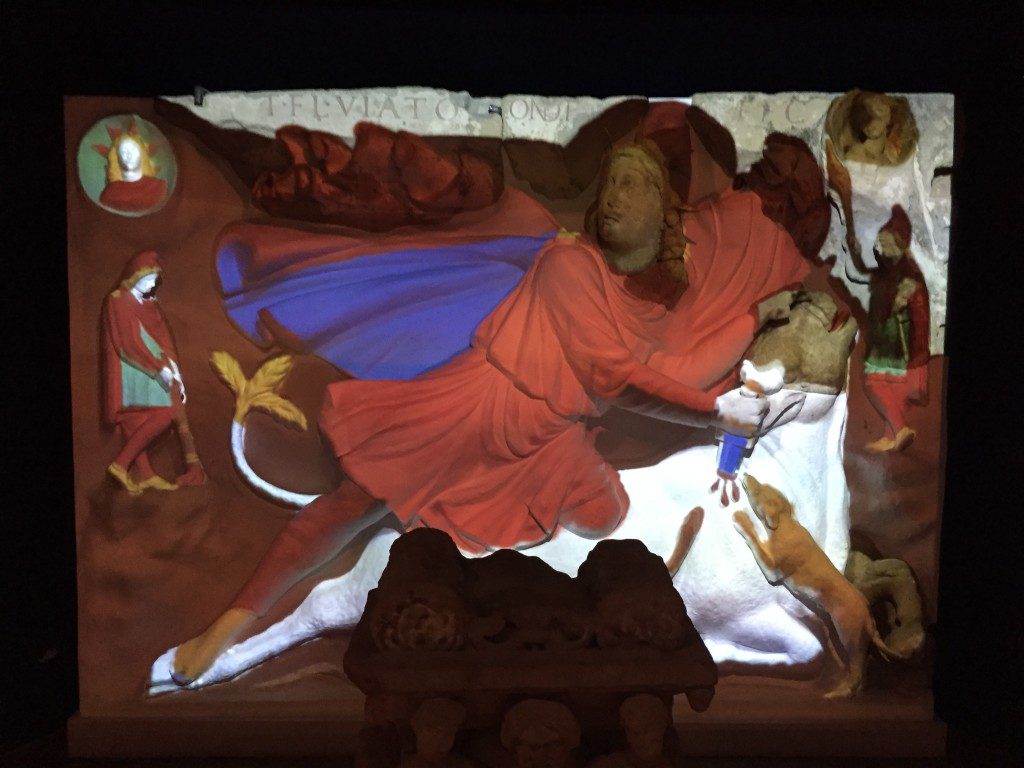
A carved stone relief at Carnuntum shows the god Mithras slaying a bull. (Lori Erickson photo)
We don’t know a lot about what happened in these underground grottos, because devotees of Mithras were sworn to secrecy on the pain of death. Much of what scholars have pieced together is speculation, mainly taken from descriptions of the rites given by detractors, especially early Christian writers.
Historians believe there were seven levels of initiation and that those who completed them were said to attain eternal life. The rituals, which were open only to men, including purification through water, feasting, and enactments of a sacred journey from life to death to rebirth.
Isn’t it interesting how so many religions revolve around this archetypal story? One can dismiss this, of course, as simply due to the fact that humans try to find ways to deal with their fear of death. And yet perhaps there is a deep intuition, an innate knowledge, that death is not the end. Standing in the Mithraeum, I had a sense for how long people have been struggling with these questions, seeking answers in rituals, myths, and stories.
In my travels around the world, I’ve become increasingly interested in sites where ancient gods were once worshipped, places haunted by the ghosts of pilgrims past. Carnuntum is among the most splendid of these landmarks, an entry point into a twilight world between ages, a site where the past doesn’t seem like the past at all.
Stay in touch! Like Holy Rover on Facebook:
Previous Post
August 10, 2016
In Vienna, A Tale of Two Churches
Next Post

September 1, 2016 Recipes for a Sacred Life
Browse Our Archives
Select a Category Aging & Spirituality Amish Anabaptists Animals Apocalypse Archeological sites Art and Spirituality Awards Belgian Holy Sites birds Blessings Books Buddhism Business & Spirituality Callings Cats Celtic Cemeteries Children Christianity church Colorado Creation Death Desert Spirituality Easter Economics Education & Spirituality Egypt Episcopal Church Faith Fear Films First Nations Food Forgiveness Germany God Good & Evil Good Friday Grace Gratitude Happiness Healing Hildegard of Bingen Hinduism History Holy Rover blog Holy Sites Holy Week Horses Iceland Illness Images of God Indigenous Spiritualilty Interfaith Interfaith Dialogue Iowa Islam Israel Japan Judaism LDS Church Lent Machu Picchu Martin Luther Media Meditation Monasteries Museums Music Music and Spirituality Musings Mysticism Native American Nature New Age New Zealand Norse History/Culture/Spirituality Orthodox Paradox Paranormal Peru Philosophy Pilgrimage Poetry Politics Pop Culture Pilgrimage Sites Prayers sermons Silence Social Media Spiritual writers Spirituality and Food Spirituality and Social Media Stone Circles Thomas Merton Turkey Uncategorized Unconventional Holy Sites Utopian communities Videos Virgin Mary Wicca Work World War I Writing Zen
Select a Month August 2017 July 2017 June 2017 May 2017 April 2017 March 2017 February 2017 December 2016 November 2016 October 2016 September 2016 August 2016 July 2016 June 2016 May 2016 April 2016 March 2016 February 2016 January 2016 December 2015 July 2015 June 2015 May 2015 April 2015 March 2015 February 2015 January 2015 December 2014 November 2014 October 2014 September 2014 August 2014 July 2014 June 2014 May 2014 April 2014 March 2014 February 2014 January 2014 December 2013 October 2013 September 2013 August 2013 July 2013 June 2013 May 2013 April 2013 March 2013 February 2013 January 2013 December 2012 November 2012 October 2012 September 2012 August 2012 July 2012 June 2012 May 2012 April 2012 March 2012 February 2012 January 2012 December 2011 November 2011 October 2011 September 2011 August 2011 July 2011 June 2011 May 2011 April 2011 March 2011 February 2011 January 2011 December 2010 November 2010
Follow Us!
TAKE THE
Religious Wisdom Quiz
Who had a coat of many colors?
Select your answer to see how you score.
Benjamin Joseph Esau Jacob
Related posts from Holy Rover

A Ceremony Amid Sun-Dappled Mayan Ruins

Announcing Holy-Rover-the-Book
TRENDING AT PATHEOS New Visions

Did Prayer Cure His Cancer? Or Was It...
At 4 AM one morning, Joshua W. Brown’s wife awoke to a...

8 Ways a Near-Death Experience Rewires the Soul
Does Consciousness Survive Physical Death? After 50 Years of Research, Dr. Raymond...

Holy Longing: What Our Restlessness Is Telling Us
“One can find so many pains when the rain is falling.” -John...

What this is NOT about. This blog is definitely not about...

Who said the Israelites were God’s chosen? That’s right, they did. Who...

The Spirit World Is the Real World: God...
A Monk’s Wisdom on Body and Spirit I sit with Brother Martin...
view all New Visions blogs
Ad-Free & Subscriber Log-In Subscription Support
- About Us
- 2026 Calendar
- Videos
- Podcasts
- Library of World Religions
- Faith In Media Tracker
- Advertise With Us
- Write for Us
- Privacy Policy
- Terms of Service
- Do Not Sell My Data
- Contact Us
- Radiant Digital
- Manage Newsletter Subscriptions
- Unsubscribe From Notifications
- Sitemap
Copyright 2008-2026, Patheos. All rights reserved.
Subscription Support Ad-Free & Subscriber Log-In
Follow Patheos