
BuddhistCatholicContemplativeEvangelicalGeneral ChristianHinduJewishLatter-day SaintMuslimNew VisionsProgressive Christian
Beliefs
- Buddhist
- Catholic
- Contemplative
- Evangelical
- General Christian
- Hindu
- Jewish
- Latter-day Saint
- More Voices
- Muslim
- New Visions
- Pagan
- Progressive Christian
Topics
- Religion News
- Food and Religion
- Sports and Religion
- Religious Art
- Religious Music and Entertainment
- Religious Events
- History and Religion
- Style and Religion
- Politics and Religion
- Women in Religion
- Recreation Outdoors and Religion
- Business Finance and Religion
- Careers Workplace and Religion
- Education and Religion
- Family Parenting and Religion
- Health Fitness and Religion
- Home and Religion
- Relationships and Religion
- Technology and Religion
- Travel and Religion
Columnists
- Buddhist Columnists
- Business Finance and Religion Columnists
- Careers Workplace and Religion Columnists
- Catholic Columnists
- Contemplative Columnists
- Education and Religion Columnists
- Evangelists Columnists
- Family Parenting and Religion Columnists
- General Christian Columnists
- Health Fitness and Religion Columnists
- Hindu Columnists
- History and Religion Columnists
- Home and Religion Columnists
- Jewish Columnists
- More Voices Columnists
- Latter Day Columnists
- Muslim Columnists
- New Visions Columnists
- Nonreligious Columnists
- Pagan Columnists
- Politics and Religion Columnists
- Progressive Columnists
- Recreation Outdoors and Religion Columnists
- Relationships and Religion Columnists
- Religion News Columnists
- Religious Art Columnists
- Religious Events Columnists
- Religious Music and Entertainment Columnists
- Sports and Religion Columnists
- Style and Religion Columnists
- Technology and Religion Columnists
- Travel and Religion Columnists
- Women in Religion Columnists
Resource Library
- 2026 Calendar
- Library of World Religions
- The 100 Most Holy Places on Earth
- Patheos Answers
- Podcasts
- Videos
- Faith Leaders Database
- Anglican Episcopalian
- Bahai
- Baptist
- Buddhism
- Christianity
- Confucianism
- Eastern Orthodoxy
- Hinduism
- Holiness and Pentecostal
- ISKCON
- Islam
- Judaism
- Lutheran
- Methodist
- The Church of Jesus Christ of Latter-day Saints
- New Age
- Paganism
- Presbytarian and Reformed
- Protestantism
- Religion Behind the Scenes
- Roman Catholic
- Scientology
- Shia Islam
- Sikhism
- Sufism
- Sunni Islam
- Taoism
- Zen
- See all religions
Research Tools
 Ad-Free & Subscriber Log-In Subscription Support
Ad-Free & Subscriber Log-In Subscription Support
Follow Patheos 

- Trending:
- Forgiveness
- |
- Marriage
- |
- Consciousness
- |
- Death Penalty
- |
- Election
- |
- Halloween
 Holy Rover
- Home
- New Visions
- The Pilgrim Journey
The Pilgrim Journey
Last updated on: July 15, 2016 at 5:33 am by Lori Erickson
The Pilgrim Journey 2016-07-15T05:33:56-06:00 Lori Erickson
Patheos Explore the world's faith through different perspectives on religion and spirituality! Patheos has the views of the prevalent religions and spiritualities of the world.
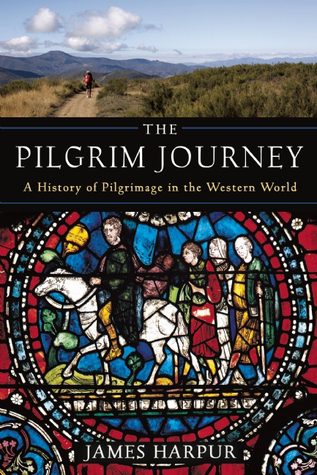 As soon as I saw the cover of James Harpur’s new book, The Pilgrim Journey: A History of Pilgrimage, I knew I was going to like it. At its top is a picture of a lone hiker striding across a beautiful landscape; below is a stained glass depiction of a group of pilgrims. The two images sum up the themes of the book. Whether a seeker sets out alone on a deserted trail, or travels in the company of like-minded souls, pilgrimage is a combination of an inner and outer journey that can lead to life-changing insights.
Harpur is a Cambridge-educated author whose works include The Atlas of Sacred Places. In his newest book he writes primarily about Christian pilgrimage, but his book touches upon many universal spiritual themes.
Harpur begins by speculating that we are in a new age of pilgrimage, which is more popular today than it has been at any time since the Middle Ages. While commitment to organized religion is declining in many countries, a growing number of people are seeking on the road what they cannot find in churches, mosques, temples, and synagogues.
The Pilgrim Journey traces the history of why countless people through the ages have set out on these spiritual trips. Especially in the early days of pilgrimage, one had to be a little crazy even to consider such a journey, given the dangers of travel in the ancient world.
Harpur writes that the first pilgrims associated with the Christian faith were the Magi, the Three Wise Men who came from the East to worship the baby Jesus. Their story contains the classic elements of a pilgrimage. There was a long journey, in their case from what was likely Persia. They brought an offering (gold, incense, and myrrh), as many pilgrims do. Most of all, they traveled in search of an encounter with holiness.
Modern pilgrims don’t travel with gold, incense, and myrrh, but there are many similarities to this first pilgrimage, nevertheless.
Writes Harpur: “A pilgrimage … traditionally has a number of recognized stages: preparation, including putting one’s affairs in order before departing and acquiring the right traveling clothes and accessories; the journey itself; the arrival, accompanied by sacred rituals (such as saying prayers and lighting a candle); the return journey; and reintegration into the world the pilgrim had left behind.”
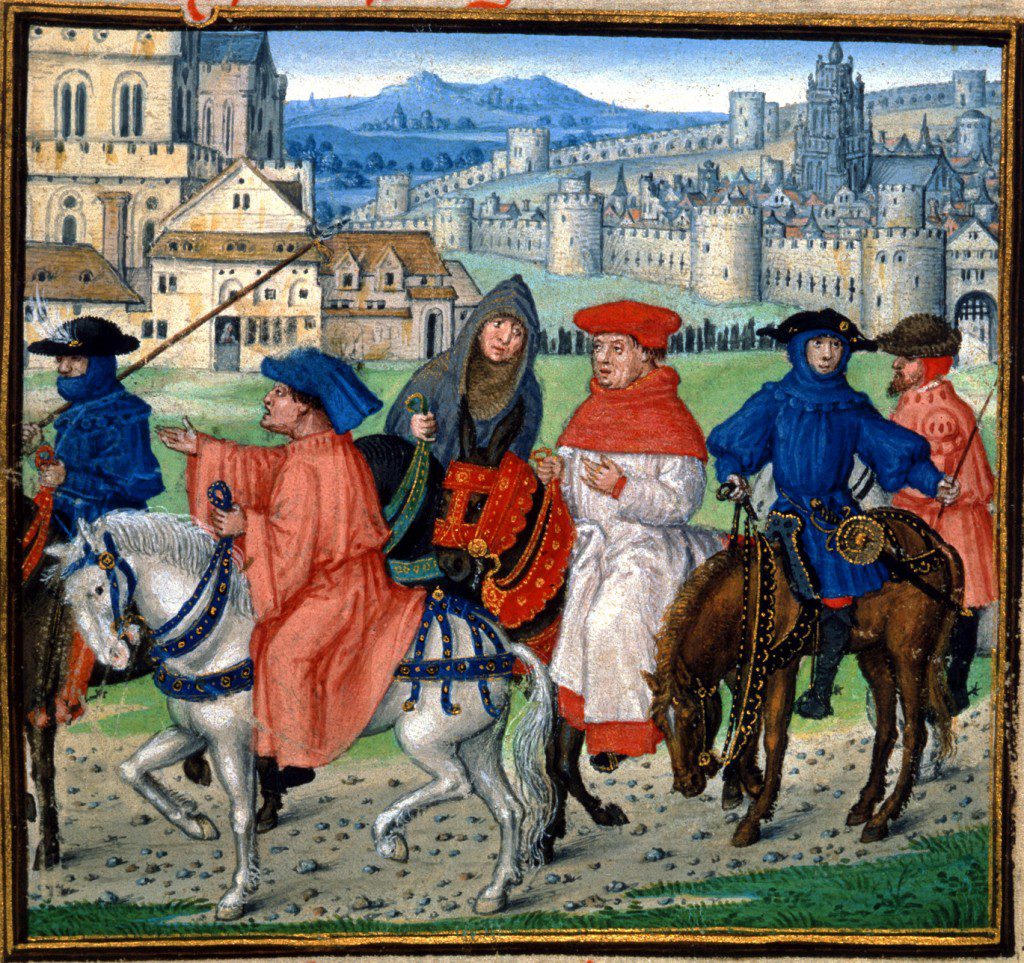
Medieval pilgrims traveling to Canterbury in England (WIkimedia Commons image)
The Pilgrim Journey weaves together stories from many time periods and places. We learn about shrines ranging from the basilicas of Our Lady of Guadalupe in Mexico and Sainte-Anne-de-Beaupre in Canada to Croagh Patrick in Ireland.
I was pleased that I was already familiar with many of the places Harpur describes. But I also learned new things. Harpur’s description of the rigors of pilgrimage in the Middle Ages was particularly interesting to me. After the Roman Empire disintegrated, roads fell into disrepair and crime increased. Travel became far harder. A typical journey from London to Rome could take several months.
Because journeys were so dangerous, pilgrims would put their affairs in order before they left: paying debts, drawing up wills, and making provisions for dependents. They would be blessed by a priest and anointed with holy water. If they died on the trip, they were ready to meet their maker.
The rigors and dangers of the road included robbers, rivers that were crossed on fragile ferries, high mountain passes, ship passages plagued by seasickness and shipwrecks, and staying in inns that were riddled with vermin, lice, and bedbugs. Anyone who’s ever complained about hotel accommodations on a tour should read his description of what it was like to travel in the Middle Ages.
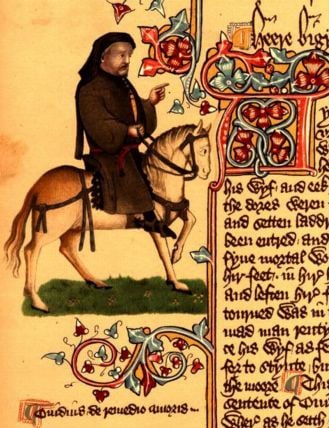
Chaucer, author of the Canterbury Tales, is shown here as a pilgrim (Image from the Ellesmere manuscript via Wikimedia Commons)
The popularity of pilgrimage has waxed and waned through the centuries, according to Harpur. It flourished in the Middle Ages, then declined during the Reformation and the Age of Enlightenment. But pilgrimage never completely disappeared. One way in which it continued was in the tradition of the Grand Tour through Europe, a popular pastime of the wealthy in the eighteenth and nineteenth centuries. These tours had many elements of pilgrimage, though they were not explicitly spiritual.
Most intriguing to me is Harpur’s assertion that we are now in a new era of pilgrimage. Why is pilgrimage coming back, especially in an age when many are questioning traditional religion? There seems to be a deep longing in humans for this form of spiritual practice. We often set out not knowing where we need to go, only that our souls need the journey.
Writes Harpur: “What is essential is that the journey, by whatever means it is accomplished, gives the pilgrim enough time to expose himself or herself to the possibility of a sacred metamorphosis. If that is done, the destination—a shrine, a holy mountain, or a house of God—will signify not the end of the journey, but the start: a gateway into a new way of being, of seeing life afresh with spiritually cleansed eyes.”
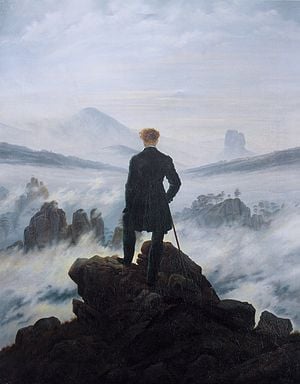
Caspar David Friedrich, Wanderer above the Sea of Fog (Wikimedia Commons Image)
The Pilgrim Journey is a helpful volume for anyone interested in spiritual travels. You’re likely to get tips for your own journeys of the heart—and you’re certainly going to be grateful that we live in an age when this type of travel is far easier than it’s ever been.
On a personal note, let me end with news about my own writing on pilgrimage. I’m happy to say that the memoir I’ve been working on for the past year will be published in 2017 by Fortress Press. Its working title is Holy Rover: A Pilgrim’s Progress Through a Dozen Holy Sites Around the World. Faithful readers of this blog will recognize parts of it, but much of it will be new to you. It includes Vikings in search of expensive souvenirs, Hidden People in Iceland, a reincarnation of Hildegard of Bingen, and lots of references to the Virgin Mary. And bears. Can’t forget to mention the bears.
My own book on pilgrimage is much more personal than Harpur’s. But we ask many of the same questions relating to the intertwining of travel and spirituality, faith and doubt, tradition and mysticism. Reading his book has given me new insights into one of the oldest of spiritual practices, ancient but still vibrant.
Stay in touch! Like Holy Rover on Facebook:

Next Post

July 18, 2016 Learning From Aging
Browse Our Archives
Select a Category Aging & Spirituality Amish Anabaptists Animals Apocalypse Archeological sites Art and Spirituality Awards Belgian Holy Sites birds Blessings Books Buddhism Business & Spirituality Callings Cats Celtic Cemeteries Children Christianity church Colorado Creation Death Desert Spirituality Easter Economics Education & Spirituality Egypt Episcopal Church Faith Fear Films First Nations Food Forgiveness Germany God Good & Evil Good Friday Grace Gratitude Happiness Healing Hildegard of Bingen Hinduism History Holy Rover blog Holy Sites Holy Week Horses Iceland Illness Images of God Indigenous Spiritualilty Interfaith Interfaith Dialogue Iowa Islam Israel Japan Judaism LDS Church Lent Machu Picchu Martin Luther Media Meditation Monasteries Museums Music Music and Spirituality Musings Mysticism Native American Nature New Age New Zealand Norse History/Culture/Spirituality Orthodox Paradox Paranormal Peru Philosophy Pilgrimage Poetry Politics Pop Culture Pilgrimage Sites Prayers sermons Silence Social Media Spiritual writers Spirituality and Food Spirituality and Social Media Stone Circles Thomas Merton Turkey Uncategorized Unconventional Holy Sites Utopian communities Videos Virgin Mary Wicca Work World War I Writing Zen
Select a Month August 2017 July 2017 June 2017 May 2017 April 2017 March 2017 February 2017 December 2016 November 2016 October 2016 September 2016 August 2016 July 2016 June 2016 May 2016 April 2016 March 2016 February 2016 January 2016 December 2015 July 2015 June 2015 May 2015 April 2015 March 2015 February 2015 January 2015 December 2014 November 2014 October 2014 September 2014 August 2014 July 2014 June 2014 May 2014 April 2014 March 2014 February 2014 January 2014 December 2013 October 2013 September 2013 August 2013 July 2013 June 2013 May 2013 April 2013 March 2013 February 2013 January 2013 December 2012 November 2012 October 2012 September 2012 August 2012 July 2012 June 2012 May 2012 April 2012 March 2012 February 2012 January 2012 December 2011 November 2011 October 2011 September 2011 August 2011 July 2011 June 2011 May 2011 April 2011 March 2011 February 2011 January 2011 December 2010 November 2010
Follow Us!
TAKE THE
Religious Wisdom Quiz
What was the disciple Luke's profession?
Select your answer to see how you score.
Fisherman Tentmaker Physician Carpenter
Related posts from Holy Rover

Announcing Holy-Rover-the-Book


TRENDING AT PATHEOS New Visions

Did Prayer Cure His Cancer? Or Was It...
At 4 AM one morning, Joshua W. Brown’s wife awoke to a...

8 Ways a Near-Death Experience Rewires the Soul
Does Consciousness Survive Physical Death? After 50 Years of Research, Dr. Raymond...

Holy Longing: What Our Restlessness Is Telling Us
“One can find so many pains when the rain is falling.” -John...

What this is NOT about. This blog is definitely not about...

Who said the Israelites were God’s chosen? That’s right, they did. Who...

The Spirit World Is the Real World: God...
A Monk’s Wisdom on Body and Spirit I sit with Brother Martin...
view all New Visions blogs
Ad-Free & Subscriber Log-In Subscription Support
- About Us
- 2026 Calendar
- Videos
- Podcasts
- Library of World Religions
- Faith In Media Tracker
- Advertise With Us
- Write for Us
- Privacy Policy
- Terms of Service
- Do Not Sell My Data
- Contact Us
- Radiant Digital
- Manage Newsletter Subscriptions
- Unsubscribe From Notifications
- Sitemap
Copyright 2008-2026, Patheos. All rights reserved.
Subscription Support Ad-Free & Subscriber Log-In
Follow Patheos