
BuddhistCatholicContemplativeEvangelicalGeneral ChristianHinduJewishLatter-day SaintMuslimNew VisionsProgressive Christian
Beliefs
- Buddhist
- Catholic
- Contemplative
- Evangelical
- General Christian
- Hindu
- Jewish
- Latter-day Saint
- More Voices
- Muslim
- New Visions
- Pagan
- Progressive Christian
Topics
- Religion News
- Food and Religion
- Sports and Religion
- Religious Art
- Religious Music and Entertainment
- Religious Events
- History and Religion
- Style and Religion
- Politics and Religion
- Women in Religion
- Recreation Outdoors and Religion
- Business Finance and Religion
- Careers Workplace and Religion
- Education and Religion
- Family Parenting and Religion
- Health Fitness and Religion
- Home and Religion
- Relationships and Religion
- Technology and Religion
- Travel and Religion
Columnists
- Buddhist Columnists
- Business Finance and Religion Columnists
- Careers Workplace and Religion Columnists
- Catholic Columnists
- Contemplative Columnists
- Education and Religion Columnists
- Evangelists Columnists
- Family Parenting and Religion Columnists
- General Christian Columnists
- Health Fitness and Religion Columnists
- Hindu Columnists
- History and Religion Columnists
- Home and Religion Columnists
- Jewish Columnists
- More Voices Columnists
- Latter Day Columnists
- Muslim Columnists
- New Visions Columnists
- Nonreligious Columnists
- Pagan Columnists
- Politics and Religion Columnists
- Progressive Columnists
- Recreation Outdoors and Religion Columnists
- Relationships and Religion Columnists
- Religion News Columnists
- Religious Art Columnists
- Religious Events Columnists
- Religious Music and Entertainment Columnists
- Sports and Religion Columnists
- Style and Religion Columnists
- Technology and Religion Columnists
- Travel and Religion Columnists
- Women in Religion Columnists
Resource Library
- 2026 Calendar
- Library of World Religions
- The 100 Most Holy Places on Earth
- Patheos Answers
- Podcasts
- Videos
- Faith Leaders Database
- Anglican Episcopalian
- Bahai
- Baptist
- Buddhism
- Christianity
- Confucianism
- Eastern Orthodoxy
- Hinduism
- Holiness and Pentecostal
- ISKCON
- Islam
- Judaism
- Lutheran
- Methodist
- The Church of Jesus Christ of Latter-day Saints
- New Age
- Paganism
- Presbytarian and Reformed
- Protestantism
- Religion Behind the Scenes
- Roman Catholic
- Scientology
- Shia Islam
- Sikhism
- Sufism
- Sunni Islam
- Taoism
- Zen
- See all religions
Research Tools
 Ad-Free & Subscriber Log-In Subscription Support
Ad-Free & Subscriber Log-In Subscription Support
Follow Patheos 

- Trending:
- Forgiveness
- |
- Marriage
- |
- Consciousness
- |
- Death Penalty
- |
- Election
- |
- Halloween
 Holy Rover
- Home
- New Visions
- Learning from the Pueblo Indians of New Mexico
Learning from the Pueblo Indians of New Mexico
Last updated on: June 17, 2016 at 9:17 am by Lori Erickson
Learning from the Pueblo Indians of New Mexico 2016-06-17T09:17:36-06:00 Lori Erickson
Patheos Explore the world's faith through different perspectives on religion and spirituality! Patheos has the views of the prevalent religions and spiritualities of the world.
For years my long-standing interest in Native American cultures had a large gap: the Pueblo Indians of the Southwest. Our recent trip to New Mexico enlightened some of that ignorance, thanks to two sites that I’ll describe today.
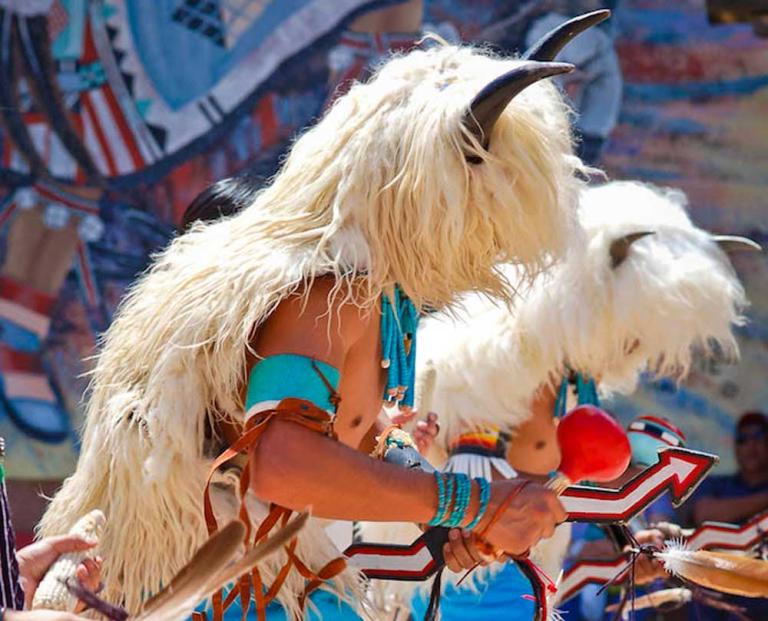
Albuquerque’s Indian Pueblo Cultural Center has traditional dancing each Saturday and Sunday. (Photo used with permission of IPCC.)
The first is the Indian Pueblo Cultural Center, which was founded in 1976 by the 19 pueblos of New Mexico. There I learned that while these Indians have considerable diversity in their languages and customs, they have a common name given to them by the Spaniards. In the 16th century, these indigenous groups lived in settlements made of adobe and divided into apartments with numerous rooms. Many of these dwelling places were located on top of mesas, the high table lands that rise from the desert floor of the Southwest. The Spanish word for “town” was used to describe these settlements, and the name has been used to describe the various tribes ever since.
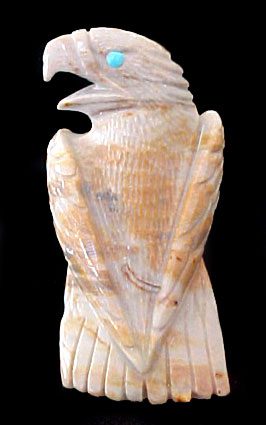
A Zuni Eagle Fetish (WIkimedia Commons image)
While their ancestors were nomadic, over the centuries most Puebloans had become farmers, growing corn, squash and beans as well as other crops. They also became skilled potters and basketweavers, traditions which continue to this day.
The Indian Pueblo Cultural Center’s exhibits begin with a description of the origin story of these cultures. Long ago, their ancestors lived in a series of underworlds below the earth. With the help of the Spirits, these people eventually emerged into the current world, founding communities that include Mesa Verde and Chaco Canyon. Their lives were cyclical, based around a seasonal calendar of planting, harvesting, dances, and ceremonies. To this day the Pueblo Indians believe that ancestral Spirits continue to guide them and that their land is full of sacred mountains, rivers, and cliffs.
Another exhibit gave information on the role of fetishes in Pueblo culture. These small, symbolic objects guide hunters, protect individuals and communities, promote healing, and bring rain and fertility to the land. Certain animals are associated with each of the directions: eagle for the sky, mole for the earth below, mountain lion in the north, badger in the south, wolf in the east, and bear in the west.
As we toured the center, I was especially interested to learn about the ways in which these traditional beliefs are intertwined with Catholicism.
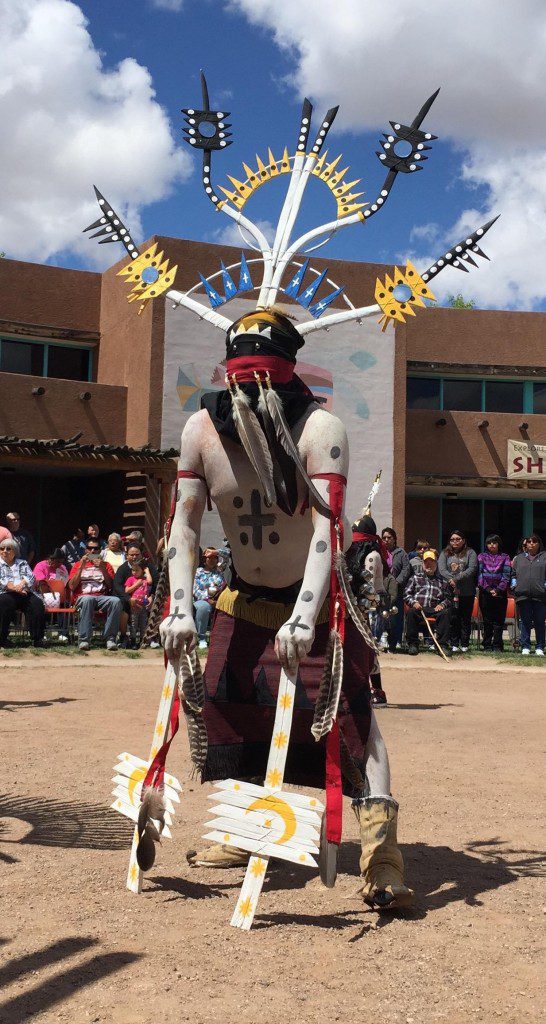
A White Mountain Apache Crown Dancer (Bob Sessions photo)
The Franciscan fathers who came to this region in the 16th and 17th centuries chose a patron saint for each pueblo, one whose feast day coincided with the people’s existing traditional ceremonies. These saints continue to be honored during annual feast days at each pueblo. The celebrations include traditional dancing, singing, drumming, and feasting, along with a Catholic mass and processions through the streets. While these events are often open to the public, private ceremonies are still held in kivas (underground ceremonial chambers).
According to the center’s exhibits, many Puebloans believe that their adoption of the Catholic faith was not an unwelcome addition, but rather an enhancement of the spiritual traditions they had long followed. The contemporary Pueblos often view the two faiths as joined, linked by the common good of each and by a deep, prayerful connection.
Here’s a quote from one of the displays: “When asked why the Pueblos maintain Catholicism despite all of the hardship suffered under the Spanish, one Rio Grande Pueblo woman responded: ‘How old does something have to be before it’s your own traditional instead of ‘borrowed?” We’ve had the Catholic way for a long time; isn’t it our way by now?”
One of the ways in which the old traditions are kept alive is in native dances, which are held at the center each weekend. You can also have a meal at its Pueblo Harvest Cafe, which serves Native fusion cuisine that combines traditional Pueblo ingredients and flavors with contemporary cooking.
On our visit, I was very taken by the artwork on display, which included pottery, paintings, baskets, and jewelry. An artisans fair was being held in its central courtyard, and it was interesting to visit with the artists about their creations.
“Many of us incorporate spiritual symbols into our work,” a potter told me. “They may not be immediately obvious to others, but to us they have great meaning.”
My most vivid memory of our visit is an extraordinary performance done by the White Mountain Apache Crown Dancers. There was a haunting quality to their dancing, in part because of their unusual costumes. As you can see from the photo above, the men’s faces were hidden by black cloths, making them look not quite human. White paint covered their bodies, contributing to the ghost-like element. As they danced, they seemed to be channeling something other-worldly.
The second attraction we visited in the Albuquerque area was Acoma Pueblo Sky City, located 65 miles west of Albuquerque. Here we got the chance to see a place where the Puebloan culture is a living tradition.
The physical setting of the Acoma Pueblo is amazing: it is built atop a mesa nearly 370 feet above the desert floor.
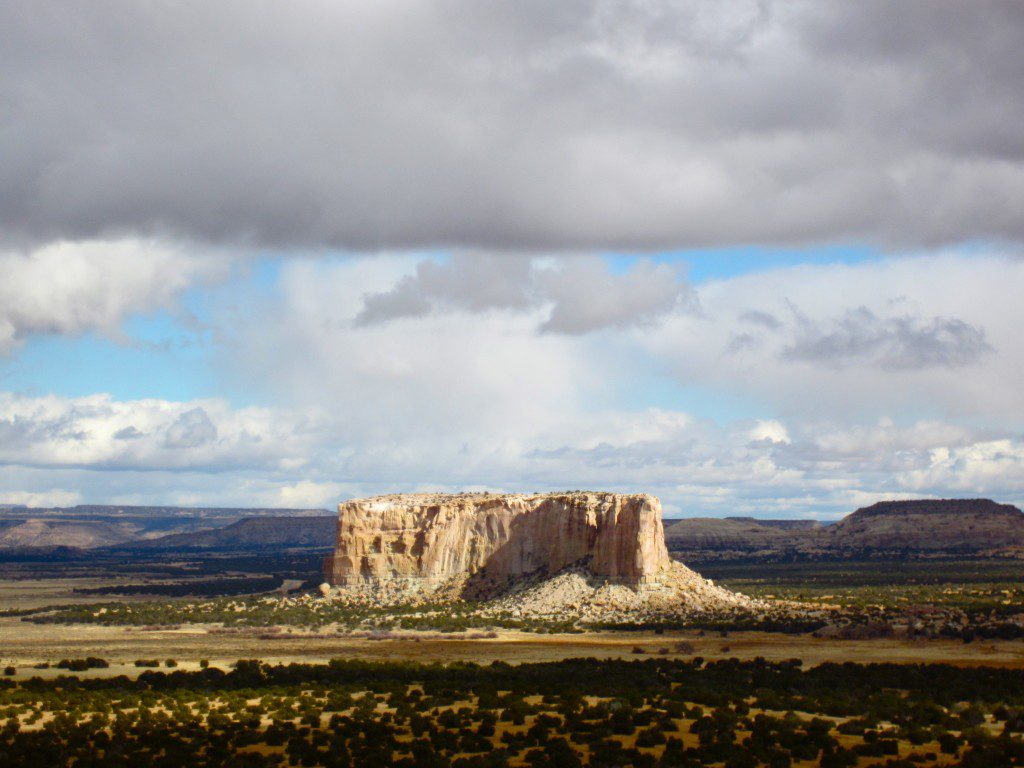
Acoma Pueblo is located atop a tall mesa west of Albuquerque. (photo by Sky City Cultural Center)
After taking a bus up a steep hill to the top, we were led by a guide on a walking tour among the adobe and sandstone homes of the pueblo. People have been living at Acoma Pueblo since approximately 1100 A. D., making this one of the oldest continuously inhabited communities in North America. Our guide told us that for many centuries, the only way the pueblo could be reached was by a nearly vertical set of stairs cut into the rock.
After the Spaniards arrived, there was conflict and bloodshed, as well as diseases spread by the invaders. The rainwater basins on the mesa were contaminated by their horses and are unusable to this day.
Our guide, who had spent a good part of her childhood in the pueblo, explained that the homes are owned by Acoma Pueblo women. When an owner dies, the home is traditionally given to the youngest daughter of a family, as she is the one who is most likely to remain at home caring for the elders and keeping the cultural traditions alive.
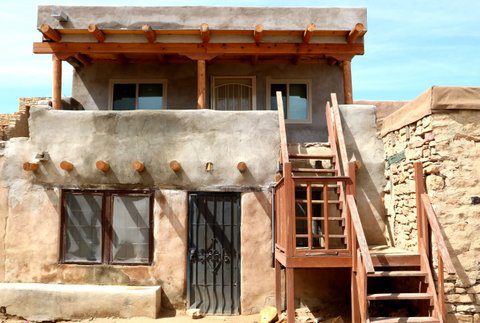
An adobe home in the Acoma Pueblo (Bob Sessions photo)
Today the community has about 40 people who live here year-round, but additional relatives come for ceremonial occasions. The residents support themselves by selling handcrafts, including intricately detailed pottery.
Our tour ended at the San Esteban del Rey Mission, which was built between 1629-1640. After the Spaniards brought Christianity to this region of the country, mission churches like this one were built in each of the pueblos.
Our guide pointed out a hole in the fence that surrounds the church’s cemetery. “Several of our children were stolen by the Spaniards and taken away,” she said. “They never came back to us in life, but the gap in the fence was made so that their spirits could return here after death.”
I’ll long remember standing on that windswept plateau, a place where the spirits of many centuries seem to linger.
Stay in touch! Like Holy Rover on Facebook:
Previous Post

June 7, 2016
With the Bear Woman at the Gathering of Nations
Next Post
June 23, 2016 The Holy Dirt of Chimayo, New Mexico
Browse Our Archives
Select a Category Aging & Spirituality Amish Anabaptists Animals Apocalypse Archeological sites Art and Spirituality Awards Belgian Holy Sites birds Blessings Books Buddhism Business & Spirituality Callings Cats Celtic Cemeteries Children Christianity church Colorado Creation Death Desert Spirituality Easter Economics Education & Spirituality Egypt Episcopal Church Faith Fear Films First Nations Food Forgiveness Germany God Good & Evil Good Friday Grace Gratitude Happiness Healing Hildegard of Bingen Hinduism History Holy Rover blog Holy Sites Holy Week Horses Iceland Illness Images of God Indigenous Spiritualilty Interfaith Interfaith Dialogue Iowa Islam Israel Japan Judaism LDS Church Lent Machu Picchu Martin Luther Media Meditation Monasteries Museums Music Music and Spirituality Musings Mysticism Native American Nature New Age New Zealand Norse History/Culture/Spirituality Orthodox Paradox Paranormal Peru Philosophy Pilgrimage Poetry Politics Pop Culture Pilgrimage Sites Prayers sermons Silence Social Media Spiritual writers Spirituality and Food Spirituality and Social Media Stone Circles Thomas Merton Turkey Uncategorized Unconventional Holy Sites Utopian communities Videos Virgin Mary Wicca Work World War I Writing Zen
Select a Month August 2017 July 2017 June 2017 May 2017 April 2017 March 2017 February 2017 December 2016 November 2016 October 2016 September 2016 August 2016 July 2016 June 2016 May 2016 April 2016 March 2016 February 2016 January 2016 December 2015 July 2015 June 2015 May 2015 April 2015 March 2015 February 2015 January 2015 December 2014 November 2014 October 2014 September 2014 August 2014 July 2014 June 2014 May 2014 April 2014 March 2014 February 2014 January 2014 December 2013 October 2013 September 2013 August 2013 July 2013 June 2013 May 2013 April 2013 March 2013 February 2013 January 2013 December 2012 November 2012 October 2012 September 2012 August 2012 July 2012 June 2012 May 2012 April 2012 March 2012 February 2012 January 2012 December 2011 November 2011 October 2011 September 2011 August 2011 July 2011 June 2011 May 2011 April 2011 March 2011 February 2011 January 2011 December 2010 November 2010
Follow Us!
TAKE THE
Religious Wisdom Quiz
Which disciple of Jesus was a former zealot?
Select your answer to see how you score.
Judas Iscariot Bartholomew Thaddeus Simon
Related posts from Holy Rover
The Spiritual Side of Michigan's Mackinac Island
With the Bear Woman at the Gathering of...
In Search of the Holy at Wyoming's Medicine...
TRENDING AT PATHEOS New Visions

Did Prayer Cure His Cancer? Or Was It...
At 4 AM one morning, Joshua W. Brown’s wife awoke to a...

8 Ways a Near-Death Experience Rewires the Soul
Does Consciousness Survive Physical Death? After 50 Years of Research, Dr. Raymond...

Holy Longing: What Our Restlessness Is Telling Us
“One can find so many pains when the rain is falling.” -John...

What this is NOT about. This blog is definitely not about...

Who said the Israelites were God’s chosen? That’s right, they did. Who...

The Spirit World Is the Real World: God...
A Monk’s Wisdom on Body and Spirit I sit with Brother Martin...
view all New Visions blogs
Ad-Free & Subscriber Log-In Subscription Support
- About Us
- 2026 Calendar
- Videos
- Podcasts
- Library of World Religions
- Faith In Media Tracker
- Advertise With Us
- Write for Us
- Privacy Policy
- Terms of Service
- Do Not Sell My Data
- Contact Us
- Radiant Digital
- Manage Newsletter Subscriptions
- Unsubscribe From Notifications
- Sitemap
Copyright 2008-2026, Patheos. All rights reserved.
Subscription Support Ad-Free & Subscriber Log-In
Follow Patheos