
BuddhistCatholicContemplativeEvangelicalGeneral ChristianHinduJewishLatter-day SaintMuslimNew VisionsProgressive Christian
Beliefs
- Buddhist
- Catholic
- Contemplative
- Evangelical
- General Christian
- Hindu
- Jewish
- Latter-day Saint
- More Voices
- Muslim
- New Visions
- Pagan
- Progressive Christian
Topics
- Religion News
- Food and Religion
- Sports and Religion
- Religious Art
- Religious Music and Entertainment
- Religious Events
- History and Religion
- Style and Religion
- Politics and Religion
- Women in Religion
- Recreation Outdoors and Religion
- Business Finance and Religion
- Careers Workplace and Religion
- Education and Religion
- Family Parenting and Religion
- Health Fitness and Religion
- Home and Religion
- Relationships and Religion
- Technology and Religion
- Travel and Religion
Columnists
- Buddhist Columnists
- Business Finance and Religion Columnists
- Careers Workplace and Religion Columnists
- Catholic Columnists
- Contemplative Columnists
- Education and Religion Columnists
- Evangelists Columnists
- Family Parenting and Religion Columnists
- General Christian Columnists
- Health Fitness and Religion Columnists
- Hindu Columnists
- History and Religion Columnists
- Home and Religion Columnists
- Jewish Columnists
- More Voices Columnists
- Latter Day Columnists
- Muslim Columnists
- New Visions Columnists
- Nonreligious Columnists
- Pagan Columnists
- Politics and Religion Columnists
- Progressive Columnists
- Recreation Outdoors and Religion Columnists
- Relationships and Religion Columnists
- Religion News Columnists
- Religious Art Columnists
- Religious Events Columnists
- Religious Music and Entertainment Columnists
- Sports and Religion Columnists
- Style and Religion Columnists
- Technology and Religion Columnists
- Travel and Religion Columnists
- Women in Religion Columnists
Resource Library
- 2026 Calendar
- Library of World Religions
- The 100 Most Holy Places on Earth
- Patheos Answers
- Podcasts
- Videos
- Faith Leaders Database
- Anglican Episcopalian
- Bahai
- Baptist
- Buddhism
- Christianity
- Confucianism
- Eastern Orthodoxy
- Hinduism
- Holiness and Pentecostal
- ISKCON
- Islam
- Judaism
- Lutheran
- Methodist
- The Church of Jesus Christ of Latter-day Saints
- New Age
- Paganism
- Presbytarian and Reformed
- Protestantism
- Religion Behind the Scenes
- Roman Catholic
- Scientology
- Shia Islam
- Sikhism
- Sufism
- Sunni Islam
- Taoism
- Zen
- See all religions
Research Tools
 Ad-Free & Subscriber Log-In Subscription Support
Ad-Free & Subscriber Log-In Subscription Support
Follow Patheos 

- Trending:
- Forgiveness
- |
- Marriage
- |
- Consciousness
- |
- Death Penalty
- |
- Election
- |
- Halloween
 Holy Rover
- Home
- New Visions
- One of Religion’s Biggest, Scariest Words
One of Religion’s Biggest, Scariest Words
Last updated on: April 6, 2016 at 1:02 pm by Lori Erickson
One of Religion’s Biggest, Scariest Words 2016-04-06T13:02:49-06:00 Lori Erickson
Patheos Explore the world's faith through different perspectives on religion and spirituality! Patheos has the views of the prevalent religions and spiritualities of the world.
Apocalypse. The end of the world. The last great cataclysm.
It’s one of religion’s thorniest concepts. And it’s found in cultures throughout the world.
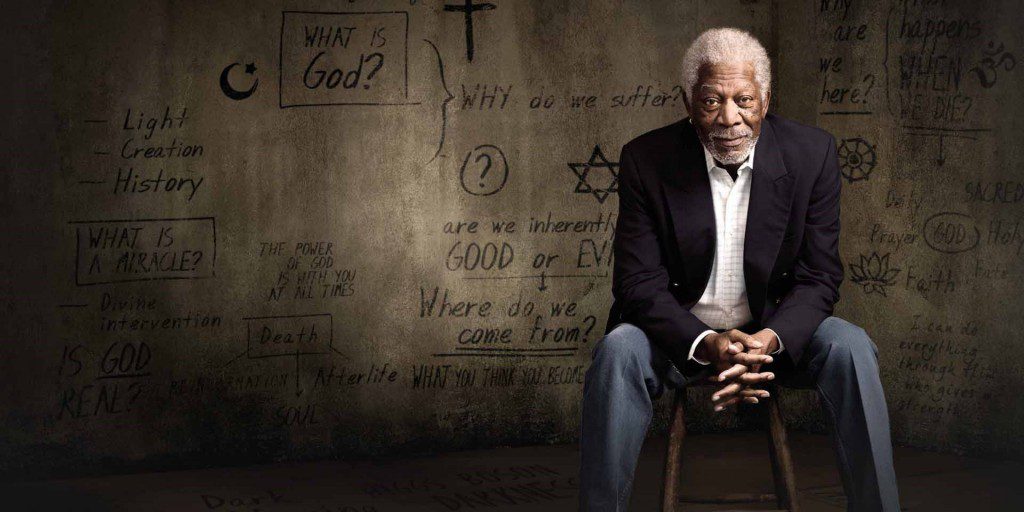
Morgan Freeman travels the world in The Story of God
I’ve been asked by National Geographic to be one of a number of bloggers responding to The Story of God with Morgan Freeman, which is currently playing on Sunday evenings on the National Geographic Channel. I’ve gotten an early screening of this coming Sunday’s episode Apocalypse.
In this episode Freeman travels to Jerusalem, to the Judean desert where the apocalyptic Essene Community lived in the first century A.D., and to a scientific lab where researchers are studying how people react to pain. He speaks with a former Islamist radical, a Tibetan lama, and survivors of Hurricane Katrina. It’s a compelling, thought-provoking program.
I consider myself pretty well-versed in religious matters, but the end-of-days wasn’t on my spiritual radar for a long time. I was raised a small-town Lutheran, and Apocalypse was something that other Christians worried about. There was a faint whiff of bad taste about it, in fact. It was the preoccupation of fire-and-brimstone preachers on TV and the uneducated.
But as an adult, I’ve come to learn that apocalyptic beliefs are more significant and ubiquitous that I’d realized. They’re present in various religions, of course, particularly Christianity and Islam. But I hear echoes of them in more secular settings as well, especially from friends who are filled with fear at threats that include environmental degradation, global warming, the spread of Ebola/Zika/Name-The-Terrifying-Disease, the rise of politicians they despise, etc. There are always many reasons to be terrified.
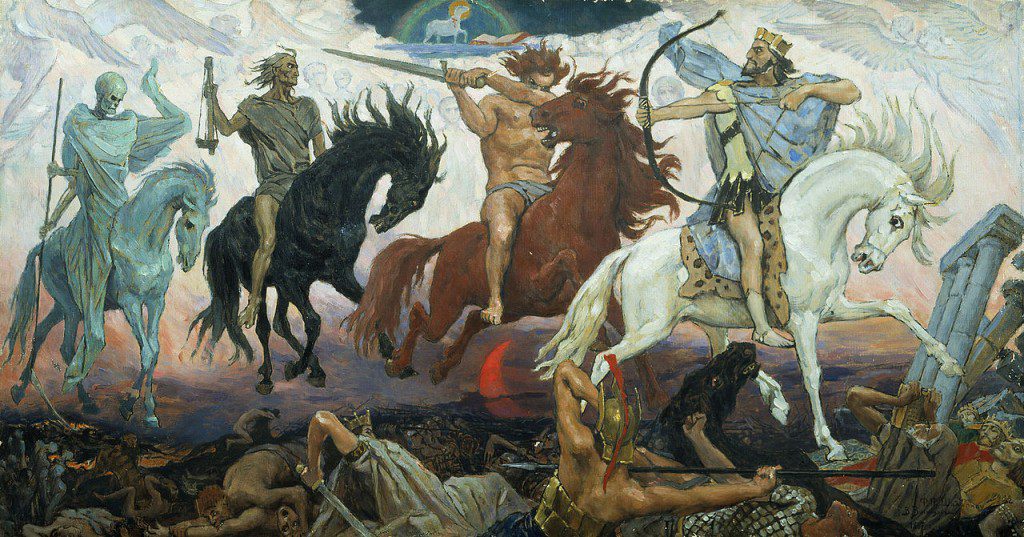
Four Horsemen of the Apocalypse by Viktor Vasnetsov (Wikimedia Commons image)
I’ve watched loved ones go through their own personal apocalypses, too, tragedies so great that they seemed almost Biblical in scope. Some of them were able to go on, and some weren’t. But even the survivors bear permanent scars.
So I think part of this universal human fascination with the end-of-days springs from the recognition that everything we have is at risk. It’s all temporary and vulnerable, a fact that becomes blindingly obvious when we are sleepless at 3 o’clock in the morning.
There’s something liberating, I recognize, about turning those fears into a grand cosmic drama. Your feeling of powerlessness can be lessened by thinking that this is all part of a divine plan that is being worked out on a global scale. If you’re a victim of injustice now, there will be retribution for those who are hurting you. Both religious and secular people find apocalypse a powerful way to make meaning out of chaos.
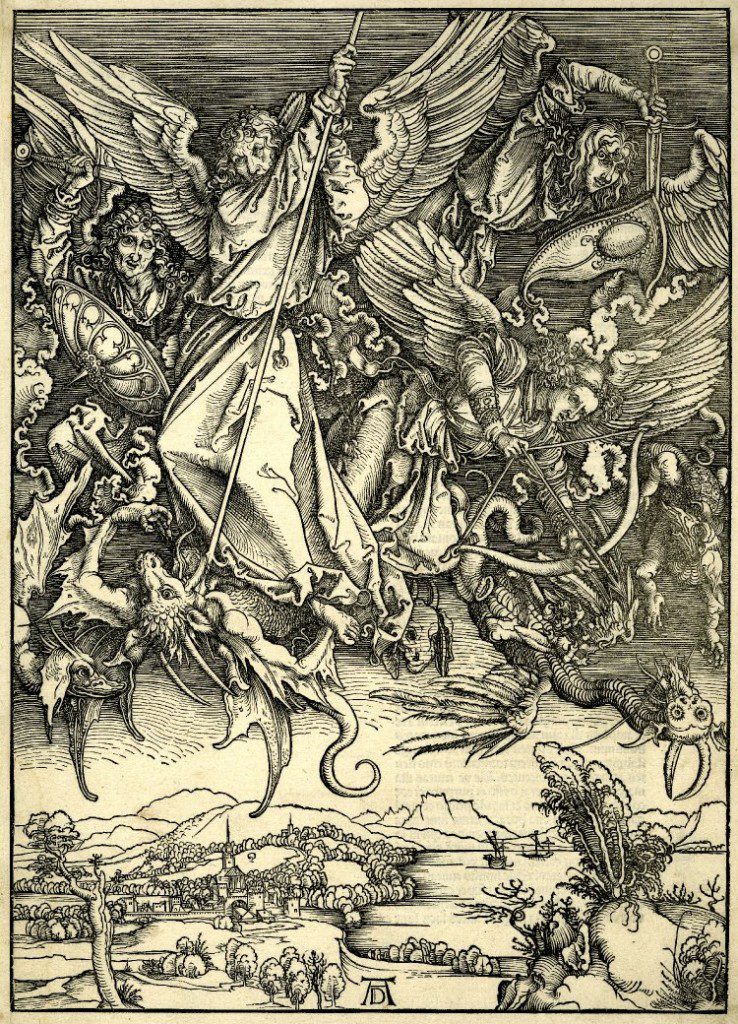
St Michael fighting the Dragon, from Albrecht Durer’s Apocalypse (Wikimedia Commons image)
I’ve been fortunate not to have gone through a personal apocalypse on the order of a Katrina, a major health crisis, or great suffering. But few of us get to our 50s without some scars. And so I have sympathy for those who try to put their trials in a larger context.
But for myself, the apocalyptic writings of Revelation, or the Book of Daniel, or the latest bestseller on how the world-is-going-to-hell-in-a-handbasket aren’t of much interest.
Though I’m a Christian, I’ve found the Buddhists to have the wisest perspective on these matters (a viewpoint that Morgan Freeman presents very well in the Apocalypse episode). There are profound lessons to be found in disintegration, failure, and sadness. We can approach the turmoil with curiosity, asking what it can teach us.
This process can awaken us to our true natures—for the word Buddhism comes from the Sanskrit budhi, which simply means to “wake up.”
“There is no end, only change,” says a Tibetan Buddhist teacher to Freeman.
In this there may be some connection with apocalypse after all. For the word apocalypse comes from a Greek word meaning “to lift the veil.” It doesn’t have to mean a violent end—instead it can mean a revelation of hidden truths.
And while that process can be life-changing, it doesn’t have to be terrifying.
Stay in touch! Like Holy Rover on Facebook:
Previous Post
March 30, 2016
Changing Climate, Observed From an Iowa Woodland
Next Post

April 7, 2016 Whad'ya Know? Not Much, How About You?
Browse Our Archives
Select a Category Aging & Spirituality Amish Anabaptists Animals Apocalypse Archeological sites Art and Spirituality Awards Belgian Holy Sites birds Blessings Books Buddhism Business & Spirituality Callings Cats Celtic Cemeteries Children Christianity church Colorado Creation Death Desert Spirituality Easter Economics Education & Spirituality Egypt Episcopal Church Faith Fear Films First Nations Food Forgiveness Germany God Good & Evil Good Friday Grace Gratitude Happiness Healing Hildegard of Bingen Hinduism History Holy Rover blog Holy Sites Holy Week Horses Iceland Illness Images of God Indigenous Spiritualilty Interfaith Interfaith Dialogue Iowa Islam Israel Japan Judaism LDS Church Lent Machu Picchu Martin Luther Media Meditation Monasteries Museums Music Music and Spirituality Musings Mysticism Native American Nature New Age New Zealand Norse History/Culture/Spirituality Orthodox Paradox Paranormal Peru Philosophy Pilgrimage Poetry Politics Pop Culture Pilgrimage Sites Prayers sermons Silence Social Media Spiritual writers Spirituality and Food Spirituality and Social Media Stone Circles Thomas Merton Turkey Uncategorized Unconventional Holy Sites Utopian communities Videos Virgin Mary Wicca Work World War I Writing Zen
Select a Month August 2017 July 2017 June 2017 May 2017 April 2017 March 2017 February 2017 December 2016 November 2016 October 2016 September 2016 August 2016 July 2016 June 2016 May 2016 April 2016 March 2016 February 2016 January 2016 December 2015 July 2015 June 2015 May 2015 April 2015 March 2015 February 2015 January 2015 December 2014 November 2014 October 2014 September 2014 August 2014 July 2014 June 2014 May 2014 April 2014 March 2014 February 2014 January 2014 December 2013 October 2013 September 2013 August 2013 July 2013 June 2013 May 2013 April 2013 March 2013 February 2013 January 2013 December 2012 November 2012 October 2012 September 2012 August 2012 July 2012 June 2012 May 2012 April 2012 March 2012 February 2012 January 2012 December 2011 November 2011 October 2011 September 2011 August 2011 July 2011 June 2011 May 2011 April 2011 March 2011 February 2011 January 2011 December 2010 November 2010
Follow Us!
TAKE THE
Religious Wisdom Quiz
According to Jesus, how should we treat our neighbor?
Select your answer to see how you score.
As ourselves With anger With suspicion Ignore them
Related posts from Holy Rover
An Unexpected Shrine in the Middle of the...
Our Lady of Guadalupe, At Last

'Tis a Gift to be Simple with the...
In Sedona With the Buddha and the Holy...
TRENDING AT PATHEOS New Visions

Did Prayer Cure His Cancer? Or Was It...
At 4 AM one morning, Joshua W. Brown’s wife awoke to a...

8 Ways a Near-Death Experience Rewires the Soul
Does Consciousness Survive Physical Death? After 50 Years of Research, Dr. Raymond...

Holy Longing: What Our Restlessness Is Telling Us
“One can find so many pains when the rain is falling.” -John...

What this is NOT about. This blog is definitely not about...

Who said the Israelites were God’s chosen? That’s right, they did. Who...

The Spirit World Is the Real World: God...
A Monk’s Wisdom on Body and Spirit I sit with Brother Martin...
view all New Visions blogs
Ad-Free & Subscriber Log-In Subscription Support
- About Us
- 2026 Calendar
- Videos
- Podcasts
- Library of World Religions
- Faith In Media Tracker
- Advertise With Us
- Write for Us
- Privacy Policy
- Terms of Service
- Do Not Sell My Data
- Contact Us
- Radiant Digital
- Manage Newsletter Subscriptions
- Unsubscribe From Notifications
- Sitemap
Copyright 2008-2026, Patheos. All rights reserved.
Subscription Support Ad-Free & Subscriber Log-In
Follow Patheos