
BuddhistCatholicContemplativeEvangelicalGeneral ChristianHinduJewishLatter-day SaintMuslimNew VisionsProgressive Christian
Beliefs
- Buddhist
- Catholic
- Contemplative
- Evangelical
- General Christian
- Hindu
- Jewish
- Latter-day Saint
- More Voices
- Muslim
- New Visions
- Pagan
- Progressive Christian
Topics
- Religion News
- Food and Religion
- Sports and Religion
- Religious Art
- Religious Music and Entertainment
- Religious Events
- History and Religion
- Style and Religion
- Politics and Religion
- Women in Religion
- Recreation Outdoors and Religion
- Business Finance and Religion
- Careers Workplace and Religion
- Education and Religion
- Family Parenting and Religion
- Health Fitness and Religion
- Home and Religion
- Relationships and Religion
- Technology and Religion
- Travel and Religion
Columnists
- Buddhist Columnists
- Business Finance and Religion Columnists
- Careers Workplace and Religion Columnists
- Catholic Columnists
- Contemplative Columnists
- Education and Religion Columnists
- Evangelists Columnists
- Family Parenting and Religion Columnists
- General Christian Columnists
- Health Fitness and Religion Columnists
- Hindu Columnists
- History and Religion Columnists
- Home and Religion Columnists
- Jewish Columnists
- More Voices Columnists
- Latter Day Columnists
- Muslim Columnists
- New Visions Columnists
- Nonreligious Columnists
- Pagan Columnists
- Politics and Religion Columnists
- Progressive Columnists
- Recreation Outdoors and Religion Columnists
- Relationships and Religion Columnists
- Religion News Columnists
- Religious Art Columnists
- Religious Events Columnists
- Religious Music and Entertainment Columnists
- Sports and Religion Columnists
- Style and Religion Columnists
- Technology and Religion Columnists
- Travel and Religion Columnists
- Women in Religion Columnists
Resource Library
- 2026 Calendar
- Library of World Religions
- The 100 Most Holy Places on Earth
- Patheos Answers
- Podcasts
- Videos
- Faith Leaders Database
- Anglican Episcopalian
- Bahai
- Baptist
- Buddhism
- Christianity
- Confucianism
- Eastern Orthodoxy
- Hinduism
- Holiness and Pentecostal
- ISKCON
- Islam
- Judaism
- Lutheran
- Methodist
- The Church of Jesus Christ of Latter-day Saints
- New Age
- Paganism
- Presbytarian and Reformed
- Protestantism
- Religion Behind the Scenes
- Roman Catholic
- Scientology
- Shia Islam
- Sikhism
- Sufism
- Sunni Islam
- Taoism
- Zen
- See all religions
Research Tools
 Ad-Free & Subscriber Log-In Subscription Support
Ad-Free & Subscriber Log-In Subscription Support
Follow Patheos 

- Trending:
- Forgiveness
- |
- Marriage
- |
- Consciousness
- |
- Death Penalty
- |
- Election
- |
- Halloween
 Holy Rover
- Home
- New Visions
- Where the Music Died (and Lives)
Where the Music Died (and Lives)
Last updated on: June 18, 2014 at 5:00 pm by Lori Erickson
Where the Music Died (and Lives) 2014-06-18T17:00:28-06:00 Lori Erickson
Patheos Explore the world's faith through different perspectives on religion and spirituality! Patheos has the views of the prevalent religions and spiritualities of the world.
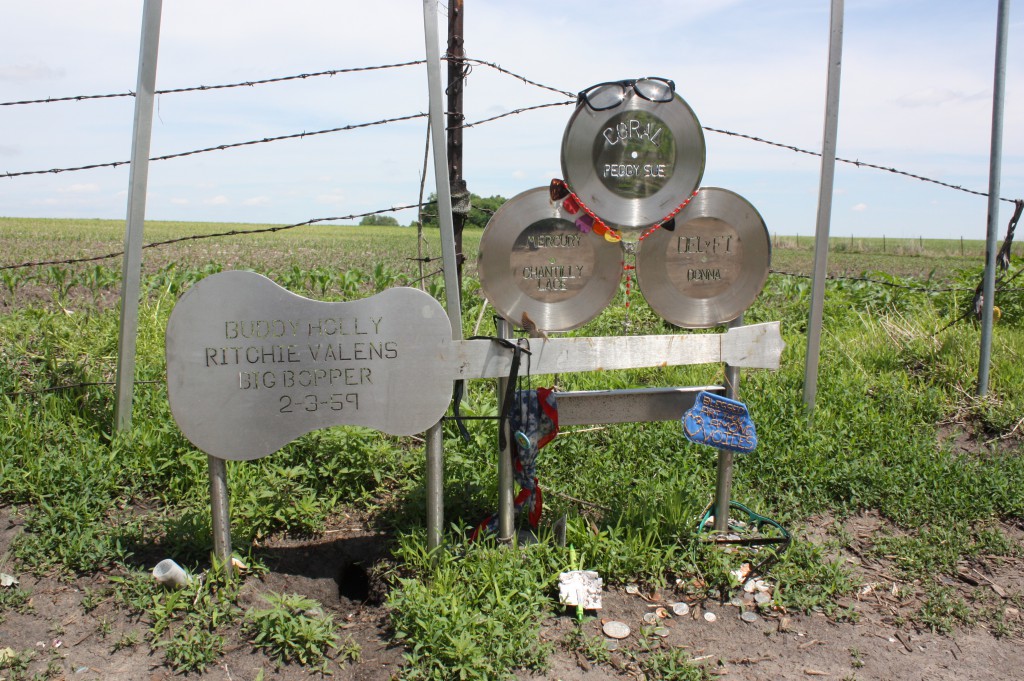
A farmer’s field near Clear Lake, Iowa, is the site of a memorial marking the place where Buddy Holly, Ritchie Valens, and J.P. Richardson died on February 3, 1959. (Bob Sessions photo)
It’s not the cheeriest of thoughts, but isn’t it interesting how many spiritual sites are connected with death? From the Church of the Holy Sepulcher in Jerusalem and Normandy Cemetery in France to the Gettysburg Battlefield in Pennsylvania, places associated with tragedy are often considered sacred.
On a recent trip to northern Iowa, I added another such site to my list, one that at first might seem an unlikely pilgrimage destination: the farmer’s field where Buddy Holly, Ritchie Valens and J.P. “The Big Bopper” Richardson were killed in a plane crash in 1959. If you’re of my vintage, you may know of this tragedy as “The Day the Music Died,” a phrase from the song “American Pie” by Don McLean (that melancholy song was part of the soundtrack of my generation’s teenage years, each line endlessly parsed for symbolic meaning.)
To be honest, it took me awhile to realize that this is a place of pilgrimage. But as I stood at the simple memorial, suddenly it clicked. I saw the offerings left on the ground. I realized I’d met pilgrims as I approached the site–a couple from Norman, Oklahoma, who had made a detour on a cross-country trip to pay their respects. I could see another group of visitors walking down the path. Yes, this is a pilgrimage site, all right–one that is connected not to religious faith, but instead is intertwined with music, memory and lost youth.

The path to the crash site is marked by a sculpture recalling Buddy Holly’s iconic eyeglasses. (Bob Sessions photo)
As with most pilgrimage sites, there’s a narrative that helps shape the meaning of this place, one that is told and retold by visitors. It begins the evening before the three musicians died, when they played a concert at the nearby Surf Ballroom in Clear Lake, Iowa. As rising stars in the new genre of rock ‘n roll, they drew a large and enthusiastic crowd at the Surf. Buddy Holly in particular was on the fast track to fame, thanks to a string of hits that included “Peggy Sue” and “That’ll Be the Day.”
That evening, Holly decided to book a small private plane to take him to the group’s next gig in North Dakota rather than travel by the drafty and cold tour bus. There was much discussion about the two other available seats. Waylon Jennings, a member of Holly’s band, was offered a spot, but he graciously gave it to Richardson, who had come down with the flu. The last seat was wanted by both band member Tommy Allsup and Ritchie Valens, so the two flipped a coin. Allsup lost the toss and won his life.
The plane went down soon after take-off, plunging into a farmer’s field. The three musicians and pilot, Roger Peterson, were killed instantly. And ever since pilgrims have been coming to this spot in the middle of rural Iowa. Marked with a metal memorial made in the shape of a guitar and three vinyl records, the site attracts one kind of offering more than any other: coins, given in recognition of the fateful toss.
It’s interesting to speculate on why this place continues to draw people from around the world. Part of it is simply that the musicians died young, at the height of their fame (Holly was 22, Valens was 17 and Richardson 28). Part of it is the way that their music helped define an entire era, in a way that music, segmented as it is today into so many different genres, no longer does. And part of it, I think, is that the tragedy makes one reflect on the passing of one’s own youth.
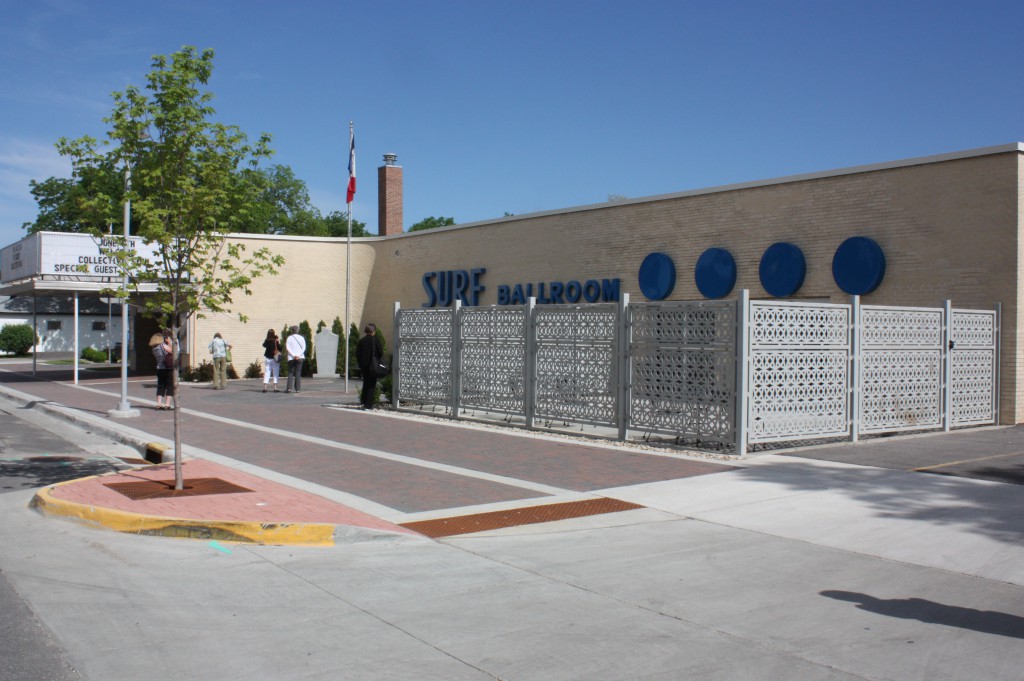
Clear Lake’s Surf Ballroom is one of the nation’s music landmarks. (Bob Sessions photo)
But if this is where the music died, I must also tell you about where the music lives. The Surf Ballroom–the site of the last concert of the three–is as much a pilgrimage destination as the crash site. If it wasn’t for the Buddy Holly connection it’s unlikely the Surf would have survived, but the fame brought by the last concert attracts a steady stream of patrons and musicians to its doors. The Rock and Roll Hall of Fame and Museum in Cleveland has designated the Surf a Rock and Roll Landmark. Travel + Leisure Magazine has named it as one of the Coolest Music Venues in America, an honor shared with Red Rocks Amphitheatre in Colorado and the Ryman Auditorium in Nashville.
“People come from around the world to honor the memory of those who died,” says Nicki Barragy, education coordinator for the ballroom and museum. “But the Surf is a living place as well, full of dances, concerts and events. That’s the best way to honor their legacy.”
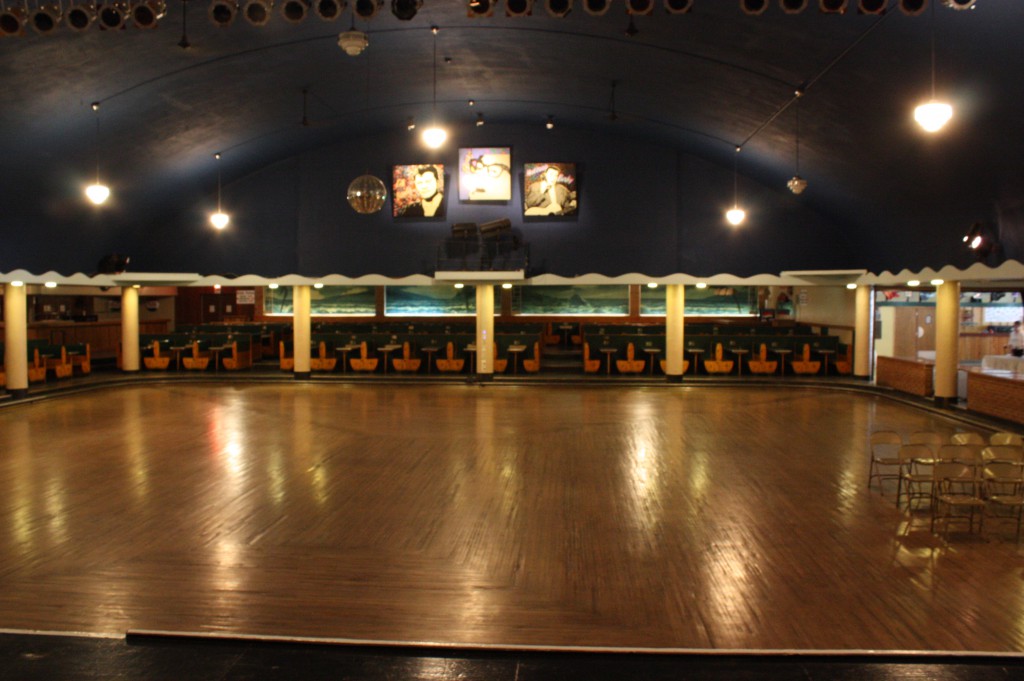
The Surf Ballroom has been restored to its 1950s glory. (Bob Sessions photo)
The original Surf opened in Clear Lake in 1934. After being destroyed by fire, it was rebuilt across the street in 1948, decorated in a tropical theme with murals of surf and palm trees and faux clouds projected on its midnight blue ceiling. Holding up to 2,100 people, the Surf has hosted many of the entertainment world’s top names, from Roy Orbison and the Everly Brothers to Martina McBride and B.B. King.
Today its 1950s interior, restored to pristine condition, is like a time machine, its hallways lined with publicity photos of guest artists from past decades. Musicians have also left their mark on the walls of the Surf’s dressing room, which is covered with hundreds of signatures (including a handwritten stanza of “American Pie” signed by McLean).
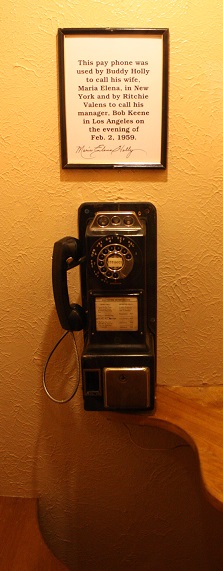
The Surf Ballroom preserves the phone booth where Buddy Holly and Ritchie Valens made their last phone calls. (Bob Sessions photo)
The Surf’s museum, located in a lounge adjacent to the main ballroom, gives information on the three musicians who lost their lives as well as other artists who have played here. Its memorabilia includes a briefcase used by J.P. Richardson and the handwritten lyrics to Ritchie’s “La Bamba.” Most poignant of all is the phone booth where Buddy Holly and Ritchie Valens made their final phone calls after finishing their concert.
When I visited the Surf I got the chance to talk with Margaret Majerczyk, a native of England who now lives in Iowa and who teaches dancing lessons at the Surf. She also helps host its international visitors, including many from her home country.
“The British Buddy Holly Society started in the early 1960s and has many members in England,” she says. “He was a huge influence there on younger musicians and on teenagers like myself, who grew up surrounded by rock ‘n roll music. We’ve had hundreds of members of the club visit over the years. One man has been here 31 years in a row.”
But while Majerczyk enjoys hosting her fellow Brits on their annual pilgrimage, her favorite event at the Surf happens much more frequently. “I like to watch older visitors come into the Surf,” she says. “As they come down the ramp into the ballroom, they often seem frail. But once they step onto the dance floor a transformation occurs and they’re gliding like they’re young again.”
I left the Surf in a contemplative mood. I thought of those coins left at the crash site and of how so much of what happens to us seems to be the result of random chance. I thought of those elderly couples dancing underneath the fake clouds and the benevolent gaze of Holly, Valens and Richardson, whose pictures overlook the ballroom. And I thought of how holy sites blossom in unexpected places, nurtured by the need we have to remember, to celebrate and to mourn, whether it’s someone we knew or someone who symbolizes part of our past that is gone forever.
On a happier note, let me end with Buddy Holly and Ritchie Valens, followed by Don McLean singing “American Pie.” For thankfully, it turns out that the music didn’t die after all.
The Surf Ballroom and Museum are open for self-guided tours daily during the summer months and Monday through Friday during the rest of the year, with occasional closures for special events. The most popular time to visit the Surf is during its annual Winter Dance Party, which is held on the weekend closest to the date of the fateful plane crash. In addition to concerts, the event typically includes a record show, family sock hop, dance lessons, and dance and costume contests.
The website also has directions to the memorial site where Buddy Holly, Ritchie Valens and J.P. “The Big Bopper” Richardson died. While it’s located on private land, visitors are welcomed.
crash site of Buddy Holly's death
J.P. the Big Bopper Richardson
Previous Post

June 6, 2014
In the Middle of Missouri, A Most Surprising Find
Next Post
June 25, 2014 Christ Has No Online Presence But Yours
Browse Our Archives
Select a Category Aging & Spirituality Amish Anabaptists Animals Apocalypse Archeological sites Art and Spirituality Awards Belgian Holy Sites birds Blessings Books Buddhism Business & Spirituality Callings Cats Celtic Cemeteries Children Christianity church Colorado Creation Death Desert Spirituality Easter Economics Education & Spirituality Egypt Episcopal Church Faith Fear Films First Nations Food Forgiveness Germany God Good & Evil Good Friday Grace Gratitude Happiness Healing Hildegard of Bingen Hinduism History Holy Rover blog Holy Sites Holy Week Horses Iceland Illness Images of God Indigenous Spiritualilty Interfaith Interfaith Dialogue Iowa Islam Israel Japan Judaism LDS Church Lent Machu Picchu Martin Luther Media Meditation Monasteries Museums Music Music and Spirituality Musings Mysticism Native American Nature New Age New Zealand Norse History/Culture/Spirituality Orthodox Paradox Paranormal Peru Philosophy Pilgrimage Poetry Politics Pop Culture Pilgrimage Sites Prayers sermons Silence Social Media Spiritual writers Spirituality and Food Spirituality and Social Media Stone Circles Thomas Merton Turkey Uncategorized Unconventional Holy Sites Utopian communities Videos Virgin Mary Wicca Work World War I Writing Zen
Select a Month August 2017 July 2017 June 2017 May 2017 April 2017 March 2017 February 2017 December 2016 November 2016 October 2016 September 2016 August 2016 July 2016 June 2016 May 2016 April 2016 March 2016 February 2016 January 2016 December 2015 July 2015 June 2015 May 2015 April 2015 March 2015 February 2015 January 2015 December 2014 November 2014 October 2014 September 2014 August 2014 July 2014 June 2014 May 2014 April 2014 March 2014 February 2014 January 2014 December 2013 October 2013 September 2013 August 2013 July 2013 June 2013 May 2013 April 2013 March 2013 February 2013 January 2013 December 2012 November 2012 October 2012 September 2012 August 2012 July 2012 June 2012 May 2012 April 2012 March 2012 February 2012 January 2012 December 2011 November 2011 October 2011 September 2011 August 2011 July 2011 June 2011 May 2011 April 2011 March 2011 February 2011 January 2011 December 2010 November 2010
Follow Us!
TAKE THE
Religious Wisdom Quiz
Who was Noah's father?
Select your answer to see how you score.
Abel Enoch Lamech Seth
Related posts from Holy Rover



TRENDING AT PATHEOS New Visions

Did Prayer Cure His Cancer? Or Was It...
At 4 AM one morning, Joshua W. Brown’s wife awoke to a...

8 Ways a Near-Death Experience Rewires the Soul
Does Consciousness Survive Physical Death? After 50 Years of Research, Dr. Raymond...

Holy Longing: What Our Restlessness Is Telling Us
“One can find so many pains when the rain is falling.” -John...

What this is NOT about. This blog is definitely not about...

Who said the Israelites were God’s chosen? That’s right, they did. Who...

The Spirit World Is the Real World: God...
A Monk’s Wisdom on Body and Spirit I sit with Brother Martin...
view all New Visions blogs
Ad-Free & Subscriber Log-In Subscription Support
- About Us
- 2026 Calendar
- Videos
- Podcasts
- Library of World Religions
- Faith In Media Tracker
- Advertise With Us
- Write for Us
- Privacy Policy
- Terms of Service
- Do Not Sell My Data
- Contact Us
- Radiant Digital
- Manage Newsletter Subscriptions
- Unsubscribe From Notifications
- Sitemap
Copyright 2008-2026, Patheos. All rights reserved.
Subscription Support Ad-Free & Subscriber Log-In
Follow Patheos