
BuddhistCatholicContemplativeEvangelicalGeneral ChristianHinduJewishLatter-day SaintMuslimNew VisionsProgressive Christian
Beliefs
- Buddhist
- Catholic
- Contemplative
- Evangelical
- General Christian
- Hindu
- Jewish
- Latter-day Saint
- More Voices
- Muslim
- New Visions
- Pagan
- Progressive Christian
Topics
- Religion News
- Food and Religion
- Sports and Religion
- Religious Art
- Religious Music and Entertainment
- Religious Events
- History and Religion
- Style and Religion
- Politics and Religion
- Women in Religion
- Recreation Outdoors and Religion
- Business Finance and Religion
- Careers Workplace and Religion
- Education and Religion
- Family Parenting and Religion
- Health Fitness and Religion
- Home and Religion
- Relationships and Religion
- Technology and Religion
- Travel and Religion
Columnists
- Buddhist Columnists
- Business Finance and Religion Columnists
- Careers Workplace and Religion Columnists
- Catholic Columnists
- Contemplative Columnists
- Education and Religion Columnists
- Evangelists Columnists
- Family Parenting and Religion Columnists
- General Christian Columnists
- Health Fitness and Religion Columnists
- Hindu Columnists
- History and Religion Columnists
- Home and Religion Columnists
- Jewish Columnists
- More Voices Columnists
- Latter Day Columnists
- Muslim Columnists
- New Visions Columnists
- Nonreligious Columnists
- Pagan Columnists
- Politics and Religion Columnists
- Progressive Columnists
- Recreation Outdoors and Religion Columnists
- Relationships and Religion Columnists
- Religion News Columnists
- Religious Art Columnists
- Religious Events Columnists
- Religious Music and Entertainment Columnists
- Sports and Religion Columnists
- Style and Religion Columnists
- Technology and Religion Columnists
- Travel and Religion Columnists
- Women in Religion Columnists
Resource Library
- 2026 Calendar
- Library of World Religions
- The 100 Most Holy Places on Earth
- Patheos Answers
- Podcasts
- Videos
- Faith Leaders Database
- Anglican Episcopalian
- Bahai
- Baptist
- Buddhism
- Christianity
- Confucianism
- Eastern Orthodoxy
- Hinduism
- Holiness and Pentecostal
- ISKCON
- Islam
- Judaism
- Lutheran
- Methodist
- The Church of Jesus Christ of Latter-day Saints
- New Age
- Paganism
- Presbytarian and Reformed
- Protestantism
- Religion Behind the Scenes
- Roman Catholic
- Scientology
- Shia Islam
- Sikhism
- Sufism
- Sunni Islam
- Taoism
- Zen
- See all religions
Research Tools
 Ad-Free & Subscriber Log-In Subscription Support
Ad-Free & Subscriber Log-In Subscription Support
Follow Patheos 

- Trending:
- Forgiveness
- |
- Marriage
- |
- Consciousness
- |
- Death Penalty
- |
- Election
- |
- Halloween
 Holy Rover
- Home
- New Visions
- With Hildegard in Bingen
With Hildegard in Bingen
Last updated on: January 28, 2014 at 11:34 pm by Lori Erickson
With Hildegard in Bingen 2014-01-28T23:34:43-06:00 Lori Erickson
Patheos Explore the world's faith through different perspectives on religion and spirituality! Patheos has the views of the prevalent religions and spiritualities of the world.
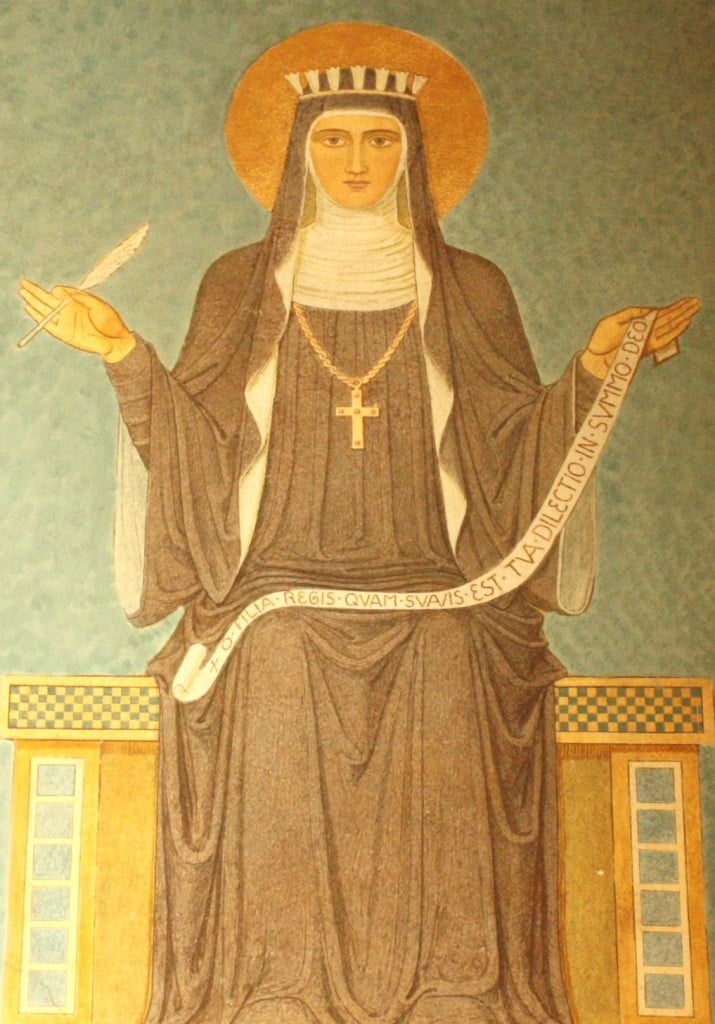
Mural of Hildegard from the Benedictine Abbey of St. Hildegard near Bingen (Bob Sessions photo)
Today we come to Bingen, Germany, home to one of the most remarkable women in history. If Hildegard of Bingen had a resume (unusual for a 12th-century mystic, I admit, but humor me) it would have been many pages long. She was an abbess, healer, writer, musician, visionary, counselor, preacher, linguist, naturalist, poet and an adviser to kings, bishops and princes. She wrote more than 70 liturgical songs, the first sung play, and books on theology, medicine, diet and natural history. All the while she kept up a voluminous correspondence with people in and out of the church, leading one scholar to dub her the “Dear Abby of the 12th century.”
If I could invite a handful of people from history for dinner at my house, Hildegard would be among them—though I suspect she would likely dominate the conversation so much that the other guests would be intimidated.
So when my son Carl decided to study in Belgium and I looked at a map and found that Bingen was a short train ride away, I was delighted (one indication of my enthusiasm for Hildegard is that I visited her before Carl).
As I wrote in my post On the Romantic Rhine, Bingen is located at the southern end of one of the most scenic stretches of the Rhine River. Hildegard’s life was tied to this beautiful valley–in fact, she was called “The Sybil of the Rhine” by later generations of admirers. Thus if you’re doing a Hildegard Tour, there’s no better way to arrive in Bingen than by boat from the north, for a slow journey through the gorgeous countryside helps explain Hildegard’s love for the natural world and her view of creation as holy.
If you’ve ever been tempted to complain about your childhood (and admit it—you have), consider the life of Hildegard. Born in 1098 as the tenth of ten children of a noble family, she was dedicated to the church by her parents at the tender age of eight, though she didn’t formally enter religious life until she was fourteen. As a young woman she went to live with her older cousin Jutta in a nun’s hermitage attached to a male Benedictine monastery at Disibodenberg.
Jutta seems to have been a pretty stern and ascetic sort, and one wonders how a bright spirit like Hildegard fared in such a constrained (at least by contemporary standards) atmosphere. The two lived quiet lives shaped by the rhythms of prayer, liturgy and Biblical study. While Hildegard didn’t have a formal education, the Benedictines had great respect for learning and she received instruction in natural history as well as religious matters, learning a rough-and-ready Latin that served her well in her later writings.

An image of Hildegard from St. Rochus Chapel in Bingen (Bob Sessions photo)
Hildegard grew into a most unusual woman, brilliant, charismatic and interested in a wide range of subjects that went far beyond the cloister. She was also sickly, suffering from periodic fevers, pain and fatigue. And she had a secret unknown to virtually everyone: she had been seeing extraordinary mystical visions from the time she was three.
At the age of 42, Hildegard’s quiet life changed forever when she received a divine command to share her visions with the world. “I am merely a too-sensitive, frail rib with mystical lungs, who saw a living, blazing fire that couldn’t be put out,” she wrote. “This Light said to me, ‘Shame-filled, earth-shod woman—untaught and unlettered—remember you’ve been illuminated by My light. It ignites in you an inner sun, burning with divine mysteries and secrets. Don’t be timid. Tell these. Although you’re hesitant to speak out, don’t be. Speak of the Fire this vision has shown you.’”
By this time Hildegard was the abbess of a small community of nuns that had formed at Disibodenberg. She spent the next ten years writing Scivias, a theological work that attempts to explain the fiery images she had received. With characteristic Hildegard chutzpah, she sent a draft of the manuscript to one of the most prominent religious figures of the day, Bernard of Clairvaux. He in turn sent it to Pope Eugene III. And while popes throughout history have gotten many things wrong (i.e., Galileo), this pope got it right. He declared Hildegard’s visions to be divinely inspired, and from that point on the obscure German nun was launched into public life, gradually gaining fame and influence in both the religious and political realms.
At the age of 49, Hildegard founded her first abbey at Bingen, taking 18 nuns with her over the objections of the monks at Disibodenberg (Hildegard took to her bed when they refused her request, and then experienced a miraculous recovery when they relented). That abbey was destroyed long ago, but after visiting Bingen I can see why she would choose to relocate there. While Disibodenberg was in the hinterlands, Bingen was on the Rhine, the busiest travel route through Europe. While Hildegard was a nun, she also clearly liked to be where the action was.
During an age when women rarely lived into their 50s, Hildegard seemed to grow more creative and productive with each passing year. After she completed her first book, she launched into a second and then a third book of theology. She composed songs for her nuns to sing, taking the standard plain chant of the day and turbo-charging it, greatly expanding its vocal range to create soaring melodies that one historian has described as the equivalent of Gothic cathedrals in music. She wrote books on medicine and natural history and corresponded with monks and nuns on spiritual matters and with royalty about political concerns. She was both deeply mystical and deeply practical, a rare combination in any age.
At the age of 60, Hildegard went on the first of four preaching tours, speaking in marketplaces because at the time women were prohibited from speaking in churches. At the age of 67 she founded a second abbey on the other side of the Rhine because her own community had grown too large, crossing the river by boat twice a week to oversee it. And as if all of this indefatigable energy and creativity wasn’t enough, she even created her own language, a secret code that was discovered after her death. (Honestly, the more I learn about Hildegard the more I feel that I have totally wasted my life.) When she died at the age of 81, I bet they kept checking her body to make sure she didn’t leap up for yet one more endeavor.
So there’s a brief introduction to the amazing Hildegard, who intrigues the modern world as much as she did her contemporaries. Let me leave you with her own self-description:
“There was once a king sitting on his throne. Around him stood great and wonderfully beautiful columns ornamented with ivory, bearing the banners of the king with great honor. Then it pleased the king to raise a small feather from the ground, and he commanded it to fly. The feather flew, not because of anything in itself but because the air bore it along. Thus am I, a feather on the breath of God.”
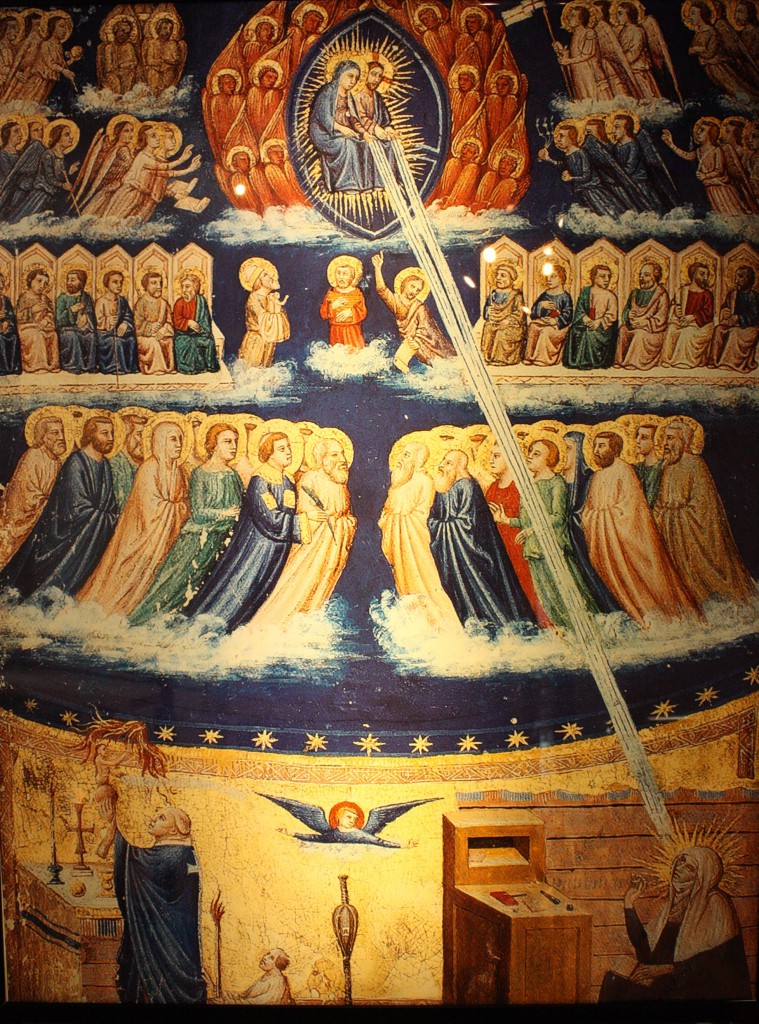
One of Hildegard’s visions, showing her being divinely inspired (image taken at Bingen’s Museum am Strom by Bob Sessions)
Previous Post

January 23, 2014
Beginner's Mind
Next Post
February 2, 2014 The Hildegard Trail
Browse Our Archives
Select a Category Aging & Spirituality Amish Anabaptists Animals Apocalypse Archeological sites Art and Spirituality Awards Belgian Holy Sites birds Blessings Books Buddhism Business & Spirituality Callings Cats Celtic Cemeteries Children Christianity church Colorado Creation Death Desert Spirituality Easter Economics Education & Spirituality Egypt Episcopal Church Faith Fear Films First Nations Food Forgiveness Germany God Good & Evil Good Friday Grace Gratitude Happiness Healing Hildegard of Bingen Hinduism History Holy Rover blog Holy Sites Holy Week Horses Iceland Illness Images of God Indigenous Spiritualilty Interfaith Interfaith Dialogue Iowa Islam Israel Japan Judaism LDS Church Lent Machu Picchu Martin Luther Media Meditation Monasteries Museums Music Music and Spirituality Musings Mysticism Native American Nature New Age New Zealand Norse History/Culture/Spirituality Orthodox Paradox Paranormal Peru Philosophy Pilgrimage Poetry Politics Pop Culture Pilgrimage Sites Prayers sermons Silence Social Media Spiritual writers Spirituality and Food Spirituality and Social Media Stone Circles Thomas Merton Turkey Uncategorized Unconventional Holy Sites Utopian communities Videos Virgin Mary Wicca Work World War I Writing Zen
Select a Month August 2017 July 2017 June 2017 May 2017 April 2017 March 2017 February 2017 December 2016 November 2016 October 2016 September 2016 August 2016 July 2016 June 2016 May 2016 April 2016 March 2016 February 2016 January 2016 December 2015 July 2015 June 2015 May 2015 April 2015 March 2015 February 2015 January 2015 December 2014 November 2014 October 2014 September 2014 August 2014 July 2014 June 2014 May 2014 April 2014 March 2014 February 2014 January 2014 December 2013 October 2013 September 2013 August 2013 July 2013 June 2013 May 2013 April 2013 March 2013 February 2013 January 2013 December 2012 November 2012 October 2012 September 2012 August 2012 July 2012 June 2012 May 2012 April 2012 March 2012 February 2012 January 2012 December 2011 November 2011 October 2011 September 2011 August 2011 July 2011 June 2011 May 2011 April 2011 March 2011 February 2011 January 2011 December 2010 November 2010
Follow Us!
TAKE THE
Religious Wisdom Quiz
Look to the LORD and his strength; seek his face, ____________.
Select your answer to see how you score.
Always Forever Every Time Eternally
Related posts from Holy Rover
An Unexpected Shrine in the Middle of the...
Our Lady of Guadalupe, At Last

'Tis a Gift to be Simple with the...
In Sedona With the Buddha and the Holy...
TRENDING AT PATHEOS New Visions

Did Prayer Cure His Cancer? Or Was It...
At 4 AM one morning, Joshua W. Brown’s wife awoke to a...

8 Ways a Near-Death Experience Rewires the Soul
Does Consciousness Survive Physical Death? After 50 Years of Research, Dr. Raymond...

Holy Longing: What Our Restlessness Is Telling Us
“One can find so many pains when the rain is falling.” -John...

What this is NOT about. This blog is definitely not about...

Who said the Israelites were God’s chosen? That’s right, they did. Who...

The Spirit World Is the Real World: God...
A Monk’s Wisdom on Body and Spirit I sit with Brother Martin...
view all New Visions blogs
Ad-Free & Subscriber Log-In Subscription Support
- About Us
- 2026 Calendar
- Videos
- Podcasts
- Library of World Religions
- Faith In Media Tracker
- Advertise With Us
- Write for Us
- Privacy Policy
- Terms of Service
- Do Not Sell My Data
- Contact Us
- Radiant Digital
- Manage Newsletter Subscriptions
- Unsubscribe From Notifications
- Sitemap
Copyright 2008-2026, Patheos. All rights reserved.
Subscription Support Ad-Free & Subscriber Log-In
Follow Patheos