
BuddhistCatholicContemplativeEvangelicalGeneral ChristianHinduJewishLatter-day SaintMuslimNew VisionsProgressive Christian
Beliefs
- Buddhist
- Catholic
- Contemplative
- Evangelical
- General Christian
- Hindu
- Jewish
- Latter-day Saint
- More Voices
- Muslim
- New Visions
- Pagan
- Progressive Christian
Topics
- Religion News
- Food and Religion
- Sports and Religion
- Religious Art
- Religious Music and Entertainment
- Religious Events
- History and Religion
- Style and Religion
- Politics and Religion
- Women in Religion
- Recreation Outdoors and Religion
- Business Finance and Religion
- Careers Workplace and Religion
- Education and Religion
- Family Parenting and Religion
- Health Fitness and Religion
- Home and Religion
- Relationships and Religion
- Technology and Religion
- Travel and Religion
Columnists
- Buddhist Columnists
- Business Finance and Religion Columnists
- Careers Workplace and Religion Columnists
- Catholic Columnists
- Contemplative Columnists
- Education and Religion Columnists
- Evangelists Columnists
- Family Parenting and Religion Columnists
- General Christian Columnists
- Health Fitness and Religion Columnists
- Hindu Columnists
- History and Religion Columnists
- Home and Religion Columnists
- Jewish Columnists
- More Voices Columnists
- Latter Day Columnists
- Muslim Columnists
- New Visions Columnists
- Nonreligious Columnists
- Pagan Columnists
- Politics and Religion Columnists
- Progressive Columnists
- Recreation Outdoors and Religion Columnists
- Relationships and Religion Columnists
- Religion News Columnists
- Religious Art Columnists
- Religious Events Columnists
- Religious Music and Entertainment Columnists
- Sports and Religion Columnists
- Style and Religion Columnists
- Technology and Religion Columnists
- Travel and Religion Columnists
- Women in Religion Columnists
Resource Library
- 2026 Calendar
- Library of World Religions
- The 100 Most Holy Places on Earth
- Patheos Answers
- Podcasts
- Videos
- Faith Leaders Database
- Anglican Episcopalian
- Bahai
- Baptist
- Buddhism
- Christianity
- Confucianism
- Eastern Orthodoxy
- Hinduism
- Holiness and Pentecostal
- ISKCON
- Islam
- Judaism
- Lutheran
- Methodist
- The Church of Jesus Christ of Latter-day Saints
- New Age
- Paganism
- Presbytarian and Reformed
- Protestantism
- Religion Behind the Scenes
- Roman Catholic
- Scientology
- Shia Islam
- Sikhism
- Sufism
- Sunni Islam
- Taoism
- Zen
- See all religions
Research Tools
 Ad-Free & Subscriber Log-In Subscription Support
Ad-Free & Subscriber Log-In Subscription Support
Follow Patheos 

- Trending:
- Forgiveness
- |
- Marriage
- |
- Consciousness
- |
- Death Penalty
- |
- Election
- |
- Halloween
 Holy Rover
- Home
- New Visions
- The Venice of the North
The Venice of the North
Last updated on: December 15, 2013 at 11:53 pm by Lori Erickson
The Venice of the North 2013-12-15T23:53:51-06:00 Lori Erickson
Patheos Explore the world's faith through different perspectives on religion and spirituality! Patheos has the views of the prevalent religions and spiritualities of the world.
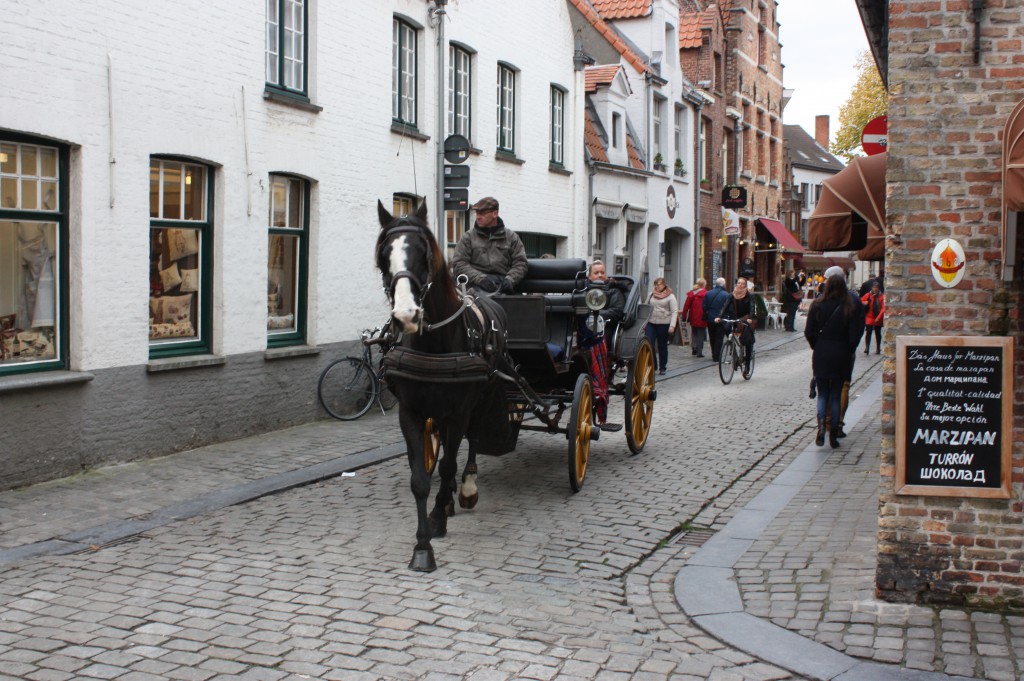
Carriages offer rides through the historic quarter of Bruges (Bob Sessions photo)
Before leaving Belgium we need to make a brief visit to Bruges, one of the most picturesque cities I’ve ever visited. Remember how I told you that the Belgium city of Leuven is pronounced in two ways? Bruges is the same way. If you’re a French-speaking Belgian it’s Broozh; if you speak Flemish it’s Broo-gah. Whatever way you pronounce it, it’s gorgeous.
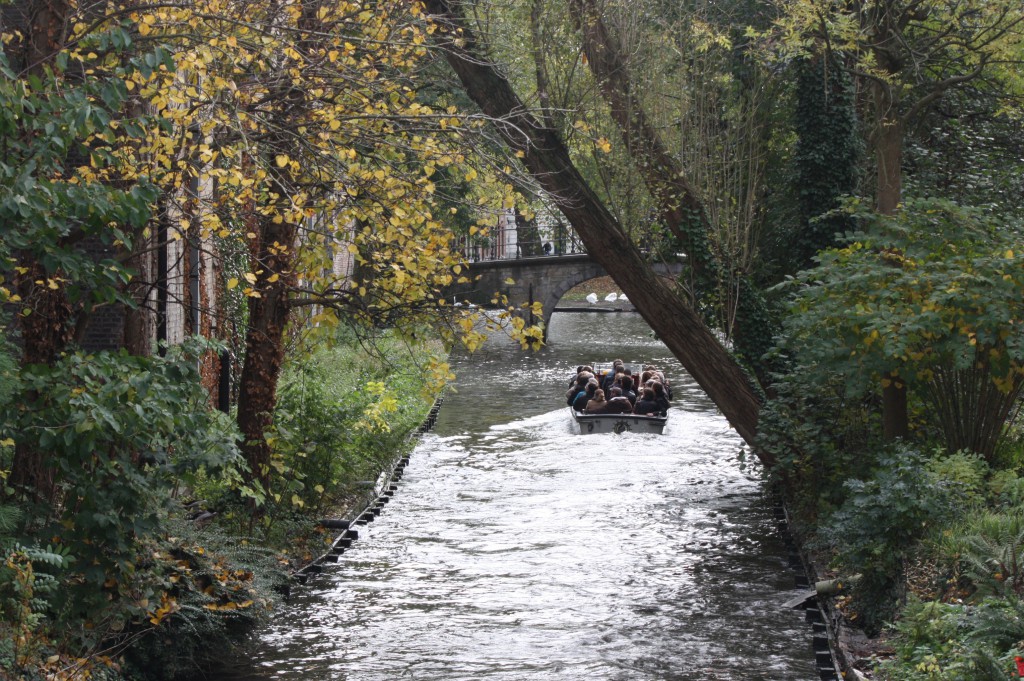
Boat tours wind their way through the canals of Bruges (Bob Sessions photo)
Alas, that’s part of the problem in Bruges, which reminds me of a celebrity who’s mobbed by paparazzi wherever she goes. Even in November, Bruges was full of tourists, and in the height of summer I’m sure it’s even more crowded. But don’t let that keep you away, for even surrounded by gawkers, she is one extraordinary beauty.
Bruges became a major trading port in the 13th century, growing wealthy from international trade. But by 1500 its connection to the North Sea had silted in, cutting it off from its most lucrative industry. Bruges settled into sleepy decline, its medieval buildings spared destruction because so few people were interested in living there.
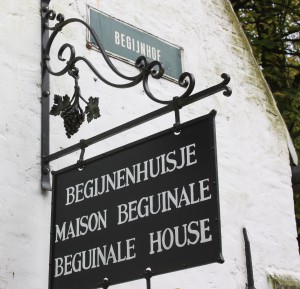
The Beguine Museum preserves a typical home of the Beguine religious community in Bruges. (Bob Sessions photo)
It wasn’t until the late-nineteenth century that the outside world rediscovered Bruges, drawn by its time-capsule vibe. With its cobblestone streets, cozy brick cottages, grand public buildings, and clip-clopping carriages, the city is a delight for the eyes. Most charming are the canals that thread through the historic district, waterways that give Bruges the title of Venice of the North.
One of the most peaceful places in the city owes its existence to those indomitable Beguines that I told you about a couple of posts ago. Founded in 1245, the Bruges Begijnhof is now home to a group of Benedictine nuns who worship in the Church of the Beguinage. Next to the church is the Beguine Museum, located in a former Beguine house. Its spare interior gives a sense for the daily lives of these women who took vows of simplicity and service. Outside, the enclosed courtyard to the Begijnhof exudes tranquility, making its “silence” signs seem superfluous.
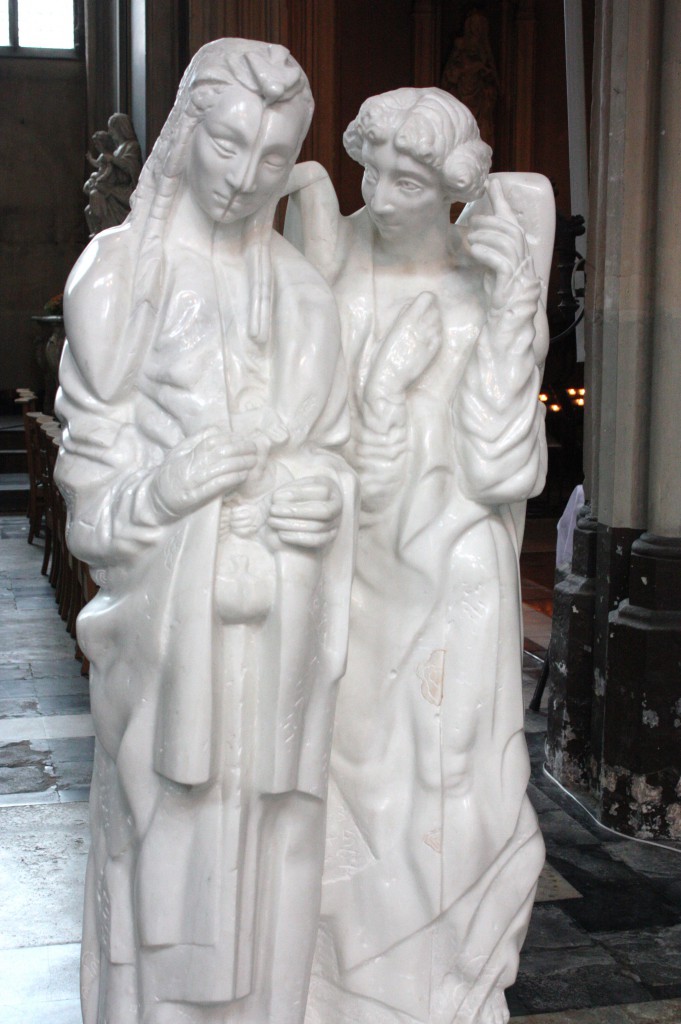
Statue of Mary and an angel in the Church of Our Lady in Bruges (Bob Sessions photo)
From the Begijnhof we went exploring, fortified by some Belgian chocolates purchased from a quaint shop (hey, it’s research). Next stop was the Church of Our Lady, which is famous for having one of the few Michelangelo statues to have left Italy during his lifetime (those wealthy Bruges burghers had plenty of money to throw around). Unfortunately the church is under renovation and so we weren’t able to see its most important treasure, but I was quite taken by the more modern representation of Mary and an angel that you can see at right. It’s a curious statue in many ways: the angel is smaller than Mary, for one thing, and seems tentative in his approach to her. Her face and body are bisected by a line, perhaps indicating the two-fold nature of the child she carries. I stood in front of it for a long time, pondering.
But an even grander church is located on the town’s central square. The Basilica of the Holy Blood is a gilded wonder that houses a relic brought back from Jerusalem in 1150 from the Second Crusade: a vial said to contain some of Christ’s blood.
As regular readers of this blog know, I have an extremely high tolerance for unusual religious sites, so I was delighted to see the church and also the relic, which is displayed reverently on a pillow at certain times of the week (we got the chance to see it–it looks like a vial of dried blood). The upstairs chapel is exuberantly neo-Gothic in style, with an ornate altar and brilliantly colored stained glass windows. This is just the sort of thing that horrified my Protestant ancestors, but we don’t all have to worship in Quaker meetinghouses, do we? And if that vial helps someone have an experience of the holy, it doesn’t make any difference if it came from Jerusalem or a local blood bank.
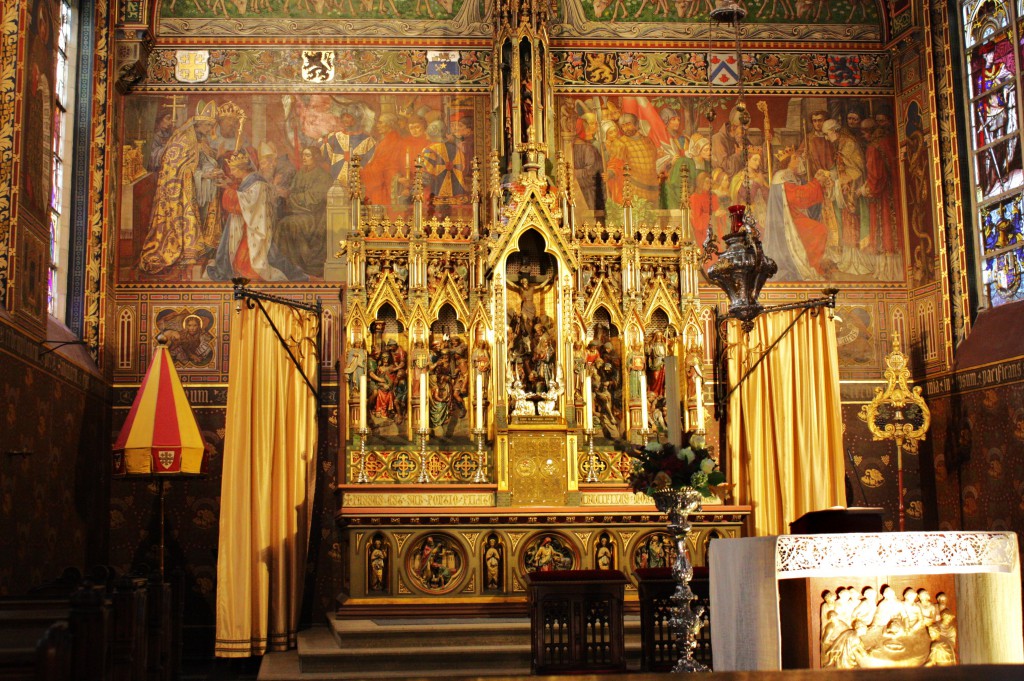
The Basilica of the Holy Blood’s neo-Gothic altar in Bruges, Belgium (Bob Sessions photo)
Let me close by telling you about my favorite part of our visit to Bruges. After being surrounded by crowds much of the day, my son Carl and Bob and I had a late dinner and emerged afterwards into nearly deserted streets. A light rain was falling, and we walked back to the train station past buildings lit with sparkling lights, their reflections shimmering in the waters of the canals. It was easy to imagine the people who had once taken this same path before us: medieval tradesmen, ship captains coming back from lengthy voyages, wealthy burghers and their wives dressed in silks, and Beguines in modest dress on their way to tend to the sick.
It was really quite magical and I mentally thanked all those people who had thoughtfully vacated the city so we could have it to ourselves.
Many popular destinations are like this, I think. You go to Rome or Paris and may well be disappointed to be surrounded by picture-snapping tourists (even though you’re one of them). But if you’re patient and lucky, you will get a brief respite when the crowds thin, the light shifts, and suddenly the city reveals its inner character to you.
We had such an experience in Bruges that night as we strolled along its canals, marveling at the beauty that surrounded us. I don’t know what to think about the authenticity of that relic in the Basilica of the Holy Blood, but I do know this: Bruges is authentically entrancing, especially on a misty night when the past doesn’t seem past at all.
Previous Post

December 8, 2013
The Greatest Belgian
Next Post
December 22, 2013 A Christmas Greeting From the Holy Rover
Browse Our Archives
Select a Category Aging & Spirituality Amish Anabaptists Animals Apocalypse Archeological sites Art and Spirituality Awards Belgian Holy Sites birds Blessings Books Buddhism Business & Spirituality Callings Cats Celtic Cemeteries Children Christianity church Colorado Creation Death Desert Spirituality Easter Economics Education & Spirituality Egypt Episcopal Church Faith Fear Films First Nations Food Forgiveness Germany God Good & Evil Good Friday Grace Gratitude Happiness Healing Hildegard of Bingen Hinduism History Holy Rover blog Holy Sites Holy Week Horses Iceland Illness Images of God Indigenous Spiritualilty Interfaith Interfaith Dialogue Iowa Islam Israel Japan Judaism LDS Church Lent Machu Picchu Martin Luther Media Meditation Monasteries Museums Music Music and Spirituality Musings Mysticism Native American Nature New Age New Zealand Norse History/Culture/Spirituality Orthodox Paradox Paranormal Peru Philosophy Pilgrimage Poetry Politics Pop Culture Pilgrimage Sites Prayers sermons Silence Social Media Spiritual writers Spirituality and Food Spirituality and Social Media Stone Circles Thomas Merton Turkey Uncategorized Unconventional Holy Sites Utopian communities Videos Virgin Mary Wicca Work World War I Writing Zen
Select a Month August 2017 July 2017 June 2017 May 2017 April 2017 March 2017 February 2017 December 2016 November 2016 October 2016 September 2016 August 2016 July 2016 June 2016 May 2016 April 2016 March 2016 February 2016 January 2016 December 2015 July 2015 June 2015 May 2015 April 2015 March 2015 February 2015 January 2015 December 2014 November 2014 October 2014 September 2014 August 2014 July 2014 June 2014 May 2014 April 2014 March 2014 February 2014 January 2014 December 2013 October 2013 September 2013 August 2013 July 2013 June 2013 May 2013 April 2013 March 2013 February 2013 January 2013 December 2012 November 2012 October 2012 September 2012 August 2012 July 2012 June 2012 May 2012 April 2012 March 2012 February 2012 January 2012 December 2011 November 2011 October 2011 September 2011 August 2011 July 2011 June 2011 May 2011 April 2011 March 2011 February 2011 January 2011 December 2010 November 2010
Follow Us!
TAKE THE
Religious Wisdom Quiz
According to Hebrews, for what purpose did Jesus taste death?
Select your answer to see how you score.
For everyone For the righteous For his disciples For Israel
Related posts from Holy Rover


Announcing Holy-Rover-the-Book
TRENDING AT PATHEOS New Visions

Did Prayer Cure His Cancer? Or Was It...
At 4 AM one morning, Joshua W. Brown’s wife awoke to a...

8 Ways a Near-Death Experience Rewires the Soul
Does Consciousness Survive Physical Death? After 50 Years of Research, Dr. Raymond...

Holy Longing: What Our Restlessness Is Telling Us
“One can find so many pains when the rain is falling.” -John...

What this is NOT about. This blog is definitely not about...

Who said the Israelites were God’s chosen? That’s right, they did. Who...

The Spirit World Is the Real World: God...
A Monk’s Wisdom on Body and Spirit I sit with Brother Martin...
view all New Visions blogs
Ad-Free & Subscriber Log-In Subscription Support
- About Us
- 2026 Calendar
- Videos
- Podcasts
- Library of World Religions
- Faith In Media Tracker
- Advertise With Us
- Write for Us
- Privacy Policy
- Terms of Service
- Do Not Sell My Data
- Contact Us
- Radiant Digital
- Manage Newsletter Subscriptions
- Unsubscribe From Notifications
- Sitemap
Copyright 2008-2026, Patheos. All rights reserved.
Subscription Support Ad-Free & Subscriber Log-In
Follow Patheos