
BuddhistCatholicContemplativeEvangelicalGeneral ChristianHinduJewishLatter-day SaintMuslimNew VisionsProgressive Christian
Beliefs
- Buddhist
- Catholic
- Contemplative
- Evangelical
- General Christian
- Hindu
- Jewish
- Latter-day Saint
- More Voices
- Muslim
- New Visions
- Pagan
- Progressive Christian
Topics
- Religion News
- Food and Religion
- Sports and Religion
- Religious Art
- Religious Music and Entertainment
- Religious Events
- History and Religion
- Style and Religion
- Politics and Religion
- Women in Religion
- Recreation Outdoors and Religion
- Business Finance and Religion
- Careers Workplace and Religion
- Education and Religion
- Family Parenting and Religion
- Health Fitness and Religion
- Home and Religion
- Relationships and Religion
- Technology and Religion
- Travel and Religion
Columnists
- Buddhist Columnists
- Business Finance and Religion Columnists
- Careers Workplace and Religion Columnists
- Catholic Columnists
- Contemplative Columnists
- Education and Religion Columnists
- Evangelists Columnists
- Family Parenting and Religion Columnists
- General Christian Columnists
- Health Fitness and Religion Columnists
- Hindu Columnists
- History and Religion Columnists
- Home and Religion Columnists
- Jewish Columnists
- More Voices Columnists
- Latter Day Columnists
- Muslim Columnists
- New Visions Columnists
- Nonreligious Columnists
- Pagan Columnists
- Politics and Religion Columnists
- Progressive Columnists
- Recreation Outdoors and Religion Columnists
- Relationships and Religion Columnists
- Religion News Columnists
- Religious Art Columnists
- Religious Events Columnists
- Religious Music and Entertainment Columnists
- Sports and Religion Columnists
- Style and Religion Columnists
- Technology and Religion Columnists
- Travel and Religion Columnists
- Women in Religion Columnists
Resource Library
- 2026 Calendar
- Library of World Religions
- The 100 Most Holy Places on Earth
- Patheos Answers
- Podcasts
- Videos
- Faith Leaders Database
- Anglican Episcopalian
- Bahai
- Baptist
- Buddhism
- Christianity
- Confucianism
- Eastern Orthodoxy
- Hinduism
- Holiness and Pentecostal
- ISKCON
- Islam
- Judaism
- Lutheran
- Methodist
- The Church of Jesus Christ of Latter-day Saints
- New Age
- Paganism
- Presbytarian and Reformed
- Protestantism
- Religion Behind the Scenes
- Roman Catholic
- Scientology
- Shia Islam
- Sikhism
- Sufism
- Sunni Islam
- Taoism
- Zen
- See all religions
Research Tools
 Ad-Free & Subscriber Log-In Subscription Support
Ad-Free & Subscriber Log-In Subscription Support
Follow Patheos 

- Trending:
- Forgiveness
- |
- Marriage
- |
- Consciousness
- |
- Death Penalty
- |
- Election
- |
- Halloween
 Holy Rover
- Home
- New Visions
- With the Beguines in Belgium
With the Beguines in Belgium
Last updated on: December 1, 2013 at 11:56 pm by Lori Erickson
With the Beguines in Belgium 2013-12-01T23:56:01-06:00 Lori Erickson
Patheos Explore the world's faith through different perspectives on religion and spirituality! Patheos has the views of the prevalent religions and spiritualities of the world.

On the central square in Leuven, Belgium (Bob Sessions photo)
The long silence on The Holy Rover is a result of a trip my husband and I took over the past three weeks to see our son Carl, who is spending a semester studying in Belgium. I had never been to Belgium, Bob had never been to continental Europe, and before you know it we had planned a trip that also included Germany, France and Amsterdam (in the military this is known as “mission creep,” but it also happens to travel writers).
Given our interests, it’s not surprising that our journey took us to many holy sites, some major, some obscure. Over the next weeks, you’ll be hearing about them, making this winter a kind of Holy Rover Channels Rick Steves. I hope you’ll come along with me, as there are a lot of people and places I’d like to introduce you to.
We begin in the Belgian city of Leuven. Before Carl landed there I knew very little about Belgium, and even after our visit I’m still trying to figure out the country. Despite being about the size of a postage stamp on most maps, Belgium is a sometimes-fractious blend of two distinct cultures. The north is Flemish (a form of Dutch) and the southern region is home to the French-speaking Walloons.
As far as I can tell, pretty much everything in Belgium gets divided. For example, Carl’s temporary home is Leuven to the Flemish and Louvain to the French. In the 1960s there was so much acrimony at the city’s main university that the school split into two parts (they even divvied up the library books). The historic campus in the heart of the city conducts itself in Flemish, while a newer campus on the outskirts does so in French. One can either find this depressing (is there any hope for world harmony if even Belgian academics can’t get along?) or somewhat amusing. I found it both. Carl is studying at the historic campus, and I just hope he doesn’t get caught in the cultural crossfire before he leaves.
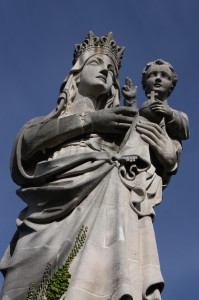
Surprise! I especially liked this 50-foot statue of Mary and Jesus that overlooks the city of Leuven. (Bob Sessions photo)
If you’re a beer lover, you may already have heard of Leuven, which prides itself on being the Beer Capital of the Beer Capital of Europe. I found it totally charming, with its cobblestone streets, cozy pubs, and Oude Markt (old market square). But what really captured my heart, to the point of wanting to move there, was a portion of the city known as the Grand Beguinage.
If you think of beguine as only a dance, you’re missing a nearly forgotten but important part of Christian history. Beginning in the 13th century, a movement began of lay women who lived in loosely structured religious communities while serving the poor and sick. With many men killed in the Crusades or lost to the myriad dangers of medieval life, there were a lot of unattached women in Europe. In the Low Countries of Holland and Belgium in particular, hundreds of Beguine communities formed. Their members did not make permanent vows and were not affiliated with any monastic order, but instead pledged more flexible vows that typically involved piety, simplicity, chastity and service to others. Some eventually left their communities, while others spent the remainder of their lives as Beguines.
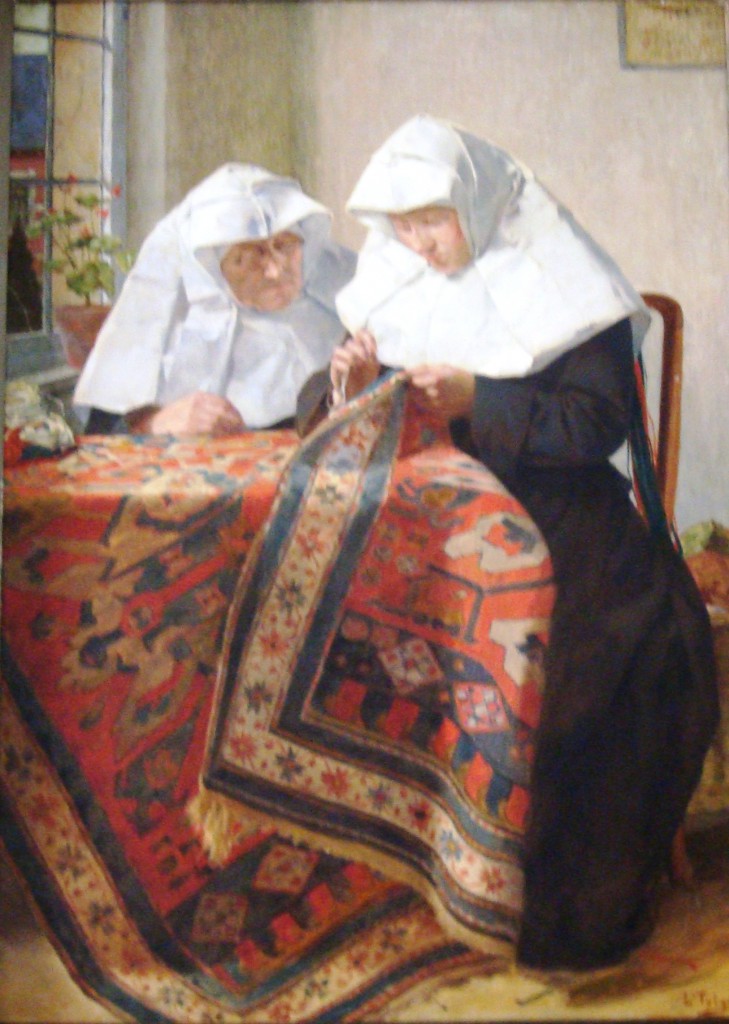
A painting of Beguines by the Belgian artist Louis Tytgadt (Wikimedia Commons image)
These communities varied greatly in size, with some Beguines living alone and others residing in walled neighborhoods that housed a thousand or more women, typically in close proximity to a church. Those who did not come from wealthy families supported themselves by manual labor or teaching.
The Beguine movement flourished for centuries in Europe, despite drawing at times the ire of the official church. During an era when single women were highly vulnerable, these enclosed communities provided a safe haven as well as spiritual sustenance.
The more I learn about the Beguines, the more I want to revive the order. What a splendid model they created, a kind of halfway point between monastic and secular life (I also love what the elected leaders of each community were called: The Grande Dame). Now there’s a title to aspire to.
And when I saw the digs these women had in Leuven–well, I was ready to sign up on the spot.
Even in a city full of picturesque neighborhoods, the Grand Beguinage of Leuven seems like it belongs in a fairy tale. The community was founded in the early-13th century and at its height housed 300 women. Though their numbers gradually dwindled, Beguines lived here until the 1980s. A UNESCO World Heritage Site, the enclosure is maintained by the University of Leuven, which uses it as a residence facility for students, professors and visitors. Thankfully, the public is welcome to stroll through the area, which is exactly what we did on a brisk November afternoon, marveling at its canals, foot bridges, small brick homes with steeply pitched roofs, and winding cobblestone streets.
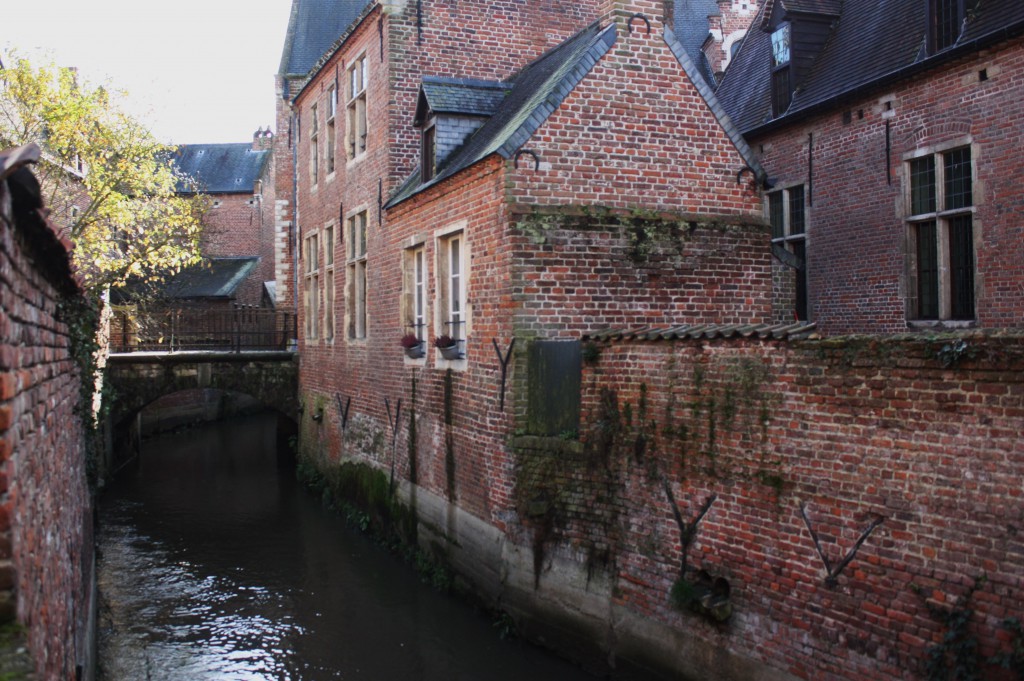
Where I’d love to live in the Grand Beguinage of Leuven (Bob Sessions photo)
My new home is pictured above. In the event that Bob goes off to the Crusades (unlikely, I realize, but one never knows), I daydream of moving into this little cottage by the canal, a block away from an equally charming church and hopefully with a group of like-minded women friends. It’s not that I don’t like men–some of my best friends have a Y chromosome–but I think it must have been a wonderful existence for those Beguines. Living in community, supporting each other, and serving the poor, they always had someone to talk to and someone to care for them. And while I haven’t been able to find historical evidence for this, I’m almost certain that many of them kept cats. Certainly the neighborhood is made for them.
I’ll tell you a bit more about the Beguines when we travel to Bruges, but in the meantime let me leave you with part of an obituary that The Economist published on Marcella Pattyn, the last Beguine, who died on April 14, 2013:
In her energy and willpower she was typical of Beguines of the past. Their writings—in their own vernacular, Flemish or French, rather than men’s Latin—were free-spirited and breathed defiance. “Men try to dissuade me from everything Love bids me do,” wrote Hadewijch of Antwerp. “They don’t understand it, and I can’t explain it to them. I must live out what I am.”
Prous Bonnet saw Christ, the mystical bridegroom of all Beguines, opening his heart to her like rays blazing from a lantern. But a Beguine who was blind [as was Pattyn] could take comfort in knowing … that Love’s light also lay within her…
When she was known to be the last, Marcella Pattyn became famous. The mayor and aldermen of [her home city of] Courtrai visited her, called her a piece of world heritage, and gave her Beguine-shaped chocolates and champagne, which she downed eagerly…The story of the Beguines, she confessed, was very sad, one of swift success and long decline. They had caught the medieval longing for apostolic simplicity, lay involvement and mysticism that also fired St Francis; but the male clergy, unable to control them, attacked them as heretics and burned some alive. With the Protestant Reformation the order almost vanished; with the French revolution their property was lost, and they struggled to recover. In the high Middle Ages a city like Ghent could count its Beguines in thousands. At Courtrai in 1960 Sister Marcella was one of only nine scattered among 40 neat white houses, sleeping in snowy linen in their narrow serge-curtained beds. And then there were none.
Previous Post

October 28, 2013
The Sistine Chapel of Mississippi
Next Post
December 8, 2013 The Greatest Belgian
Browse Our Archives
Select a Category Aging & Spirituality Amish Anabaptists Animals Apocalypse Archeological sites Art and Spirituality Awards Belgian Holy Sites birds Blessings Books Buddhism Business & Spirituality Callings Cats Celtic Cemeteries Children Christianity church Colorado Creation Death Desert Spirituality Easter Economics Education & Spirituality Egypt Episcopal Church Faith Fear Films First Nations Food Forgiveness Germany God Good & Evil Good Friday Grace Gratitude Happiness Healing Hildegard of Bingen Hinduism History Holy Rover blog Holy Sites Holy Week Horses Iceland Illness Images of God Indigenous Spiritualilty Interfaith Interfaith Dialogue Iowa Islam Israel Japan Judaism LDS Church Lent Machu Picchu Martin Luther Media Meditation Monasteries Museums Music Music and Spirituality Musings Mysticism Native American Nature New Age New Zealand Norse History/Culture/Spirituality Orthodox Paradox Paranormal Peru Philosophy Pilgrimage Poetry Politics Pop Culture Pilgrimage Sites Prayers sermons Silence Social Media Spiritual writers Spirituality and Food Spirituality and Social Media Stone Circles Thomas Merton Turkey Uncategorized Unconventional Holy Sites Utopian communities Videos Virgin Mary Wicca Work World War I Writing Zen
Select a Month August 2017 July 2017 June 2017 May 2017 April 2017 March 2017 February 2017 December 2016 November 2016 October 2016 September 2016 August 2016 July 2016 June 2016 May 2016 April 2016 March 2016 February 2016 January 2016 December 2015 July 2015 June 2015 May 2015 April 2015 March 2015 February 2015 January 2015 December 2014 November 2014 October 2014 September 2014 August 2014 July 2014 June 2014 May 2014 April 2014 March 2014 February 2014 January 2014 December 2013 October 2013 September 2013 August 2013 July 2013 June 2013 May 2013 April 2013 March 2013 February 2013 January 2013 December 2012 November 2012 October 2012 September 2012 August 2012 July 2012 June 2012 May 2012 April 2012 March 2012 February 2012 January 2012 December 2011 November 2011 October 2011 September 2011 August 2011 July 2011 June 2011 May 2011 April 2011 March 2011 February 2011 January 2011 December 2010 November 2010
Follow Us!
TAKE THE
Religious Wisdom Quiz
What did Satan claim was the reason for Job’s faithfulness?
Select your answer to see how you score.
That Job was a prophet That Job was unaware of suffering That God had blessed him with wealth and protection That Job had personally seen God
Related posts from Holy Rover


Announcing Holy-Rover-the-Book
TRENDING AT PATHEOS New Visions

Did Prayer Cure His Cancer? Or Was It...
At 4 AM one morning, Joshua W. Brown’s wife awoke to a...

8 Ways a Near-Death Experience Rewires the Soul
Does Consciousness Survive Physical Death? After 50 Years of Research, Dr. Raymond...

Holy Longing: What Our Restlessness Is Telling Us
“One can find so many pains when the rain is falling.” -John...

What this is NOT about. This blog is definitely not about...

Who said the Israelites were God’s chosen? That’s right, they did. Who...

The Spirit World Is the Real World: God...
A Monk’s Wisdom on Body and Spirit I sit with Brother Martin...
view all New Visions blogs
Ad-Free & Subscriber Log-In Subscription Support
- About Us
- 2026 Calendar
- Videos
- Podcasts
- Library of World Religions
- Faith In Media Tracker
- Advertise With Us
- Write for Us
- Privacy Policy
- Terms of Service
- Do Not Sell My Data
- Contact Us
- Radiant Digital
- Manage Newsletter Subscriptions
- Unsubscribe From Notifications
- Sitemap
Copyright 2008-2026, Patheos. All rights reserved.
Subscription Support Ad-Free & Subscriber Log-In
Follow Patheos