
BuddhistCatholicContemplativeEvangelicalGeneral ChristianHinduJewishLatter-day SaintMuslimNew VisionsProgressive Christian
Beliefs
- Buddhist
- Catholic
- Contemplative
- Evangelical
- General Christian
- Hindu
- Jewish
- Latter-day Saint
- More Voices
- Muslim
- New Visions
- Pagan
- Progressive Christian
Topics
- Religion News
- Food and Religion
- Sports and Religion
- Religious Art
- Religious Music and Entertainment
- Religious Events
- History and Religion
- Style and Religion
- Politics and Religion
- Women in Religion
- Recreation Outdoors and Religion
- Business Finance and Religion
- Careers Workplace and Religion
- Education and Religion
- Family Parenting and Religion
- Health Fitness and Religion
- Home and Religion
- Relationships and Religion
- Technology and Religion
- Travel and Religion
Columnists
- Buddhist Columnists
- Business Finance and Religion Columnists
- Careers Workplace and Religion Columnists
- Catholic Columnists
- Contemplative Columnists
- Education and Religion Columnists
- Evangelists Columnists
- Family Parenting and Religion Columnists
- General Christian Columnists
- Health Fitness and Religion Columnists
- Hindu Columnists
- History and Religion Columnists
- Home and Religion Columnists
- Jewish Columnists
- More Voices Columnists
- Latter Day Columnists
- Muslim Columnists
- New Visions Columnists
- Nonreligious Columnists
- Pagan Columnists
- Politics and Religion Columnists
- Progressive Columnists
- Recreation Outdoors and Religion Columnists
- Relationships and Religion Columnists
- Religion News Columnists
- Religious Art Columnists
- Religious Events Columnists
- Religious Music and Entertainment Columnists
- Sports and Religion Columnists
- Style and Religion Columnists
- Technology and Religion Columnists
- Travel and Religion Columnists
- Women in Religion Columnists
Resource Library
- 2026 Calendar
- Library of World Religions
- The 100 Most Holy Places on Earth
- Patheos Answers
- Podcasts
- Videos
- Faith Leaders Database
- Anglican Episcopalian
- Bahai
- Baptist
- Buddhism
- Christianity
- Confucianism
- Eastern Orthodoxy
- Hinduism
- Holiness and Pentecostal
- ISKCON
- Islam
- Judaism
- Lutheran
- Methodist
- The Church of Jesus Christ of Latter-day Saints
- New Age
- Paganism
- Presbytarian and Reformed
- Protestantism
- Religion Behind the Scenes
- Roman Catholic
- Scientology
- Shia Islam
- Sikhism
- Sufism
- Sunni Islam
- Taoism
- Zen
- See all religions
Research Tools
 Ad-Free & Subscriber Log-In Subscription Support
Ad-Free & Subscriber Log-In Subscription Support
Follow Patheos 

- Trending:
- Forgiveness
- |
- Marriage
- |
- Consciousness
- |
- Death Penalty
- |
- Election
- |
- Halloween
 Holy Rover
- Home
- New Visions
- The Sistine Chapel of Mississippi
The Sistine Chapel of Mississippi
Last updated on: October 28, 2013 at 5:16 am by Lori Erickson
The Sistine Chapel of Mississippi 2013-10-28T05:16:01-06:00 Lori Erickson
Patheos Explore the world's faith through different perspectives on religion and spirituality! Patheos has the views of the prevalent religions and spiritualities of the world.
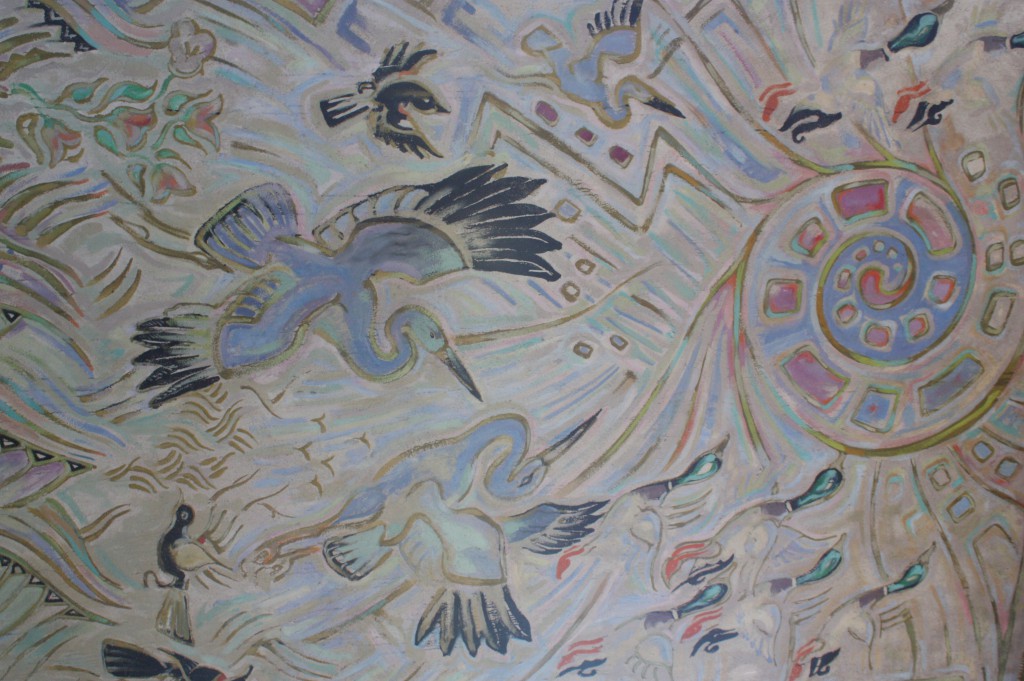
Image courtesy of Walter Anderson Museum of Art
Sometimes holy places are easy to find, and sometimes they emerge only upon reflection. I was reminded of this truth on a recent trip to the Gulf Coast of Mississippi to attend a meeting of the Society of American Travel Writers (an added treat was a visit with my friend and Holy-Rover-commentator-extraordinaire Mississippi Marian). I knew I would enjoy the Gulf Coast, but I didn’t expect to find a spiritual destination on my trip. But suddenly there one was, popping up in a most unexpected place: the Walter Anderson Museum of Art.
The term “eccentric” doesn’t really do justice to Walter Inglis Anderson (and keep in mind that he lived in the mother lode for eccentrics, the same state that produced Eudora Welty and William Faulkner). Born in 1903, he was raised in an artistic family and attended two of the nation’s top art schools. As an adult, however, that early promise fizzled. He was an occasional husband and largely absent father to his four children, earning a small amount of money working in his brother’s pottery business. As the years passed he became increasingly reclusive and peculiar and was periodically hospitalized for treatment of schizophrenia. Dressed in mismatched clothes, Anderson would ride his rickety bike around the streets of Ocean Springs. Even his own children would cross the street to avoid him when they saw him coming.
But underneath that troubled exterior, his early artistic promise hadn’t died at all. After Anderson’s death in 1965, an astonishing body of work was revealed: more than 30,000 pen-and-ink drawings, watercolor paintings, wooden carvings, and sculptures.
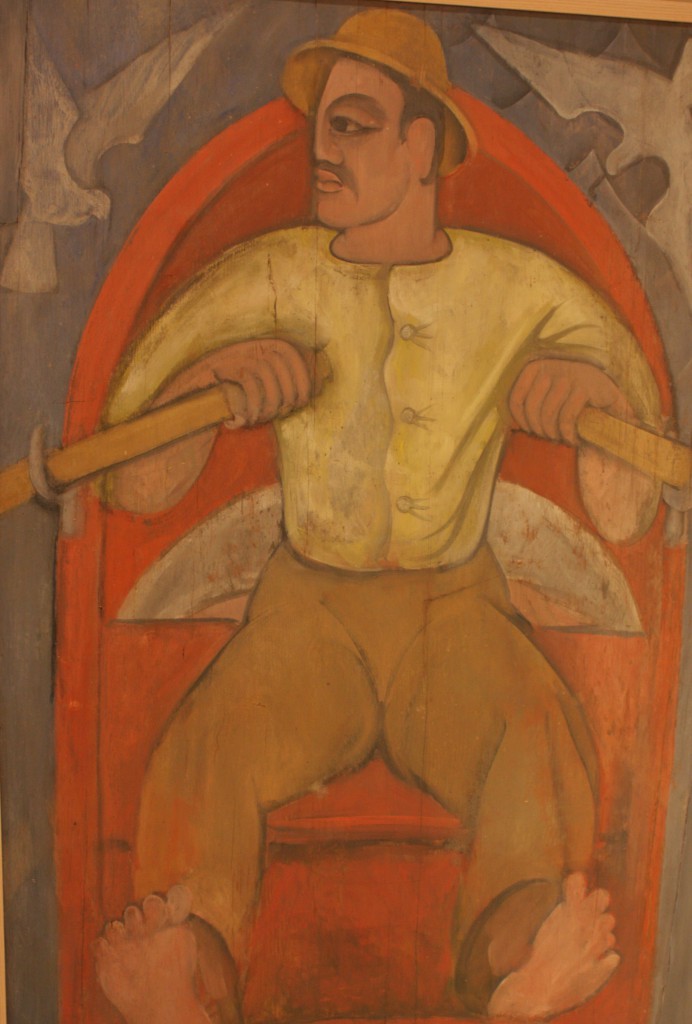
Image courtesy of Walter Anderson Museum of Art
Anderson’s art reflects not just a love of nature, but an almost total immersion in it. One place in particular was his muse, a windswept barrier island called Horn. Over the course of nearly two decades Anderson made countless trips to Horn Island, laboriously rowing 14 miles across open water in a small wooden boat loaded down with his art supplies. There he would stay for weeks at a time, enduring extreme heat, sweltering humidity, biting insects, relentless sun and fierce winds.
Anderson did all of this because he was entranced by the flora and fauna of the Gulf Coast. There was hardly a single animal or plant he didn’t capture in his art: oysters, shrimp, fish, crabs, pelicans, turtles, herons, marsh grasses, insects and trees. Some creatures he would paint twenty times until he was satisfied with them, covering page after page with his sketches. At night he slept in the shelter of his overturned boat; by day he would climb trees, crawl through marshes, and lie nose-to-nose with hermit crabs. One time he even chained himself to a tree during a hurricane because he wanted to fully experience its power. He also produced thousands of pages of journal entries reflecting upon his experiences, writing by the flickering light of a campfire.
His wife Sissy would later say this: “Being with him was like having intense sunlight concentrated on everything … he knew things not only by observation, but by a sort of intuition. He himself was later to define it as the ability to become one with any living thing, a tree, flower, ant or bird.”

Walter Anderson’s Little Room (image courtesy of Walter Anderson Museum of Art)
Of all the works discovered after his death, the most surprising was found inside a locked room in the cottage where he had lived alone for 18 years. When his wife broke open its padlock, she discovered that every square inch of the room was covered with murals–a kind of Sistine Chapel of Mississippi, one might say. According to Anderson’s journal, the room’s swirling patterns and dreamlike images were inspired by Psalm 103, that exuberant hymn that begins, “Praise the Lord, my soul; all my inmost being, praise his holy name.” But the Little Room, as it has come to be known, is also a hymn of praise for all that Anderson had experienced on his many trips to Horn Island.
Today Walter Anderson’s artistic reputation is steadily rising and his works sell for many thousands of dollars (benefiting, I’m happy to say, his long-suffering family). A lovely museum showcases his life and work in Ocean Springs, whose residents have come to realize that the hermit who once rode their streets on his rickety bicycle was actually an artistic genius. And in 1978, Horn Island was made a federally protected Wilderness Area, ensuring that its windswept beaches and marshes will remain untouched by human encroachment.
As long-time readers of this blog know, I’m a firm believer in the transformative power of holy places. I love Walter Anderson’s story in part because it shows that while sometimes a pilgrim needs to set out on a journey of many miles, equally valuable pilgrimages can happen when a man sets out in a rowboat to a tiny nearby island, opening himself to the power and wildness he finds there. Anderson’s story is also a testimony to the high price that spiritual seekers often pay for a call. Walter Anderson paid that price freely, but not without considerable suffering both on his part and that of his family.
And, finally, it’s intriguing to speculate on the role schizophrenia played in Anderson’s creative genius and spirituality. According to his daughter, Mary, his mental illness made him “cracked open, vulnerable and acutely receptive to everything that comes through the senses.” That’s a pretty accurate description of a religious mystic, many of whom balance on that fine edge between sanity and what the world sees as madness.

Image courtesy of Walter Anderson Museum of Art
If you get the chance to visit the Gulf Coast of Mississippi, go to the Walter Anderson Museum of Art and stand in the middle of the Little Room that has been moved in its entirety there. I’ve never been to the Sistine Chapel in Rome, but I have a sense that there’s a kinship between those two spaces made sacred by creative passion. Both serve as signposts to heaven. In Walter Anderson’s case, that heaven was populated by scuttling crabs and gliding herons, its air filled with the call of seagulls, the swish of marsh grasses and the rhythmic lullaby of waves.
Previous Post

October 13, 2013
The Gift of Pain
Next Post
December 1, 2013 With the Beguines in Belgium
Browse Our Archives
Select a Category Aging & Spirituality Amish Anabaptists Animals Apocalypse Archeological sites Art and Spirituality Awards Belgian Holy Sites birds Blessings Books Buddhism Business & Spirituality Callings Cats Celtic Cemeteries Children Christianity church Colorado Creation Death Desert Spirituality Easter Economics Education & Spirituality Egypt Episcopal Church Faith Fear Films First Nations Food Forgiveness Germany God Good & Evil Good Friday Grace Gratitude Happiness Healing Hildegard of Bingen Hinduism History Holy Rover blog Holy Sites Holy Week Horses Iceland Illness Images of God Indigenous Spiritualilty Interfaith Interfaith Dialogue Iowa Islam Israel Japan Judaism LDS Church Lent Machu Picchu Martin Luther Media Meditation Monasteries Museums Music Music and Spirituality Musings Mysticism Native American Nature New Age New Zealand Norse History/Culture/Spirituality Orthodox Paradox Paranormal Peru Philosophy Pilgrimage Poetry Politics Pop Culture Pilgrimage Sites Prayers sermons Silence Social Media Spiritual writers Spirituality and Food Spirituality and Social Media Stone Circles Thomas Merton Turkey Uncategorized Unconventional Holy Sites Utopian communities Videos Virgin Mary Wicca Work World War I Writing Zen
Select a Month August 2017 July 2017 June 2017 May 2017 April 2017 March 2017 February 2017 December 2016 November 2016 October 2016 September 2016 August 2016 July 2016 June 2016 May 2016 April 2016 March 2016 February 2016 January 2016 December 2015 July 2015 June 2015 May 2015 April 2015 March 2015 February 2015 January 2015 December 2014 November 2014 October 2014 September 2014 August 2014 July 2014 June 2014 May 2014 April 2014 March 2014 February 2014 January 2014 December 2013 October 2013 September 2013 August 2013 July 2013 June 2013 May 2013 April 2013 March 2013 February 2013 January 2013 December 2012 November 2012 October 2012 September 2012 August 2012 July 2012 June 2012 May 2012 April 2012 March 2012 February 2012 January 2012 December 2011 November 2011 October 2011 September 2011 August 2011 July 2011 June 2011 May 2011 April 2011 March 2011 February 2011 January 2011 December 2010 November 2010
Follow Us!
TAKE THE
Religious Wisdom Quiz
Who was Moses' brother?
Select your answer to see how you score.
Eleazar Aaron Caleb Joshua
Related posts from Holy Rover
In Vienna, A Tale of Two Churches

The Ben Long Frescoes of North Carolina
TRENDING AT PATHEOS New Visions

Did Prayer Cure His Cancer? Or Was It...
At 4 AM one morning, Joshua W. Brown’s wife awoke to a...

8 Ways a Near-Death Experience Rewires the Soul
Does Consciousness Survive Physical Death? After 50 Years of Research, Dr. Raymond...

Holy Longing: What Our Restlessness Is Telling Us
“One can find so many pains when the rain is falling.” -John...

What this is NOT about. This blog is definitely not about...

Who said the Israelites were God’s chosen? That’s right, they did. Who...

The Spirit World Is the Real World: God...
A Monk’s Wisdom on Body and Spirit I sit with Brother Martin...
view all New Visions blogs
Ad-Free & Subscriber Log-In Subscription Support
- About Us
- 2026 Calendar
- Videos
- Podcasts
- Library of World Religions
- Faith In Media Tracker
- Advertise With Us
- Write for Us
- Privacy Policy
- Terms of Service
- Do Not Sell My Data
- Contact Us
- Radiant Digital
- Manage Newsletter Subscriptions
- Unsubscribe From Notifications
- Sitemap
Copyright 2008-2026, Patheos. All rights reserved.
Subscription Support Ad-Free & Subscriber Log-In
Follow Patheos