
BuddhistCatholicContemplativeEvangelicalGeneral ChristianHinduJewishLatter-day SaintMuslimNew VisionsProgressive Christian
Beliefs
- Buddhist
- Catholic
- Contemplative
- Evangelical
- General Christian
- Hindu
- Jewish
- Latter-day Saint
- More Voices
- Muslim
- New Visions
- Pagan
- Progressive Christian
Topics
- Religion News
- Food and Religion
- Sports and Religion
- Religious Art
- Religious Music and Entertainment
- Religious Events
- History and Religion
- Style and Religion
- Politics and Religion
- Women in Religion
- Recreation Outdoors and Religion
- Business Finance and Religion
- Careers Workplace and Religion
- Education and Religion
- Family Parenting and Religion
- Health Fitness and Religion
- Home and Religion
- Relationships and Religion
- Technology and Religion
- Travel and Religion
Columnists
- Buddhist Columnists
- Business Finance and Religion Columnists
- Careers Workplace and Religion Columnists
- Catholic Columnists
- Contemplative Columnists
- Education and Religion Columnists
- Evangelists Columnists
- Family Parenting and Religion Columnists
- General Christian Columnists
- Health Fitness and Religion Columnists
- Hindu Columnists
- History and Religion Columnists
- Home and Religion Columnists
- Jewish Columnists
- More Voices Columnists
- Latter Day Columnists
- Muslim Columnists
- New Visions Columnists
- Nonreligious Columnists
- Pagan Columnists
- Politics and Religion Columnists
- Progressive Columnists
- Recreation Outdoors and Religion Columnists
- Relationships and Religion Columnists
- Religion News Columnists
- Religious Art Columnists
- Religious Events Columnists
- Religious Music and Entertainment Columnists
- Sports and Religion Columnists
- Style and Religion Columnists
- Technology and Religion Columnists
- Travel and Religion Columnists
- Women in Religion Columnists
Resource Library
- 2026 Calendar
- Library of World Religions
- The 100 Most Holy Places on Earth
- Patheos Answers
- Podcasts
- Videos
- Faith Leaders Database
- Anglican Episcopalian
- Bahai
- Baptist
- Buddhism
- Christianity
- Confucianism
- Eastern Orthodoxy
- Hinduism
- Holiness and Pentecostal
- ISKCON
- Islam
- Judaism
- Lutheran
- Methodist
- The Church of Jesus Christ of Latter-day Saints
- New Age
- Paganism
- Presbytarian and Reformed
- Protestantism
- Religion Behind the Scenes
- Roman Catholic
- Scientology
- Shia Islam
- Sikhism
- Sufism
- Sunni Islam
- Taoism
- Zen
- See all religions
Research Tools
 Ad-Free & Subscriber Log-In Subscription Support
Ad-Free & Subscriber Log-In Subscription Support
Follow Patheos 

- Trending:
- Forgiveness
- |
- Marriage
- |
- Consciousness
- |
- Death Penalty
- |
- Election
- |
- Halloween
 Holy Rover
- Home
- New Visions
- The Gift of Pain
The Gift of Pain
Last updated on: October 13, 2013 at 11:25 pm by Lori Erickson
The Gift of Pain 2013-10-13T23:25:29-06:00 Lori Erickson
Patheos Explore the world's faith through different perspectives on religion and spirituality! Patheos has the views of the prevalent religions and spiritualities of the world.
(Today’s post is a sermon I gave yesterday at Trinity Episcopal Church in Iowa City, Iowa.)
On the way to Jerusalem Jesus was going through the region between Samaria and Galilee. As he entered a village, ten lepers approached him. Keeping their distance, they called out, saying, “Jesus, Master, have mercy on us!” When he saw them, he said to them, “Go and show yourselves to the priests.” And as they went, they were made clean. Then one of them, when he saw that he was healed, turned back, praising God with a loud voice. He prostrated himself at Jesus’ feet and thanked him. And he was a Samaritan. Then Jesus asked, “Were not ten made clean? But the other nine, where are they? Was none of them found to return and give praise to God except this foreigner?” Then he said to him, “Get up and go on your way; your faith has made you well.” (Luke 17:11-19)
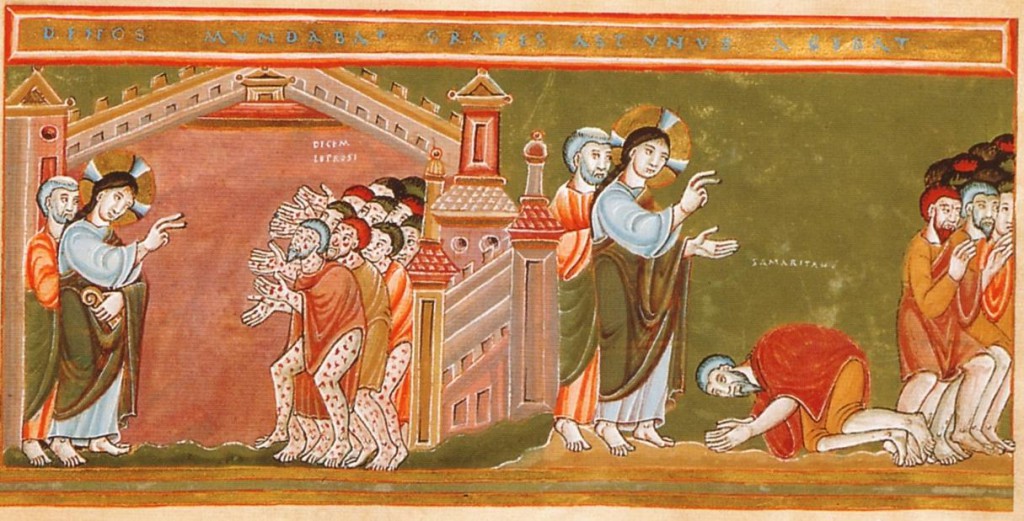
Cleansing of the Ten Lepers from the Codex Aureus Epternacensis (WIkimedia Commons image)
In the Gospel reading this morning, we encounter the most feared, isolated, and vulnerable people in the Bible: lepers. Ten of them have been healed by Jesus, but only one comes back to give him thanks. We are meant to notice the fact that this man is a Samaritan, a member of a group considered to be social and religious outcasts by most Jews of the day. While the other nine rush off to begin their new lives, only one returns to express his gratitude to Jesus for the miraculous transformation he has undergone.
There are nearly 70 references to leprosy in the Bible, which is not surprising given the fact that it was the most dreaded disease in the ancient world. Biblical scholars say the term likely included a wide range of skin conditions, of which the most devastating was the illness that is now termed Hansen’s Disease. In Jesus’ day, this virulent bacterial infection not only crippled people’s bodies: it also robbed them of their home, family, community, livelihood, and dignity. Because of the contagious nature of the disease, a leper was cast out from society, reduced to begging for food and prohibited from participating in religious rituals. It is no wonder that lepers dogged Jesus’ steps, for once it became known that he was someone who could heal this deadly affliction, they must have flocked to him at every opportunity.
While leprosy has not been completely eradicated in the world, its terrors are greatly lessened because of advances in medical treatments. The story of how these breakthroughs were made is recounted in a fascinating book by physician Paul Brand. Published in 1993, it bears the seemingly contradictory title The Gift of Pain
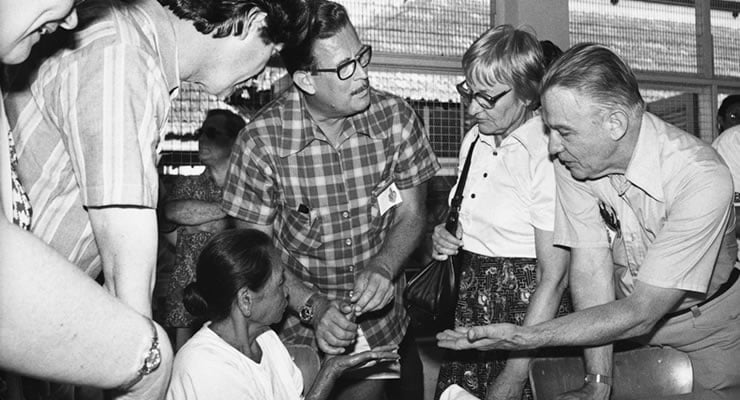
Paul Brand examining a patient in India (Leprosy Mission photo).
Paul Brand grew up in India as the child of missionary parents and, after receiving medical training in England, returned to India to devote himself to those afflicted with leprosy. He did so at a time when medical science was just beginning to develop treatments for the disease. While newly discovered sulfa drugs could halt the spread of the bacterial infection, even after being treated most leprosy patients continued to suffer terrible disfigurements. Dr. Brand was the first to figure out why that happened. He came to realize that the crippling power of leprosy came not because the flesh was rotting away, as had been previously thought, but because the disease destroyed the body’s ability to feel pain. That simple fact accounted for the great majority of the damage that was done.
Leprosy patients would sprain their ankles and not realize it, for example, continuing to walk on the injured foot until it was irreparably damaged. They would go blind, because without sensation in their eyes they didn’t feel the need to blink, which keeps the eyes lubricated and free of impurities. In a normal body, pain sets limits on our movements and warns us of potential damage and injury. But leprosy patients, without a pain reflex, have no built-in warning system. Much of Brand’s work, therefore, focused on teaching his patients how to compensate for that lack of sensation.
We might think of all of this as a curious medical oddity, but Brand believes that we have much to learn from the experiences of those afflicted with leprosy. His book is a heartfelt and often moving meditation on the gifts of pain. After many years of working with people who feel no pain, he describes how he came to realize that it can be an indispensable teacher and an opportunity for growth.
He writes: “I began to view painlessness as one of the greatest curses that can befall a human being…My esteem for pain runs so counter to the common attitude that I sometimes feel like a subversive, especially in modern Western countries. On my travels I have observed an ironic law of reversal at work: as a society gains the ability to limit suffering, it loses the ability to cope with what suffering remains…traditional cultures may lack modern analgesics, but the beliefs and family support systems built into everyday life help equip individuals to cope with pain.”
I’ve been fortunate thus far in my life not to have to deal with great pain. But through our healing ministries here at Trinity I’ve been part of the lives of many who are not so fortunate. I am profoundly grateful to have been a companion on the healing journeys of these people. Some have returned to full health, and some have lost their battle with disease. In seeing how these people have dealt with the challenge of their illnesses, I find myself agreeing with Paul Brand that we make a mistake in not reflecting on the complex meanings and potential gifts of pain.
I think of Terry Breitbach, who died of cancer a year ago this past summer. Those of you who knew her will remember her love of life and infectious laugh. Despite the suffering she endured, in the last year of her illness she often spoke of how incredibly fortunate she was and how grateful she was to be surrounded by people who loved and cared for her. Terry taught us about one of the paradoxical gifts that can come with pain: the gift of finding deep joy in simple things. In the last months of her life she spent a lot of time simply watching the world. She especially loved to sit in her backyard, delighting in the glinting of sunlight on the leaves and the sound of bird songs. I remember her saying that she used to feel guilty about sitting doing nothing, but that she’d come to believe that God wants us to savor how beautiful the world is. “I’m making up for all those people who are too busy to do so,” she said.
I’ve also seen how other people can be changed and deepened by someone’s pain. In Dick and Debra Dorzweiler’s neighborhood, for example, people have rallied to care for a woman dying of pancreatic cancer. Neighbors who once were casual acquaintances have stepped into the difficult and challenging role of caregivers for someone without a family. This, too, can be a gift of pain: the way it can deepen the bonds of a community. Paul Brand, who spent his life treating serious illness, writes this: “The best single thing I can do to prepare for pain is to surround myself with a loving community who will stand beside me when tragedy strikes.”
Learning from suffering, clearly, is an essential part of a spiritual path. The Franciscan priest and author Richard Rohr says that God has two main ways to teach us: through love and through suffering. Everybody prefers the former, but for many of us the lessons are more deeply learned through pain. Without it, we remain content in our cozy cocoon of ego and self-regard. Difficulties, failure, humiliation and defeat force us to look where we never would have otherwise. Rohr writes: “It seems that in the spiritual world, we do not really find something until we first lose it, ignore it, miss it, long for it, choose it, and … find it again–[but this time] on a new level.”
One of the great models for the transformative power of suffering is St. John of the Cross, the sixteenth-century Spanish mystic. During his life he suffered terrible persecution, trials, and illness. Bleakest of all was the experience of feeling abandoned by God, a trial he called the Dark Night of the Soul. But his greatest insight came when he realized that the spirit of God was present in that darkness, working a transformation in him far deeper than what would have been possible without it.
St. John spoke of this experience as a kind of “luminous darkness.” One can sense the truth of that memorable phrase, I think, in viewing great religious art. Think of the rich hues and gilded lines of Russian icons, for example, with their faces that radiate both sorrow and peace, or the tenderness of Michelangelo’s Pieta. Or a crucifix, that powerful symbol of the God-who-suffers-with-us.
In saying all of this, I realize how easy it is to talk about the lessons of pain while you’re not presently experiencing it. Most of us would likely agree with the words of St. Teresa of Avila, who said that given how God treats his friends, it’s no wonder he has so few of them. And I’m sure you, like me, know people for whom physical and mental pain are relentlessly debilitating and isolating. There is no gift for them hidden in its talons. Instead, it breaks them. But I hope you also know people who have been broken open by pain, transforming them in ways that allow divine light to shine forth from them. These people are beacons among us, showing us what is possible.
If all of this sounds contradictory, it is, in the way that most spiritual truths are. I’m afraid it’s paradoxes all the way down.
But in pondering how to deal with suffering, we can take inspiration from the life of Paul Brand, the tireless physician and humanitarian. After his death in 2003, one of his colleagues in India recalled one telling detail about how he worked. He said that when Dr. Brand saw patients, he never focused just on their disability. As he examined them, he would gently cradle their damaged feet or hands as he looked directly into their eyes. He talked to them about their lives and their struggles. He saw them not just as patients, but as fellow children of God. And for people who had been cast out by their families and communities, that was perhaps as healing as any medical treatment he could offer.
In doing so, Brand was following the example of another healer who reached out to outcasts. Writes Brand: “I have sometimes wondered why Jesus so frequently touched the people he healed. Many … must have been unattractive, obviously diseased, unsanitary … With his power, Jesus easily could have waved a magic wand. In fact, a wand would have reached more people than a touch. He could have divided the crowd into … groups and organized his miracles–paralyzed people over there, feverish people here, people with leprosy there–raising his hands to heal each group efficiently …. But he chose not to. Jesus’ mission was not chiefly a crusade against disease …but rather a ministry to individual people, some of whom happened to have a disease. He wanted those people, one by one, to feel his love and warmth and his full identification with them.”
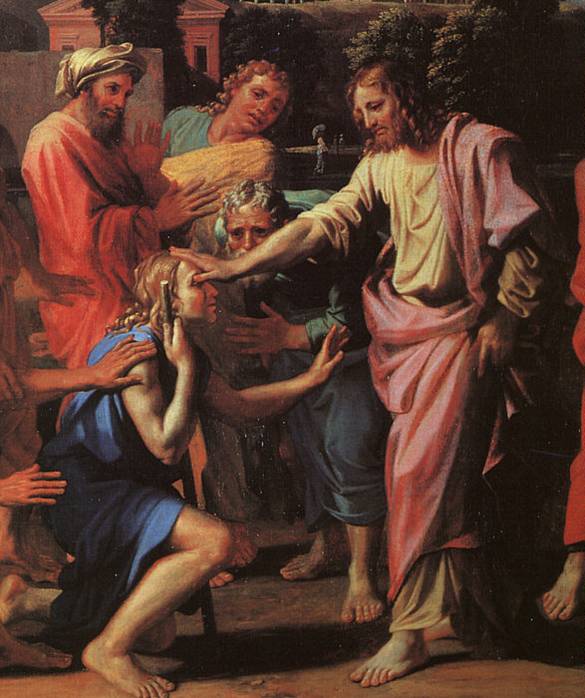
(Wikimedia Commons image)
Brand’s words point to the reason why the healing stories of the Gospels continue to have such immediacy and power. We do not suffer from leprosy, yet we too at times have been isolated and rejected. We live in a time when medical science has made tremendous strides in treating illness, yet most of us will at some point face a health crisis. Like those people in the Gospels desperate for healing of the body, we may not realize that the real healing we need is of our souls. And so we wait, by the side of a dusty road in Galilee or in a pew here in Iowa City, longing for the Great Healer to reach out his hand and make us whole.
Previous Post

September 29, 2013
Krista Tippett's Ministry of Listening
Next Post
October 28, 2013 The Sistine Chapel of Mississippi
Browse Our Archives
Select a Category Aging & Spirituality Amish Anabaptists Animals Apocalypse Archeological sites Art and Spirituality Awards Belgian Holy Sites birds Blessings Books Buddhism Business & Spirituality Callings Cats Celtic Cemeteries Children Christianity church Colorado Creation Death Desert Spirituality Easter Economics Education & Spirituality Egypt Episcopal Church Faith Fear Films First Nations Food Forgiveness Germany God Good & Evil Good Friday Grace Gratitude Happiness Healing Hildegard of Bingen Hinduism History Holy Rover blog Holy Sites Holy Week Horses Iceland Illness Images of God Indigenous Spiritualilty Interfaith Interfaith Dialogue Iowa Islam Israel Japan Judaism LDS Church Lent Machu Picchu Martin Luther Media Meditation Monasteries Museums Music Music and Spirituality Musings Mysticism Native American Nature New Age New Zealand Norse History/Culture/Spirituality Orthodox Paradox Paranormal Peru Philosophy Pilgrimage Poetry Politics Pop Culture Pilgrimage Sites Prayers sermons Silence Social Media Spiritual writers Spirituality and Food Spirituality and Social Media Stone Circles Thomas Merton Turkey Uncategorized Unconventional Holy Sites Utopian communities Videos Virgin Mary Wicca Work World War I Writing Zen
Select a Month August 2017 July 2017 June 2017 May 2017 April 2017 March 2017 February 2017 December 2016 November 2016 October 2016 September 2016 August 2016 July 2016 June 2016 May 2016 April 2016 March 2016 February 2016 January 2016 December 2015 July 2015 June 2015 May 2015 April 2015 March 2015 February 2015 January 2015 December 2014 November 2014 October 2014 September 2014 August 2014 July 2014 June 2014 May 2014 April 2014 March 2014 February 2014 January 2014 December 2013 October 2013 September 2013 August 2013 July 2013 June 2013 May 2013 April 2013 March 2013 February 2013 January 2013 December 2012 November 2012 October 2012 September 2012 August 2012 July 2012 June 2012 May 2012 April 2012 March 2012 February 2012 January 2012 December 2011 November 2011 October 2011 September 2011 August 2011 July 2011 June 2011 May 2011 April 2011 March 2011 February 2011 January 2011 December 2010 November 2010
Follow Us!
TAKE THE
Religious Wisdom Quiz
What was the currency for the temple tax?
Select your answer to see how you score.
Denarius Talent Shekel Mina
Related posts from Holy Rover

The Holy Dirt of Chimayo, New Mexico

Seeking Miracles, Near and Far

TRENDING AT PATHEOS New Visions

Did Prayer Cure His Cancer? Or Was It...
At 4 AM one morning, Joshua W. Brown’s wife awoke to a...

8 Ways a Near-Death Experience Rewires the Soul
Does Consciousness Survive Physical Death? After 50 Years of Research, Dr. Raymond...

Holy Longing: What Our Restlessness Is Telling Us
“One can find so many pains when the rain is falling.” -John...

What this is NOT about. This blog is definitely not about...

Who said the Israelites were God’s chosen? That’s right, they did. Who...

The Spirit World Is the Real World: God...
A Monk’s Wisdom on Body and Spirit I sit with Brother Martin...
view all New Visions blogs
Ad-Free & Subscriber Log-In Subscription Support
- About Us
- 2026 Calendar
- Videos
- Podcasts
- Library of World Religions
- Faith In Media Tracker
- Advertise With Us
- Write for Us
- Privacy Policy
- Terms of Service
- Do Not Sell My Data
- Contact Us
- Radiant Digital
- Manage Newsletter Subscriptions
- Unsubscribe From Notifications
- Sitemap
Copyright 2008-2026, Patheos. All rights reserved.
Subscription Support Ad-Free & Subscriber Log-In
Follow Patheos