
BuddhistCatholicContemplativeEvangelicalGeneral ChristianHinduJewishLatter-day SaintMuslimNew VisionsProgressive Christian
Beliefs
- Buddhist
- Catholic
- Contemplative
- Evangelical
- General Christian
- Hindu
- Jewish
- Latter-day Saint
- More Voices
- Muslim
- New Visions
- Pagan
- Progressive Christian
Topics
- Religion News
- Food and Religion
- Sports and Religion
- Religious Art
- Religious Music and Entertainment
- Religious Events
- History and Religion
- Style and Religion
- Politics and Religion
- Women in Religion
- Recreation Outdoors and Religion
- Business Finance and Religion
- Careers Workplace and Religion
- Education and Religion
- Family Parenting and Religion
- Health Fitness and Religion
- Home and Religion
- Relationships and Religion
- Technology and Religion
- Travel and Religion
Columnists
- Buddhist Columnists
- Business Finance and Religion Columnists
- Careers Workplace and Religion Columnists
- Catholic Columnists
- Contemplative Columnists
- Education and Religion Columnists
- Evangelists Columnists
- Family Parenting and Religion Columnists
- General Christian Columnists
- Health Fitness and Religion Columnists
- Hindu Columnists
- History and Religion Columnists
- Home and Religion Columnists
- Jewish Columnists
- More Voices Columnists
- Latter Day Columnists
- Muslim Columnists
- New Visions Columnists
- Nonreligious Columnists
- Pagan Columnists
- Politics and Religion Columnists
- Progressive Columnists
- Recreation Outdoors and Religion Columnists
- Relationships and Religion Columnists
- Religion News Columnists
- Religious Art Columnists
- Religious Events Columnists
- Religious Music and Entertainment Columnists
- Sports and Religion Columnists
- Style and Religion Columnists
- Technology and Religion Columnists
- Travel and Religion Columnists
- Women in Religion Columnists
Resource Library
- 2026 Calendar
- Library of World Religions
- The 100 Most Holy Places on Earth
- Patheos Answers
- Podcasts
- Videos
- Faith Leaders Database
- Anglican Episcopalian
- Bahai
- Baptist
- Buddhism
- Christianity
- Confucianism
- Eastern Orthodoxy
- Hinduism
- Holiness and Pentecostal
- ISKCON
- Islam
- Judaism
- Lutheran
- Methodist
- The Church of Jesus Christ of Latter-day Saints
- New Age
- Paganism
- Presbytarian and Reformed
- Protestantism
- Religion Behind the Scenes
- Roman Catholic
- Scientology
- Shia Islam
- Sikhism
- Sufism
- Sunni Islam
- Taoism
- Zen
- See all religions
Research Tools
 Ad-Free & Subscriber Log-In Subscription Support
Ad-Free & Subscriber Log-In Subscription Support
Follow Patheos 

- Trending:
- Forgiveness
- |
- Marriage
- |
- Consciousness
- |
- Death Penalty
- |
- Election
- |
- Halloween
 Holy Rover
- Home
- New Visions
- On Becoming An Animal
On Becoming An Animal
Last updated on: July 11, 2013 at 11:36 pm by Lori Erickson
On Becoming An Animal 2013-07-11T23:36:19-06:00 Lori Erickson
Patheos Explore the world's faith through different perspectives on religion and spirituality! Patheos has the views of the prevalent religions and spiritualities of the world.
Today’s post is by guest blogger Bob Sessions, a continuation of his Barriers to Spiritual Growth:
If you’re like me, you’ve struggled to make sense of the many far-out claims of religion. So often it seems we’re asked to leave our intelligence, experience, and scientific learning at the door when we enter the holy realm. At the very least we’re asked to embrace an extraordinary vocabulary and set of beliefs that seem to fly in the face of most of what we ordinarily know and believe.
For example, in the Abrahamic faiths, the metaphors we use when speaking of the holy are almost always transcendent in one way or another: beyond the veil, in heaven, crossing over, sacred not profane, leaving the flesh behind, and so on. I find that the usual ways we are taught to make sense of these doctrines don’t mesh with the world I know.
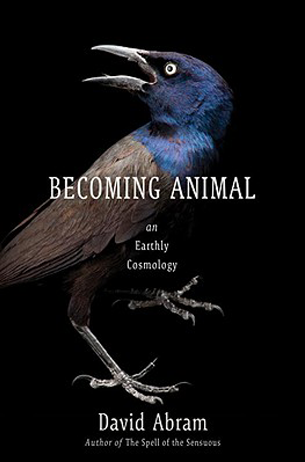 I’ve come to believe that perhaps the problem isn’t that religious experience and dogma are about a totally different world, but that we’ve been given the wrong tools for making sense of them. What if in our quest for the sacred we are looking in the wrong ways for the wrong thing in the wrong places? What if striving to transcend our animal nature, our embodiment, harms the very basis of spiritual life?
Richard Rohr suggests as much in his Franciscan focus on the everyday sacred. While not explicitly spiritual or religious, philosopher David Abram’s recent book Becoming Animal: An Earthly Cosmology explores in profound and lyrical detail what it would be like to become more rather than less animal. In the process he bends his readers’ imaginations in surprising and potentially life-changing ways. I’ve found this nuanced and richly textured book to be very helpful in healing the mind/body split that plagues western culture.
Becoming Animal is a work of “applied phenomenology.” Phenomenology begins with phenomena, with our experience of what is, and tries to understand a reality in all its complexity instead of passing judgment on the ultimate nature of reality (the domain of traditional metaphysics) or the kinds and limits of knowledge (epistemology) or the abstract nature of goodness or beauty.
Through vivid descriptions of personal experiences with animals, as well as reviewing some of the findings of animal scientists, Abram coaxes us to re-examine our deep-seated belief that we are alone in our ability to understand and communicate thoughts and feelings because we have words. He believes this bias lies behind not only our lording over nature but also our alienation from our bodies.
I love Abram’s examples of his communication with animals and plants. He recounts being in situations of potential danger when he is among a large herd of sea lions or when he comes face-to-face with a cow moose and her calf. He defused these situations by talking, singing or signaling to the animals who he is and that he means no harm. Part of what is fascinating about his remarkable examples is that Abram found himself behaving in ways that established harmony with the other creatures without thinking–his body knew the right kinds of gestures to communicate his peaceful intentions. He was shocked out of his self-consciousness (“I’m going to die!”) into his animal nature.
Abram writes that other creatures have highly developed capacities to communicate and that they share with us an understanding of friend or foe, another animal’s intentions, and whether a creature is to be trusted. Language allows humans to engage in more complex communication, perhaps, but as anyone knows who has had a pet, communicating with our non-human companions is pretty easy if we pay attention.
One way to put Abram’s point is that mind/body dualism is a self-reinforcing belief: if we believe we are minds and our bodies are “weak vessels,” we tend to live more in our minds and ignore what our bodies are telling us. The way out of this rut that has so many harmful results is to become more animal.
The communication abilities of other creatures weave them into the fabric of their surroundings rather than separate them from it. Why should it be different for us? The more we use our remarkable abilities to understand the world, the more we realize our embeddedness not only in our local places, but in the atmosphere, the grand cycles of nature, the intricate interplays of the forces of physics, and so on. The phenomenologist wants us to realize the dynamic connections we have with other beings (including humans) precisely because we are bodies. Our bodies connect us directly with the world rather than alienating us from it.
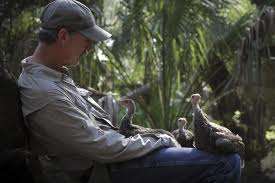
Joe Hutto’s documentary “My Life As A Turkey” describes his two years living among wild turkeys.
If you want to see what this looks like, I highly recommend My Life as a Turkey, a 2011 PBS documentary about Joe Hutto’s year as a turkey mom. Literally. Hutto hatched 16 wild turkey eggs and imprinted with each hatchling as they emerged by clucking to them and holding them. Early on he is with them 24/7, taking them afield to forage, napping and then roosting with them at the end of the day.
For nine months, until they literally fly the coop, he is their protector and comforter, but in many ways they are more his teacher than he is theirs. Hutto learns how much intelligence is hard-wired in his brood—-they easily distinguish between a wide array of snakes and have vocal variations signifying which one they spot, for example. Hutto sees how they use subtle vocal differences to communicate changes in moods, weather, available food, and well-being, and how they interact easily and differently with a wide variety of other species. And he is startled when he realizes that because of his role as mother hen to the turkeys, animals like bears, deer, squirrels and birds do not shy from him as they would if he was not with his brood.
Hutto’s ruminations about his experiences mirror Abram’s more philosophical discussion. Being fully embodied in the moment heightens his awareness of his interconnectedness with other beings and how being embodied is primary.
Here is where all this talk about becoming animal hits the theological road. God may be incomprehensible but that doesn’t mean we have to put him in a separate, transcendent realm. It’s not about transcendence. The main message of the Bible (and of the Koran) is that God is here with us now. If there is separateness or alienation it is because we are ignoring the relationship, for as Abram and Hutto suggest, it is through relationships, even with turkeys, that we jettison our narrow ego concerns and experience unity consciousness. The stuff of spiritual experience.
Watch My Life as a Turkey, and read Becoming Animal: An Earthly Cosmology
Previous Post

July 9, 2013
Barriers to Spiritual Growth
Next Post
July 23, 2013 Two Great Mysteries
Browse Our Archives
Select a Category Aging & Spirituality Amish Anabaptists Animals Apocalypse Archeological sites Art and Spirituality Awards Belgian Holy Sites birds Blessings Books Buddhism Business & Spirituality Callings Cats Celtic Cemeteries Children Christianity church Colorado Creation Death Desert Spirituality Easter Economics Education & Spirituality Egypt Episcopal Church Faith Fear Films First Nations Food Forgiveness Germany God Good & Evil Good Friday Grace Gratitude Happiness Healing Hildegard of Bingen Hinduism History Holy Rover blog Holy Sites Holy Week Horses Iceland Illness Images of God Indigenous Spiritualilty Interfaith Interfaith Dialogue Iowa Islam Israel Japan Judaism LDS Church Lent Machu Picchu Martin Luther Media Meditation Monasteries Museums Music Music and Spirituality Musings Mysticism Native American Nature New Age New Zealand Norse History/Culture/Spirituality Orthodox Paradox Paranormal Peru Philosophy Pilgrimage Poetry Politics Pop Culture Pilgrimage Sites Prayers sermons Silence Social Media Spiritual writers Spirituality and Food Spirituality and Social Media Stone Circles Thomas Merton Turkey Uncategorized Unconventional Holy Sites Utopian communities Videos Virgin Mary Wicca Work World War I Writing Zen
Select a Month August 2017 July 2017 June 2017 May 2017 April 2017 March 2017 February 2017 December 2016 November 2016 October 2016 September 2016 August 2016 July 2016 June 2016 May 2016 April 2016 March 2016 February 2016 January 2016 December 2015 July 2015 June 2015 May 2015 April 2015 March 2015 February 2015 January 2015 December 2014 November 2014 October 2014 September 2014 August 2014 July 2014 June 2014 May 2014 April 2014 March 2014 February 2014 January 2014 December 2013 October 2013 September 2013 August 2013 July 2013 June 2013 May 2013 April 2013 March 2013 February 2013 January 2013 December 2012 November 2012 October 2012 September 2012 August 2012 July 2012 June 2012 May 2012 April 2012 March 2012 February 2012 January 2012 December 2011 November 2011 October 2011 September 2011 August 2011 July 2011 June 2011 May 2011 April 2011 March 2011 February 2011 January 2011 December 2010 November 2010
Follow Us!
TAKE THE
Religious Wisdom Quiz
What does the name "Jesus" mean?
Select your answer to see how you score.
The Lord saves Prince of peace Shepherd God is love
Related posts from Holy Rover
Announcing Holy-Rover-the-Book

Bay View: A Chautauqua on Lake Michigan

The Spiritual Side of Michigan's Mackinac Island
TRENDING AT PATHEOS New Visions

Did Prayer Cure His Cancer? Or Was It...
At 4 AM one morning, Joshua W. Brown’s wife awoke to a...

8 Ways a Near-Death Experience Rewires the Soul
Does Consciousness Survive Physical Death? After 50 Years of Research, Dr. Raymond...

Holy Longing: What Our Restlessness Is Telling Us
“One can find so many pains when the rain is falling.” -John...

What this is NOT about. This blog is definitely not about...

Who said the Israelites were God’s chosen? That’s right, they did. Who...

The Spirit World Is the Real World: God...
A Monk’s Wisdom on Body and Spirit I sit with Brother Martin...
view all New Visions blogs
Ad-Free & Subscriber Log-In Subscription Support
- About Us
- 2026 Calendar
- Videos
- Podcasts
- Library of World Religions
- Faith In Media Tracker
- Advertise With Us
- Write for Us
- Privacy Policy
- Terms of Service
- Do Not Sell My Data
- Contact Us
- Radiant Digital
- Manage Newsletter Subscriptions
- Unsubscribe From Notifications
- Sitemap
Copyright 2008-2026, Patheos. All rights reserved.
Subscription Support Ad-Free & Subscriber Log-In
Follow Patheos