
BuddhistCatholicContemplativeEvangelicalGeneral ChristianHinduJewishLatter-day SaintMuslimNew VisionsProgressive Christian
Beliefs
- Buddhist
- Catholic
- Contemplative
- Evangelical
- General Christian
- Hindu
- Jewish
- Latter-day Saint
- More Voices
- Muslim
- New Visions
- Pagan
- Progressive Christian
Topics
- Religion News
- Food and Religion
- Sports and Religion
- Religious Art
- Religious Music and Entertainment
- Religious Events
- History and Religion
- Style and Religion
- Politics and Religion
- Women in Religion
- Recreation Outdoors and Religion
- Business Finance and Religion
- Careers Workplace and Religion
- Education and Religion
- Family Parenting and Religion
- Health Fitness and Religion
- Home and Religion
- Relationships and Religion
- Technology and Religion
- Travel and Religion
Columnists
- Buddhist Columnists
- Business Finance and Religion Columnists
- Careers Workplace and Religion Columnists
- Catholic Columnists
- Contemplative Columnists
- Education and Religion Columnists
- Evangelists Columnists
- Family Parenting and Religion Columnists
- General Christian Columnists
- Health Fitness and Religion Columnists
- Hindu Columnists
- History and Religion Columnists
- Home and Religion Columnists
- Jewish Columnists
- More Voices Columnists
- Latter Day Columnists
- Muslim Columnists
- New Visions Columnists
- Nonreligious Columnists
- Pagan Columnists
- Politics and Religion Columnists
- Progressive Columnists
- Recreation Outdoors and Religion Columnists
- Relationships and Religion Columnists
- Religion News Columnists
- Religious Art Columnists
- Religious Events Columnists
- Religious Music and Entertainment Columnists
- Sports and Religion Columnists
- Style and Religion Columnists
- Technology and Religion Columnists
- Travel and Religion Columnists
- Women in Religion Columnists
Resource Library
- 2026 Calendar
- Library of World Religions
- The 100 Most Holy Places on Earth
- Patheos Answers
- Podcasts
- Videos
- Faith Leaders Database
- Anglican Episcopalian
- Bahai
- Baptist
- Buddhism
- Christianity
- Confucianism
- Eastern Orthodoxy
- Hinduism
- Holiness and Pentecostal
- ISKCON
- Islam
- Judaism
- Lutheran
- Methodist
- The Church of Jesus Christ of Latter-day Saints
- New Age
- Paganism
- Presbytarian and Reformed
- Protestantism
- Religion Behind the Scenes
- Roman Catholic
- Scientology
- Shia Islam
- Sikhism
- Sufism
- Sunni Islam
- Taoism
- Zen
- See all religions
Research Tools
 Ad-Free & Subscriber Log-In Subscription Support
Ad-Free & Subscriber Log-In Subscription Support
Follow Patheos 

- Trending:
- Forgiveness
- |
- Marriage
- |
- Consciousness
- |
- Death Penalty
- |
- Election
- |
- Halloween
 Holy Rover
- Home
- New Visions
- With the Dreamers in New Harmony, Indiana
With the Dreamers in New Harmony, Indiana
Last updated on: June 6, 2013 at 11:02 pm by Lori Erickson
With the Dreamers in New Harmony, Indiana 2013-06-06T23:02:07-06:00 Lori Erickson
Patheos Explore the world's faith through different perspectives on religion and spirituality! Patheos has the views of the prevalent religions and spiritualities of the world.

New Harmony was founded as a communal religious society in 1814. (Bob Sessions photo)
The urge to retreat from the larger world and build an ideal society in the wilderness is a perennial human impulse. From the Pilgrims to the Hippies, American history has periodically produced groups that try to create these utopian communities. Their efforts almost always end in disarray and conflict, but often very interesting things happen along the way.
So it was in New Harmony, Indiana, which Bob and I visited on our way to Louisville in May. This charming little town on the bank of the Wabash River has the unusual distinction of having been home to two of these pie-in-the-sky, utopian communities. Both have long disbanded, but something of their spirit remains in the appropriately named New Harmony.
The town was founded in 1814 by the Harmonie Society, a group of Pietists who had fled religious persecution in their native Germany to settle in Pennsylvania. After a decade in the East they wanted an even more remote location for their community and bought 20,000 acres of swampy land on what was then the sparsely populated frontier of the Indiana Territory. With typical German industriousness they went to work, draining the wetlands and building nearly 200 log and brick structures. Soon the self-sufficient community was producing highly prized textiles and other goods that were sold as far away as Europe.

The historic district of New Harmony has beautiful gardens (Bob Sessions photo).
While they were practical in their work habits, their theology was mighty peculiar. They believed that the Second Coming of Christ was due any day and required members to abstain from sex and give up tobacco (no record of which was harder). But the isolation of the area eventually weighed on them, and after ten years the entire town was put up for sale as the group made plans to return to Pennsylvania.
The next strange chapter in New Harmony history brings to mind the old adage attributed to Frederick of Prussia: “If I wished to punish a province,” he said, “I would have it governed by philosophers.”
In 1824, a wealthy, Welsh-born industrialist named Robert Owen bought the settlement to establish his own utopian society, which he called New Harmony. While the first group was Christian in its basic theology, Owen’s community was founded upon an equally passionate commitment to social equality, progressive education and scientific research. He believed that the three greatest evils in society were the institution of marriage, private property and the established church of his day. He also had strong views on education, believing that children should be taken from their parents at the age of two and put into school. New Harmony would be an ideal place to put these philosophical ideas to the test.
His partner in these efforts was William Maclure, who was both a wealthy businessman and a well-known geologist. Maclure’s scientific reputation helped lure internationally known scholars and educators to the new colony, including American naturalist Thomas Say; French naturalist Charles-Alexandre Lesueur; educators Joseph Neef, Phiquepal d’Arusmont, and Madame Marie Duclos Fretageot; Dutch geologist Gerard Troost; and Frances Wright, a Scots-born early feminist.
Picture it: this small town in the middle of nowhere became a cultured and intellectual haven with a progressive educational system, a lively scientific community, and frequent lectures, balls, and concerts. It’s really quite remarkable.

A statue of St. Francis stands near a pond near the historic district in New Harmony (Bob Sessions photo).
And then, inevitably, the entire enterprise failed, just two years after it began. Owen was a great theorizer but a poor planner, and the scientists and educators in the community turned out to be pretty clueless when it came to practical matters like growing crops. The settlement was also riven by personal conflicts between its members (one guesses that all those large egos tended to bump into each other in the small confines of the village).
Arguably the most abiding influence of Owen’s experimental community came through his children. His oldest son, Robert Dale, was a U.S. Representative who helped establish the Smithsonian Institution. His brother David Dale became the chief geologist for the U.S. government. Youngest son Richard was a professor of natural sciences at Indiana University and became the first president of Purdue University. Clearly they had learned something from their visionary father.
Even after Owen’s community disbanded, some members stayed on in New Harmony, helping shape the town in unusual ways. Scientific research continued to flourish here, particularly in the field of geology, and the town kept its strong support for the arts and education. And New Harmony has yet another spiritual connection, for the ashes of the renowned philosopher and theologian Paul Tillich are interred in Tillich Park on the edge of the historic district (maybe it’s something in the water here).
All of this history was on our minds as Bob and I wandered the tree-lined streets of New Harmony on a warm and sunny day last month. Near the river, we walked amid the re-built log buildings of the original settlement, delighting in its pocket gardens and flowering bushes. With just 915 residents, New Harmony is a still a quiet and peaceful corner of the world—when people give directions here, for example, they always begin by referencing the one blinking stoplight in the center of town.
The historic district is interspersed with newer structures and an abundance of public art. A modernist-style visitor center has won a number of architectural awards (though in my opinion it seems out of place in this quiet village). The Roofless Church was designed by architect Philip Johnson and built in 1960. It has an interior of grass, walls of brick, and an open space where the roof would normally be. Maintained by the Episcopal Diocese of Indiana, it’s a popular site for weddings and sacred ceremonies.
But the most wonderful part of New Harmony are its two labyrinths (what is it about this place that they need to do everything twice?). A labyrinth, as you may know, is different from a maze. While a maze is designed to confuse, a labyrinth has a single, winding path to its center and is meant to mirror the inner pilgrimage of the soul. The original Harmonists built labyrinths in each of the towns they occupied. The one pictured below was re-created in 1939 from a design dating back to the early years of the colony. Made of hedges, its center has a small temple adorned with philosophical sayings, including “A harmonious and united society of man may be said to be a kingdom of God,” and “The golden treasure of this world to those who know how to preserve it, is Friendship.”
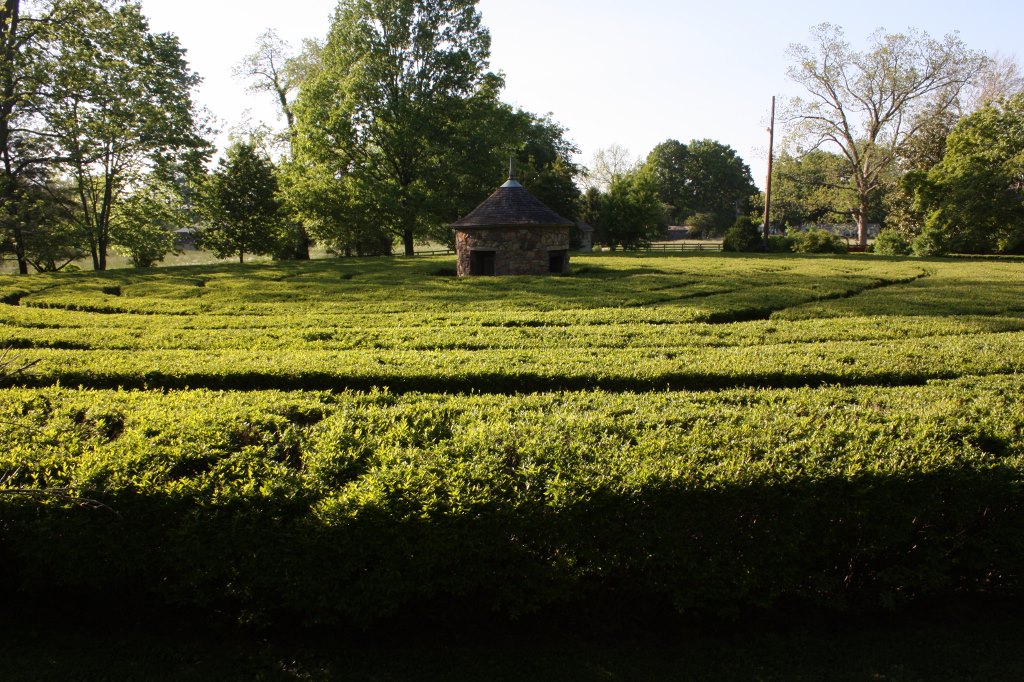
This labyrinth is based on a design of the original New Harmony settlers. (Bob Sessions photo)
But it’s the second labyrinth that impressed me the most. I’ve seen many labyrinths around the world, but I think this one is the most beautiful. Bordered on one side by tall trees and on the other by the Wabash River, it is made of polished marble, dappled by sunlight by day and moonlight at night. I walked it at dusk, serenaded by birds as twilight fell. As I slowly paced its twists and turns, I could see why this place—remote and serene, with air that somehow seems more rarefied than that of the larger world—has drawn dreamers and idealists for so many years. This is still a place for spiritual renewal.
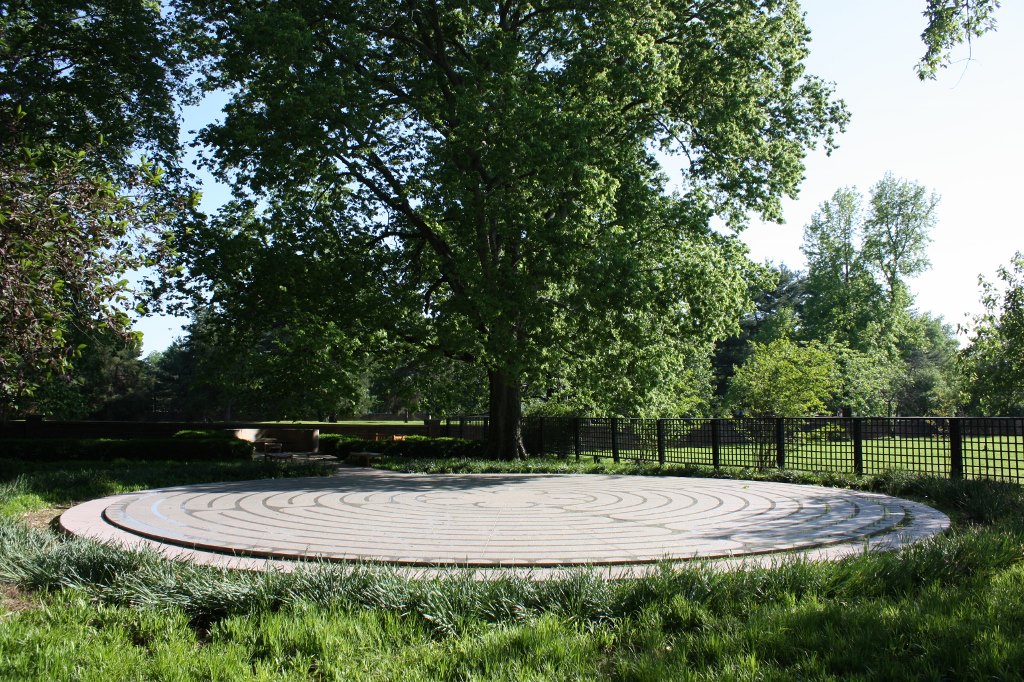
This labyrinth in New Harmony is based on a design from Chartres Cathedral in France. (Bob Sessions photo)
If you’re interested in visiting New Harmony, the New Harmony Inn is located adjacent to the historic area and includes the Red Geranium Restaurant. For more information see Historic New Harmony.
Previous Post

June 3, 2013
Ghost Hunting at Waverly Hills
Next Post
June 16, 2013 Indiana's Archabbey
Browse Our Archives
Select a Category Aging & Spirituality Amish Anabaptists Animals Apocalypse Archeological sites Art and Spirituality Awards Belgian Holy Sites birds Blessings Books Buddhism Business & Spirituality Callings Cats Celtic Cemeteries Children Christianity church Colorado Creation Death Desert Spirituality Easter Economics Education & Spirituality Egypt Episcopal Church Faith Fear Films First Nations Food Forgiveness Germany God Good & Evil Good Friday Grace Gratitude Happiness Healing Hildegard of Bingen Hinduism History Holy Rover blog Holy Sites Holy Week Horses Iceland Illness Images of God Indigenous Spiritualilty Interfaith Interfaith Dialogue Iowa Islam Israel Japan Judaism LDS Church Lent Machu Picchu Martin Luther Media Meditation Monasteries Museums Music Music and Spirituality Musings Mysticism Native American Nature New Age New Zealand Norse History/Culture/Spirituality Orthodox Paradox Paranormal Peru Philosophy Pilgrimage Poetry Politics Pop Culture Pilgrimage Sites Prayers sermons Silence Social Media Spiritual writers Spirituality and Food Spirituality and Social Media Stone Circles Thomas Merton Turkey Uncategorized Unconventional Holy Sites Utopian communities Videos Virgin Mary Wicca Work World War I Writing Zen
Select a Month August 2017 July 2017 June 2017 May 2017 April 2017 March 2017 February 2017 December 2016 November 2016 October 2016 September 2016 August 2016 July 2016 June 2016 May 2016 April 2016 March 2016 February 2016 January 2016 December 2015 July 2015 June 2015 May 2015 April 2015 March 2015 February 2015 January 2015 December 2014 November 2014 October 2014 September 2014 August 2014 July 2014 June 2014 May 2014 April 2014 March 2014 February 2014 January 2014 December 2013 October 2013 September 2013 August 2013 July 2013 June 2013 May 2013 April 2013 March 2013 February 2013 January 2013 December 2012 November 2012 October 2012 September 2012 August 2012 July 2012 June 2012 May 2012 April 2012 March 2012 February 2012 January 2012 December 2011 November 2011 October 2011 September 2011 August 2011 July 2011 June 2011 May 2011 April 2011 March 2011 February 2011 January 2011 December 2010 November 2010
Follow Us!
TAKE THE
Religious Wisdom Quiz
Where did Elisha multiply oil?
Select your answer to see how you score.
Samaria Zarephath Jericho Shunem
Related posts from Holy Rover


A Flowering of Tibetan Buddhism in Bloomington

With the Dalai Lama's Family in Indiana
TRENDING AT PATHEOS New Visions

Did Prayer Cure His Cancer? Or Was It...
At 4 AM one morning, Joshua W. Brown’s wife awoke to a...

8 Ways a Near-Death Experience Rewires the Soul
Does Consciousness Survive Physical Death? After 50 Years of Research, Dr. Raymond...

Holy Longing: What Our Restlessness Is Telling Us
“One can find so many pains when the rain is falling.” -John...

What this is NOT about. This blog is definitely not about...

Who said the Israelites were God’s chosen? That’s right, they did. Who...

The Spirit World Is the Real World: God...
A Monk’s Wisdom on Body and Spirit I sit with Brother Martin...
view all New Visions blogs
Ad-Free & Subscriber Log-In Subscription Support
- About Us
- 2026 Calendar
- Videos
- Podcasts
- Library of World Religions
- Faith In Media Tracker
- Advertise With Us
- Write for Us
- Privacy Policy
- Terms of Service
- Do Not Sell My Data
- Contact Us
- Radiant Digital
- Manage Newsletter Subscriptions
- Unsubscribe From Notifications
- Sitemap
Copyright 2008-2026, Patheos. All rights reserved.
Subscription Support Ad-Free & Subscriber Log-In
Follow Patheos