
BuddhistCatholicContemplativeEvangelicalGeneral ChristianHinduJewishLatter-day SaintMuslimNew VisionsProgressive Christian
Beliefs
- Buddhist
- Catholic
- Contemplative
- Evangelical
- General Christian
- Hindu
- Jewish
- Latter-day Saint
- More Voices
- Muslim
- New Visions
- Pagan
- Progressive Christian
Topics
- Religion News
- Food and Religion
- Sports and Religion
- Religious Art
- Religious Music and Entertainment
- Religious Events
- History and Religion
- Style and Religion
- Politics and Religion
- Women in Religion
- Recreation Outdoors and Religion
- Business Finance and Religion
- Careers Workplace and Religion
- Education and Religion
- Family Parenting and Religion
- Health Fitness and Religion
- Home and Religion
- Relationships and Religion
- Technology and Religion
- Travel and Religion
Columnists
- Buddhist Columnists
- Business Finance and Religion Columnists
- Careers Workplace and Religion Columnists
- Catholic Columnists
- Contemplative Columnists
- Education and Religion Columnists
- Evangelists Columnists
- Family Parenting and Religion Columnists
- General Christian Columnists
- Health Fitness and Religion Columnists
- Hindu Columnists
- History and Religion Columnists
- Home and Religion Columnists
- Jewish Columnists
- More Voices Columnists
- Latter Day Columnists
- Muslim Columnists
- New Visions Columnists
- Nonreligious Columnists
- Pagan Columnists
- Politics and Religion Columnists
- Progressive Columnists
- Recreation Outdoors and Religion Columnists
- Relationships and Religion Columnists
- Religion News Columnists
- Religious Art Columnists
- Religious Events Columnists
- Religious Music and Entertainment Columnists
- Sports and Religion Columnists
- Style and Religion Columnists
- Technology and Religion Columnists
- Travel and Religion Columnists
- Women in Religion Columnists
Resource Library
- 2026 Calendar
- Library of World Religions
- The 100 Most Holy Places on Earth
- Patheos Answers
- Podcasts
- Videos
- Faith Leaders Database
- Anglican Episcopalian
- Bahai
- Baptist
- Buddhism
- Christianity
- Confucianism
- Eastern Orthodoxy
- Hinduism
- Holiness and Pentecostal
- ISKCON
- Islam
- Judaism
- Lutheran
- Methodist
- The Church of Jesus Christ of Latter-day Saints
- New Age
- Paganism
- Presbytarian and Reformed
- Protestantism
- Religion Behind the Scenes
- Roman Catholic
- Scientology
- Shia Islam
- Sikhism
- Sufism
- Sunni Islam
- Taoism
- Zen
- See all religions
Research Tools
 Ad-Free & Subscriber Log-In Subscription Support
Ad-Free & Subscriber Log-In Subscription Support
Follow Patheos 

- Trending:
- Forgiveness
- |
- Marriage
- |
- Consciousness
- |
- Death Penalty
- |
- Election
- |
- Halloween
 Holy Rover
- Home
- New Visions
- A Flowering of Tibetan Buddhism in Bloomington
A Flowering of Tibetan Buddhism in Bloomington
Last updated on: February 18, 2013 at 11:15 pm by Lori Erickson
A Flowering of Tibetan Buddhism in Bloomington 2013-02-18T23:15:52-06:00 Lori Erickson
Patheos Explore the world's faith through different perspectives on religion and spirituality! Patheos has the views of the prevalent religions and spiritualities of the world.
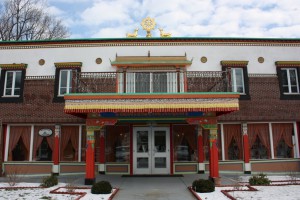
Kumbum Chamtse Ling Interfaith Temple, Bloomington, Indiana
Today I want to tell you about what has grown from the seeds planted in Indiana by Thubten Jigme Norbu, the brother of the Dalai Lama (see With the Dalai Lama’s Family in Indiana).
Norbu founded a cultural center in 1979 to promote understanding of his homeland (it was later expanded to include Mongolian culture as well). From that small foundation has grown nearly a dozen buildings on 108 wooded acres in the southwest corner of Bloomington. This is a sacred place, with a peaceful and contemplative atmosphere.
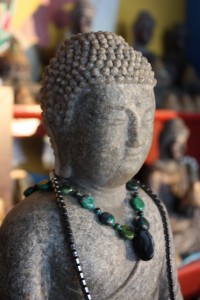
Buddha at Kumbum Chamtse Ling (Lori Erickson photo)
After passing beneath an ornately decorated Tibetan-style gate, a winding road leads to the Tibetan Mongolian Buddhist Cultural Center (TMBCC), which houses a library, gift shop, meeting room and educational displays. Here people can learn about the distinctive features of Tibetan Buddhism, which arrived in the Himalayas from India in the ninth and tenth centuries. In Tibet, it mingled with indigenous, shamanistic religious practices, producing a tradition that is distinct from other forms of Buddhism. Tibetan Buddhism places particular emphasis on the idea of bodhisattvas, Buddhas who have pledged to forego final liberation until all sentient beings are enlightened. It also stresses the development of compassion and believes that its esteemed teachers, known as lamas, have the ability to return over multiple lifetimes. While the Dalai Lama is held in highest reverence in Tibetan Buddhism, there are other reincarnated lamas who are also honored as enlightened teachers.
On a more prosaic note, I was amused to learn in the cultural center that butter sculptures are also a feature of Tibetan Buddhism. As an Iowan, I’m used to seeing such creations at the Iowa State Fair (including, most notably, a life-size butter cow). In Tibetan Buddhism, butter sculptures are traditionally made by monks from yak butter and dyes, though one can use cow butter, fat or wax if one’s yak herd is meager. The designs are typically made for the Tibetan New Year and, in addition to being beautiful in themselves, are a symbol of impermanence.
As you drive farther into the complex, you pass two tall stupas (known in Tibetan as chorten). The first stupa, the Jangchub Chorten, was dedicated by the Dalai Lama in 1987 in memory of all who have lost their lives in the fight for freedom, including the millions of Tibetans who have died since the Chinese invasion. The second shrine, the Kalachakra Stupa, was dedicated by the Dalai Lama in 1999 as a symbol of world peace. A popular spiritual practice is to walk around the dome-shaped monuments, praying and meditating.
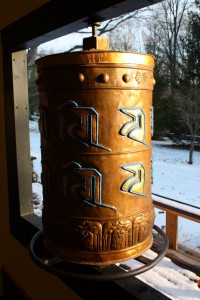
Tibetan prayer wheels at Kumbum Chamtse Ling (Lori Erickson photo)
On the grounds, I was particularly intrigued by the Mani Korlo, a structure containing large Tibetan prayer wheels. The bronze wheels come from the Kumbum Monastery in Tibet and contain more than 800,000,000 copies of the Om Mani Padme Hum mantra, a central prayer in Buddhism. It is believed that when a person reverently turns the wheel (always in the direction of the sun), blessings will be bestowed upon all suffering beings.
The heart of the center is the Kumbum Chamtse Ling Temple. Chamtse Ling means “Field of Compassion” in Tibetan, while Kumbum is the name of one of the most important monasteries in Tibet. Upstairs is a residence for monks as well as a two-room suite for the Dalai Lama (he has been here six times). Downstairs is a shrine room, bookstore, reception room and kitchen.
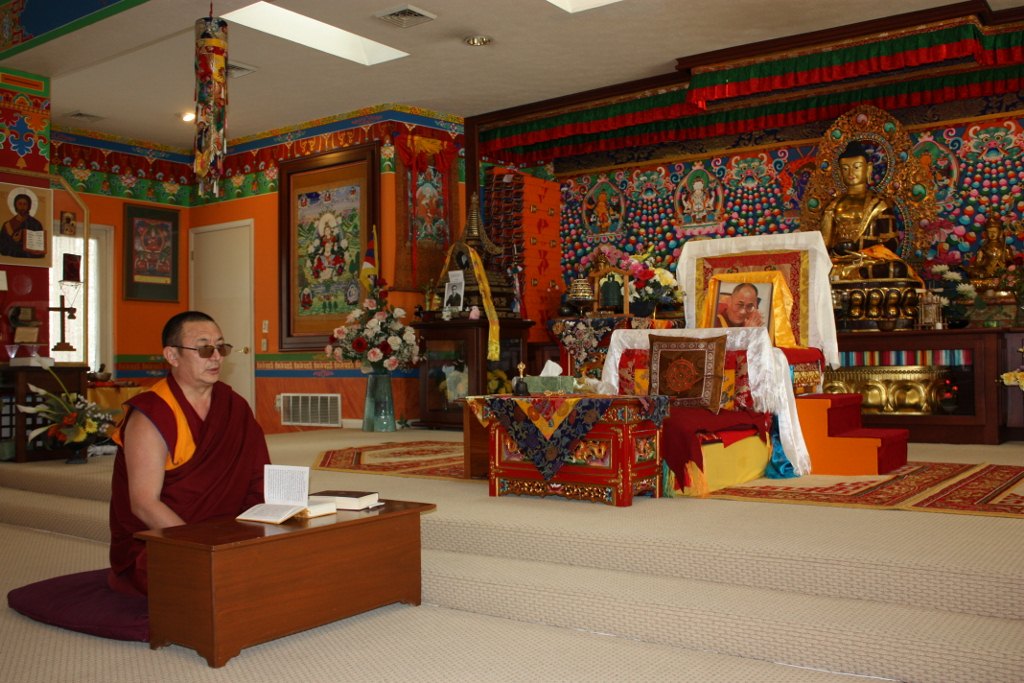
Shrine room at Kumbum Chamtse Ling Temple with spiritual teacher Geshe Kunga (Lori Erickson photo)
Before we entered the shrine room, our guide translated for us a Sanskrit sign above its entrance. “It says that all who enter this room should have a pure heart, so please lay your negative thoughts and worries outside this door,” she said. “Don’t worry–you can pick them up again on the way out.” (Would that Christian churches had a similar sign!)
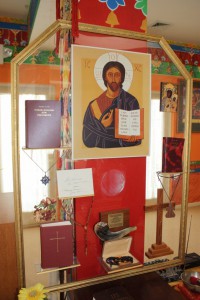
Interfaith symbols at Kumbum Chamtse Ling Temple (Lori Erickson photo)
In keeping with the temple’s interfaith mission, in addition to Buddhist statues, ornamentation and iconography, the shrine room also contains sacred objects from a variety of other faiths, from a Koran and Jewish shofar to an Episcopal Book of Common Prayer. Members of eleven traditions helped consecrate the temple in 2003: Roman Catholic, Episcopalian, Methodist, Society of Friends, Bahai, Jewish, Hindu, Shinto, Sikh, Unitarian, and Native American. Muhammed Ali, a Muslim, was a special guest who co-hosted the ceremony with His Holiness the Dalai Lama.
Fittingly, when Thubten Jigme Norbu died in 2008, his body was cremated on the grounds behind the temple and his ashes were interred at the altar. Without his efforts, this center would not exist, and his benevolent spirit is still honored here.
Recognizing the importance of this center in the worldwide Tibetan Buddhist community, the Dalai Lama has named it Kumbum West, an institution that is meant to be the western counterpart of the original Kumbum in Tibet. Buddhist teachers and scholars from around the world frequently visit here to offer teachings.
Another indication of the center’s importance is that the Dalai Lama appointed Arjia Rinpoche as its director after Norbu’s death. Arjia, a Tibetan lama of Mongolian descent, is one of the most prominent Buddhist teachers and lamas to have left Tibet (rinpoche is a term meaning “precious one” and is a title given to highly esteemed teachers). He is the author of Surviving the Dragon: A Tibetan Lama’s Account of 40 Years under Chinese Rule
So there you go: another flowering of Tibetan Buddhism in the heart of the Midwest. I like to think of those prayer wheels spinning blessings out into the world, through the neighborhoods and city streets of Bloomington, across the farm fields, over the woodlands, and far across the ocean and mountains to Tibet:
As Wind carries our prayers for Earth and All Life, may respect and love light our way.
May our hearts be filled with compassion for others and for ourselves.
May peace increase on Earth. May it begin with me.
Tibetan Buddhist Center in Bloomington
Previous Post

February 15, 2013
With the Dalai Lama's Family in Indiana
Next Post
February 20, 2013 Louisville's Festival of Faiths
Browse Our Archives
Select a Category Aging & Spirituality Amish Anabaptists Animals Apocalypse Archeological sites Art and Spirituality Awards Belgian Holy Sites birds Blessings Books Buddhism Business & Spirituality Callings Cats Celtic Cemeteries Children Christianity church Colorado Creation Death Desert Spirituality Easter Economics Education & Spirituality Egypt Episcopal Church Faith Fear Films First Nations Food Forgiveness Germany God Good & Evil Good Friday Grace Gratitude Happiness Healing Hildegard of Bingen Hinduism History Holy Rover blog Holy Sites Holy Week Horses Iceland Illness Images of God Indigenous Spiritualilty Interfaith Interfaith Dialogue Iowa Islam Israel Japan Judaism LDS Church Lent Machu Picchu Martin Luther Media Meditation Monasteries Museums Music Music and Spirituality Musings Mysticism Native American Nature New Age New Zealand Norse History/Culture/Spirituality Orthodox Paradox Paranormal Peru Philosophy Pilgrimage Poetry Politics Pop Culture Pilgrimage Sites Prayers sermons Silence Social Media Spiritual writers Spirituality and Food Spirituality and Social Media Stone Circles Thomas Merton Turkey Uncategorized Unconventional Holy Sites Utopian communities Videos Virgin Mary Wicca Work World War I Writing Zen
Select a Month August 2017 July 2017 June 2017 May 2017 April 2017 March 2017 February 2017 December 2016 November 2016 October 2016 September 2016 August 2016 July 2016 June 2016 May 2016 April 2016 March 2016 February 2016 January 2016 December 2015 July 2015 June 2015 May 2015 April 2015 March 2015 February 2015 January 2015 December 2014 November 2014 October 2014 September 2014 August 2014 July 2014 June 2014 May 2014 April 2014 March 2014 February 2014 January 2014 December 2013 October 2013 September 2013 August 2013 July 2013 June 2013 May 2013 April 2013 March 2013 February 2013 January 2013 December 2012 November 2012 October 2012 September 2012 August 2012 July 2012 June 2012 May 2012 April 2012 March 2012 February 2012 January 2012 December 2011 November 2011 October 2011 September 2011 August 2011 July 2011 June 2011 May 2011 April 2011 March 2011 February 2011 January 2011 December 2010 November 2010
Follow Us!
TAKE THE
Religious Wisdom Quiz
Who was the Roman centurion first baptized into the Christian faith?
Select your answer to see how you score.
Cornelius Gallio Felix Festus
Related posts from Holy Rover
In Sedona With the Buddha and the Holy...

With the Dreamers in New Harmony, Indiana

TRENDING AT PATHEOS New Visions

Did Prayer Cure His Cancer? Or Was It...
At 4 AM one morning, Joshua W. Brown’s wife awoke to a...

8 Ways a Near-Death Experience Rewires the Soul
Does Consciousness Survive Physical Death? After 50 Years of Research, Dr. Raymond...

Holy Longing: What Our Restlessness Is Telling Us
“One can find so many pains when the rain is falling.” -John...

What this is NOT about. This blog is definitely not about...

Who said the Israelites were God’s chosen? That’s right, they did. Who...

The Spirit World Is the Real World: God...
A Monk’s Wisdom on Body and Spirit I sit with Brother Martin...
view all New Visions blogs
Ad-Free & Subscriber Log-In Subscription Support
- About Us
- 2026 Calendar
- Videos
- Podcasts
- Library of World Religions
- Faith In Media Tracker
- Advertise With Us
- Write for Us
- Privacy Policy
- Terms of Service
- Do Not Sell My Data
- Contact Us
- Radiant Digital
- Manage Newsletter Subscriptions
- Unsubscribe From Notifications
- Sitemap
Copyright 2008-2026, Patheos. All rights reserved.
Subscription Support Ad-Free & Subscriber Log-In
Follow Patheos