
BuddhistCatholicContemplativeEvangelicalGeneral ChristianHinduJewishLatter-day SaintMuslimNew VisionsProgressive Christian
Beliefs
- Buddhist
- Catholic
- Contemplative
- Evangelical
- General Christian
- Hindu
- Jewish
- Latter-day Saint
- More Voices
- Muslim
- New Visions
- Pagan
- Progressive Christian
Topics
- Religion News
- Food and Religion
- Sports and Religion
- Religious Art
- Religious Music and Entertainment
- Religious Events
- History and Religion
- Style and Religion
- Politics and Religion
- Women in Religion
- Recreation Outdoors and Religion
- Business Finance and Religion
- Careers Workplace and Religion
- Education and Religion
- Family Parenting and Religion
- Health Fitness and Religion
- Home and Religion
- Relationships and Religion
- Technology and Religion
- Travel and Religion
Columnists
- Buddhist Columnists
- Business Finance and Religion Columnists
- Careers Workplace and Religion Columnists
- Catholic Columnists
- Contemplative Columnists
- Education and Religion Columnists
- Evangelists Columnists
- Family Parenting and Religion Columnists
- General Christian Columnists
- Health Fitness and Religion Columnists
- Hindu Columnists
- History and Religion Columnists
- Home and Religion Columnists
- Jewish Columnists
- More Voices Columnists
- Latter Day Columnists
- Muslim Columnists
- New Visions Columnists
- Nonreligious Columnists
- Pagan Columnists
- Politics and Religion Columnists
- Progressive Columnists
- Recreation Outdoors and Religion Columnists
- Relationships and Religion Columnists
- Religion News Columnists
- Religious Art Columnists
- Religious Events Columnists
- Religious Music and Entertainment Columnists
- Sports and Religion Columnists
- Style and Religion Columnists
- Technology and Religion Columnists
- Travel and Religion Columnists
- Women in Religion Columnists
Resource Library
- 2026 Calendar
- Library of World Religions
- The 100 Most Holy Places on Earth
- Patheos Answers
- Podcasts
- Videos
- Faith Leaders Database
- Anglican Episcopalian
- Bahai
- Baptist
- Buddhism
- Christianity
- Confucianism
- Eastern Orthodoxy
- Hinduism
- Holiness and Pentecostal
- ISKCON
- Islam
- Judaism
- Lutheran
- Methodist
- The Church of Jesus Christ of Latter-day Saints
- New Age
- Paganism
- Presbytarian and Reformed
- Protestantism
- Religion Behind the Scenes
- Roman Catholic
- Scientology
- Shia Islam
- Sikhism
- Sufism
- Sunni Islam
- Taoism
- Zen
- See all religions
Research Tools
 Ad-Free & Subscriber Log-In Subscription Support
Ad-Free & Subscriber Log-In Subscription Support
Follow Patheos 

- Trending:
- Forgiveness
- |
- Marriage
- |
- Consciousness
- |
- Death Penalty
- |
- Election
- |
- Halloween
 Holistic Spirituality
- Home
- Pagan
- The Twelve Deities
The Twelve Deities
Last updated on: October 18, 2026 at 1:14 am by Tony Mierzwicki
The Twelve Deities 2026-10-18T01:14:44-08:00 Tony Mierzwicki
Patheos Explore the world's faith through different perspectives on religion and spirituality! Patheos has the views of the prevalent religions and spiritualities of the world.
When we talk about Greek religion, we often begin with the dodekatheion—the Twelve Gods / Deities, which can be traced back no further than the late 6th century BCE. It is not as a fixed set of twelve, as the identity of the twelve varied from place to place.
In 1987, Charlotte R Long’s The Twelve Gods of Greece and Rome identified 54 different divinities who were, at one time or another, counted among a “Twelve.”
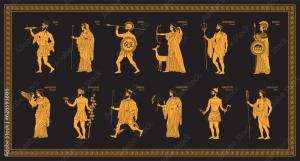
This may well come as a surprise to those who are familiar with only the two most common variants: Zeus, Hera, Poseidon, Demeter, Athena, Apollo, Artemis, Ares, Aphrodite, Hephaistos, and Hermes, with either Hestia or Dionysos completing the twelve.
Sometimes we have
- Complete rosters: evidence allowing us to name every member of a particular Twelve.
- Partial rosters: evidence identifying some members, but not all.
- Collective attestations: a dedication, sanctuary, or text referring to “the Twelve Gods” without identifying their individual names.
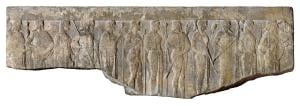
Fragment of a Hellenistic relief (1st century BCE–1st century CE) depicting the twelve Olympians carrying their attributes in procession; from left to right: Hestia (scepter), Hermes (winged cap and staff), Aphrodite (veiled), Ares (helmet and spear), Demeter (scepter and wheat sheaf), Hephaistos (staff), Hera (scepter), Poseidon (trident), Athena (owl and helmet), Zeus (thunderbolt and staff), Artemis (bow and quiver) and Apollo (lyre) from the Walters Art Museum in Baltimore, Maryland.
The Twelve Deities: A Fixed Number, a Variable Membership
The number twelve could remain fixed while the membership and arrangement varied. Different sanctuaries, artistic representations, and philosophical treatments could organize divine completeness differently. A twelvefold framework could accommodate different local traditions and different religious purposes.
I want to compare six ancient examples. Three examples come from Greece, two from Rome, and one from late-antique Greek philosophy.
First: Athens, the Parthenon Frieze
Our first example is the east frieze of the Parthenon at Athens, carved in the fifth century BCE, around the 440s.
Here we find twelve seated deities: Zeus, Hera, Poseidon, Demeter, Athena, Apollo, Artemis, Ares, Aphrodite, Hephaistos, Hermes, and Dionysos.
This is one of the two most familiar modern lists, the Dionysos-inclusive membership
This is an artistic representation, not a surviving membership inscription from the Athenian Altar of the Twelve Gods.
Dionysos is included; Hestia is not.
Roughly a century earlier, the Altar of the Twelve Gods was dedicated in the Athenian Agora around 522 BC. While the exact identities of the twelve gods are uncertain, some researchers believe that Hestia may have been one of the twelve. However, no inscription from the altar explicitly names her, and the list remains debated.
There is a familiar story that Hestia surrendered her seat to Dionysos, but this is not formally verified in surviving ancient sources.
Second: Olympia and Its Paired Altars
Our second example comes from Olympia.
In Pindar’s Olympian Odes, the phrase “six double altars” means six altars, each with two sides or faces, making twelve in total, which were associated with the Twelve.
A detailed account attributed to Herodorus of Heraclea, an author active around 400 BCE, identifies the six pairs of gods at Olympia as: The pairs are Zeus and Poseidon; Hera and Athena; Hermes and Apollo; the Charites and Dionysos; Artemis and Alpheios; and Kronos and Rhea.
This is substantially different from the Parthenon group. While this list includes the eight Olympians: Zeus, Poseidon, Hera, Athena, Hermes, Apollo, Artemis, and Dionysos, it also contains three clear non-Olympians.
Alpheios is the river deity associated with Olympia, bringing local geography into the arrangement.
Kronos and Rhea belong to the older divine generation – they were the king and queen of the Titans, and parents of the first generation of Olympians. Their presence challenges the assumption that every Twelve must consist exclusively of the younger Olympians.
The Charites [KHARITES or Graces] are particularly interesting. They are three goddesses of grace, beauty, adornment, joy, mirth, festivity, dance and song. They are a collective group occupying one position in the twelvefold scheme.
So, twelve does not necessarily mean twelve individual deities of exactly the same category.
We should also distinguish the date of Herodorus from the foundation date of the cult. This arrangement may well predate the literary tradition of around 400 BCE.
Third: The Bosporus Sanctuary Tradition
Our third example comes from the sanctuary traditions of the Bosporus, at the entrance to the Black Sea.
The Scholia on Apollonius Rhodius’ Argonautica (1st century CE and later) states:
“And Herodoros says that the Argonauts sacrificed at the altar, where Argos the son of Phrixos had sacrificed on his return. The Twelve Gods are Zeus, Poseidon, Hades, Hermes, Hephaistos, Apollo, Demeter, Hestia, Ares, Aphrodite, Hera, and Athena.”
Its foundation belongs to legendary Argonautic tradition, so we should not assign a precise historical foundation date.
Hades and Hestia are present. Artemis and Dionysos are absent. [Personally, I love having Hades in the Twelve as he is the brother of Zeus and Poseidon and each was given one third of the world to rule over.]
Hades was not categorically excluded from every ancient Twelve just because his realm lay below, rather than on, Olympus.
Fourth: Rome, the List of Ennius
Our fourth example comes from Rome and the poet Ennius, in the late third century BCE in a paraphrase of an unknown Greek poet:
His enumeration gives Juno, Vesta, Minerva, Ceres, Diana, Venus, Mars, Mercury, Jupiter, Neptune, Vulcan, and Apollo.
Their conventional Greek equivalents are Hera, Hestia, Athena, Demeter, Artemis, Aphrodite, Ares, Hermes, Zeus, Poseidon, Hephaistos, and Apollo.
This is the familiar Hestia-inclusive membership.
Of course, Roman deities are not simply Greek deities wearing different names. For this table, the equivalences allow us to compare the groupings; they do not erase differences between the two religious traditions.
Fifth: Rome, the Divine Banquet of 217 BCE
Our fifth example also comes from Rome, but it concerns a particular public ceremony.
Livy records a divine banquet, or lectisternium, held in 217 BCE. The deities were arranged on six couches.
“Six couches were publicly exhibited; one for Jupiter and Juno, another for Neptune and Minerva, a third for Mars and Venus, a fourth for Apollo and Diana, a fifth for Vulcan and Vesta, and the sixth for Mercury and Ceres.”
Their conventional Greek equivalents are Zeus and Hera; Poseidon and Athena; Ares and Aphrodite; Hephaistos and Hestia; and Hermes and Demeter.
The membership matches Ennius’ list, giving us the familiar Hestia-inclusive membership, but the evidence is different.
Ennius gives a poetic enumeration. Livy describes a ritual arrangement.
Here, the twelve are organized into six male–female pairs. Their placement is part of the ceremony, not simply a list of important names.
Livy may well have been describing a much earlier tradition.
Sixth: Sallustius in Late Antiquity
Our sixth example comes from Sallustius’ On the Gods and the World, written in the fourth century CE.
This is not a city’s cult roster. It is a philosophical account of twelve deities governing the cosmos.
Sallustius divides them into four functional triads.
Jupiter, Neptune, and Vulcan, fabricate the world; Ceres, Juno, and Diana, animate it; Mercury, Venus, and Apollo, harmonize it; and, lastly, Vesta, Minerva, and Mars, preside over it with a guardian power.
Their conventional Greek equivalents are:
Zeus, Poseidon, and Hephaistos fabricate the world.
Demeter, Hera, and Artemis animate it.
Apollo, Aphrodite, and Hermes harmonize it.
Hestia, Athena, and Ares preside over it with a guardian power.
The membership again matches the Hestia-inclusive arrangement, but the interpretation is distinctive.
The deities are organized according to cosmic activities, not merely assembled as characters in a divine household. It shows how an inherited twelvefold grouping could become the basis of a philosophical theology.
Comparison of the six examples
We can now compare these six examples.
Six names recur throughout: Zeus, Hera, Poseidon, Athena, Apollo, and Hermes.
Demeter, Artemis, Ares, Aphrodite and Hephaistos appear five times each.
Hestia appears four times.
Dionysos appears twice.
Hades, Kronos, Rhea, Alpheios and the Charites, collectively appear once.
Artemis is absent from the Bosporus list, yet she was central at Ephesos. Demeter is absent from the Olympian arrangement, yet she and Persephone were central to the Eleusinian Mysteries.
Olympia includes a river, an older divine generation, and a collective group. The Bosporus tradition includes Hades. Athens includes Dionysos. Other arrangements include Hestia.
The Twelve were a way of representing divine order—not a complete inventory of the deities. Their number could suggest completeness while their membership reflected different places, purposes, and theological understandings.
Comparison Table
The six shared names appear first; the remaining deities are ordered by their frequency across these six attestations. Each column contains twelve positions.
Deity Athens: Parthenon, c. 440 BCE Olympia: Herodorus tradition, c. 400 BCE reporting author Bosporus: sanctuary tradition, foundation date uncertain Rome: Ennius, late 3rd–early 2nd c. BCE Rome: banquet of 217 BCE, reported by Livy Sallustius, 4th c. CE Present in Zeus ✓ ✓ ✓ ✓ ✓ ✓ 6/6 Hera ✓ ✓ ✓ ✓ ✓ ✓ 6/6 Poseidon ✓ ✓ ✓ ✓ ✓ ✓ 6/6 Athena ✓ ✓ ✓ ✓ ✓ ✓ 6/6 Apollo ✓ ✓ ✓ ✓ ✓ ✓ 6/6 Hermes ✓ ✓ ✓ ✓ ✓ ✓ 6/6 Demeter ✓ — ✓ ✓ ✓ ✓ 5/6 Artemis ✓ ✓ — ✓ ✓ ✓ 5/6 Ares ✓ — ✓ ✓ ✓ ✓ 5/6 Aphrodite ✓ — ✓ ✓ ✓ ✓ 5/6 Hephaistos ✓ — ✓ ✓ ✓ ✓ 5/6 Hestia — — ✓ ✓ ✓ ✓ 4/6 Dionysos ✓ ✓ — — — — 2/6 Hades — — ✓ — — — 1/6 Kronos — ✓ — — — — 1/6 Rhea — ✓ — — — — 1/6 Alpheios — ✓ — — — — 1/6 Charites, collectively — ✓ — — — — 1/6 Total positions 12 12 12 12 12 12
Column evidence: Athens; Olympia; Bosporus; Ennius; Livy; Sallustius.
The table represents six selected complete attestations, not an exhaustive catalogue of every ancient Twelve-God tradition.
Bibliography
Jan N Bremmer (ed), Andrew Erskine (ed). Canonizing the Pantheon: The Dodekatheon in Greek Religion and its Origins.
Charlotte R Long. The Twelve Gods of Greece and Rome
Ira S Mark. “The Gods on the East Frieze of the Parthenon”
https://www.ascsa.edu.gr/uploads/media/hesperia/147709.pdf
John McK Camp. Gods and Heroes in the Athenian Agora. American School of Classical Studies. (1980). p17.
https://www.ascsa.edu.gr/news/newsDetails/new-publication-gods-and-heroes-in-the-athenian-agora
Fabienne S Morgana. “Hestia & Dionysos”
https:// fabiennesmorgana.com/2023/09/08/hestia-dionysos/
Frederick Apthorp Paley (translated). The Odes of Pindar, Olympian Ode V (1868).
https://en.wikisource.org/wiki/Odes_of_Pindar_%28Paley%29/Olympian_Ode_5
Daniel Ogden. A Companion to Greek Religion, p 43.
https://books.google.com/books?id=yOQtHNJJU9UC&pg=PA43#v=onepage&q&f=false
Alfonso Morenio. Hieron: The Ancient Mouth Sanctuary of the Black Sea. Hesperia 77 (2OO8). p 693
https://www.ascsa.edu.gr/uploads/media/hesperia/40205765.pdf
Apuleius, De Deo Socratis — Fragment 45 (Ennius ed., 2.28–2.29)
https://tacitus15.thelatinlibrary.com/apuleius/apuleius.deosocratis.shtml
Livy. Ab Urbe Condita Libri [From the Founding of the City]. Translated by Rev Canon Roberts. Book 22: The Disaster of Cannae. (1905)
https://en.wikisource.org/wiki/From_the_Founding_of_the_City/Book_22
Sallustius. On the Gods and the World. translated by Thomas Taylor. Chap. VI.
https://en.wikisource.org/wiki/Sallust_On_the_Gods_and_the_World/Sallust_on_the_Gods_and_the_World
Tony Mierzwicki
Author of Hellenismos: Practicing Greek Polytheism Today and Graeco-Egyptian Magick: Everyday Empowerment.
Previous Post

July 24, 2026
The Odyssey
Browse Our Archives
Select a Category Uncategorized
Select a Month October 2026 July 2026 December 2025 November 2025 September 2025 March 2025 February 2025 January 2025 August 2024 July 2024 June 2024 April 2024 March 2024 February 2024 January 2024 December 2023 September 2023 June 2023 May 2023 April 2023 February 2023 January 2023 December 2022 November 2022 October 2022 September 2022 August 2022 July 2022 June 2022 March 2022 January 2022 December 2021 October 2021 September 2021 August 2021 July 2021 June 2021 May 2021 April 2021 March 2021 February 2021 January 2021 December 2020 November 2020 September 2020 August 2020 July 2020 June 2020 March 2020 March 2019 February 2019
Follow Us!
TAKE THE
Religious Wisdom Quiz
Who is traditionally believed to have written the book of Ecclesiastes?
Select your answer to see how you score.
David Ezra Solomon Isaiah
Related posts from Holistic Spirituality

The Intuitive’s Oracle by Angela Orora Medway-Smith, et...

TRENDING AT PATHEOS Pagan

When we talk about Greek religion, we often begin with the dodekatheion—the...

I was recently chatting with someone on Instagram. She asked me what...

While there are many people who share their results, the end of...
On July 23, I saw Christopher Nolan's The Odyssey which is Homer’s...

As I write this two big events have just finished up. One...

Restoring the Watershed of Divine Love
Perhaps cooperation is not something we manufacture through legislation, ideology, or moral...
view all Pagan blogs
Ad-Free & Subscriber Log-In Subscription Support
- About Us
- 2026 Calendar
- Videos
- Podcasts
- Library of World Religions
- Faith In Media Tracker
- Advertise With Us
- Write for Us
- Privacy Policy
- Terms of Service
- Do Not Sell My Data
- Contact Us
- Radiant Digital
- Manage Newsletter Subscriptions
- Unsubscribe From Notifications
- Sitemap
Copyright 2008-2026, Patheos. All rights reserved.
Subscription Support Ad-Free & Subscriber Log-In
Follow Patheos