
BuddhistCatholicContemplativeEvangelicalGeneral ChristianHinduJewishLatter-day SaintMuslimNew VisionsProgressive Christian
Beliefs
- Buddhist
- Catholic
- Contemplative
- Evangelical
- General Christian
- Hindu
- Jewish
- Latter-day Saint
- More Voices
- Muslim
- New Visions
- Pagan
- Progressive Christian
Topics
- Religion News
- Food and Religion
- Sports and Religion
- Religious Art
- Religious Music and Entertainment
- Religious Events
- History and Religion
- Style and Religion
- Politics and Religion
- Women in Religion
- Recreation Outdoors and Religion
- Business Finance and Religion
- Careers Workplace and Religion
- Education and Religion
- Family Parenting and Religion
- Health Fitness and Religion
- Home and Religion
- Relationships and Religion
- Technology and Religion
- Travel and Religion
Columnists
- Buddhist Columnists
- Business Finance and Religion Columnists
- Careers Workplace and Religion Columnists
- Catholic Columnists
- Contemplative Columnists
- Education and Religion Columnists
- Evangelists Columnists
- Family Parenting and Religion Columnists
- General Christian Columnists
- Health Fitness and Religion Columnists
- Hindu Columnists
- History and Religion Columnists
- Home and Religion Columnists
- Jewish Columnists
- More Voices Columnists
- Latter Day Columnists
- Muslim Columnists
- New Visions Columnists
- Nonreligious Columnists
- Pagan Columnists
- Politics and Religion Columnists
- Progressive Columnists
- Recreation Outdoors and Religion Columnists
- Relationships and Religion Columnists
- Religion News Columnists
- Religious Art Columnists
- Religious Events Columnists
- Religious Music and Entertainment Columnists
- Sports and Religion Columnists
- Style and Religion Columnists
- Technology and Religion Columnists
- Travel and Religion Columnists
- Women in Religion Columnists
Resource Library
- 2026 Calendar
- Library of World Religions
- The 100 Most Holy Places on Earth
- Patheos Answers
- Podcasts
- Videos
- Faith Leaders Database
- Anglican Episcopalian
- Bahai
- Baptist
- Buddhism
- Christianity
- Confucianism
- Eastern Orthodoxy
- Hinduism
- Holiness and Pentecostal
- ISKCON
- Islam
- Judaism
- Lutheran
- Methodist
- The Church of Jesus Christ of Latter-day Saints
- New Age
- Paganism
- Presbytarian and Reformed
- Protestantism
- Religion Behind the Scenes
- Roman Catholic
- Scientology
- Shia Islam
- Sikhism
- Sufism
- Sunni Islam
- Taoism
- Zen
- See all religions
Research Tools
 Ad-Free & Subscriber Log-In Subscription Support
Ad-Free & Subscriber Log-In Subscription Support
Follow Patheos 

- Trending:
- Forgiveness
- |
- Marriage
- |
- Consciousness
- |
- Death Penalty
- |
- Election
- |
- Halloween
 Holistic Spirituality
- Home
- Pagan
- The Odyssey
The Odyssey
Last updated on: July 24, 2026 at 3:57 pm by Tony Mierzwicki
The Odyssey 2026-07-24T15:57:49-08:00 Tony Mierzwicki
Patheos Explore the world's faith through different perspectives on religion and spirituality! Patheos has the views of the prevalent religions and spiritualities of the world.
On July 23, I saw Christopher Nolan’s The Odyssey which is Homer’s epic about Odysseus’ return to Ithaca after the Trojan War. This movie came out on July 17, 2026. It has a stellar cast: Matt Damon, Tom Holland, Anne Hathaway, Robert Pattinson, Lupita Nyong’o, Zendaya and Charlize Theron.
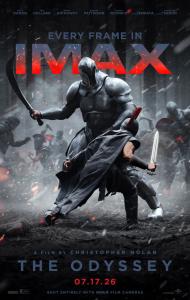
The movie generated a huge amount of controversy prior to its release and polarized potential audiences. I am so glad that I ignored the negativity and gave it a chance. I really enjoyed the movie. Despite knowing how the story unfolded and ended, it had a number of nail-biting moments for me!
Prior to release
On the one hand, given the cast and Christopher Nolan’s capacity for producing spectacular epics many, myself included, had high hopes for it. Major sequences were filmed in Greece, especially in the Peloponnese, including Methoni Castle, Voidokilia Beach, Nestor’s Cave, Almyrolaka Beach, Pylos, and Acrocorinth. These impart a feeling of authenticity to the movie. Controversy always generates publicity and the movie has surely reinvigorated interest in Homer and ancient Greece.
On the other hand, the film has also generated considerable negativity. There are a number of unconventional casting decisions, including having Lupita Nyong’o play Helen of Troy, having Elliot Page play Sinon – a Greek soldier, and having Rapper Travis Scott play a bard. There in an absence of Greeks in starring roles. Other controversies include costume design, modern dialogue, and the use of American accents.
In Greece, Professor Vana Nikolaidou criticized the casting and argued that interpreting Homer through modern ideological frameworks risks altering the historical and literary context of the epics. By contrast, Greek Culture Minister Lina Mendoni emphasized artistic freedom, arguing that governments should not impose ideological or artistic criteria on filmmakers.
And there lies the crux of the issue – should movies prioritize historical accuracy when adapting classic epics, or should directors have broad creative freedom? At the end of the day, it should be remembered that we are dealing with a film rather than a documentary.
Elon Musk wrote on X: “Before this year ends, Grok Imagine will make a full-length movie of The Odyssey that is historically accurate and true to the art of Homer.” Musk also seems open to the idea of giving director Mel Gibson $100 million to make a “historically accurate” Odyssey.
Significance of Homer to the Ancient Greeks
The two epic poems of Homer [Homēros], the Iliad (about the ten-year siege of Troy by the Greeks) and the Odyssey (the tale of Odysseus’ ten-year journey home after the siege of Troy) are among the greatest texts of Western culture.
According to Valerie M Warrior, Greek Religion [p13], it is currently generally agreed that the siege of Troy took place c 1200 BCE, and Homer’s epics were composed in the second half of the eighth century BCE, reaching their final form in the sixth century BCE.
According to Francois Chamoux, Civilization of Greece [p54–65], the Greeks introduced the innovation of recording vowels when they adapted the Phoenician (or Late Proto-Canaanite as the case may be) alphabet. The first two literary works to be recorded are Homer’s the Iliad and the Odyssey. This suggests that the Greek alphabet came into being to record Homer’s writings. Everything else followed.
According to Robert Garland, in Religion and the Greeks, the Greeks did not have any sacred literature to parallel the Christian Bible. Such a sweeping statement obviously hinges on exactly how the Bible is viewed.
There are, however, good reasons to consider Homer’s the Iliad and the Odyssey to be the ancient Greek equivalent of the Bible. These epic poems were the basis of formal school education and permeated the culture. Fifth-century Athenian schoolboys would memorize the poems. Every question, whether it concerned morals or appropriate behavior, in the human realm, the realm of the divine, as well as the interaction between these realms, could be answered by quoting verses from Homer. Homer’s writings were seen as a repository of all wisdom and knowledge, and provided inspiration for artists, poets, politicians, and philosophers, as well as providing guidance on duties toward the family and the deities. They also gave the Greeks a sense of unity despite the never-ending squabbling between the various city-states. Homer was the law, religion, and entertainment of Hellenic Greece.
Thoughts on the Movie
I felt that Christopher Nolan was mostly respectful to the source text.
The central theme of the Odyssey is Odysseus’s ten-year journey home after the Trojan War, filled with incredible adventures after which he returns to Ithaca, to regain his throne, his wife Penelope who is besieged by numerous suitors competing for her hand in marriage, and reestablish a relationship with their son Telemachus who has been struggling to protect the household.
I loved all the esoteric references. Athena is featured throughout, while Poseidon, Zeus and Helios (who loses cattle to Odysseus’ crew) and mentioned. We encounter the witch, Circe who transforms his men into pigs, but is persuaded to allow them to return to their original form. We experience a necromancy where a portal is opened to the Underworld and the prophet Tiresias is asked for guidance. We meet the nymph Calipso. We have the Cyclops Polyphemus, the Sirens, and the list goes on. There is so much here for lovers of mythology!
Homer was writing about events in the Mycenaean period, or the Late Bronze Age, which spanned approximately 1600 BCE to 1100 BCE in Greece. Critics have pointed out that the armor, costumes and weapons were inconsistent with archaeological evidence from the Bronze Age. The ships appear more Viking than Greek. In fact one vessel is Glad av Gillberga, a traditional Viking longship replica owned by the Vikingaleden association in Värmland, Sweden. It was loaned to Universal for about six months during filming, serving as one of the escort ships in the film’s flotilla. It was returned damaged, and Universal Pictures are refusing to pay for repairs.
Personally, I would have preferred authentic reproductions of Bronze Age armor, costumes, weapons and ships. I would rather immerse myself in something authentic rather than reimagined.
I did not have a problem with the accents and dialogue. I think that having familiar speech made the movie more immersive.
I previously pointed out that Homeric writings served to unify squabbling ancient Greek city-states. It can be argued that having a diverse cast could serve to unify all nations. Such a view would mean that while Homeric writings have a Greek origin, they now belong to the world.
On a related note, consider the success of “Hamilton,” the biggest sensation in Broadway history which was Lin-Manuel Miranda’s Pulitzer-winning refashioning of the Founding Fathers with an original cast of mostly Black and brown faces assuming the roles of historic white figures. There is definitely a market for reimagining history.

My recommendation is to ignore the negative reviews and make up your own mind. I hope you enjoy the movie as much as I did.
The primary reference text for this article is:
Tony Mierzwicki, Hellenismos: Practicing Greek Polytheism Today
Tony Mierzwicki
Author of Hellenismos: Practicing Greek Polytheism Today and Graeco-Egyptian Magick: Everyday Empowerment.
Previous Post
December 13, 2025
Browse Our Archives
Select a Category Uncategorized
Select a Month July 2026 December 2025 November 2025 September 2025 March 2025 February 2025 January 2025 August 2024 July 2024 June 2024 April 2024 March 2024 February 2024 January 2024 December 2023 September 2023 June 2023 May 2023 April 2023 February 2023 January 2023 December 2022 November 2022 October 2022 September 2022 August 2022 July 2022 June 2022 March 2022 January 2022 December 2021 October 2021 September 2021 August 2021 July 2021 June 2021 May 2021 April 2021 March 2021 February 2021 January 2021 December 2020 November 2020 September 2020 August 2020 July 2020 June 2020 March 2020 March 2019 February 2019
Follow Us!
TAKE THE
Religious Wisdom Quiz
Who was turned into a pillar of salt?
Select your answer to see how you score.
Sarah Lot Lot’s wife Rachel
Related posts from Holistic Spirituality

The Intuitive’s Oracle by Angela Orora Medway-Smith, et...


Do Christian Rights Need to be Protected?
TRENDING AT PATHEOS Pagan

I was recently chatting with someone on Instagram. She asked me what...

While there are many people who share their results, the end of...

On July 23, I saw Christopher Nolan's The Odyssey which is Homer’s...

As I write this two big events have just finished up. One...

Restoring the Watershed of Divine Love
Perhaps cooperation is not something we manufacture through legislation, ideology, or moral...

Many UUs don’t pray because of bad experiences in a previous religion,...
view all Pagan blogs
Ad-Free & Subscriber Log-In Subscription Support
- About Us
- 2026 Calendar
- Videos
- Podcasts
- Library of World Religions
- Faith In Media Tracker
- Advertise With Us
- Write for Us
- Privacy Policy
- Terms of Service
- Do Not Sell My Data
- Contact Us
- Radiant Digital
- Manage Newsletter Subscriptions
- Unsubscribe From Notifications
- Sitemap
Copyright 2008-2026, Patheos. All rights reserved.
Subscription Support Ad-Free & Subscriber Log-In
Follow Patheos