
BuddhistCatholicContemplativeEvangelicalGeneral ChristianHinduJewishLatter-day SaintMuslimNew VisionsProgressive Christian
Beliefs
- Buddhist
- Catholic
- Contemplative
- Evangelical
- General Christian
- Hindu
- Jewish
- Latter-day Saint
- More Voices
- Muslim
- New Visions
- Pagan
- Progressive Christian
Topics
- Religion News
- Food and Religion
- Sports and Religion
- Religious Art
- Religious Music and Entertainment
- Religious Events
- History and Religion
- Style and Religion
- Politics and Religion
- Women in Religion
- Recreation Outdoors and Religion
- Business Finance and Religion
- Careers Workplace and Religion
- Education and Religion
- Family Parenting and Religion
- Health Fitness and Religion
- Home and Religion
- Relationships and Religion
- Technology and Religion
- Travel and Religion
Columnists
- Buddhist Columnists
- Business Finance and Religion Columnists
- Careers Workplace and Religion Columnists
- Catholic Columnists
- Contemplative Columnists
- Education and Religion Columnists
- Evangelists Columnists
- Family Parenting and Religion Columnists
- General Christian Columnists
- Health Fitness and Religion Columnists
- Hindu Columnists
- History and Religion Columnists
- Home and Religion Columnists
- Jewish Columnists
- More Voices Columnists
- Latter Day Columnists
- Muslim Columnists
- New Visions Columnists
- Nonreligious Columnists
- Pagan Columnists
- Politics and Religion Columnists
- Progressive Columnists
- Recreation Outdoors and Religion Columnists
- Relationships and Religion Columnists
- Religion News Columnists
- Religious Art Columnists
- Religious Events Columnists
- Religious Music and Entertainment Columnists
- Sports and Religion Columnists
- Style and Religion Columnists
- Technology and Religion Columnists
- Travel and Religion Columnists
- Women in Religion Columnists
Resource Library
- 2026 Calendar
- Library of World Religions
- The 100 Most Holy Places on Earth
- Patheos Answers
- Podcasts
- Videos
- Faith Leaders Database
- Anglican Episcopalian
- Bahai
- Baptist
- Buddhism
- Christianity
- Confucianism
- Eastern Orthodoxy
- Hinduism
- Holiness and Pentecostal
- ISKCON
- Islam
- Judaism
- Lutheran
- Methodist
- The Church of Jesus Christ of Latter-day Saints
- New Age
- Paganism
- Presbytarian and Reformed
- Protestantism
- Religion Behind the Scenes
- Roman Catholic
- Scientology
- Shia Islam
- Sikhism
- Sufism
- Sunni Islam
- Taoism
- Zen
- See all religions
Research Tools
 Ad-Free & Subscriber Log-In Subscription Support
Ad-Free & Subscriber Log-In Subscription Support
Follow Patheos 

- Trending:
- Forgiveness
- |
- Marriage
- |
- Consciousness
- |
- Death Penalty
- |
- Election
- |
- Halloween
 Holistic Spirituality
- Home
- Pagan
- Dionysos and the Paris Olympics Opening Ceremony
Dionysos and the Paris Olympics Opening Ceremony
Last updated on: August 16, 2024 at 4:42 pm by Tony Mierzwicki
Dionysos and the Paris Olympics Opening Ceremony 2024-08-16T16:42:21-08:00 Tony Mierzwicki
Patheos Explore the world's faith through different perspectives on religion and spirituality! Patheos has the views of the prevalent religions and spiritualities of the world.
The Paris Olympics opening ceremony has led to a firestorm of controversy due to a number of misunderstandings. The scene in question was a celebration of diversity and inclusion which honored Dionysos. This is in keeping with the original Olympics, which by the end of the 6th century BCE had become the most famous of all Greek sporting festivals and were dedicated to Zeus.
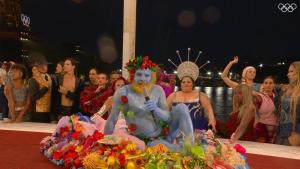
The Paris Olympics opening ceremony
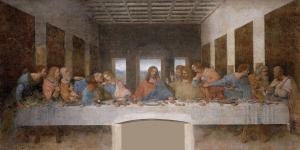
According to Associated Press, the Paris Olympics opening ceremony was possibly the most flamboyant, diversity-celebrating, LGBTQ+-visible event ever. It featured a controversial tableau [a group of models or motionless figures representing a scene from a story or from history] that to many people, evoked Leonardo da Vinci’s The Last Supper, but modified into a fashion show involving dancers, drag queens and a DJ.
The organizers apologized to anyone who was offended but defended the concept behind it.
The ceremony’s artistic director Mr Thomas Jolly had distanced his scene from any “Last Supper” parallels after the ceremony, saying it was meant to celebrate diversity and pay tribute to feasting and French gastronomy.
Mr Jolly said, “My wish isn’t to be subversive, nor to mock or to shock. Most of all, I wanted to send a message of love, a message of inclusion and not at all to divide.”
[“A practically naked singer painted blue made thinly veiled references to his body parts. Blonde-bearded drag queen Piche crawled on all fours to the thumping beat of ‘Freed From Desire’ by singer-songwriter Gala, who has long been a potent voice against homophobia. There were the beginnings of a menage à trois — the door was slammed on the camera before things got really steamy — and the tail end of an intimate embrace between two men who danced away, hugging and holding hands.]
Mr Jolly said, “In France, we have the right to love each other, as we want and with who we want. In France, we have the right to believe or to not believe. In France, we have a lot of rights. Voila.”
According to the BBC, Mr Jolly told French broadcaster BFM: “The idea was to do a big pagan party linked to the gods of Olympus.
“You’ll never find in my work any desire to mock or denigrate anyone. I wanted a ceremony that brings people together, that reconciles, but also a ceremony that affirms our Republican values of liberty, equality and fraternity.”
This references the national motto of France, which is Liberté, égalité, fraternité (‘liberty, equality, fraternity’). This is a wonderful expression of the freedom that the French expect.
The Last Supper
The Last Supper, is one of the most famous artworks in the world, and was painted by Leonardo da Vinci in the late 15th century, probably between 1495 and 1498 for the Dominican monastery Santa Maria delle Grazie in Milan. It is very recognizable and has inspired many artists over the years.
According to Snopes, Ms Barbara Butch, played a DJ in the controversial scene from the opening ceremony who some claimed was supposed to represent Jesus Christ. “In a now-inaccessible Instagram story, Butch said she was the Greek God of the Sun, Apollo, and referenced Jan van Bijlert’s painting ‘The Feast of the Gods’, which is displayed in a French art museum.”
Ms Butch was wearing a 7-ray crown, which is a common representation for Helios. So, while she was correct that she was representing a sun god rather than Jesus, it seems that she confused her sun gods, as she was portraying Helios rather than Apollo. As an interesting side note, the Colossus of Rhodes (which portrayed Helios) was the inspiration for the Statue of Liberty, who also has a 7-ray crown.
Ms Butch was totally correct about the painting being referenced…
The Feast of Gods
It is important to note that during the 16th and 17th centuries many paintings featured Dionysos / Bacchus and scenes of godly excess. As Ms Butch pointed out, it was one of these paintings which was actually the basis for the controversial scene in the Opening Ceremony of the Olympics, namely The Feast of Gods (c. 1635–40) by Dutch artist Jan Harmensz van Biljert. This painting is superficially similar to The Last Supper, but is much less familiar to the public.
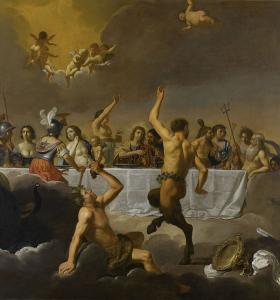
The Feast of Gods depicts a gathering of gods at a banquet on Mount Olympus celebrating the marriage of the Argonaut warrior Peleus and the Nereid (sea nymph) Thetis. The fruit of their union would be Achilles, the central character in Homer’s Iliad. In the foreground of the painting, Dionysos / Bacchus is shown lying on the ground, dangling a bunch of grapes over his mouth while a satyr dances on the table.
Dionysos
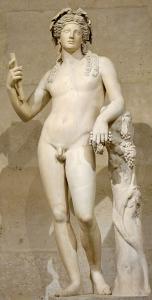
Dionysos [Dionusos]: the son of Zeus and the mortal Theban princess Semele; the god of wine and intoxication, vegetation, fertility, theater, festivity, epiphanies, and ritual madness or frenzied ecstasy. His dark side involved cults, blood sacrificing, and murderous frenzies. He was already known in Mycenaean times, around 1400 BCE. It used to be believed that he was a deity of foreign origin who arrived at a relatively late period. In earlier representations he was portrayed as a mature bearded man in long robes or wearing a panther skin or deerskin, wreathed in ivy or vine, holding a cup or drinking horn. Later representations show him as a youthful, effeminate, beardless figure, either lightly dressed or naked. His special emblem was the thyrsos (a staff tipped with a pine-cone or similar looking ornament, often entwined with ivy or vine).
He was usually accompanied by a troop of satyrs and Mainades (Maenads— female devotees or nymphs). His symbols include the thyrsos, drinking cup, fruiting vine, ivy, tiger, panther, leopard, dolphin, and goat.
The number of Olympians remained constant at twelve, however, their composition changed over time. Hestia was initially included, but was eventually replaced by Dionysos.
Transvestism in Dionysian Worship
A number of scholars have been interested in the issue of transvestism in ancient Greece and their work explains the appropriateness of the symbolism in the controversial opening ceremony of the Paris Olympics. These scholars include:
Dr Allison Surtees, Associate Professor, at the University of Winnipeg, wrote a fascinating essay, Satyrs as Women and Maenads as Men: Transvestites and Transgression in Dionysian Worship.
Dr Margaret Christina Miller, an archaeologist and Professor of Classical Archaeology at the University of Sydney, wrote Reexamining Transvestism in Archaic and Classical Athens: The Zewadski Stamnos.
Christiane Caruso, wrote about Dionysian Cross-Dressing in ‘Travestissements dionysiaques’, Images et socie’te’ en Grece ancienne: l’iconographie comme me’thode d’analyse.
The visual evidence, is focused on a series of vases dating to ca 510–470BCE and features bearded men in costume. They wear the long chiton, himation, mitra, and boots; they carry lyres, drinking vessels, and sometimes parasols, and wear earrings. Margaret Miller has convincingly argued that these men are wearing women’s clothing, that there is a cultic connection between Dionysos and the vases.
Christiane Caruso has collected other images depicting other Dionysian cross-dressers; that is, maenads dressing as satyrs and satyrs dressing as maenads, and has convincingly argued that cross-dressing is as part of Dionysian cultic activity, rather than theatrical scenes.
Allison Surtees sees Dionysos as a complex, wild liminal deity, thoroughly Greek, but is seen as a foreigner, who unleashes madness through the vine, but he is also a civic deity, with cult activity in the heart of the city. He is a god strongly associated with the phallus, and yet he has a special connection to female worshipers not shared by any other male deity.
Just a quick word of appreciation to author, Georgi Mishev, for drawing my attention to the academic research into transvestism in Dionysian Worship.
Summarizing
The Paris Olympics opening ceremony was a colorful interpretation of a Dionysian gathering celebrating diversity and inclusion in keeping with what we know of ancient Greek practices.
Tony Mierzwicki
Author of Hellenismos: Practicing Greek Polytheism Today and Graeco-Egyptian Magick: Everyday Empowerment.
https://www.amazon.com/Hellenismos-Practicing-Greek-Polytheism-Today/dp/0738725935
https://www.amazon.com/gp/product/1905713037/ref=dbs_a_def_rwt_bibl_vppi_i1
Previous Post

July 31, 2024
Review of "Crystal Magick" by Judy Ann Nock
Next Post

January 20, 2025 Review of Mysticism by Simon Critchley
Browse Our Archives
Select a Category Uncategorized
Select a Month July 2026 December 2025 November 2025 September 2025 March 2025 February 2025 January 2025 August 2024 July 2024 June 2024 April 2024 March 2024 February 2024 January 2024 December 2023 September 2023 June 2023 May 2023 April 2023 February 2023 January 2023 December 2022 November 2022 October 2022 September 2022 August 2022 July 2022 June 2022 March 2022 January 2022 December 2021 October 2021 September 2021 August 2021 July 2021 June 2021 May 2021 April 2021 March 2021 February 2021 January 2021 December 2020 November 2020 September 2020 August 2020 July 2020 June 2020 March 2020 March 2019 February 2019
Follow Us!
TAKE THE
Religious Wisdom Quiz
What does God question Job about, showing His wisdom in creation?
Select your answer to see how you score.
Kingdoms Animals and nature Battles Religious rituals
Related posts from Holistic Spirituality


The Intuitive’s Oracle by Angela Orora Medway-Smith, et...
TRENDING AT PATHEOS Pagan

I was recently chatting with someone on Instagram. She asked me what...

While there are many people who share their results, the end of...

On July 23, I saw Christopher Nolan's The Odyssey which is Homer’s...

As I write this two big events have just finished up. One...

Restoring the Watershed of Divine Love
Perhaps cooperation is not something we manufacture through legislation, ideology, or moral...

Many UUs don’t pray because of bad experiences in a previous religion,...
view all Pagan blogs
Ad-Free & Subscriber Log-In Subscription Support
- About Us
- 2026 Calendar
- Videos
- Podcasts
- Library of World Religions
- Faith In Media Tracker
- Advertise With Us
- Write for Us
- Privacy Policy
- Terms of Service
- Do Not Sell My Data
- Contact Us
- Radiant Digital
- Manage Newsletter Subscriptions
- Unsubscribe From Notifications
- Sitemap
Copyright 2008-2026, Patheos. All rights reserved.
Subscription Support Ad-Free & Subscriber Log-In
Follow Patheos