
BuddhistCatholicContemplativeEvangelicalGeneral ChristianHinduJewishLatter-day SaintMuslimNew VisionsProgressive Christian
Beliefs
- Buddhist
- Catholic
- Contemplative
- Evangelical
- General Christian
- Hindu
- Jewish
- Latter-day Saint
- More Voices
- Muslim
- New Visions
- Pagan
- Progressive Christian
Topics
- Religion News
- Food and Religion
- Sports and Religion
- Religious Art
- Religious Music and Entertainment
- Religious Events
- History and Religion
- Style and Religion
- Politics and Religion
- Women in Religion
- Recreation Outdoors and Religion
- Business Finance and Religion
- Careers Workplace and Religion
- Education and Religion
- Family Parenting and Religion
- Health Fitness and Religion
- Home and Religion
- Relationships and Religion
- Technology and Religion
- Travel and Religion
Columnists
- Buddhist Columnists
- Business Finance and Religion Columnists
- Careers Workplace and Religion Columnists
- Catholic Columnists
- Contemplative Columnists
- Education and Religion Columnists
- Evangelists Columnists
- Family Parenting and Religion Columnists
- General Christian Columnists
- Health Fitness and Religion Columnists
- Hindu Columnists
- History and Religion Columnists
- Home and Religion Columnists
- Jewish Columnists
- More Voices Columnists
- Latter Day Columnists
- Muslim Columnists
- New Visions Columnists
- Nonreligious Columnists
- Pagan Columnists
- Politics and Religion Columnists
- Progressive Columnists
- Recreation Outdoors and Religion Columnists
- Relationships and Religion Columnists
- Religion News Columnists
- Religious Art Columnists
- Religious Events Columnists
- Religious Music and Entertainment Columnists
- Sports and Religion Columnists
- Style and Religion Columnists
- Technology and Religion Columnists
- Travel and Religion Columnists
- Women in Religion Columnists
Resource Library
- 2026 Calendar
- Library of World Religions
- The 100 Most Holy Places on Earth
- Patheos Answers
- Podcasts
- Videos
- Faith Leaders Database
- Anglican Episcopalian
- Bahai
- Baptist
- Buddhism
- Christianity
- Confucianism
- Eastern Orthodoxy
- Hinduism
- Holiness and Pentecostal
- ISKCON
- Islam
- Judaism
- Lutheran
- Methodist
- The Church of Jesus Christ of Latter-day Saints
- New Age
- Paganism
- Presbytarian and Reformed
- Protestantism
- Religion Behind the Scenes
- Roman Catholic
- Scientology
- Shia Islam
- Sikhism
- Sufism
- Sunni Islam
- Taoism
- Zen
- See all religions
Research Tools
 Ad-Free & Subscriber Log-In Subscription Support
Ad-Free & Subscriber Log-In Subscription Support
Follow Patheos 

- Trending:
- Forgiveness
- |
- Marriage
- |
- Consciousness
- |
- Death Penalty
- |
- Election
- |
- Halloween
 Holistic Spirituality
- Home
- Pagan
- Review of “The Sorcery of Solomon” by Sara L Mastros
Review of “The Sorcery of Solomon” by Sara L Mastros
Last updated on: June 11, 2024 at 9:52 am by Tony Mierzwicki
Review of “The Sorcery of Solomon” by Sara L Mastros 2024-06-11T09:52:34-08:00 Tony Mierzwicki
Patheos Explore the world's faith through different perspectives on religion and spirituality! Patheos has the views of the prevalent religions and spiritualities of the world.
Review of The Sorcery of Solomon: A Guide to the 44 Planetary Pentacles of the Magician King by Sara L Mastros
It’s fair to say that everyone who has dabbled in ceremonial magick has at least heard of the Solomonic grimoires. For those who’ve never felt comfortable taking the plunge as they didn’t resonate with the explanatory texts on the market would do well to have a look at Sara L Mastros’ The Sorcery of Solomon: A Guide to the 44 Planetary Pentacles of the Magician King. Ms Mastros has a very creative approach to making them work.
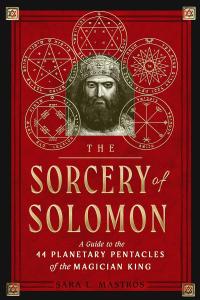
Ms Mastros explains:
“Although usage of the word ‘Solomonic’ varies greatly among speakers, to me, what makes a text Solomonic is that it claims to speak with the voice of Solomon. What makes a magician Solomonic is that they can actually do so. While originally rooted in the sorcerous styles and traditions of Jewish antiquity, Solomonic magic is a living cross-cultural tradition. There is no time over the last several thousand years during which it was not being practiced, debated, and constantly reinvented.”
S L Mathers’ The Key of Solomon the King has the pentacles ordered by planet and by number. Ms Mastros wants her version to be a teaching text, and to that end, has “reordered the planetary progression of the pentacles. … in this book we start with the pentacles of the Moon and end with the pentacles of the Saturn. This is largely because the pentacles of the Moon and Mercury are the most applicable to studying magic, so I chose to teach those first, so you could use them to ‘level up’ your learning of the rest of the book.”
This makes a lot of sense for those with little or no experience with the Solomonic pentacles – start with the easiest ones to obtain results from, and end with the most difficult.
Ms Mastros recommends for beginners her three pillared approach which she calls the SLM method. “S” stands for Solomon who is the best spirit to summon so as to be “a beloved teacher, guide, ally, and initiator.” “L” stands for Logos and relies on Names of Power. “M” stands for Magic which is assumed to be real.
Ms Mastros provides an excellent introduction to the large corpus of Solomonic literature as well as the history of the Golden Dawn. She emphasizes the importance of Solomon:
“Solomon, the son of David, is one of the greatest figures in Jewish mytho-history. He was perhaps the most powerful king of ancient Israel, as well as one of the most fabled magicians of all time. He built the Holy Temple and made pacts with the angels, demons, and djinn. While the core of Solomon’s legend is Jewish, he is also an important figure in Persian, Arabic, Ethiopian, and Christian mythology and folklore. … He spoke the languages of all the plants and animals and wrote the grimoires. In both Jewish and Muslim folklore, he is the foremost archetype of the wizard, and it is in this vein that we magicians work with and learn from him.”
Ms Mastros then leads readers to working with the Mighty Dead, who are “dead humans who retain a high level of personal coherence long after their death.” She explains that working with them rests on three foundations:
1) learning about their life and hagiography,
2) making devotional offerings, and
3) seeking contact and visitation.
It was at this point that the penny drops and readers realize that she is steering them to developing a personal relationship with the spirit of Solomon.
I particularly enjoyed Ms Mastros’ outline of a shared meal with Solomon followed by channeling dream messages. It was very heartfelt and I’m sure that if done with the right mindset would generate results.
Ms Mastros explains that there are different kinds of magick:
“In traditional European magic, there are understood to be three basic kinds of magic; 1) natural, 2) celestial, and 3) divine.
To grossly oversimplify, natural magic primarily relies on the inherent magical virtues of natural materials and on alliance with natural and elemental spirits. Celestial magic, which we moderns often call “astrological,” relies primarily on careful astrological timing to infuse the powers of celestial bodies and sacred geometry into the magic at hand. … Agrippa called “Divine” (also called “Ceremonial” or “Theological”) magic, which relies primarily on sacred Names of Power and alliance with angels, god(s), and other divine beings.”
Ms Mastros has a wonderfully informative chapter on the importance of the pentagram. The goddess, Hygeia, is particularly important to the pentagram. This is what Ms Mastros has to say about her:
“While to the uninitiated, Hygeia is a goddess of health and healing, to the initiate she is much more. Health of the body is only one facet of Hygeia’s sacred harmony. She is the goddess that ensures natural systems remain in balance. She heals bodies and also spirits. She heals humans and also ecosystems. Hygeia is the fractal beauty inherent in nature’s geometry, the guiding hand that shapes the whole cosmos toward perfection. This is just one cultural instantiation of the pentagram’s connection with the golden ratio, and thus with cosmic beauty.”
Ms Mastros explains her rationale in beginning with lunar pentacles and working up sequentially to Saturnine pentacles:
“This is among the many reasons why I construct my magic books of pentacles (including this one) to begin with the lunar ones and work up from there, even though many manuscripts begin with Saturn and work their way down. In many cultures, the first initiation of a magician is to enter into the Land Below and arise again. In particular, in many Jewish magical traditions, including Merkavah (a kind of ecstatic trance journey we discuss more later), we are taught that we must first learn to descend before we can learn to ascend to the heavens.”
I found Ms Mastros’ discussion of the attributions of the five Platonic solids to the five elements to be refreshingly honest. The attributions are: the tetrahedron (four faces) with fire, the cube (six faces) with earth, the octahedron (eight faces) with air, the dodecahedron (twelve faces) with water, and the icosahedron (twenty faces) with ether. She freely admitted that she did not understand the elemental attributions of the three last Platonic solids. So many authors would just gloss over not understanding something hoping that readers did not notice. Such a strategy instils confidence in the readers that the remainder of the book is on a firm foundation. Elsewhere, discussing one of the pentacles of Saturn, she states that she does not understand all of the symbols on it, which again, is also indicative of honesty.
Towards the end, Ms Mastros writes:
“If you’ve successfully completed all the exercises in this book, you should have a basic understanding of the forty-four Mathers pentacles, as well as a solid vocabulary of Hebrew Names of Power. You’ve developed a relationship with Solomon, the Magician King, as well as some beginner skills in dream incubation, trance journey, and spirit communication. You’ve written many awakened pentacles and magically deployed them using a variety of techniques and kavvanot. Perhaps most importantly, you have birthed a powerful magical familiar, your awakened and enchanted Magic Book of Pentacles.”
[“kavvanah” is the mystic intention held while writing]
All in all, Ms Mastros has created a comprehensive curriculum taken primarily from Hebrew sources for readers who have been wanting to work Solomonic magick but did not know exactly how to go about it. If this is a path you’ve been wanting to try but were feeling daunted, this could be just the instructional text that you’ve been waiting for.
Tony Mierzwicki
Author of Hellenismos: Practicing Greek Polytheism Today and Graeco-Egyptian Magick: Everyday Empowerment.
https://www.amazon.com/Hellenismos-Practicing-Greek-Polytheism-Today/dp/0738725935
Previous Post
April 26, 2024
Searching for the Divine Spark by Darren Lorente-Bull
Next Post
June 24, 2024 Review of "Io Typhon" by Harper Feist
Browse Our Archives
Select a Category Uncategorized
Select a Month July 2026 December 2025 November 2025 September 2025 March 2025 February 2025 January 2025 August 2024 July 2024 June 2024 April 2024 March 2024 February 2024 January 2024 December 2023 September 2023 June 2023 May 2023 April 2023 February 2023 January 2023 December 2022 November 2022 October 2022 September 2022 August 2022 July 2022 June 2022 March 2022 January 2022 December 2021 October 2021 September 2021 August 2021 July 2021 June 2021 May 2021 April 2021 March 2021 February 2021 January 2021 December 2020 November 2020 September 2020 August 2020 July 2020 June 2020 March 2020 March 2019 February 2019
Follow Us!
TAKE THE
Religious Wisdom Quiz
What destroyed Pharaoh's army as they pursued the Israelites?
Select your answer to see how you score.
The sea Fire from heaven Earthquake Plague of locusts
Related posts from Holistic Spirituality

The Intuitive’s Oracle by Angela Orora Medway-Smith, et...

TRENDING AT PATHEOS Pagan

I was recently chatting with someone on Instagram. She asked me what...

While there are many people who share their results, the end of...

On July 23, I saw Christopher Nolan's The Odyssey which is Homer’s...

As I write this two big events have just finished up. One...

Restoring the Watershed of Divine Love
Perhaps cooperation is not something we manufacture through legislation, ideology, or moral...

Many UUs don’t pray because of bad experiences in a previous religion,...
view all Pagan blogs
Ad-Free & Subscriber Log-In Subscription Support
- About Us
- 2026 Calendar
- Videos
- Podcasts
- Library of World Religions
- Faith In Media Tracker
- Advertise With Us
- Write for Us
- Privacy Policy
- Terms of Service
- Do Not Sell My Data
- Contact Us
- Radiant Digital
- Manage Newsletter Subscriptions
- Unsubscribe From Notifications
- Sitemap
Copyright 2008-2026, Patheos. All rights reserved.
Subscription Support Ad-Free & Subscriber Log-In
Follow Patheos