
BuddhistCatholicContemplativeEvangelicalGeneral ChristianHinduJewishLatter-day SaintMuslimNew VisionsProgressive Christian
Beliefs
- Buddhist
- Catholic
- Contemplative
- Evangelical
- General Christian
- Hindu
- Jewish
- Latter-day Saint
- More Voices
- Muslim
- New Visions
- Pagan
- Progressive Christian
Topics
- Religion News
- Food and Religion
- Sports and Religion
- Religious Art
- Religious Music and Entertainment
- Religious Events
- History and Religion
- Style and Religion
- Politics and Religion
- Women in Religion
- Recreation Outdoors and Religion
- Business Finance and Religion
- Careers Workplace and Religion
- Education and Religion
- Family Parenting and Religion
- Health Fitness and Religion
- Home and Religion
- Relationships and Religion
- Technology and Religion
- Travel and Religion
Columnists
- Buddhist Columnists
- Business Finance and Religion Columnists
- Careers Workplace and Religion Columnists
- Catholic Columnists
- Contemplative Columnists
- Education and Religion Columnists
- Evangelists Columnists
- Family Parenting and Religion Columnists
- General Christian Columnists
- Health Fitness and Religion Columnists
- Hindu Columnists
- History and Religion Columnists
- Home and Religion Columnists
- Jewish Columnists
- More Voices Columnists
- Latter Day Columnists
- Muslim Columnists
- New Visions Columnists
- Nonreligious Columnists
- Pagan Columnists
- Politics and Religion Columnists
- Progressive Columnists
- Recreation Outdoors and Religion Columnists
- Relationships and Religion Columnists
- Religion News Columnists
- Religious Art Columnists
- Religious Events Columnists
- Religious Music and Entertainment Columnists
- Sports and Religion Columnists
- Style and Religion Columnists
- Technology and Religion Columnists
- Travel and Religion Columnists
- Women in Religion Columnists
Resource Library
- 2026 Calendar
- Library of World Religions
- The 100 Most Holy Places on Earth
- Patheos Answers
- Podcasts
- Videos
- Faith Leaders Database
- Anglican Episcopalian
- Bahai
- Baptist
- Buddhism
- Christianity
- Confucianism
- Eastern Orthodoxy
- Hinduism
- Holiness and Pentecostal
- ISKCON
- Islam
- Judaism
- Lutheran
- Methodist
- The Church of Jesus Christ of Latter-day Saints
- New Age
- Paganism
- Presbytarian and Reformed
- Protestantism
- Religion Behind the Scenes
- Roman Catholic
- Scientology
- Shia Islam
- Sikhism
- Sufism
- Sunni Islam
- Taoism
- Zen
- See all religions
Research Tools
 Ad-Free & Subscriber Log-In Subscription Support
Ad-Free & Subscriber Log-In Subscription Support
Follow Patheos 

- Trending:
- Forgiveness
- |
- Marriage
- |
- Consciousness
- |
- Death Penalty
- |
- Election
- |
- Halloween
 Holistic Spirituality
- Home
- Pagan
- Review of Seven Goddesses of the Hellenistic World by Jo Graham
Review of Seven Goddesses of the Hellenistic World by Jo Graham
Last updated on: February 3, 2023 at 5:11 pm by Tony Mierzwicki
Review of Seven Goddesses of the Hellenistic World by Jo Graham 2023-02-03T17:11:34-08:00 Tony Mierzwicki
Patheos Explore the world's faith through different perspectives on religion and spirituality! Patheos has the views of the prevalent religions and spiritualities of the world.
Review of Seven Goddesses of the Hellenistic World: Ancient Worship for Modern Times by Jo Graham
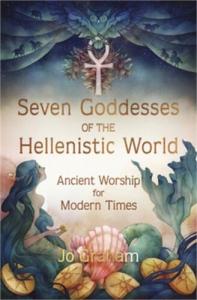
Seven Goddesses of the Hellenistic World does not focus on the gods of the Hellenistic world, which were often venerated in large magnificent temples, but rather on seven of the great goddesses which were “often worshiped more modestly with more intimate rites at home shrines or small temples.” This worship occurred between 320 BCE and approximately 200 CE.
The book selects seven goddesses, “each chosen because they reached out to a wide variety of worshipers over a long period of time rather than being confined to a particular people and place and because they continue to be relevant to many.” Four are familiar to most: Isis, Athena, Aphrodite, and Epona, who is thought of as a Celtic deity. Three are less familiar: Atargatis, Tyche, and Cybele.
The format used to experience the seven goddesses is to first encounter one through a story, much like those living in the Hellenistic world would have. Then the story and its context is be examined through journaling and reading. Then there is a meditation directed to meet the goddess in a modern context, so as to “make these ancient goddesses relevant and alive to the modern polytheist.” Lastly, the book provides “a modern rite to each goddess appropriate to a solitary practitioner or a small group.”
While readers have to decide exactly how they will venerate the goddesses, it’s suggested that they have an altar and use libations and/or incense. The goddesses that readers can look forward to interacting with are as follows.
Tyche, the Trickster Goddess, known to the Romans as Fortuna, was “one of the most popular goddesses of the Hellenistic period. … As a patron of commerce and shipping, Tyche was especially beloved in great trading centers such as Damascus, Beirut (Biruta), Pelousion, Alexandria, and Palmyra … She is a trickster goddess —’fortune is fickle’. She gives her gifts and then withdraws them, perhaps capriciously or not. Winning and keeping her favor was the subject of much art … Tyche also owns you with her ability to raise you to the heights or dash you to the depths.”
Isis, Mother of the World, was “perhaps the best-known goddess of the Hellenistic world. Her worship spread from her native Egypt all over the Mediterranean, and in the Roman period as far north as Britain and Germany. There are many stories of Isis, for she had many faces and millions of worshipers over thousands of years.”
Athena, Companion of Heroes, was “one of the best known of the Greek gods. She is the goddess of wisdom and strategy, invoked as the protector of democracy. Her worship was widespread in the Hellenistic world. Not only was she the patron of the city of Athens, where the Parthenon, her remarkable temple, still stands today, but she was also worshiped at many temples from the Silk Road of central Asia to Spain. Her worship therefore encompassed many different things at different times. She had a variety of names, from Athena Parthenos (‘Virgin, Ever Pure’) to Athena Strategos (‘Wise in War’). It is in that last capacity that she is the companion of heroes, the goddess at their back who inspires them to think creatively and win through smarts. … Athena likes strategy. It’s not about how many enemies you kill or how big your muscles are but how smart you are.”
Atargatis, Mermaid of the Great River, is “little known today but in the Hellenistic period her worship was widespread. She was one of the patron goddesses of the Seleucid Empire, a kingdom that at its height stretched from modern Turkey through Syria, Iraq, Iran, and northward into Turkmenistan. Seleucid influence was even more widespread—images of Atargatis have been found as far west as France. As Dea Sura (a contraction of Dea Syria, ‘the goddess from Syria’) she was popular during the Roman period throughout the empire.”
Epona, Lady of Horses, is currently “thought of as a goddess native to the British Isles or sometimes northern France as well. However, the Celtic tribes of the Hellenistic period were spread across Europe, as far east as the Black Sea and what is now Romania. They fought wars into Greece in 281–279 BCE and migrated into northern Turkey in 278, where they established the Kingdom of Galatia. Celts also lived in the Hellenistic kingdoms of Pontus and Pergamon, and smaller groups of soldiers took service with many of the successor states, thus mingling with far-flung peoples.”
Aphrodite, Queen of the Sea, the goddess of love, is “one of the best-known Hellenistic goddesses. Love has no boundaries, and therefore Aphrodite had none: as Aphrodite Pandemos she was the goddess of all people. In addition, she was also a sea goddess: as Aphrodite Pelagia, she was patron of sailors and fair voyages. Indeed, her worship as a sea goddess seems to predate her function as the goddess of love.”
Cybele, Death and Rebirth, was very controversial in the Hellenistic world. “Invited by some states and banned in others, her priests, the galli, were both revered and reviled. Death and rebirth are always scary subjects, but because Cybele’s priests were considered neither men nor women, her worship was especially frightening to some cultures. Parts of the Hellenistic world had a long history of accepting a third gender, while others emphatically did not. To assign that gender a liminal role, standing between death and rebirth in such a position of power, seemed to challenge any number of cultures. The Romans especially were both intrigued and dismayed by Cybele’s worship, both inviting it into the city of Rome and then trying to limit and regulate it.”
Seven Goddesses of the Hellenistic World takes the form of a workbook to ensure that readers derive maximum benefit. I would recommend this text as a starting point for anyone curious about Hellenistic goddesses and wanting a firm foundation in their veneration.
Tony Mierzwicki
Author of Hellenismos: Practicing Greek Polytheism Today and Graeco-Egyptian Magick: Everyday Empowerment.
https://www.amazon.com/Hellenismos-Practicing-Greek-Polytheism-Today/dp/0738725935
https://www.amazon.com/gp/product/1905713037/ref=dbs_a_def_rwt_bibl_vppi_i1
Previous Post
January 21, 2023
Review of The Tablet of Cebes by John Opsopaus PhD
Next Post
February 24, 2023 Review of An Oracle of Kemet by Doug Blake
Recent Comments
Browse Our Archives
Select a Category Uncategorized
Select a Month July 2026 December 2025 November 2025 September 2025 March 2025 February 2025 January 2025 August 2024 July 2024 June 2024 April 2024 March 2024 February 2024 January 2024 December 2023 September 2023 June 2023 May 2023 April 2023 February 2023 January 2023 December 2022 November 2022 October 2022 September 2022 August 2022 July 2022 June 2022 March 2022 January 2022 December 2021 October 2021 September 2021 August 2021 July 2021 June 2021 May 2021 April 2021 March 2021 February 2021 January 2021 December 2020 November 2020 September 2020 August 2020 July 2020 June 2020 March 2020 March 2019 February 2019
Follow Us!
TAKE THE
Religious Wisdom Quiz
Who dreamed of a ladder reaching to heaven?
Select your answer to see how you score.
Joseph Daniel Jacob Paul
Related posts from Holistic Spirituality


The Intuitive’s Oracle by Angela Orora Medway-Smith, et...

TRENDING AT PATHEOS Pagan

I was recently chatting with someone on Instagram. She asked me what...

While there are many people who share their results, the end of...

On July 23, I saw Christopher Nolan's The Odyssey which is Homer’s...

As I write this two big events have just finished up. One...

Restoring the Watershed of Divine Love
Perhaps cooperation is not something we manufacture through legislation, ideology, or moral...

Many UUs don’t pray because of bad experiences in a previous religion,...
view all Pagan blogs
Ad-Free & Subscriber Log-In Subscription Support
- About Us
- 2026 Calendar
- Videos
- Podcasts
- Library of World Religions
- Faith In Media Tracker
- Advertise With Us
- Write for Us
- Privacy Policy
- Terms of Service
- Do Not Sell My Data
- Contact Us
- Radiant Digital
- Manage Newsletter Subscriptions
- Unsubscribe From Notifications
- Sitemap
Copyright 2008-2026, Patheos. All rights reserved.
Subscription Support Ad-Free & Subscriber Log-In
Follow Patheos