
BuddhistCatholicContemplativeEvangelicalGeneral ChristianHinduJewishLatter-day SaintMuslimNew VisionsProgressive Christian
Beliefs
- Buddhist
- Catholic
- Contemplative
- Evangelical
- General Christian
- Hindu
- Jewish
- Latter-day Saint
- More Voices
- Muslim
- New Visions
- Pagan
- Progressive Christian
Topics
- Religion News
- Food and Religion
- Sports and Religion
- Religious Art
- Religious Music and Entertainment
- Religious Events
- History and Religion
- Style and Religion
- Politics and Religion
- Women in Religion
- Recreation Outdoors and Religion
- Business Finance and Religion
- Careers Workplace and Religion
- Education and Religion
- Family Parenting and Religion
- Health Fitness and Religion
- Home and Religion
- Relationships and Religion
- Technology and Religion
- Travel and Religion
Columnists
- Buddhist Columnists
- Business Finance and Religion Columnists
- Careers Workplace and Religion Columnists
- Catholic Columnists
- Contemplative Columnists
- Education and Religion Columnists
- Evangelists Columnists
- Family Parenting and Religion Columnists
- General Christian Columnists
- Health Fitness and Religion Columnists
- Hindu Columnists
- History and Religion Columnists
- Home and Religion Columnists
- Jewish Columnists
- More Voices Columnists
- Latter Day Columnists
- Muslim Columnists
- New Visions Columnists
- Nonreligious Columnists
- Pagan Columnists
- Politics and Religion Columnists
- Progressive Columnists
- Recreation Outdoors and Religion Columnists
- Relationships and Religion Columnists
- Religion News Columnists
- Religious Art Columnists
- Religious Events Columnists
- Religious Music and Entertainment Columnists
- Sports and Religion Columnists
- Style and Religion Columnists
- Technology and Religion Columnists
- Travel and Religion Columnists
- Women in Religion Columnists
Resource Library
- 2026 Calendar
- Library of World Religions
- The 100 Most Holy Places on Earth
- Patheos Answers
- Podcasts
- Videos
- Faith Leaders Database
- Anglican Episcopalian
- Bahai
- Baptist
- Buddhism
- Christianity
- Confucianism
- Eastern Orthodoxy
- Hinduism
- Holiness and Pentecostal
- ISKCON
- Islam
- Judaism
- Lutheran
- Methodist
- The Church of Jesus Christ of Latter-day Saints
- New Age
- Paganism
- Presbytarian and Reformed
- Protestantism
- Religion Behind the Scenes
- Roman Catholic
- Scientology
- Shia Islam
- Sikhism
- Sufism
- Sunni Islam
- Taoism
- Zen
- See all religions
Research Tools
 Ad-Free & Subscriber Log-In Subscription Support
Ad-Free & Subscriber Log-In Subscription Support
Follow Patheos 

- Trending:
- Forgiveness
- |
- Marriage
- |
- Consciousness
- |
- Death Penalty
- |
- Election
- |
- Halloween
 Holistic Spirituality
- Home
- Pagan
- Review of GaeaGenesis by Oberon Zell
Review of GaeaGenesis by Oberon Zell
Last updated on: June 20, 2022 at 10:21 am by Tony Mierzwicki
Review of GaeaGenesis by Oberon Zell 2022-06-20T10:21:45-08:00 Tony Mierzwicki
Patheos Explore the world's faith through different perspectives on religion and spirituality! Patheos has the views of the prevalent religions and spiritualities of the world.
Review of GaeaGenesis: Conception and Birth of the Living Earth by Oberon Zell
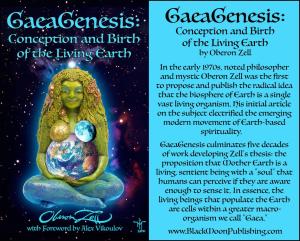
In GaeaGenesis, Oberon Zell proposes that the Earth is a living, sentient being, while the lifeforms that populate it are cells within a greater macro-organism. He first expressed this idea in 1971 and it has taken 51 years for it to evolve to its current form.
Oberon Zell and Dr James Lovelock, a British independent scientist, environmentalist and futurist, came to very similar theories regarding the Earth and all its lifeforms in the 1970s. In 2011, Michael Ruse, Lucyle T. Werkmeister Professor of Philosophy, interviewed both Oberon Zell and James Lovelock and concluded:
“My strong sense from my interview yesterday is that Lovelock claims that he has always believed in the level of consciousness but did not want to stress it because then he would be even more identified with New Age thinking (I know that you do not think of yourself as a New Ager)—he is very tense on this matter. … The point is he wants Gaia to be scientific and contamination with folks like you (forgive me for being blunt) scares the shit out of him.”
It would appear that Lovelock’s “Gaia Hypothesis” is the widely accepted core of the theory of the Earth and its biological systems behaving as a huge single entity, while Oberon takes this to its ultimate conclusion where everything is seen to be sentient.
James Lovelock’s “Gaia Hypothesis”
“The Gaia hypothesis was formulated by the chemist James Lovelock and co-developed by the microbiologist Lynn Margulis in the 1970s. Initially received with hostility by the scientific community, it is now studied in the disciplines of geophysiology and Earth system science, and some of its principles have been adopted in fields like biogeochemistry and systems ecology.”
According to P.J. Boston, in Encyclopedia of Ecology, 2008:
“The Gaia hypothesis, named after the ancient Greek goddess of Earth, posits that Earth and its biological systems behave as a huge single entity. This entity has closely controlled self-regulatory negative feedback loops that keep the conditions on the planet within boundaries that are favorable to life. Introduced in the early 1970s, the idea was conceived by chemist and inventor James E. Lovelock and biologist Lynn Margulis. This new way of looking at global ecology and evolution differs from the classical picture of ecology as a biological response to a menu of physical conditions. The idea of co-evolution of biology and the physical environment where each influences the other was suggested as early as the mid-1700s, but never as strongly as Gaia, which claims the power of biology to control the nonliving environment. More recently, the terms Gaian science or Gaian theory have become more common than the original Gaia hypothesis because of modifications in response to criticisms and expansion of our scientific understanding.
Oberon Zell’s GaeaGenesis Hypothesis
GaeaGenesis is an anthology of writings developing Oberon’s theory of the Earth being a living organism. The book is long and information dense. The first section is of particular interest to me where Oberon essentially reconciles religion and science, presenting spiritual writings and scientific papers.
Rather than ramming his point home, Oberon opts to present ideas letting readers come to their own conclusions.
A translation of the creation myth in Hesiod’s Theogony is provided where cosmic entities are readily seen as living deities rather than concepts. Elsewhere in this text personified abstractions also have a life of their own. To the ancient Greeks everything was vibrant and pulsing with life.
The concept of the anima mundi or world soul is introduced, which goes back to Plato’s idea of the psychè kósmou]. According to several systems of thought, this is an intrinsic connection between all living beings, which relates to the world in much the same way as the soul is connected to the human body. This would imply that the Earth was governed by spiritual forces rather than mechanical laws.
Although the concept of the anima mundi originated in classical antiquity, similar ideas can be found in the thoughts of later European philosophers such as those of Baruch Spinoza, Gottfried Leibniz, Immanuel Kant, Friedrich Schelling, and Georg W.F. Hegel (particularly in his concept of Weltgeist).
Not content with tracing back the idea of a living Earth to the ancient Greeks, Oberon points out that the Mother Earth archetype or “Mother of all mothers” dates back to prehistoric times, and is something which our ancestors understood intuitively:
“We have always known, in our deepest heart of hearts, that the Earth is alive. Throughout the world, even small children intuitively recognize Mother Earth. She is the oldest and most universally acknowledged religious archetype in all of human experience. Sculpted images of this primordial “Mother of all mothers” date back at least to the CroMagnon Aurignacian peoples of 40,000 years ago (R) and are found across the Eurasian continent from Spain to Siberia. Indeed, similar images have recently been found that push that dating back hundreds of thousands of years— to Neanderthals and even Homo erectus. The October 2003 issue of Discover magazine shows a beautiful picture of a two-inch crude prototype of the ‘Venus of Willendorf’ carved from a piece of quartzite, pulled from a 400,000- year-old deposit near the Moroccan city of Tan-Tan. Stone tools found in the same deposit were made by Homo erectus.”
The idea of the whole Earth as one being permeates many philosophical and spiritual systems:
“The idea that all life or all consciousness is interconnected is one of humanity’s most enduring spiritual traditions; indeed, it is the very essence of what is called ‘The Perennial Philosophy.’ Human groups as various as the Iroquois, the Sufis, and Western European Freemasons all incorporate it into their belief structures. References to it can be found in ancient documents of the classical world, both East and West. It is a compelling idea, spanning both millennia and the vast variety and complexity of human cultures.
Carl Jung coined the term ‘Collective Unconscious’ to refer to such a global mind: ‘So far as we can see, the collective unconscious is identical with Nature.’ And Teilhard de Chardin described it as the Noosphere—an envelope of intelligence for the Earth, and the inevitable extension of the planetary biosphere. But the true heart of this understanding is found in the Alchemical mystical concept of Anima Mundi— ‘The Spirit of the Earth.’ This term is nothing less than a Medieval rephrasing of the most ancient and primordial thealogical premise of ‘The Goddess’ as Mother Earth, or Mother Nature. And it is the Spirit animating Jesse Wolf Hardin’s lifetime of work.”
Oberon compares his work with that of Lovelock:
“The crucial distinction between my ‘TheaGenesis’ revelation of Gaea and Lovelock’s ‘Gaia Hypothesis’ is in our direction of approach. I came to the realization of Gaea from the inside out—from microbiology, embryology, and paleontology. Lovelock, on the other hand, approached Gaia from the outside in—from atmospheric biochemistry and systems analysis. He analyzed and noted a remarkable homeostasis of atmospheric composition and surface temperature over the past three billion years and concluded that this could only be attributed to a biospheric regulatory mechanism. In Lovelock’s version Gaia is viewed more as a metaphor or allegory than as an actual entity. This approach posits a Gaian superorganism as a cooperative aggregation or ‘colony’ of discrete components. Whereas I regard the entire evolution of life on Earth as literally the embryology of a single vast living Being—one replicating continuum of DNA and protoplasm, beginning with the first living cell, and its fertilization in the ‘Cambrian Explosion’.”
The Earth faces climate change as well as numerous other environmental crises. Perhaps the best way to avoid disaster through fostering an Earth-based system of spirituality that fosters the mindset of cherishing the Earth rather than exploiting it. To quote ecology-movement spokesperson Rene Dubos:
“Our salvation depends upon our ability to create a religion of Nature…suited to the needs and knowledge of modern humanity.”
What could be more effective for solving all of our problems than a religion that teaches that the entire Earth and all its lifeforms are alive and interconnected?
I see Oberon**’s** GaeaGenesis as being embraced by those who care about the environment as well as those seeking to enhance their spiritual practices through forging a more powerful connection with everything around them.
Tony Mierzwicki
Author of Hellenismos: Practicing Greek Polytheism Today and Graeco-Egyptian Magick: Everyday Empowerment.
Previous Post

June 6, 2022
My First Ever Dodger Game at Dodger Stadium

Browse Our Archives
Select a Category Uncategorized
Select a Month July 2026 December 2025 November 2025 September 2025 March 2025 February 2025 January 2025 August 2024 July 2024 June 2024 April 2024 March 2024 February 2024 January 2024 December 2023 September 2023 June 2023 May 2023 April 2023 February 2023 January 2023 December 2022 November 2022 October 2022 September 2022 August 2022 July 2022 June 2022 March 2022 January 2022 December 2021 October 2021 September 2021 August 2021 July 2021 June 2021 May 2021 April 2021 March 2021 February 2021 January 2021 December 2020 November 2020 September 2020 August 2020 July 2020 June 2020 March 2020 March 2019 February 2019
Follow Us!
TAKE THE
Religious Wisdom Quiz
What does the rider of the Black Horse in Revelation hold in his hand?
Select your answer to see how you score.
A pair of scales A sword A bow A book
Related posts from Holistic Spirituality


The Intuitive’s Oracle by Angela Orora Medway-Smith, et...

TRENDING AT PATHEOS Pagan

I was recently chatting with someone on Instagram. She asked me what...

While there are many people who share their results, the end of...

On July 23, I saw Christopher Nolan's The Odyssey which is Homer’s...

As I write this two big events have just finished up. One...

Restoring the Watershed of Divine Love
Perhaps cooperation is not something we manufacture through legislation, ideology, or moral...

Many UUs don’t pray because of bad experiences in a previous religion,...
view all Pagan blogs
Ad-Free & Subscriber Log-In Subscription Support
- About Us
- 2026 Calendar
- Videos
- Podcasts
- Library of World Religions
- Faith In Media Tracker
- Advertise With Us
- Write for Us
- Privacy Policy
- Terms of Service
- Do Not Sell My Data
- Contact Us
- Radiant Digital
- Manage Newsletter Subscriptions
- Unsubscribe From Notifications
- Sitemap
Copyright 2008-2026, Patheos. All rights reserved.
Subscription Support Ad-Free & Subscriber Log-In
Follow Patheos