
BuddhistCatholicContemplativeEvangelicalGeneral ChristianHinduJewishLatter-day SaintMuslimNew VisionsProgressive Christian
Beliefs
- Buddhist
- Catholic
- Contemplative
- Evangelical
- General Christian
- Hindu
- Jewish
- Latter-day Saint
- More Voices
- Muslim
- New Visions
- Pagan
- Progressive Christian
Topics
- Religion News
- Food and Religion
- Sports and Religion
- Religious Art
- Religious Music and Entertainment
- Religious Events
- History and Religion
- Style and Religion
- Politics and Religion
- Women in Religion
- Recreation Outdoors and Religion
- Business Finance and Religion
- Careers Workplace and Religion
- Education and Religion
- Family Parenting and Religion
- Health Fitness and Religion
- Home and Religion
- Relationships and Religion
- Technology and Religion
- Travel and Religion
Columnists
- Buddhist Columnists
- Business Finance and Religion Columnists
- Careers Workplace and Religion Columnists
- Catholic Columnists
- Contemplative Columnists
- Education and Religion Columnists
- Evangelists Columnists
- Family Parenting and Religion Columnists
- General Christian Columnists
- Health Fitness and Religion Columnists
- Hindu Columnists
- History and Religion Columnists
- Home and Religion Columnists
- Jewish Columnists
- More Voices Columnists
- Latter Day Columnists
- Muslim Columnists
- New Visions Columnists
- Nonreligious Columnists
- Pagan Columnists
- Politics and Religion Columnists
- Progressive Columnists
- Recreation Outdoors and Religion Columnists
- Relationships and Religion Columnists
- Religion News Columnists
- Religious Art Columnists
- Religious Events Columnists
- Religious Music and Entertainment Columnists
- Sports and Religion Columnists
- Style and Religion Columnists
- Technology and Religion Columnists
- Travel and Religion Columnists
- Women in Religion Columnists
Resource Library
- 2026 Calendar
- Library of World Religions
- The 100 Most Holy Places on Earth
- Patheos Answers
- Podcasts
- Videos
- Faith Leaders Database
- Anglican Episcopalian
- Bahai
- Baptist
- Buddhism
- Christianity
- Confucianism
- Eastern Orthodoxy
- Hinduism
- Holiness and Pentecostal
- ISKCON
- Islam
- Judaism
- Lutheran
- Methodist
- The Church of Jesus Christ of Latter-day Saints
- New Age
- Paganism
- Presbytarian and Reformed
- Protestantism
- Religion Behind the Scenes
- Roman Catholic
- Scientology
- Shia Islam
- Sikhism
- Sufism
- Sunni Islam
- Taoism
- Zen
- See all religions
Research Tools
 Ad-Free & Subscriber Log-In Subscription Support
Ad-Free & Subscriber Log-In Subscription Support
Follow Patheos 

- Trending:
- Forgiveness
- |
- Marriage
- |
- Consciousness
- |
- Death Penalty
- |
- Election
- |
- Halloween
 Holistic Spirituality
- Home
- Pagan
- Review of The Ultimate Pagan Almanac 2022
Review of The Ultimate Pagan Almanac 2022
Last updated on: January 21, 2022 at 5:31 pm by Tony Mierzwicki
Review of The Ultimate Pagan Almanac 2022 2022-01-21T17:31:41-08:00 Tony Mierzwicki
Patheos Explore the world's faith through different perspectives on religion and spirituality! Patheos has the views of the prevalent religions and spiritualities of the world.
Review of The Ultimate Pagan Almanac 2022: Northern Hemisphere by Jean-Louis DE BIASI and Patricia BOURIN.
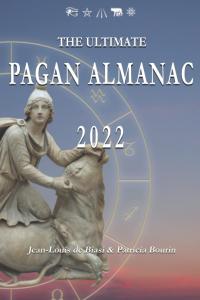
The Ultimate Pagan Almanac 2022 focuses primarily on a number of traditions, and their calendars – Druidic/Gaulish, Roman, Georgius Gemistus Pletho (of the Byzantine era), Athenian/Attic, and Egyptian. I am sure that it will also be of interest to those involved in eclectic workings.
Regardless of which pantheon a pagan feels drawn to, and works with, it is intuitively obvious that certain times and certain days will make for a more effective ritual. But how do we determine those times and days?
The authors point out that almost all ancient calendars were based on the natural cycles of the sun (seasons) and moon.
The wheel of the year should be determined by the Equinoxes and Solstices, and the intermediary celebrations (Imbolc, Beltane, Lughnasadh and Samhain) were at the halfway points between the Equinoxes and Solstices.
The authors stress the difference between working on the correct day and almost the correct day is crucial:
“We can see the dates of celebrations as gates that open for a specific time frame. Then the participant to the ritual can connect to the powers and energies that have been involved in this event for centuries. As you can imagine, if you have the dates wrong, you can still be in harmony with the symbols involved but not with the full amount of accessible energy.”
The Western Tradition uses the concept of Planetary Days:
“Monday = Moon, Tuesday = Mars, Wednesday = Mercury, Thursday = Jupiter, Friday = Venus, Saturday = Saturn, Sunday = Sun.”
The authors state, however, the planetary days as found in the civil calendar are “totally arbitrary” and “useless” as they are not based on “magic or religious systems”.
It should be noted that the planetary days are used extensively within ceremonial magick, and are normally accepted without question, so this is quite controversial.
The reasoning used by the authors is quite compelling. The following is proposed to determine the “Real Planetary Day”:
Day 1 (new moon) – Saturn/Kronos
Day 2 – Sun/Helios
Day 3 – Moon/Selene
Day 4 – Mars/Ares
Day 5 – Mercury/Hermes
Day 6 – Jupiter/Zeus
Day 7 – Venus/Aphrodite
This cycle is repeated three more times. Any days left over between the end of the fourth cycle and the new moon are dedicated to the Aether.
For more information on this, refer to Jean-Louis de Biasi’s Rediscover the Magick of the Gods and Goddesses.
On a personal note, for ancient Greek practices I have worked with the Athenian calendar, which is a lunisolar calendar, where each month starts on the new moon. For practices derived from late antiquity onwards to contemporary modalities, I have used the planetary days as derived from the civil calendar (used by everyone in the western world). I have treated these as an either-or proposition, as the correspondences would vary from week to week as well as month to month. The idea of reconciling the two makes a lot of sense as each lunar month would have the same correspondences.
Now that we understand the basic structure of The Ultimate Pagan Almanac 2022, it should be noted that zodiac signs, the 36 ancient Egyptian decans, astrological rulers and astral events, such as eclipses, are also incorporated.
Flipping through the book is a fascinating experience as each day is shown to have so many possibilities for very different magickal workings. It’s also a good starting point for investigating unusual results obtained in a magickal working, due to multiplicity of currents revealed to be acting each day. Eclectic practitioners, working with multiple pantheons will greatly benefit as a smorgasbord of options opens itself up to them.
I would suggest that open-minded ceremonial magicians owe it to themselves to experiment with modifying the planetary days underpinning their practices to at least try the alternative planetary days as detailed by the authors. The authors claim that there will be an appreciable increase in energy raised. It is certainly worth attempting, and all the hard work of calculating the new days has already been done.
I am sure that there are many other practitioners who will try the bold vision detailed herein.
Each year The Ultimate Pagan Almanac presents a few bonus essays. These are all worth reading, but I was most drawn to the two essays penned by John Opsopaus PhD – an Introduction to Plethon’s Theology and Saturnalia or Brumalia, a Winter Solstice Ritual. Those readers hungry for more information on Plethon, will have to wait till May 2022, when his The Secret Texts of Hellenic Polytheism: A Practical Guide to the Restored Pagan Religion of George Gemistos Plethon will be published.
Jean-Louis de Biasi is an author, lecturer, and philosopher. His philosophical, religious, and spiritual domains of expertise are focused on early Mediterranean philosophy, Neoplatonism, Hermeticism, and Western Religions. He was initiated into Freemasonry in 1990. He is a Master Mason and a Past Master currently belonging to the Grand Lodge of Nevada. While living in France he was a Grand Officer of the Grand Orient de France (France’s largest Masonic Organization). He has received all the degrees of Egyptian Freemasonry (33°-95°) and other allied degrees. He is also in charge of the Ordo Aurum Solis and the Kabbalistic Order of the Rose-Cross.
Patricia Bourin is Jean-Louis de Biasi’s wife. She is an author and co-founder of an online store “Theurgia” and an online University “Theurgia University.”
Tony Mierzwicki
Author of Hellenismos: Practicing Greek Polytheism Today and Graeco-Egyptian Magick: Everyday Empowerment.
Previous Post
January 19, 2022
Review of Esoteric Empathy by Raven Digitalis
Next Post
January 23, 2022 Ancient Greek Love
Browse Our Archives
Select a Category Uncategorized
Select a Month July 2026 December 2025 November 2025 September 2025 March 2025 February 2025 January 2025 August 2024 July 2024 June 2024 April 2024 March 2024 February 2024 January 2024 December 2023 September 2023 June 2023 May 2023 April 2023 February 2023 January 2023 December 2022 November 2022 October 2022 September 2022 August 2022 July 2022 June 2022 March 2022 January 2022 December 2021 October 2021 September 2021 August 2021 July 2021 June 2021 May 2021 April 2021 March 2021 February 2021 January 2021 December 2020 November 2020 September 2020 August 2020 July 2020 June 2020 March 2020 March 2019 February 2019
Follow Us!
TAKE THE
Religious Wisdom Quiz
What happened three days after Jesus was crucified?
Select your answer to see how you score.
A giant earthquake The temple was destroyed He rose from the dead The sea split
Related posts from Holistic Spirituality


The Intuitive’s Oracle by Angela Orora Medway-Smith, et...

TRENDING AT PATHEOS Pagan

I was recently chatting with someone on Instagram. She asked me what...

While there are many people who share their results, the end of...

On July 23, I saw Christopher Nolan's The Odyssey which is Homer’s...

As I write this two big events have just finished up. One...

Restoring the Watershed of Divine Love
Perhaps cooperation is not something we manufacture through legislation, ideology, or moral...

Many UUs don’t pray because of bad experiences in a previous religion,...
view all Pagan blogs
Ad-Free & Subscriber Log-In Subscription Support
- About Us
- 2026 Calendar
- Videos
- Podcasts
- Library of World Religions
- Faith In Media Tracker
- Advertise With Us
- Write for Us
- Privacy Policy
- Terms of Service
- Do Not Sell My Data
- Contact Us
- Radiant Digital
- Manage Newsletter Subscriptions
- Unsubscribe From Notifications
- Sitemap
Copyright 2008-2026, Patheos. All rights reserved.
Subscription Support Ad-Free & Subscriber Log-In
Follow Patheos