
BuddhistCatholicContemplativeEvangelicalGeneral ChristianHinduJewishLatter-day SaintMuslimNew VisionsProgressive Christian
Beliefs
- Buddhist
- Catholic
- Contemplative
- Evangelical
- General Christian
- Hindu
- Jewish
- Latter-day Saint
- More Voices
- Muslim
- New Visions
- Pagan
- Progressive Christian
Topics
- Religion News
- Food and Religion
- Sports and Religion
- Religious Art
- Religious Music and Entertainment
- Religious Events
- History and Religion
- Style and Religion
- Politics and Religion
- Women in Religion
- Recreation Outdoors and Religion
- Business Finance and Religion
- Careers Workplace and Religion
- Education and Religion
- Family Parenting and Religion
- Health Fitness and Religion
- Home and Religion
- Relationships and Religion
- Technology and Religion
- Travel and Religion
Columnists
- Buddhist Columnists
- Business Finance and Religion Columnists
- Careers Workplace and Religion Columnists
- Catholic Columnists
- Contemplative Columnists
- Education and Religion Columnists
- Evangelists Columnists
- Family Parenting and Religion Columnists
- General Christian Columnists
- Health Fitness and Religion Columnists
- Hindu Columnists
- History and Religion Columnists
- Home and Religion Columnists
- Jewish Columnists
- More Voices Columnists
- Latter Day Columnists
- Muslim Columnists
- New Visions Columnists
- Nonreligious Columnists
- Pagan Columnists
- Politics and Religion Columnists
- Progressive Columnists
- Recreation Outdoors and Religion Columnists
- Relationships and Religion Columnists
- Religion News Columnists
- Religious Art Columnists
- Religious Events Columnists
- Religious Music and Entertainment Columnists
- Sports and Religion Columnists
- Style and Religion Columnists
- Technology and Religion Columnists
- Travel and Religion Columnists
- Women in Religion Columnists
Resource Library
- 2026 Calendar
- Library of World Religions
- The 100 Most Holy Places on Earth
- Patheos Answers
- Podcasts
- Videos
- Faith Leaders Database
- Anglican Episcopalian
- Bahai
- Baptist
- Buddhism
- Christianity
- Confucianism
- Eastern Orthodoxy
- Hinduism
- Holiness and Pentecostal
- ISKCON
- Islam
- Judaism
- Lutheran
- Methodist
- The Church of Jesus Christ of Latter-day Saints
- New Age
- Paganism
- Presbytarian and Reformed
- Protestantism
- Religion Behind the Scenes
- Roman Catholic
- Scientology
- Shia Islam
- Sikhism
- Sufism
- Sunni Islam
- Taoism
- Zen
- See all religions
Research Tools
 Ad-Free & Subscriber Log-In Subscription Support
Ad-Free & Subscriber Log-In Subscription Support
Follow Patheos 

- Trending:
- Forgiveness
- |
- Marriage
- |
- Consciousness
- |
- Death Penalty
- |
- Election
- |
- Halloween
 Holistic Spirituality
- Home
- Pagan
- Review of The Oracles of Apollo by John Opsopaus PhD
Review of The Oracles of Apollo by John Opsopaus PhD
Last updated on: July 18, 2021 at 8:03 pm by Tony Mierzwicki
Review of The Oracles of Apollo by John Opsopaus PhD 2021-07-18T20:03:09-08:00 Tony Mierzwicki
Patheos Explore the world's faith through different perspectives on religion and spirituality! Patheos has the views of the prevalent religions and spiritualities of the world.
Review of The Oracles of Apollo: Practical Ancient Greek Divination for Today by John Opsopaus PhD
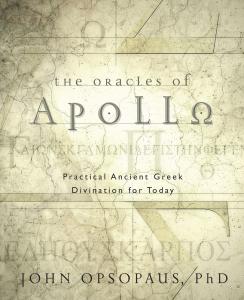
John Opsopaus’ The Oracles of Apollo points out that “since ancient times, divination has been an important tool for seeking guidance from the gods, and most modern Pagans, Wiccans, and others who practice the old faiths are familiar with divination and many practice some divinatory art … “
Mr Opsopaus teaches how to use two rediscovered divination systems:
Firstly, the Alphabet Oracle, a system that uses “the ancient Greek alphabet much like the runes are used … we have actually stone tablets (dating from the early third century CE) that give the divinatory meanings of the letters. … Stone tablets and pillars with the Alphabet Oracle were set up in town squares and similar places where wayfarers could get practical advice on their enterprises.”
Secondly, the Counsels of the Seven Sages, a series of 147 short, oracular statements that were inscribed on tablets at the Temple of Apollo at Delphi. While there is no evidence for them being used for divination in ancient times, they lend themselves very well to being used for this purpose. The Counsels of the Seven Sages “gives advice on how to live well, but it is also practical … “
I particularly enjoyed Chapter 2 which traces the origins of divination in history and mythology. Mr Opsopaus analyzes his data showing the correlation between oracular priestesses, nymphs, bees, honey, nectar, ambrosia and the gods. In the second half of the chapter he outlines the various systems of divination and their possible origins. Importantly, he points out that a divination should be “accompanied by a sincere petition to the gods. This may be accompanied by a vow to be fulfilled if the god helps you out.” A vow to the gods should be taken very seriously. Interpreting the Stoic philosopher Posidonius (135-51BCE), “our divinations will be more successful if we do them in a meditative state, focusing inward and away from our bodies and the visible world. Invite the gods or their assistant daimons to bring the knowledge you seek.” Mr Opsopaus completes the chapter by introducing Neoplatonic philosophy which provides the “most complete and sophisticated theory of divination.” This is like a bonus option for extra credit – it’s great to know, but the divination systems will still work just fine without this knowledge. The average ancient Greek was not a philosopher, but a hard-working individual, looking for an occasional insight into the occasional predicament they found themselves in.
Chapter 3 contains rituals taken from the Graeco-Egyptian magical tradition. Mr Opsopaus extracts a couple of invocations to Apollo from the Greek Magical Papyri (PGM) to form a consecration ritual and a divination ritual. I was very pleased that he limited himself to ancient magic rather than incorporating a modern modality.
The Alphabet Oracle requires 24 round stones, tumbled crystals, pottery shards, discs of clay, or round pieces of wood, onto which the Greek letters have been either painted or carved. While Greek alphabet stones can be purchased, Mr Opsopaus recommends making your own, as “a set of stones is a magical tool, and it is most effective if it is psychically attuned to you, and making it yourself is one way to attune it.” He recommends learning the meaning of each letter and chanting the name of each letter’s spirit over it, as you paint or carve that letter. “Keep your stones in a special jug, box, or bag.” To use the stones, invoke the gods (typically Apollo) and either draw one without looking which feels right, or shake the stones until one jumps out.
Other options are to use a metal leaf, a flat piece of wood, or even a card (like an index card). He also discusses the possibility of using astragaloi (knucklebones), dice, teetotums (tops similar to the dreidel), coins, geomancy, beads, pebbles and so on. The end result is the selection of a letter. Personally, I think that having a bag of 24 round objects each corresponding to a letter is elegant and simple, and allows for individual consecration leading to improved accuracy.
Finally in Chapter 7 we get to the text of the Alphabet Oracle. Mr Opsopaus explains the text, providing a range of situations with what the text is implying as examples. There are other correspondences which may well provide deeper levels of mean. Thus, we have:
Numerical value;
Planet (for the vowels only);
Olympian deity (two letters assigned to each);
Zodiac sign;
Twelve parts of the body corresponding to pairs of letters according to Marcus the Gnostic’s 2nd century CE vision of the goddess, Alêtheia;
Agrippa correspondence – planet, zodiac sign or element;
Lunar symbol (taken from PGM VII: 780-785);
Hieroglyph (taken from Gardner and Budge);
Hour of the day/night (Twelve Hôrai or hours, daughters of Helios – from Hyginus);
Vox magica (word of power/name of its spirit)
Finally in Chapter 7 we get to the text of the Counsels of the Seven Sages, an “ancient collection of 147 pithy and enigmatic sayings, which were inscribed on a tablet at the Temple of Apollo at Delphi.” While the original tablet has been lost, Johannes Stobaeus, who lived in Macedonia in the 5th century CE made a copy of them.
The number 147 is important as the tablet was engraved in three columns, there were seven sages and seven is Apollo’s sacred number.
3 X 7 X 7 = 147.
Also, the Pythagorean name for the number seven is “Athena.”
As stated previously, there is no evidence for the Counsels of the Seven Sages being used for divination in ancient times, but they lend themselves very well to being used for this purpose. Mr Opsopaus discusses a number of methods for consulting the Seven Sages using “beads or pebbles, coins or other discs, special dice and teetotums, and even dominoes.” Once a verse is selected, its interpretation can be consulted. He points out that:
“The Counsels are like spells, divine inspirations prescribed by the Sages as medicine for the soul. They must be taken in and chewed over in order to have their effect. Digest them and they will be absorbed in your soul to make it strong and healthy.”
Overall, I really liked this text and feel that anyone feeling drawn to the Greek deities would do well to try a traditional Greek method of divination, either in addition to, or instead of, more popular modalities such as tarot. I am looking forward to becoming more acquainted with the oracles in a practical sense. My only complaint, and this is a very minor matter, is that the book varies greatly in complexity. Some of the material in the book is very easy to follow, with other sections are very technical, but essential for full immersion into the subject matter. I feel that the technical sections should’ve been placed in appendices so as to not interfere with the flow.
Tony Mierzwicki
Author of Hellenismos: Practicing Greek Polytheism Today and Graeco-Egyptian Magick: Everyday Empowerment.
Previous Post

July 13, 2021
The Best System of Magick
Next Post
July 25, 2021 Review of The Wisdom of Hypatia by Bruce J MacLennan PhD
Browse Our Archives
Select a Category Uncategorized
Select a Month July 2026 December 2025 November 2025 September 2025 March 2025 February 2025 January 2025 August 2024 July 2024 June 2024 April 2024 March 2024 February 2024 January 2024 December 2023 September 2023 June 2023 May 2023 April 2023 February 2023 January 2023 December 2022 November 2022 October 2022 September 2022 August 2022 July 2022 June 2022 March 2022 January 2022 December 2021 October 2021 September 2021 August 2021 July 2021 June 2021 May 2021 April 2021 March 2021 February 2021 January 2021 December 2020 November 2020 September 2020 August 2020 July 2020 June 2020 March 2020 March 2019 February 2019
Follow Us!
TAKE THE
Religious Wisdom Quiz
What does the rider of the Black Horse in Revelation hold in his hand?
Select your answer to see how you score.
A pair of scales A sword A bow A book
Related posts from Holistic Spirituality


The Intuitive’s Oracle by Angela Orora Medway-Smith, et...

TRENDING AT PATHEOS Pagan

I was recently chatting with someone on Instagram. She asked me what...

While there are many people who share their results, the end of...

On July 23, I saw Christopher Nolan's The Odyssey which is Homer’s...

As I write this two big events have just finished up. One...

Restoring the Watershed of Divine Love
Perhaps cooperation is not something we manufacture through legislation, ideology, or moral...

Many UUs don’t pray because of bad experiences in a previous religion,...
view all Pagan blogs
Ad-Free & Subscriber Log-In Subscription Support
- About Us
- 2026 Calendar
- Videos
- Podcasts
- Library of World Religions
- Faith In Media Tracker
- Advertise With Us
- Write for Us
- Privacy Policy
- Terms of Service
- Do Not Sell My Data
- Contact Us
- Radiant Digital
- Manage Newsletter Subscriptions
- Unsubscribe From Notifications
- Sitemap
Copyright 2008-2026, Patheos. All rights reserved.
Subscription Support Ad-Free & Subscriber Log-In
Follow Patheos