
BuddhistCatholicContemplativeEvangelicalGeneral ChristianHinduJewishLatter-day SaintMuslimNew VisionsProgressive Christian
Beliefs
- Buddhist
- Catholic
- Contemplative
- Evangelical
- General Christian
- Hindu
- Jewish
- Latter-day Saint
- More Voices
- Muslim
- New Visions
- Pagan
- Progressive Christian
Topics
- Religion News
- Food and Religion
- Sports and Religion
- Religious Art
- Religious Music and Entertainment
- Religious Events
- History and Religion
- Style and Religion
- Politics and Religion
- Women in Religion
- Recreation Outdoors and Religion
- Business Finance and Religion
- Careers Workplace and Religion
- Education and Religion
- Family Parenting and Religion
- Health Fitness and Religion
- Home and Religion
- Relationships and Religion
- Technology and Religion
- Travel and Religion
Columnists
- Buddhist Columnists
- Business Finance and Religion Columnists
- Careers Workplace and Religion Columnists
- Catholic Columnists
- Contemplative Columnists
- Education and Religion Columnists
- Evangelists Columnists
- Family Parenting and Religion Columnists
- General Christian Columnists
- Health Fitness and Religion Columnists
- Hindu Columnists
- History and Religion Columnists
- Home and Religion Columnists
- Jewish Columnists
- More Voices Columnists
- Latter Day Columnists
- Muslim Columnists
- New Visions Columnists
- Nonreligious Columnists
- Pagan Columnists
- Politics and Religion Columnists
- Progressive Columnists
- Recreation Outdoors and Religion Columnists
- Relationships and Religion Columnists
- Religion News Columnists
- Religious Art Columnists
- Religious Events Columnists
- Religious Music and Entertainment Columnists
- Sports and Religion Columnists
- Style and Religion Columnists
- Technology and Religion Columnists
- Travel and Religion Columnists
- Women in Religion Columnists
Resource Library
- 2026 Calendar
- Library of World Religions
- The 100 Most Holy Places on Earth
- Patheos Answers
- Podcasts
- Videos
- Faith Leaders Database
- Anglican Episcopalian
- Bahai
- Baptist
- Buddhism
- Christianity
- Confucianism
- Eastern Orthodoxy
- Hinduism
- Holiness and Pentecostal
- ISKCON
- Islam
- Judaism
- Lutheran
- Methodist
- The Church of Jesus Christ of Latter-day Saints
- New Age
- Paganism
- Presbytarian and Reformed
- Protestantism
- Religion Behind the Scenes
- Roman Catholic
- Scientology
- Shia Islam
- Sikhism
- Sufism
- Sunni Islam
- Taoism
- Zen
- See all religions
Research Tools
 Ad-Free & Subscriber Log-In Subscription Support
Ad-Free & Subscriber Log-In Subscription Support
Follow Patheos 

- Trending:
- Forgiveness
- |
- Marriage
- |
- Consciousness
- |
- Death Penalty
- |
- Election
- |
- Halloween
 Holistic Spirituality
- Home
- Pagan
- Ancient Athenian Curse Jar and Curse Tablets
Ancient Athenian Curse Jar and Curse Tablets
Last updated on: June 13, 2021 at 7:05 pm by Tony Mierzwicki
Ancient Athenian Curse Jar and Curse Tablets 2021-06-13T19:05:47-08:00 Tony Mierzwicki
Patheos Explore the world's faith through different perspectives on religion and spirituality! Patheos has the views of the prevalent religions and spiritualities of the world.
The ancient Athenians practiced binding magick as shown by a 2300 year old curse jar and 2500 year old curse tablets, all discovered fairly recently.
Curse Jar
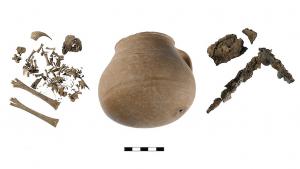
Inside the curse jar, archaeologists found iron nail, coin and bones of a chicken
[Credit: Athenian Agora Excavations]
Jessica Lamont, a professor of Classics at Yale University, wrote an article published in the American School of Classical Studies in Athens’ journal Hesperia 90 (2021), The Curious Case of the Cursed Chicken: A New Binding Ritual from the Athenian Agora:
“Excavations in the Athenian Agora recovered a ceramic pot buried in the back corner of an industrial and commercial building; the exterior of the vessel was inscribed with over 30 names, many female and several new or previously unattested in Attica. The pot contained the dismembered head and lower limbs of a young chicken. The vessel was pierced with a large iron nail and buried with a coin beneath the floor of the Agora’s Classical Commercial Building sometime around 300 B.C. The ritual assemblage belongs to the realm of Athenian binding curses and aimed to ‘bind’ or inhibit the physical and cognitive faculties of the named individuals. This unique discovery offers new evidence for the practice of ‘magic’ in the heart of ancient Athens.”
“’Curse tablets’ or thin sheets of lead inscribed with curses against a certain person, are well-known in Greece. They are commonly found underneath the ground after being buried there many centuries ago by the person who wanted someone to be cursed.
But in a twist on this type of witchery, archaeologists recently discovered the pottery jar filled with chicken bones, along with a coin, underneath the floor of the Athens Agora’s Classical Commercial Building, which millennia ago was the site of craftsmen who plied their trades there. …
The archaeologists determined that the chicken that had been killed had been no older than seven months before it was slaughtered to be used as part of the ritual; they believe that the people who employed the magic may have wanted to transfer ‘the chick’s helplessness and inability to protect itself’ to those they cursed by writing their names on the outside of the jar, [Professor Jessica] Lamont stated.
She further explains that the head of the chicken, which had been twisted off, and its piercing, along its the lower legs, meant that the corresponding body parts in the 55 unfortunate people would also be similarly affected.
‘By twisting off and piercing the head and lower legs of the chicken, the curse sought to incapacitate the use of those same body parts in their victims,’ Lamont notes.
She goes on to state ‘The ritual assemblage belongs to the realm of Athenian binding curses, and aimed to ‘bind’ or inhibit the physical and cognitive faculties of the named individuals.’ The pottery vessel was discovered near several burned pyres that still contained the burned remains of animal — another aspect of the curse, according to Lamont, which may have been something believed to have increased the power of the curse.”
Curse Tablets
On June 6, 2021, the Greek Reporter ran an article, Archaeologists Discover Ancient Curse Tablets in Athens Well:
“A major, and a bit spine-tingling, archaeological discovery of a trove of ancient curse tablets was made recently in Athens‘ downtown neighborhood of Kerameikos (Ceramicus) by archaeologists from the German Archaeological Institute of Athens.
A total of thirty well-preserved curse tablets dating back to the Classical period (2,500 years ago) were found in an ancient well which was originally discovered back in 2016, when other everyday objects — but not the tablets — were found.
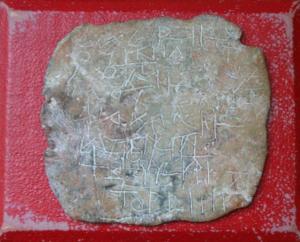
Curse tablet.
[Photo credit: Dr. Jutta Stroszeck – German Archaeological Institute]
The ancient tablets have curses engraved on them which Athenian citizens would pay to have made against other people, a practice which was relatively common in ancient Greece. …
The curse tablets were found accidentally in 2020, while archaeologists were investigating the supply of water to a 1st century BC bathhouse which was close to the well.
Ancient Greeks were known to use the method of engraving curse tablets and attaching them to wells or tombs in order to curse someone with whom they had serious differences. …
They would place the tablets near tombs because they believed that the souls of the dead would carry these curses to the gods of the underworld. …
Normally, people would curse someone they hated for personal reasons, or perhaps someone who they were fighting in court.
Athletes also tended to engage in this unique practice, apparently in an attempt to bring bad luck upon their opponents.
Even ordinary merchants were known to curse the owners of rival businesses, in an effort to bring good luck to their stores and bad luck to those of the others.”
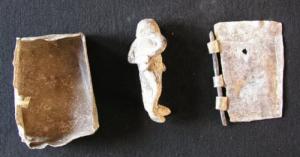
Lead objects found at the bottom of the Kerameikos well, dating back to the 5th century BC.
[Photo credit: Dr. Jutta Stroszeck – German Archaeological Institute]
Overview of Greek Magick
“The roots of magick stretch back to prehistory. Knowledge of what was termed superstition, but is now termed folklore, has shown that magick and the occult were a part of everyday life in ancient Greece. Virtually everyone believed in magick and practiced it, and periods of discrimination against magicians (and philosophers) were mainly politically motivated. Literary evidence shows that magick was practiced from the time of Homer until the Hellenistic period, during which time it underwent a resurgence. Various academics have proposed different theories to distinguish between magick and religion, but currently a number of scholars are suggesting that there is no fundamental difference. While there is no universal consensus as to how magick should be defined, one plausible suggestion is to define it as the imposition of the human will on nature or on other humans, using powers within the soul and permeating the universe. …
The so-called curse tablets … are normally thought of as having been written during the period from the fifth century BCE to the fifth century CE in an area spanning northern Africa and Europe. The earliest curse tablets were very simple and were found in Sicily and Attica from the fifth to the fourth centuries BCE. It has been argued that the earliest Sicilian binding spells could actually be dated from the late sixth century or early fifth century BCE. While the earliest curse tablets appear to have been limited geographically to Sicily, Olbia, and Attica in the fifth century BCE, they were all over the Graeco-Roman world by the second century CE. …
Quite often, ancient sources claim that those who practiced magick were either foreigners or women, or both. This could be referred to as cultural distancing where unacceptable attributes were projected onto other races or onto the opposite gender. The reality was that many Greek males practiced magick. The presence of large numbers of curse tablets and papyri are physical proof of just how widespread involvement in magick was for the Greeks. Magick was a part of daily life for the Greeks and was consequently thought of as mundane and unremarkable. …
… the practice of malevolent magick in Athens was quite prevalent, as indicated by philosophers’ criticisms, parodies in other writings, and actual curse tablets …
Magick to the ancient Greeks was often indistinguishable from their officially sanctioned cult practices, which in turn could be referred to as their religion. Expressing this more fully, magickal beliefs and practices were a part of everyday life, religious beliefs and practices were for the most part identical with forms of magick, and the neat distinctions used by contemporary academics between approved and disapproved forms of religion did not exist in antiquity except among a few philosophers.”
[Mierzwicki, Hellenismos, 149-51, 155-56, 160-61]
The primary reference text for this article is:
Tony Mierzwicki, Hellenismos: Practicing Greek Polytheism Today
Tony Mierzwicki
Author of Hellenismos: Practicing Greek Polytheism Today and Graeco-Egyptian Magick: Everyday Empowerment.
Previous Post
June 6, 2021
Review of Queer Magic by Tomás Prower
Next Post

June 22, 2021 Review of Cord Magic by Brandy Williams
Browse Our Archives
Select a Category Uncategorized
Select a Month July 2026 December 2025 November 2025 September 2025 March 2025 February 2025 January 2025 August 2024 July 2024 June 2024 April 2024 March 2024 February 2024 January 2024 December 2023 September 2023 June 2023 May 2023 April 2023 February 2023 January 2023 December 2022 November 2022 October 2022 September 2022 August 2022 July 2022 June 2022 March 2022 January 2022 December 2021 October 2021 September 2021 August 2021 July 2021 June 2021 May 2021 April 2021 March 2021 February 2021 January 2021 December 2020 November 2020 September 2020 August 2020 July 2020 June 2020 March 2020 March 2019 February 2019
Follow Us!
TAKE THE
Religious Wisdom Quiz
Who walked on water besides Jesus?
Select your answer to see how you score.
Elijah Peter Moses Paul
Related posts from Holistic Spirituality


The Intuitive’s Oracle by Angela Orora Medway-Smith, et...

TRENDING AT PATHEOS Pagan

I was recently chatting with someone on Instagram. She asked me what...

While there are many people who share their results, the end of...

On July 23, I saw Christopher Nolan's The Odyssey which is Homer’s...

As I write this two big events have just finished up. One...

Restoring the Watershed of Divine Love
Perhaps cooperation is not something we manufacture through legislation, ideology, or moral...

Many UUs don’t pray because of bad experiences in a previous religion,...
view all Pagan blogs
Ad-Free & Subscriber Log-In Subscription Support
- About Us
- 2026 Calendar
- Videos
- Podcasts
- Library of World Religions
- Faith In Media Tracker
- Advertise With Us
- Write for Us
- Privacy Policy
- Terms of Service
- Do Not Sell My Data
- Contact Us
- Radiant Digital
- Manage Newsletter Subscriptions
- Unsubscribe From Notifications
- Sitemap
Copyright 2008-2026, Patheos. All rights reserved.
Subscription Support Ad-Free & Subscriber Log-In
Follow Patheos