
BuddhistCatholicContemplativeEvangelicalGeneral ChristianHinduJewishLatter-day SaintMuslimNew VisionsProgressive Christian
Beliefs
- Buddhist
- Catholic
- Contemplative
- Evangelical
- General Christian
- Hindu
- Jewish
- Latter-day Saint
- More Voices
- Muslim
- New Visions
- Pagan
- Progressive Christian
Topics
- Religion News
- Food and Religion
- Sports and Religion
- Religious Art
- Religious Music and Entertainment
- Religious Events
- History and Religion
- Style and Religion
- Politics and Religion
- Women in Religion
- Recreation Outdoors and Religion
- Business Finance and Religion
- Careers Workplace and Religion
- Education and Religion
- Family Parenting and Religion
- Health Fitness and Religion
- Home and Religion
- Relationships and Religion
- Technology and Religion
- Travel and Religion
Columnists
- Buddhist Columnists
- Business Finance and Religion Columnists
- Careers Workplace and Religion Columnists
- Catholic Columnists
- Contemplative Columnists
- Education and Religion Columnists
- Evangelists Columnists
- Family Parenting and Religion Columnists
- General Christian Columnists
- Health Fitness and Religion Columnists
- Hindu Columnists
- History and Religion Columnists
- Home and Religion Columnists
- Jewish Columnists
- More Voices Columnists
- Latter Day Columnists
- Muslim Columnists
- New Visions Columnists
- Nonreligious Columnists
- Pagan Columnists
- Politics and Religion Columnists
- Progressive Columnists
- Recreation Outdoors and Religion Columnists
- Relationships and Religion Columnists
- Religion News Columnists
- Religious Art Columnists
- Religious Events Columnists
- Religious Music and Entertainment Columnists
- Sports and Religion Columnists
- Style and Religion Columnists
- Technology and Religion Columnists
- Travel and Religion Columnists
- Women in Religion Columnists
Resource Library
- 2026 Calendar
- Library of World Religions
- The 100 Most Holy Places on Earth
- Patheos Answers
- Podcasts
- Videos
- Faith Leaders Database
- Anglican Episcopalian
- Bahai
- Baptist
- Buddhism
- Christianity
- Confucianism
- Eastern Orthodoxy
- Hinduism
- Holiness and Pentecostal
- ISKCON
- Islam
- Judaism
- Lutheran
- Methodist
- The Church of Jesus Christ of Latter-day Saints
- New Age
- Paganism
- Presbytarian and Reformed
- Protestantism
- Religion Behind the Scenes
- Roman Catholic
- Scientology
- Shia Islam
- Sikhism
- Sufism
- Sunni Islam
- Taoism
- Zen
- See all religions
Research Tools
 Ad-Free & Subscriber Log-In Subscription Support
Ad-Free & Subscriber Log-In Subscription Support
Follow Patheos 

- Trending:
- Forgiveness
- |
- Marriage
- |
- Consciousness
- |
- Death Penalty
- |
- Election
- |
- Halloween
 Holistic Spirituality
- Home
- Pagan
- Dancers and their Muse
Dancers and their Muse
Last updated on: May 16, 2021 at 1:00 am by Tony Mierzwicki
Dancers and their Muse 2021-05-16T01:00:22-08:00 Tony Mierzwicki
Patheos Explore the world's faith through different perspectives on religion and spirituality! Patheos has the views of the prevalent religions and spiritualities of the world.
The best dancers train as hard as high level athletes, but yet express themselves artistically when performing. Watching those who have mastered their craft, such as Mikhail Baryshnikov, it appears that there are forces at play that bend the laws of physics, causing their moves to appear effortless and almost in slow motion.
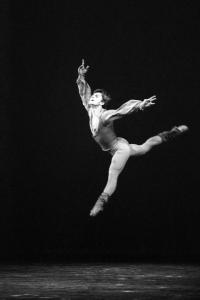
Mikhail Baryshnikov dancing at the Théâtre des Champs-Élysées in Paris on October 19, 1978.
Perhaps the most powerful indication of non-physical forces can be found in high, powerful ballet leaps. There’s a stunning compilation of 10 dancers at their finest here:
10 Most Powerful Ballet Jumpers
“Soaring ballet jumps are perhaps the most recognizable feature of the art for outsiders but also one that continues to amaze fans and experienced trainers. There are around 10 basic jumps with many different variations. They range from quick sautés to the grand jeté leaps with mid-air splits most people think of.”
These days, many creative artists declare that they have a “Muse”, which is a living human being, who inspires, motivates and encourages them to produce work of excellence. In ancient times, a Muse was most definitely not human, but rather from the spirit realm. Perhaps it is with such a Muse that the laws of physics can be bent to achieve results that appear to be impossible?
The Mousai (Muses)
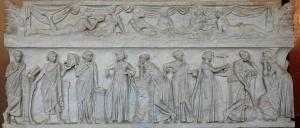
Sarcophagus known as the “Muses Sarcophagus”, representing the nine Muses and their attributes. Marble, first half of the 2nd century AD, found by the Via Ostiense.
The Muses were “in Greek mythology originally the Nymphs of inspiring springs, then goddesses of song in general, afterwards the representatives of the various kinds of poetry, arts, and sciences. In Homer, who now speaks of one, and now of many Muses, but without specifying their number or their names, they are considered as goddesses dwelling in Olympus, who at the meals of the gods sing sweetly to the lyre of Apollo, inspire the poet and prompt his song. Hesiod [Theog. 52-,76-,] calls them the nine daughters of Zeus and Mnemosyne, born in Pieria, and mentions their names … “
The Muses bore different names in different places, until the worship of the nine Muses ultimately became generally established. At this point, the Muses were assigned specific artistic spheres:
Kalliopê [Calliope, “Beautiful-Voiced”], epic poetry;
Kleiô [Clio, “Make Famous”], history;
Ouraniê [Urania, “Heavenly One”], astronomy;
Thaleia [Thalia, “Rich Festivity, Blooming”], comedy;
Melpomenê [“Celebrate with Song”], tragedy;
Polymnia [Polyhymnia, “Many Hymns”], religious hymns;
Eratô [“Lovely, Beloved”], erotic poetry;
Euterpê, [“Well Pleasing” or “Giving Delight”] lyric poetry; and
Terpsikhorê [Terpsichore, “Delighting in Dance”], choral song and dance.
It is the last muse on this list who is of interest.
Muse of Dancing, Terpsikhorê
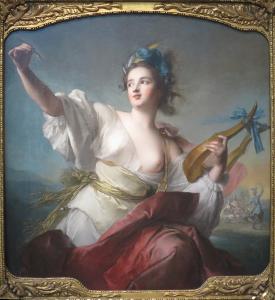
Terpsichore, Muse of Music and ballet, an oil on canvas painting by Jean-Marc Nattier (1739).
“Terpsikhorê was named Muse of choral song and dancing, and depicted with a lyre and plectrum.
Her name means ‘Delighting in Dance’ from the Greek words terpsis ‘to delight’ and khoros ‘dance’.”
Terpsikhorê was also said to be the mother of the Seirênes (Sirens) by the river-god Akhelôos (Achelous). The Seirênes (Sirens) lured nearby sailors with their enchanting music and singing voices to shipwreck on the rocky coast of their island, and could even charm the winds. In some accounts, Terpsikhorê bore the Thracian king Biston by Arês, the god of war. By another river-god, Strymôn, Terpsikhorê mothered the Thracian king Rhesus.
Calling in the Muse of Dancing, Terpsikhorê
My preference is to use pre-existing ancient hymns when working with any of the ancient deities. For the Muses, we have a short Homeric Hymn which should do the trick nicely. For Terpsikhorê, there is no complete hymn, so praying from the heart would be appropriate. Alternatively, there are a few references to her in hymns which I have cobbled together to create an ad hoc hymn.
I am particularly drawn to the second last line, which is taken from Plato’s “Phaedrus” which states that the dancers who honour the Muses on earth, win the love of Terpsikhorê. This embodies the very essence of ancient Greek religion, which is reciprocity. Devotion to the deities is rewarded with blessings. The last line is my attempt at rounding off the hymn.
Those interesting in reading more on reciprocity, are referred to a previous blog, “Reciprocity: Building a Relationship with the Gods.”
As a rule, when no incense or essential oil is recommended, opt for frankincense.
“The most widespread offering was a simple granule of frankincense strewn in the flames.”
[Mierzwicki, Hellenismos, 27-8]
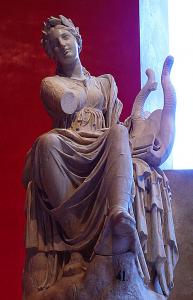
Roman statue of the Muse Terpsichore based on an Attic model from 150–100 BCE, found in Hadrian’s Villa, presently at the Prado Museum (Madrid).
Homeric Hymn 25: To the Muses and Apollo
I will begin with the Muses and Apollo and Zeus.
For it is through the Muses and Apollo that there are singers upon the earth
and players upon the lyre; but kings are from Zeus.
Happy is he whom the Muses love: sweet flows speech from his lips.
Hail, children of Zeus! Give honor to my song!
And now I will remember you and another song also.
[Translation by Hugh G. Evelyn-White, Ed.]
Ad Hoc Hymn to Terpsikhorê
I call on lovely Terpsikhorê, who delights in dance, one of the Muses who dwell on Olympos, nine daughters begotten by great Zeus.
Rosy Terpsikhorê, you brought forth the Seirênes (Sirens), by the stormy embraces of your bull-horned husband Akhelôos (Achelous).
The clear-voiced Seirênes (Sirens) used to bewitch with their seductive melodies whatever sailors anchored there, and at one time they had been handmaids to Dêmêtêr’s gallant Daughter [Persephonê], before she was married, and sung to her in chorus.
Terpsikhorê, you delight (terpein) your disciples with the good things which come from education.
Honey-tongued Terpsikhorê you have gentle-voiced and sweetly sun refrains.
Terpsikhorê, you summon me to sing.
When the grasshoppers die they go and inform the Muses in heaven who honors them on earth. They win the love of Terpsikhorê for the dancers by their report of them.
Terpsikhorê, remember me as one who honors you, and bestow your love upon me.
Cobbled together from:
Hesiod, Theogony 75 ff (trans. Evelyn-White) (Greek epic C8th or C7th B.C.)
Nonnus, Dionysiaca 13. 313 ff (trans. Rouse) (Greek epic C5th A.D.)
Apollonius Rhodius, Argonautica 4. 892 ff (trans. Rieu) (Greek epic C3rd B.C.)
Diodorus Siculus, Library of History 4. 7. 1 (trans. Oldfather) (Greek historian C1st B.C.)
Pindar, Isthmian Ode 2. 6 ff (trans. Conway) (Greek lyric C5th B.C.)
Corinna, Fragment 655 (trans. Campbell, Vol. Greek Lyric IV) (Greek lyric C5th B.C.)
Plato, Phaedrus 259 (trans. Fowler) (Greek philosopher C4th B.C.)
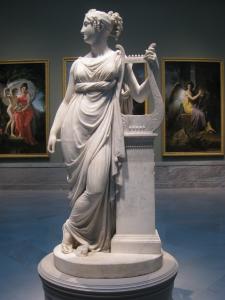
Terpsichore, created 1816 by Antonio Canova (1757-1822), in the Cleveland Museum of Art, Cleveland, Ohio, USA.
The primary reference text for this article is:
Tony Mierzwicki, Hellenismos: Practicing Greek Polytheism Today
Tony Mierzwicki
Author of Hellenismos: Practicing Greek Polytheism Today and Graeco-Egyptian Magick: Everyday Empowerment.
Previous Post

April 25, 2021
Review of The Ultimate Pagan Almanac 2021
Next Post

June 6, 2021 Review of Queer Magic by Tomás Prower
Browse Our Archives
Select a Category Uncategorized
Select a Month July 2026 December 2025 November 2025 September 2025 March 2025 February 2025 January 2025 August 2024 July 2024 June 2024 April 2024 March 2024 February 2024 January 2024 December 2023 September 2023 June 2023 May 2023 April 2023 February 2023 January 2023 December 2022 November 2022 October 2022 September 2022 August 2022 July 2022 June 2022 March 2022 January 2022 December 2021 October 2021 September 2021 August 2021 July 2021 June 2021 May 2021 April 2021 March 2021 February 2021 January 2021 December 2020 November 2020 September 2020 August 2020 July 2020 June 2020 March 2020 March 2019 February 2019
Follow Us!
TAKE THE
Religious Wisdom Quiz
Who prophesied about a locust plague and called for national repentance?
Select your answer to see how you score.
Daniel Joel Micah Amos
Related posts from Holistic Spirituality


The Intuitive’s Oracle by Angela Orora Medway-Smith, et...

TRENDING AT PATHEOS Pagan

I was recently chatting with someone on Instagram. She asked me what...

While there are many people who share their results, the end of...

On July 23, I saw Christopher Nolan's The Odyssey which is Homer’s...

As I write this two big events have just finished up. One...

Restoring the Watershed of Divine Love
Perhaps cooperation is not something we manufacture through legislation, ideology, or moral...

Many UUs don’t pray because of bad experiences in a previous religion,...
view all Pagan blogs
Ad-Free & Subscriber Log-In Subscription Support
- About Us
- 2026 Calendar
- Videos
- Podcasts
- Library of World Religions
- Faith In Media Tracker
- Advertise With Us
- Write for Us
- Privacy Policy
- Terms of Service
- Do Not Sell My Data
- Contact Us
- Radiant Digital
- Manage Newsletter Subscriptions
- Unsubscribe From Notifications
- Sitemap
Copyright 2008-2026, Patheos. All rights reserved.
Subscription Support Ad-Free & Subscriber Log-In
Follow Patheos