
BuddhistCatholicContemplativeEvangelicalGeneral ChristianHinduJewishLatter-day SaintMuslimNew VisionsProgressive Christian
Beliefs
- Buddhist
- Catholic
- Contemplative
- Evangelical
- General Christian
- Hindu
- Jewish
- Latter-day Saint
- More Voices
- Muslim
- New Visions
- Pagan
- Progressive Christian
Topics
- Religion News
- Food and Religion
- Sports and Religion
- Religious Art
- Religious Music and Entertainment
- Religious Events
- History and Religion
- Style and Religion
- Politics and Religion
- Women in Religion
- Recreation Outdoors and Religion
- Business Finance and Religion
- Careers Workplace and Religion
- Education and Religion
- Family Parenting and Religion
- Health Fitness and Religion
- Home and Religion
- Relationships and Religion
- Technology and Religion
- Travel and Religion
Columnists
- Buddhist Columnists
- Business Finance and Religion Columnists
- Careers Workplace and Religion Columnists
- Catholic Columnists
- Contemplative Columnists
- Education and Religion Columnists
- Evangelists Columnists
- Family Parenting and Religion Columnists
- General Christian Columnists
- Health Fitness and Religion Columnists
- Hindu Columnists
- History and Religion Columnists
- Home and Religion Columnists
- Jewish Columnists
- More Voices Columnists
- Latter Day Columnists
- Muslim Columnists
- New Visions Columnists
- Nonreligious Columnists
- Pagan Columnists
- Politics and Religion Columnists
- Progressive Columnists
- Recreation Outdoors and Religion Columnists
- Relationships and Religion Columnists
- Religion News Columnists
- Religious Art Columnists
- Religious Events Columnists
- Religious Music and Entertainment Columnists
- Sports and Religion Columnists
- Style and Religion Columnists
- Technology and Religion Columnists
- Travel and Religion Columnists
- Women in Religion Columnists
Resource Library
- 2026 Calendar
- Library of World Religions
- The 100 Most Holy Places on Earth
- Patheos Answers
- Podcasts
- Videos
- Faith Leaders Database
- Anglican Episcopalian
- Bahai
- Baptist
- Buddhism
- Christianity
- Confucianism
- Eastern Orthodoxy
- Hinduism
- Holiness and Pentecostal
- ISKCON
- Islam
- Judaism
- Lutheran
- Methodist
- The Church of Jesus Christ of Latter-day Saints
- New Age
- Paganism
- Presbytarian and Reformed
- Protestantism
- Religion Behind the Scenes
- Roman Catholic
- Scientology
- Shia Islam
- Sikhism
- Sufism
- Sunni Islam
- Taoism
- Zen
- See all religions
Research Tools
 Ad-Free & Subscriber Log-In Subscription Support
Ad-Free & Subscriber Log-In Subscription Support
Follow Patheos 

- Trending:
- Forgiveness
- |
- Marriage
- |
- Consciousness
- |
- Death Penalty
- |
- Election
- |
- Halloween
 Holistic Spirituality
- Home
- Pagan
- Reciprocity: Building a Relationship with the Gods
Reciprocity: Building a Relationship with the Gods
Last updated on: January 25, 2021 at 11:58 am by Tony Mierzwicki
Reciprocity: Building a Relationship with the Gods 2021-01-25T11:58:08-08:00 Tony Mierzwicki
Patheos Explore the world's faith through different perspectives on religion and spirituality! Patheos has the views of the prevalent religions and spiritualities of the world.
A relationship with the divine is best brought about through prayer and reciprocity.
Prayer
The closest writings the Greeks had to the Christian Bible were the Homeric epics, and they would turn to them for instruction.
“An example of a formula that can be employed is borrowed from the very beginning of Homer’s Iliad, which opens with a prayer for vengeance to his god by Chryses, the priest of Apollon.
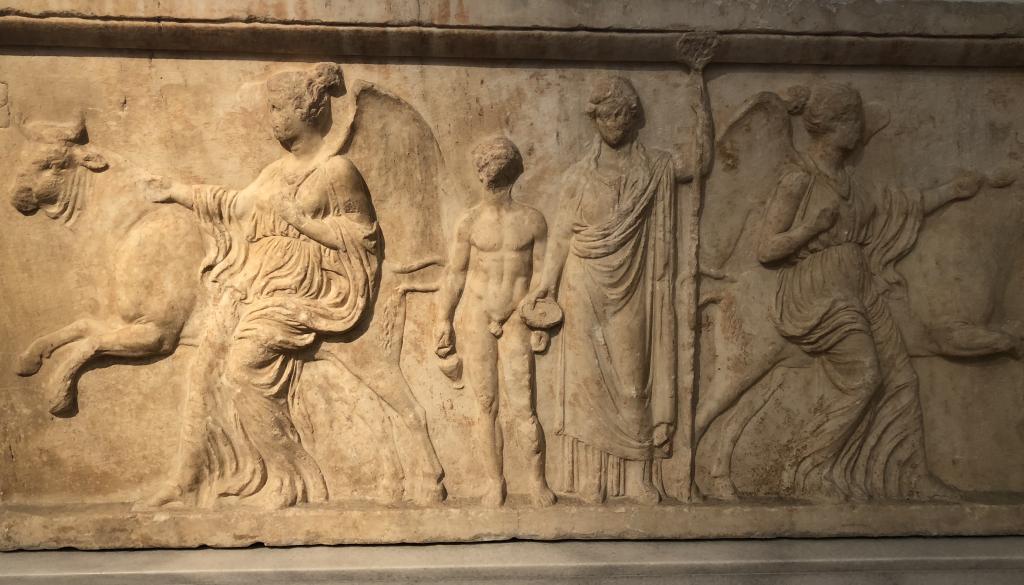
‘Hear me,’ he cried, ‘O god of the silver bow, that protectest Chryse and holy Cilla and rulest Tenedos with thy might, hear me oh thou of Sminthe. If I have ever decked your temple with garlands, or burned your thigh-bones in fat of bulls or goats, grant my prayer, and let your arrows avenge these my tears upon the Danaans.’
Its structure is very simple and can readily be adapted to use for any deity:
‘Hear me,
< insert epithets or titles of deity and description of role of deity >,
If ever I have …
< remind deity of sacrifices and offerings made in the past >…
bring this prayer to fulfillment:
< insert request to deity >’
Obviously the request has to be in keeping with the nature of the deity being called. In this case, the priest asked Apollon to unleash his spears of pestilence. If insufficient sacrifices and prayers were made in the past to sway the deity being called, promises of future sacrifices and offerings can be made, or even the completion of a task.”
[Mierzwicki, Hellenismos, 73-4]
It is important to note that Chryses would regularly perform devotions and sacrifices to his god, Apollon. Technically, these are gratitude workings, as nothing was being asked for, however, he was establishing goodwill between himself and his god. When a time of crisis eventually came, he already had a god on his side.

“Praying Boy” created around 300 BCE in the artistic tradition of the Greek sculptor Lysippus.
“Prayers would typically commence with citing a number of the deity’s titles and where the deity ruled. The deity would be reminded of what services the petitioner had performed in the past, and what they were prepared to perform in the future. A relationship of reciprocity was thus formed. …
When praying to the deities, Socrates used a simple formula:
Give me that which is best for me.
This was an expression of trust that the deities know best what good things are. Prayer was based on reciprocity—the worshipper would establish a relationship where deity remembered the gift or sacrifice and felt well disposed in the future. This did not imply indebtedness.
As part of prayer, gestures were important. To invoke the heavenly deities, the hands are raised to the sky with upturned palms. To invoke sea deities, the hands are extended toward the sea. To invoke a cult image (statue or picture), the hands are stretched toward the image. To invoke the dead or the chthonic (underworld) deities, lay on the ground and pound the earth with the fists, somewhat reminiscent of a child having a tantrum.”
[Mierzwicki, Hellenismos, 73-4]
I personally like to use pre-existing prayers, such as the Homeric and Orphic Hymns when addressing the deities. However, sometimes these are unavailable or not appropriate for a given situation.
It is often appropriate to offer a gift or libation to a deity along with a prayer. While blood sacrifices were sometimes offered in ancient Greece, my preference is for bloodless offerings.
Reciprocity: Gift Offerings and Libations
“The nature of the relationship between the Greeks and their deities was one of reciprocal favor [charis]. Gifts were given in the hope of gratitude.
Gift offerings were either first fruit offerings or votive offerings. First fruits offerings, obtained either from agricultural practices or from hunting and gathering, were set down in a sacred place after which they were taken by the poor or animals, dropped into bodies of water, or burned. Technically, once burned, the offerings should be referred to as sacrifices.
Votive offerings were gifts presented in anticipation of or as a result of divine favor. A vow would be made in front of witnesses promising a gift in return for a desired outcome. The gift could be first fruit offerings, an animal sacrifice, a promise to found a new sanctuary, bestowing goods or slaves unto an existing sanctuary, war booty (primarily weapons), or even offering locks of hair.
Other examples of votive offerings include flowers, branches, shells, gold implements, and clay images of offerings. The most widespread offering was a simple granule of frankincense strewn in the flames.
Gratitude could be shown to deities by leaving lasting visible votive offerings of durable materials such as marble, bronze, silver, gold, and clay, as well as less durable materials such as ivory and wood.
A libation [spondê] would be poured to the deities so as to request their protection. Libations would normally be one or more of the following: wine, honey, olive oil, milk, and water. There was also a libation to the dead or the chthonic deities [choê] (normally not wine).”
[Mierzwicki, Hellenismos, 27-8]
At the risk of stating the obvious, promises to the deities should always be honored. It is not appropriate to conveniently “forget” them.
A relationship with the divine is much like the diplomatic maneuverings between two allied countries where one is much stronger than the other. The more powerful country is treated with respect and gifts are often bestowed. With common sense, things should proceed smoothly.
The primary reference text for this article is:
Tony Mierzwicki, Hellenismos: Practicing Greek Polytheism Today
Tony Mierzwicki
Author of Hellenismos: Practicing Greek Polytheism Today and Graeco-Egyptian Magick: Everyday Empowerment.
Previous Post

January 15, 2021
Insurgency: Staying Safe
Next Post

February 10, 2021 Gratitude and Blood Clots
Browse Our Archives
Select a Category Uncategorized
Select a Month July 2026 December 2025 November 2025 September 2025 March 2025 February 2025 January 2025 August 2024 July 2024 June 2024 April 2024 March 2024 February 2024 January 2024 December 2023 September 2023 June 2023 May 2023 April 2023 February 2023 January 2023 December 2022 November 2022 October 2022 September 2022 August 2022 July 2022 June 2022 March 2022 January 2022 December 2021 October 2021 September 2021 August 2021 July 2021 June 2021 May 2021 April 2021 March 2021 February 2021 January 2021 December 2020 November 2020 September 2020 August 2020 July 2020 June 2020 March 2020 March 2019 February 2019
Follow Us!
TAKE THE
Religious Wisdom Quiz
What separated the Holy Place from the Most Holy Place in the Tabernacle?
Select your answer to see how you score.
A stone wall An incense altar A bronze door A curtain (veil)
Related posts from Holistic Spirituality


The Intuitive’s Oracle by Angela Orora Medway-Smith, et...

TRENDING AT PATHEOS Pagan

I was recently chatting with someone on Instagram. She asked me what...

While there are many people who share their results, the end of...

On July 23, I saw Christopher Nolan's The Odyssey which is Homer’s...

As I write this two big events have just finished up. One...

Restoring the Watershed of Divine Love
Perhaps cooperation is not something we manufacture through legislation, ideology, or moral...

Many UUs don’t pray because of bad experiences in a previous religion,...
view all Pagan blogs
Ad-Free & Subscriber Log-In Subscription Support
- About Us
- 2026 Calendar
- Videos
- Podcasts
- Library of World Religions
- Faith In Media Tracker
- Advertise With Us
- Write for Us
- Privacy Policy
- Terms of Service
- Do Not Sell My Data
- Contact Us
- Radiant Digital
- Manage Newsletter Subscriptions
- Unsubscribe From Notifications
- Sitemap
Copyright 2008-2026, Patheos. All rights reserved.
Subscription Support Ad-Free & Subscriber Log-In
Follow Patheos