
BuddhistCatholicContemplativeEvangelicalGeneral ChristianHinduJewishLatter-day SaintMuslimNew VisionsProgressive Christian
Beliefs
- Buddhist
- Catholic
- Contemplative
- Evangelical
- General Christian
- Hindu
- Jewish
- Latter-day Saint
- More Voices
- Muslim
- New Visions
- Pagan
- Progressive Christian
Topics
- Religion News
- Food and Religion
- Sports and Religion
- Religious Art
- Religious Music and Entertainment
- Religious Events
- History and Religion
- Style and Religion
- Politics and Religion
- Women in Religion
- Recreation Outdoors and Religion
- Business Finance and Religion
- Careers Workplace and Religion
- Education and Religion
- Family Parenting and Religion
- Health Fitness and Religion
- Home and Religion
- Relationships and Religion
- Technology and Religion
- Travel and Religion
Columnists
- Buddhist Columnists
- Business Finance and Religion Columnists
- Careers Workplace and Religion Columnists
- Catholic Columnists
- Contemplative Columnists
- Education and Religion Columnists
- Evangelists Columnists
- Family Parenting and Religion Columnists
- General Christian Columnists
- Health Fitness and Religion Columnists
- Hindu Columnists
- History and Religion Columnists
- Home and Religion Columnists
- Jewish Columnists
- More Voices Columnists
- Latter Day Columnists
- Muslim Columnists
- New Visions Columnists
- Nonreligious Columnists
- Pagan Columnists
- Politics and Religion Columnists
- Progressive Columnists
- Recreation Outdoors and Religion Columnists
- Relationships and Religion Columnists
- Religion News Columnists
- Religious Art Columnists
- Religious Events Columnists
- Religious Music and Entertainment Columnists
- Sports and Religion Columnists
- Style and Religion Columnists
- Technology and Religion Columnists
- Travel and Religion Columnists
- Women in Religion Columnists
Resource Library
- 2026 Calendar
- Library of World Religions
- The 100 Most Holy Places on Earth
- Patheos Answers
- Podcasts
- Videos
- Faith Leaders Database
- Anglican Episcopalian
- Bahai
- Baptist
- Buddhism
- Christianity
- Confucianism
- Eastern Orthodoxy
- Hinduism
- Holiness and Pentecostal
- ISKCON
- Islam
- Judaism
- Lutheran
- Methodist
- The Church of Jesus Christ of Latter-day Saints
- New Age
- Paganism
- Presbytarian and Reformed
- Protestantism
- Religion Behind the Scenes
- Roman Catholic
- Scientology
- Shia Islam
- Sikhism
- Sufism
- Sunni Islam
- Taoism
- Zen
- See all religions
Research Tools
 Ad-Free & Subscriber Log-In Subscription Support
Ad-Free & Subscriber Log-In Subscription Support
Follow Patheos 

- Trending:
- Forgiveness
- |
- Marriage
- |
- Consciousness
- |
- Death Penalty
- |
- Election
- |
- Halloween
 Holistic Spirituality
- Home
- Pagan
- The Gods Help Them That Help Themselves
The Gods Help Them That Help Themselves
Last updated on: July 18, 2020 at 3:53 pm by Tony Mierzwicki
The Gods Help Them That Help Themselves 2020-07-18T15:53:27-08:00 Tony Mierzwicki
Patheos Explore the world's faith through different perspectives on religion and spirituality! Patheos has the views of the prevalent religions and spiritualities of the world.
Many people wonder how to bring the influence of the divine into their lives. There is a wonderful fable attributed to Aesop concerning a petition to Hercules / Herakles from which we can learn much.
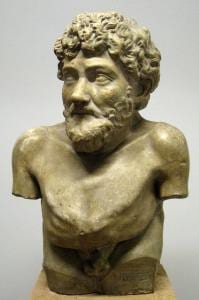
Hellenistic statue thought to depict Aesop, Art Collection of Villa Albani, Rome
Aesop’s Fables
Aesop (620–564 BCE), a slave and story-teller who lived in Ancient Greece, is best remembered for his collections of brief stories, titled “Aesop’s Fables,” which usually involve animals in banal incidents as a tool to convey profound truths.
“… no writings by him survive, numerous tales credited to him were gathered across the centuries and in many languages in a storytelling tradition that continues to this day. Many of the tales are characterized by animals and inanimate objects that speak, solve problems, and generally have human characteristics. Scattered details of Aesop’s life can be found in ancient sources, including Aristotle, Herodotus, and Plutarch. …
In ‘The Aesop Romance’, Aesop is a slave of Phrygian origin on the island of Samos, and extremely ugly. At first he lacks the power of speech, but after showing kindness to a priestess of Isis, is granted by the goddess not only speech but a gift for clever storytelling … ”
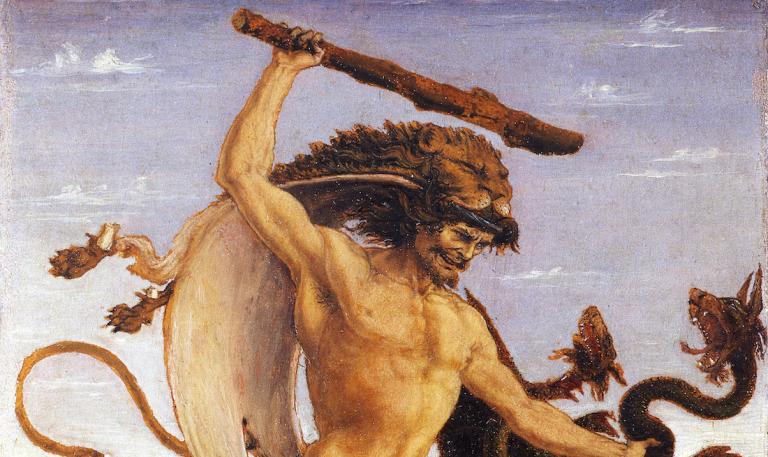
Hercules / Herakles
Hercules / Herakles [Hêraklês]: the son of Zeus and Alcmene [Alkmênê], and the greatest of Greek heroes. There were many legends of his epic feats. Herakles slayed or captured animals, and overcame fabulous monsters. He was closely guided by Athene throughout his adventures. He was adopted as a patron by many young men, especially those in military training or in gymnasiums. His name literally means ‘Hera’s glory’.
[Mierzwicki, Hellenismos, 50]
Hercules and the waggoner
Taken from an 1867 translation of Aesop’s Fables, we have the following pearl of wisdom:
“A Waggoner was once driving a heavy load along a very muddy way. At last he came to a part of the road where the wheels sank half-way into the mire, and the more the horses pulled, the deeper sank the wheels. So the Waggoner threw down his whip, and knelt down and prayed to Hercules the Strong.
‘O Hercules, help me in this my hour of distress,’ quoth he.
But Hercules appeared to him, and said:
‘Tut, man, don’t sprawl there. Get up and put your shoulder to the wheel.’
The gods help them that help themselves.”
Many people resort to magick or prayer in an attempt to manifest things in their lives, expecting those things to drop into their laps. Aesop’s advice was to meet the gods halfway, which implies being proactive. Here is an example of how this can be put into action:
Successful Goal Achievement
On Jun 29, 2018, Psychology Today uploaded a helpful checklist of 10 Key Elements of Successful Goal Achievement. A list like this readily lends itself to assistance from the gods.
- Goals. Goals basically guide our choices. Divination can assist here – calling on Apollon to ensure the most appropriate goals are chosen can save much time.
- Motivation. Motivation is generally described as the force that drives us to pursue a goal. I am a firm believer in calling on Ares for drive and determination.
- Self-confidence. A strong belief in one’s capacity for achievement is essential for success. Knowing that you have the most appropriate gods on your side is very empowering. These will obviously vary depending on what you’re trying to achieve.
- Progress monitoring. Goals do not work well unless one can track progress. Hermes as a scribe and custodian of wisdom lends himself well for this task.
- Compromise between feasibility and desirability. People generally underestimate the difficulty of successful goal pursuit. The divination mentioned in the first point should have assisted here.
- Foreseeing obstacles. As noted above, successful goal pursuits require figuring out which wishes are desirable and feasible and which ones to let go. Again, divination is essential for this point.
- The power of believing that you can improve. This ties in with self-confidence in the third point.
- Dealing with temptation. Sticking to one’s plan is hard work. This ties in with motivation in the second point.
- The power of small steps. Nothing is more motivating than the power of small wins. As the saying goes, “The journey of a thousand miles begins with one step.” This is sage advice.
- Anticipated regret. Anticipated regret can promote goal achievement via guilt about missed opportunity. Stoicism is a wonderful philosophy which would assist with this.
This list could have been shrunk down to six or seven points to remove overlap, but it comes down to personal taste.
“Christianization” of the motto
This saying “God helps them that help themselves” has crept into everyday vernacular, and many mistakenly believe it is from the Bible.
Benjamin Franklin is generally held to have popularized this motto in his Poor Richard’s Almanac. Here’s how it appears in the 1757 edition:
“…let us hearken to good advice, and something may be done for us. ‘God helps them that help themselves,’ as Poor Richard says, in his almanac of 1733.”
Bible Gateway Blog explains “Franklin was a deist. He didn’t believe in a personal God who is actively involved in the affairs of people, but rather in a God who set the world in motion but stands at a distance while we fend for ourselves.”
“According to Barna research, 82% of the general population believes that the phrase, ‘God helps those who help themselves’ is in the Bible. … 81% of Christians surveyed believe that this is in the Bible … “
This idea does not appear in the Bible. In fact, it extols the importance of spiritual self-reliance, which is inconsistent with the Judeo-Christian tradition.
“Whoever trusts in himself is foolish, but whoever lives wisely will be kept safe.”
Proverbs 28:26 [International Standard Version]
It could be inferred that the statistics above actually are indicative of how few Christians actually read their own Bible, as in this case at least their knowledge of its teachings appears to be little better than that of non-Christians.
On April 25, 2017 LifeWay Research stated:
“… more than half of Americans have read little or none of the Bible. Less than a quarter of those who have ever read a Bible have a systematic plan for reading the Christian scriptures each day. And a third of Americans never pick it up on their own … “
The primary reference texts for this article are:
Tony Mierzwicki, Hellenismos: Practicing Greek Polytheism Today
Tony Mierzwicki
Author of Hellenismos: Practicing Greek Polytheism Today and Graeco-Egyptian Magick: Everyday Empowerment.
Previous Post

July 1, 2020
Immune System, Covid-19 and Cheirôn (Chiron)
Next Post

July 24, 2020 Italian Witchcraft and Covid-19 : Lemons, pins and the Aradia
Browse Our Archives
Select a Category Uncategorized
Select a Month July 2026 December 2025 November 2025 September 2025 March 2025 February 2025 January 2025 August 2024 July 2024 June 2024 April 2024 March 2024 February 2024 January 2024 December 2023 September 2023 June 2023 May 2023 April 2023 February 2023 January 2023 December 2022 November 2022 October 2022 September 2022 August 2022 July 2022 June 2022 March 2022 January 2022 December 2021 October 2021 September 2021 August 2021 July 2021 June 2021 May 2021 April 2021 March 2021 February 2021 January 2021 December 2020 November 2020 September 2020 August 2020 July 2020 June 2020 March 2020 March 2019 February 2019
Follow Us!
TAKE THE
Religious Wisdom Quiz
According to Hebrews, without what is it impossible to please God?
Select your answer to see how you score.
Faith Sacrifice Obedience Love
Related posts from Holistic Spirituality


The Intuitive’s Oracle by Angela Orora Medway-Smith, et...

TRENDING AT PATHEOS Pagan

I was recently chatting with someone on Instagram. She asked me what...

While there are many people who share their results, the end of...

On July 23, I saw Christopher Nolan's The Odyssey which is Homer’s...

As I write this two big events have just finished up. One...

Restoring the Watershed of Divine Love
Perhaps cooperation is not something we manufacture through legislation, ideology, or moral...

Many UUs don’t pray because of bad experiences in a previous religion,...
view all Pagan blogs
Ad-Free & Subscriber Log-In Subscription Support
- About Us
- 2026 Calendar
- Videos
- Podcasts
- Library of World Religions
- Faith In Media Tracker
- Advertise With Us
- Write for Us
- Privacy Policy
- Terms of Service
- Do Not Sell My Data
- Contact Us
- Radiant Digital
- Manage Newsletter Subscriptions
- Unsubscribe From Notifications
- Sitemap
Copyright 2008-2026, Patheos. All rights reserved.
Subscription Support Ad-Free & Subscriber Log-In
Follow Patheos