
BuddhistCatholicContemplativeEvangelicalGeneral ChristianHinduJewishLatter-day SaintMuslimNew VisionsProgressive Christian
Beliefs
- Buddhist
- Catholic
- Contemplative
- Evangelical
- General Christian
- Hindu
- Jewish
- Latter-day Saint
- More Voices
- Muslim
- New Visions
- Pagan
- Progressive Christian
Topics
- Religion News
- Food and Religion
- Sports and Religion
- Religious Art
- Religious Music and Entertainment
- Religious Events
- History and Religion
- Style and Religion
- Politics and Religion
- Women in Religion
- Recreation Outdoors and Religion
- Business Finance and Religion
- Careers Workplace and Religion
- Education and Religion
- Family Parenting and Religion
- Health Fitness and Religion
- Home and Religion
- Relationships and Religion
- Technology and Religion
- Travel and Religion
Columnists
- Buddhist Columnists
- Business Finance and Religion Columnists
- Careers Workplace and Religion Columnists
- Catholic Columnists
- Contemplative Columnists
- Education and Religion Columnists
- Evangelists Columnists
- Family Parenting and Religion Columnists
- General Christian Columnists
- Health Fitness and Religion Columnists
- Hindu Columnists
- History and Religion Columnists
- Home and Religion Columnists
- Jewish Columnists
- More Voices Columnists
- Latter Day Columnists
- Muslim Columnists
- New Visions Columnists
- Nonreligious Columnists
- Pagan Columnists
- Politics and Religion Columnists
- Progressive Columnists
- Recreation Outdoors and Religion Columnists
- Relationships and Religion Columnists
- Religion News Columnists
- Religious Art Columnists
- Religious Events Columnists
- Religious Music and Entertainment Columnists
- Sports and Religion Columnists
- Style and Religion Columnists
- Technology and Religion Columnists
- Travel and Religion Columnists
- Women in Religion Columnists
Resource Library
- 2026 Calendar
- Library of World Religions
- The 100 Most Holy Places on Earth
- Patheos Answers
- Podcasts
- Videos
- Faith Leaders Database
- Anglican Episcopalian
- Bahai
- Baptist
- Buddhism
- Christianity
- Confucianism
- Eastern Orthodoxy
- Hinduism
- Holiness and Pentecostal
- ISKCON
- Islam
- Judaism
- Lutheran
- Methodist
- The Church of Jesus Christ of Latter-day Saints
- New Age
- Paganism
- Presbytarian and Reformed
- Protestantism
- Religion Behind the Scenes
- Roman Catholic
- Scientology
- Shia Islam
- Sikhism
- Sufism
- Sunni Islam
- Taoism
- Zen
- See all religions
Research Tools
 Ad-Free & Subscriber Log-In Subscription Support
Ad-Free & Subscriber Log-In Subscription Support
Follow Patheos 

- Trending:
- Forgiveness
- |
- Marriage
- |
- Consciousness
- |
- Death Penalty
- |
- Election
- |
- Halloween
 Holistic Spirituality
- Home
- Pagan
- Ancient Greek Techniques for Covid-19
Ancient Greek Techniques for Covid-19
Last updated on: June 21, 2020 at 1:56 pm by Tony Mierzwicki
Ancient Greek Techniques for Covid-19 2020-06-21T13:56:12-08:00 Tony Mierzwicki
Patheos Explore the world's faith through different perspectives on religion and spirituality! Patheos has the views of the prevalent religions and spiritualities of the world.
As of June 19, 2020, according to a New York Times database, 81 nations have seen a growth in new Covid-19 cases over the past two weeks, while only 36 have seen declines. According to the CDC, the total number of cases in the USA is almost 2.2 million while the total number of deaths is almost 120,000, with both figures increasing daily.
Despite wishes to the contrary, Covid-19 has yet to be reined in. The world needs to remain vigilant.
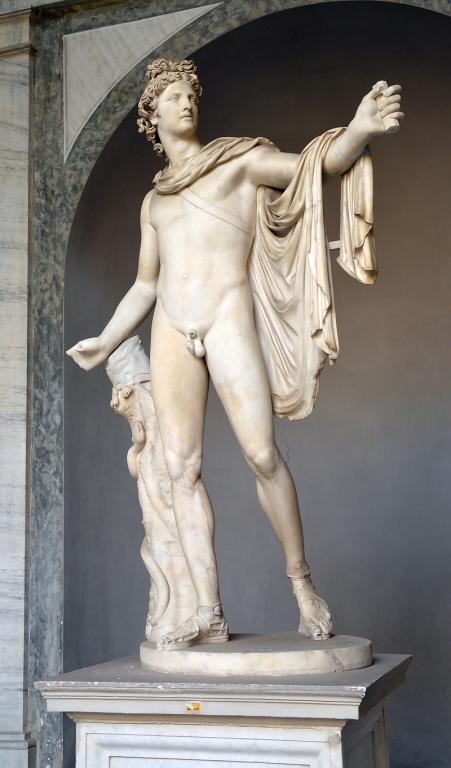
Apollo of the Belvedere, by Livioandronico2013 from WikiMedia. CC 4.0 License.

How did the ancient Greeks deal with plagues?
Prayer should never be seen as an alternative to competent medical advice. However, perhaps there is wisdom to be found in the practices of the ancient Greeks which can be used to supplement the advice given to us by WHO and CDC.
Homer’s Iliad has the earliest account of plague in Greek literature and dates back to the eighth century BCE.
Agamemnon captured for himself as a war prize the daughter of the Trojan priest of Apollon, Chryses [Chrusēs, means “golden”, which is very appropriate given that Apollo is a solar deity, and the associated metal is gold]. When Chryses attempted to ransom her, Agamemnon refused to return her.
Chryses had no option but to pray to Apollon, “god of the silver bow,” reminding him of the sacrifices and offerings he had made in the past. In the prayer, Apollo was addressed with his epithet Apollon Smintheus, or “Apollo the mouse god.” The Greeks had noticed the correlation between rodent infestation and plague, and so prayed to this aspect of Apollon. On a side note, a recent study suggests that it wasn’t so much rats that were vectors of disease, but human-feeding parasites, including fleas and lice, which were responsible for the spread of the Black Death, and doubtless other plagues as well.
Apollon heard the anguished cry of his priest, and in order to defend his honor, sent a plague sweeping through the Greek armies, shooting his arrows at the Greek soldiers for nine days, leading to bodies being piled up and burning on pyres. In mythology, the arrows of Apollon (as well as those of his twin sister Artemis) were associated with the rapid onset of disease.
The Greeks were forced to appease Apollon with sacrifices of bulls and goats, hymns, and the return of the priest’s daughter. They purified themselves and cast their filth into the sea. I assume that “filth” referred to soiled clothing and utensils.
The important points to note are the need for a prayer to Apollon, an offering of something of value and the need for hygiene. The offering can be whatever feels right. However, in ancient Greece, the most widespread offering was a simple granule of frankincense strewn in the flames. First fruits offerings, obtained either from agricultural practices or from hunting and gathering, were set down in a sacred place, dropped into bodies of water, or burned. A vow would be made in front of witnesses promising a gift in return for a desired outcome. Examples of votive offerings include locks of hair, flowers, branches, shells, ivory and wood, or durable materials such as marble, bronze, silver, gold, and clay. A libation would be poured to the deity consisting of one or more of the following: wine, honey, olive oil, milk, and water. [Mierzwicki, Hellenismos, 28]
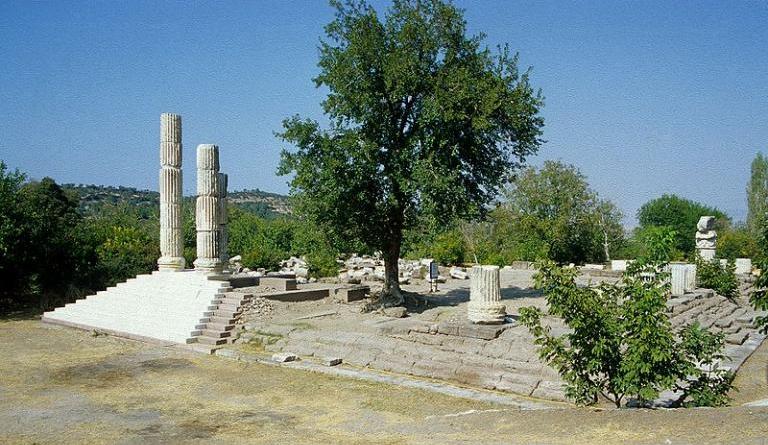
Protection from plague
The CDC recommends wearing cloth face coverings in public settings. They also emphasize the importance of maintaining 6-feet social distancing. As an added precaution, pray to Apollon for protection.
Orphic Hymn 34. For Apollon
Come, blessed Paian, slayer of Tityos;
O Phoibos, Lykoreus, god of Memphis, bright famed giver of wealth, crying “ie!”
With a golden lyre, herdsman, lord of seeds,
Pythios, Titan, Gryneios, Smintheus, slayer of Python, and Delphic prophet.
Wild, lovely, light-bringing daimon, renowned youth, you lead the Mousai in choral dance,
flinging far arrows from a bow, holy finned-one, Didymeus, Loxias working from afar, Lord of Delos.
Your eye sees all and brings light to mortals. Gold haired, you reveal accurate oracular words.
Hear me praying for the people and have a kindly heart.
For you see the boundless Aither, and the rich earth from up above;
and through the dead of night, in still silence, under starry-eyed darkness, you perceive the roots below. You hold the cosmic bounds.
You have concern for the first and the last.
Decked with flowers, you harmonize the poles
with your quick-striking lyre, arriving now at the highest string, then turning downward
to the lowest ones, in the Doric mode;
balancing the poles you draw distinctions between living nations.
In harmony you measure a common share to people,
an equal mix of winter and summer
for each of them; and you pick out the notes:
the lowest with winter, and the highest for summer.
In the Doric mode you play for spring’s much loved and flowery season.
For this, mortals celebrate you in song, and call you Lord and Pan, the two-horned god
who sends forth the whistling songs of the winds.
Wherefore you hold the seal of the cosmos—
hear, blessed one, the initiates’ cry, supplicants, for you to be their savior.
[Translation from Dunn, The Orphic Hymns]
Purification of the body
The ancient Greeks were very diligent about purifying their bodies from pollution and would resort to either fresh water, salt water, fire, or sulphur fumes. Prior to entering a sanctuary, they would wash their hands with pure water poured from a jug. It is not known whether there was some sort of ritual attached to bathing and/or washing the hands. I suggest visualizing all the pollution being washed away. This can be combined with a prayer to Hygeia, the goddess of health, during any bathing.
The CDC recommends washing the hands with soap for at least 20 seconds. The prayer to Hygeia below should be recited while visualizing pollutants flushing down the drain. [Mierzwicki, Hellenismos, 26]
Orphic Hymn 68. For Hygeia
Charming, lovely, the much-nourishing queen of all, attend, blessed Hygieia,
bringing happiness, mother of all things;
for by you, the diseases of mortals perish; and every home blossoms with joy because of you.
The arts ripen, the world longs for you, lady.
And only Hades, killer of souls, ever hates you, always blooming, the prayerful respite of mortals.
For without you, everything is harmful to humans, nor is there sweet wealth,
giver of blessings in abundance, nor do men achieve much-toiling old age without you.
For you alone rule all things and govern over everything.
But, goddess, arrive at this mystic rite; ever helpful, draw off the ill-fated grief of hard disease.
[Translation from Dunn, The Orphic Hymns]
Assistance for those infected with plague
Those who succumb to Covid-19 infection should take heed of any advice given to them by a competent medical professional. This can be supplemented with prayers to Asklepios.
Asklepios was the son of Apollon and a mortal woman. He was eventually elevated to the status of a healing god. In statues he was portrayed as a mature bearded man holding a staff with a snake coiled around it. In his healing sanctuaries, he was presented as a snake. Homer referred to him as a king of Thessaly who learned healing from the centaur Chiron. The symbol of the Staff of Asklepios is still used in modern times to represent medicine and health care. [Mierzwicki, Hellenismos, 54]
Orphic Hymn 67. For Asklepios
Healer of all, Asklepios, Paian the lord, who touches humans with magic
soothing the agonizing suffering of disease, strong one, may you come and lead down Health,
ending sickness and the hard fate of death.
You are a helper, promoting growth, and keeping evil away, sharing blessings.
Strong child of Phoibos Apollon, your fame shines and you hate disease.
You hold Hygieia as your blameless spouse.
Come, blessed one, savior, send a good end of life.
[Translation from Dunn, The Orphic Hymns]
Background on ancient Greek writing
The Greek alphabet of the eighth century BCE is commonly assumed to be derived from the Phoenician alphabet of the same period. The Greeks introduced the innovation of recording vowels when they adapted some of the letters. The first two literary works to be recorded are Homer’s the Iliad and the Odyssey.
The earliest translated Greek writings, however, are Linear B which can be dated to 1400 BCE. There had been a Minoan-Mycenaean culture on Crete that was writing in Greek some 500 years earlier than had been previously thought. The use of the Linear B tablets so far found has been limited to record keeping purposes for various palaces. [Mierzwicki, Hellenismos, 87-88]
The primary reference texts for this article are:
Patrick Dunn, The Orphic Hymns: A New Translation for the Occult Practitioner
Tony Mierzwicki, Hellenismos: Practicing Greek Polytheism Today
Tony Mierzwicki
Author of Hellenismos: Practicing Greek Polytheism Today and Graeco-Egyptian Magick: Everyday Empowerment.
Next Post

July 1, 2020 Immune System, Covid-19 and Cheirôn (Chiron)
Browse Our Archives
Select a Category Uncategorized
Select a Month July 2026 December 2025 November 2025 September 2025 March 2025 February 2025 January 2025 August 2024 July 2024 June 2024 April 2024 March 2024 February 2024 January 2024 December 2023 September 2023 June 2023 May 2023 April 2023 February 2023 January 2023 December 2022 November 2022 October 2022 September 2022 August 2022 July 2022 June 2022 March 2022 January 2022 December 2021 October 2021 September 2021 August 2021 July 2021 June 2021 May 2021 April 2021 March 2021 February 2021 January 2021 December 2020 November 2020 September 2020 August 2020 July 2020 June 2020 March 2020 March 2019 February 2019
Follow Us!
TAKE THE
Religious Wisdom Quiz
What animals did Jesus ride into Jerusalem?
Select your answer to see how you score.
A camel An ox A horse A donkey
Related posts from Holistic Spirituality


The Intuitive’s Oracle by Angela Orora Medway-Smith, et...

TRENDING AT PATHEOS Pagan

I was recently chatting with someone on Instagram. She asked me what...

While there are many people who share their results, the end of...

On July 23, I saw Christopher Nolan's The Odyssey which is Homer’s...

As I write this two big events have just finished up. One...

Restoring the Watershed of Divine Love
Perhaps cooperation is not something we manufacture through legislation, ideology, or moral...

Many UUs don’t pray because of bad experiences in a previous religion,...
view all Pagan blogs
Ad-Free & Subscriber Log-In Subscription Support
- About Us
- 2026 Calendar
- Videos
- Podcasts
- Library of World Religions
- Faith In Media Tracker
- Advertise With Us
- Write for Us
- Privacy Policy
- Terms of Service
- Do Not Sell My Data
- Contact Us
- Radiant Digital
- Manage Newsletter Subscriptions
- Unsubscribe From Notifications
- Sitemap
Copyright 2008-2026, Patheos. All rights reserved.
Subscription Support Ad-Free & Subscriber Log-In
Follow Patheos