
BuddhistCatholicContemplativeEvangelicalGeneral ChristianHinduJewishLatter-day SaintMuslimNew VisionsProgressive Christian
Beliefs
- Buddhist
- Catholic
- Contemplative
- Evangelical
- General Christian
- Hindu
- Jewish
- Latter-day Saint
- More Voices
- Muslim
- New Visions
- Pagan
- Progressive Christian
Topics
- Religion News
- Food and Religion
- Sports and Religion
- Religious Art
- Religious Music and Entertainment
- Religious Events
- History and Religion
- Style and Religion
- Politics and Religion
- Women in Religion
- Recreation Outdoors and Religion
- Business Finance and Religion
- Careers Workplace and Religion
- Education and Religion
- Family Parenting and Religion
- Health Fitness and Religion
- Home and Religion
- Relationships and Religion
- Technology and Religion
- Travel and Religion
Columnists
- Buddhist Columnists
- Business Finance and Religion Columnists
- Careers Workplace and Religion Columnists
- Catholic Columnists
- Contemplative Columnists
- Education and Religion Columnists
- Evangelists Columnists
- Family Parenting and Religion Columnists
- General Christian Columnists
- Health Fitness and Religion Columnists
- Hindu Columnists
- History and Religion Columnists
- Home and Religion Columnists
- Jewish Columnists
- More Voices Columnists
- Latter Day Columnists
- Muslim Columnists
- New Visions Columnists
- Nonreligious Columnists
- Pagan Columnists
- Politics and Religion Columnists
- Progressive Columnists
- Recreation Outdoors and Religion Columnists
- Relationships and Religion Columnists
- Religion News Columnists
- Religious Art Columnists
- Religious Events Columnists
- Religious Music and Entertainment Columnists
- Sports and Religion Columnists
- Style and Religion Columnists
- Technology and Religion Columnists
- Travel and Religion Columnists
- Women in Religion Columnists
Resource Library
- 2026 Calendar
- Library of World Religions
- The 100 Most Holy Places on Earth
- Patheos Answers
- Podcasts
- Videos
- Faith Leaders Database
- Anglican Episcopalian
- Bahai
- Baptist
- Buddhism
- Christianity
- Confucianism
- Eastern Orthodoxy
- Hinduism
- Holiness and Pentecostal
- ISKCON
- Islam
- Judaism
- Lutheran
- Methodist
- The Church of Jesus Christ of Latter-day Saints
- New Age
- Paganism
- Presbytarian and Reformed
- Protestantism
- Religion Behind the Scenes
- Roman Catholic
- Scientology
- Shia Islam
- Sikhism
- Sufism
- Sunni Islam
- Taoism
- Zen
- See all religions
Research Tools
 Ad-Free & Subscriber Log-In Subscription Support
Ad-Free & Subscriber Log-In Subscription Support
Follow Patheos 

- Trending:
- Forgiveness
- |
- Marriage
- |
- Consciousness
- |
- Death Penalty
- |
- Election
- |
- Halloween
 Hippie Heretic
- Home
- Progressive Christian
- The 4 Jesuses I Love (And I Don‘t Mean the 4 Gospels)
The 4 Jesuses I Love (And I Don‘t Mean the 4 Gospels)
Last updated on: December 10, 2018 at 12:36 pm by Chuck McKnight
The 4 Jesuses I Love (And I Don‘t Mean the 4 Gospels) 2018-12-10T12:36:22-07:00 Chuck McKnight
Patheos Explore the world's faith through different perspectives on religion and spirituality! Patheos has the views of the prevalent religions and spiritualities of the world.
If you’ve followed my blog for any length of time, then it’s no secret to you that I’m a big fan of Jesus. I talk about him fairly frequently.
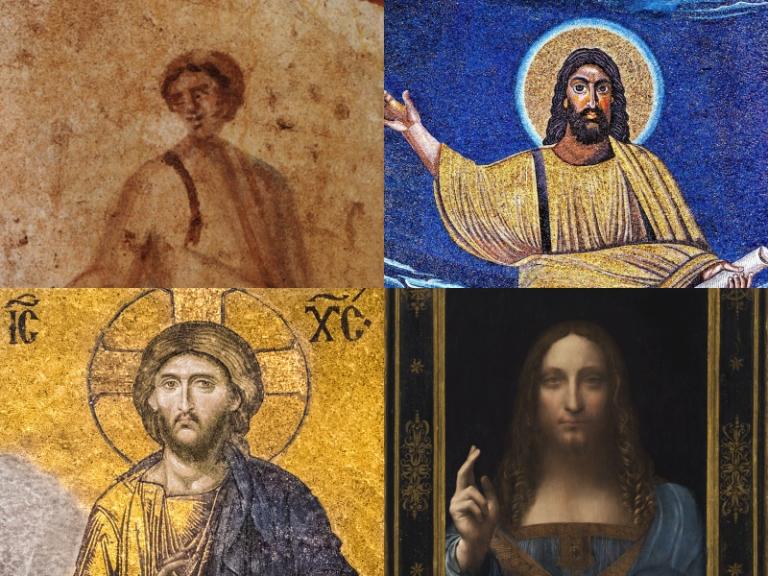
Image credits: four depictions of Jesus—from a 4th-century wall painting in the Catacombs of Marcellinus and Peter (top left), from a 6th- or 7th-century mosaic in the basilica of Santi Cosma e Damiano (top right), from the 13th-century Deësis mosaic in Hagia Sophia, Istanbul (bottom left), and from the 16th-century Salvator Mundi painting by Leonardo da Vinci (bottom right).
But the thing is, there isn’t just one Jesus whom I love. In reality, I could point to any number of different Jesuses who have influenced me over the years and different Jesuses whom I aspire to follow today. But when I talk about Jesus here on the blog, I’m usually referring to one of four:
- The historical Jesus
- The canonical Jesus
- The orthodox Jesus
- The mystical Jesus
The historical Jesus
The historical Jesus is the actual human from Nazareth who lived about 2,000 years ago. Unfortunately, there isn’t a whole lot that we can know about him with empirical certainty, but the impact he’s had on this world is pretty well undeniable.
Apart from a few fringe Jesus mythicists (who deny that Jesus existed at all), the consensus of modern critical scholarship is that Jesus was a real human who was baptized by John, preached a message of love, and was crucified by the Romans. The historical Jesus himself can be distinguished from the search for the historical Jesus, which is the scholarly attempt to identify as much about him as can be known.
I love this Jesus despite not knowing much about him. His life inspired all the other Jesuses that followed, and what can be known about him inspires me to live a life of love.
The canonical Jesus
The canonical Jesus is the figure found in the Christian canon of scripture—primarily the four Gospels, but also the rest of the New Testament to a lesser extent. We could technically separate this Jesus into the specific versions from each New Testament source, as they do at times differ, but this broader identification will suffice for the moment.
Modern scholarship deems it unlikely that any of the canonical Gospels were written by an actual eyewitness of Jesus. So the canonical Jesus is probably based on secondhand accounts at best, resulting in a mixture of fact and legend. Personally, I tend to think there is a bit more historical fact in the canonical Jesus than the strict search for the historical Jesus can tell us, but that’s just my opinion. That he is at least partially embellished is certain.
But regardless of embellishments, I love the canonical Jesus for the simple fact that we have a much more complete picture of his life and teachings. Unlike the fairly unkowable historical Jesus, I can point to exactly where the canonical Jesus said or did this or that, and I can cite a passage to back it up. Perhaps the passage in question may be historical, or perhaps it may not be, but either way, it is unquestionably a part of the Christian tradition that has been affirmed by the church for centuries.
And the life and teachings of the canonical Jesus are everything I aspire to. The core message of love that can be known from the historical Jesus is expanded in the canonical Jesus into a breadth of wisdom that is, in my personal opinion, unparalleled in any other figure, whether historical or not.
I’m frankly not all that concerned about how much of the canonical Jesus may be fictional. Such questions are of intellectual interest, but they have no bearing on whether or not this Jesus is worth following. And to me, he unquestionably is.
The orthodox Jesus
The orthodox Jesus is the particular theological version of Jesus I hold to. He stands in contrast to other theological Jesuses, including the Gnostic Jesus, the Arian Jesus, the Marcionite Jesus, the Augustinian Jesus, the Unitarian Jesus, the theological-liberal Jesus, and countless others. Those other theological Jesuses may have value in their own right, and I don’t mean to write them off entirely, but they simply aren’t as beautiful to me as the orthodox Jesus.
Be sure to note the little “o” I’m using there. I don’t quite mean the Eastern Orthodox Jesus, although he could be considered an expanded and more culturally specific version of the same. The orthodox Jesus is concisely described in the Apostles’ and Nicene creeds, and he is discussed at length in other early Christian writings such as Athanasius’ On the Incarnation of the Word of God.
This is the Jesus who, being God, became a human—not to be punished for our sins, but to stand in full solidarity with us, and to bring us into his own divinity. In the famous words of Irenaeus, this is the Jesus “who did, through His transcendent love, become what we are, that He might bring us to be even what He is Himself” (Against Heresies: Book V).
The mystical Jesus
The mystical Jesus is many things. He is the Cosmic Christ who is in all and through all, and through whom all things exist. He is to be found out in nature, in every person around us, and within each one of us. He is the personal presence of God. The Quakers refer to him the Inner Light. From the perspective of orthodoxy, we could say we experience the mystical Jesus through Holy Spirit.
This is the Jesus who speaks to us directly—not usually in an audible voice, although some mystics have reported as much—but through our feelings, through imaginative or listening prayers, and through a sense of guidance and direction. I can’t help but believe in this Jesus because I experience his presence myself, even if I may not quite be able to explain it.
On the one hand, this Jesus could be considered dangerous, as anyone could claim to have heard him tell them anything they like. But on the other hand, if the orthodox Jesus is to be believed as true, then he demands the existence of a mystical Jesus who so communes with us. And historically speaking, those people who most thoroughly pursued the mystical Jesus have tended to be those who came to most fully understand God’s essence as purest love.
Previous Post

November 18, 2018
An Open Letter to Brian Zahnd: On Full Participation in the Church
Next Post

December 24, 2018 “Christmas Heresy” by Andrew Robinson (Guest Poem)
Browse Our Archives
Select a Category Church Personal Reviews Scripture Social Justice Theology
Select a Month August 2021 September 2020 August 2020 July 2019 March 2019 December 2018 November 2018 October 2018 September 2018 August 2018 July 2018 June 2018 May 2018 April 2018 March 2018 January 2018 December 2017 November 2017 October 2017 September 2017 August 2017 July 2017 June 2017 May 2017 April 2017 March 2017 February 2017 January 2017 December 2016 November 2016 October 2016 July 2016 June 2016 April 2016 March 2016 February 2016 January 2016 December 2015 November 2015
Follow Us!
TAKE THE
Religious Wisdom Quiz
Which book includes "A time to weep and a time to laugh"?
Select your answer to see how you score.
Judges Malachi Genesis Ecclesiastes
Related posts from Hippie Heretic


Yes, Metaxas, Racism Is Still Wrong without God

The Big Book of Hippie Heretics (Daneen Akers'...

Progressives Need to Start Preaching Hell Again
TRENDING AT PATHEOS Progressive Christian

What Being a Modern-Day Apostle Means to Me
In my last column, I discussed the ins and outs of modern-day...

Did Ancient China Once Worship the God of...
Across human history, a common thread weaves through the origins of the...

Love Your Neighbor – Including Earth-Kin: Lev. 19,...
God’s command to love your neighbor means acting in an ethical and...

Lead a Church Study of “Jesus and Lao...
Guest writer Jack Thomas (The Irreverent Reverend) reflects on leading his church...

Pastoral Wisdom for Responding to Sermon Pushback
Getting sermon pushback on your social justice sermon? Learn practical, Proverbs-based strategies...

Principles for Understanding the Apostolic Ministry Today
Whenever people discover that my formal ministry title is "apostle," as in...
view all Progressive Christian blogs
Ad-Free & Subscriber Log-In Subscription Support
- About Us
- 2026 Calendar
- Videos
- Podcasts
- Library of World Religions
- Faith In Media Tracker
- Advertise With Us
- Write for Us
- Privacy Policy
- Terms of Service
- Do Not Sell My Data
- Contact Us
- Radiant Digital
- Manage Newsletter Subscriptions
- Unsubscribe From Notifications
- Sitemap
Copyright 2008-2026, Patheos. All rights reserved.
Subscription Support Ad-Free & Subscriber Log-In
Follow Patheos