
BuddhistCatholicContemplativeEvangelicalGeneral ChristianHinduJewishLatter-day SaintMuslimNew VisionsProgressive Christian
Beliefs
- Buddhist
- Catholic
- Contemplative
- Evangelical
- General Christian
- Hindu
- Jewish
- Latter-day Saint
- More Voices
- Muslim
- New Visions
- Pagan
- Progressive Christian
Topics
- Religion News
- Food and Religion
- Sports and Religion
- Religious Art
- Religious Music and Entertainment
- Religious Events
- History and Religion
- Style and Religion
- Politics and Religion
- Women in Religion
- Recreation Outdoors and Religion
- Business Finance and Religion
- Careers Workplace and Religion
- Education and Religion
- Family Parenting and Religion
- Health Fitness and Religion
- Home and Religion
- Relationships and Religion
- Technology and Religion
- Travel and Religion
Columnists
- Buddhist Columnists
- Business Finance and Religion Columnists
- Careers Workplace and Religion Columnists
- Catholic Columnists
- Contemplative Columnists
- Education and Religion Columnists
- Evangelists Columnists
- Family Parenting and Religion Columnists
- General Christian Columnists
- Health Fitness and Religion Columnists
- Hindu Columnists
- History and Religion Columnists
- Home and Religion Columnists
- Jewish Columnists
- More Voices Columnists
- Latter Day Columnists
- Muslim Columnists
- New Visions Columnists
- Nonreligious Columnists
- Pagan Columnists
- Politics and Religion Columnists
- Progressive Columnists
- Recreation Outdoors and Religion Columnists
- Relationships and Religion Columnists
- Religion News Columnists
- Religious Art Columnists
- Religious Events Columnists
- Religious Music and Entertainment Columnists
- Sports and Religion Columnists
- Style and Religion Columnists
- Technology and Religion Columnists
- Travel and Religion Columnists
- Women in Religion Columnists
Resource Library
- 2026 Calendar
- Library of World Religions
- The 100 Most Holy Places on Earth
- Patheos Answers
- Podcasts
- Videos
- Faith Leaders Database
- Anglican Episcopalian
- Bahai
- Baptist
- Buddhism
- Christianity
- Confucianism
- Eastern Orthodoxy
- Hinduism
- Holiness and Pentecostal
- ISKCON
- Islam
- Judaism
- Lutheran
- Methodist
- The Church of Jesus Christ of Latter-day Saints
- New Age
- Paganism
- Presbytarian and Reformed
- Protestantism
- Religion Behind the Scenes
- Roman Catholic
- Scientology
- Shia Islam
- Sikhism
- Sufism
- Sunni Islam
- Taoism
- Zen
- See all religions
Research Tools
 Ad-Free & Subscriber Log-In Subscription Support
Ad-Free & Subscriber Log-In Subscription Support
Follow Patheos 

- Trending:
- Forgiveness
- |
- Marriage
- |
- Consciousness
- |
- Death Penalty
- |
- Election
- |
- Halloween
 Hippie Heretic
- Home
- Progressive Christian
- A Response to My Former Self on Unity & Theological Essentials
A Response to My Former Self on Unity & Theological Essentials
Last updated on: January 31, 2018 at 5:50 am by Chuck McKnight
A Response to My Former Self on Unity & Theological Essentials 2018-01-31T05:50:52-07:00 Chuck McKnight
Patheos Explore the world's faith through different perspectives on religion and spirituality! Patheos has the views of the prevalent religions and spiritualities of the world.
I’ve been writing publicly since 2012 via blogs and a few contributions to books. During this time, I’ve been examining and re-evaluating my views on just about everything. (And the process is still ongoing—I don’t plan to settle into fixed and unchangeable beliefs any time soon.)
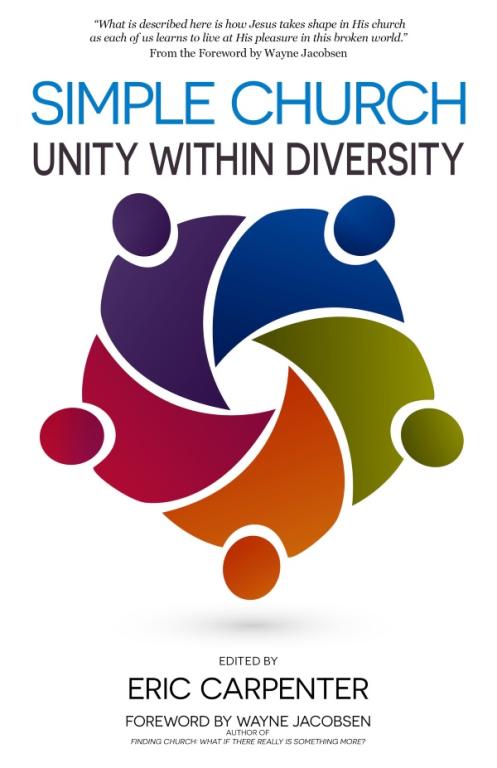
Simple Church: Unity Within Diversity, edited by Eric Carpenter.
Part of the fun with having my deconstruction be so public is that I have a record of where I’ve been and how far I’ve come. That’s why I still haven’t taken down my old blog, BeingFilled.com, even though I now disagree with a substantial portion of what I’ve written there.
I thought it would be interesting to revisit a specific published work of mine, examine it anew, and see where I now diverge from my former self. I’m going to treat this more or less like I would a review of someone else’s writing. After all, the me of four years ago was a very different person from the me of today.
Summary
In 2013, Jeremy Myers invited me to contribute a chapter to a book he and Eric Carpenter were compiling, published in 2014 as Simple Church: Unity Within Diversity. The book includes additional contributions from Keith Giles, Kathy Escobar, and many other notable and diverse voices. While I disagreed with some of them then and with others now, it’s a fascinating read that, on the whole, I’d still recommend today.
My chapter in the book is titled “A Church That Holds Theological Convictions with Humility.” I asked three questions: “Is it ever right to separate over theology? If so, when? How can we hold to theological convictions humbly without causing division?”
To answer these questions, I began by emphasizing the importance of unity. I then examined the biblical instructions surrounding “sound doctrine” and “heresy.” “Sound doctrine,” I explained, means “healthy teaching” and is “primarily used to prescribe actions” rather than accurate theology. And “heresy” is creating division—it’s not a matter of what one believes but of how one holds their beliefs.
Next, I considered which beliefs the New Testament specifically describes as “the gospel” and thus worth separating over. And I came up with a list of five:
- Jesus is the Messiah, the Son of God….
- Jesus came to earth in the flesh….
- Jesus is a descendant of David….
- Jesus died for our sins, was buried, and was raised on the third day….
- Jesus is Lord….
These five simple beliefs then became my theological essentials. I labelled those who did not hold these beliefs as “not truly believers.” And thus, I reasoned, no unity with true believers was compromised. I then concluded with some suggestions for maintaining humility while encountering other nonessential beliefs that differ from one’s own.
[I also adapted, with permission, a portion of that chapter for a post on my old blog, and you can still read it there now.]
Evaluation
The most fundamental change I’ve undergone since writing that chapter has been my approach to understanding the Bible. At the time of writing, I was still clinging to my presuppositions of biblical inerrancy and sola scriptura. Back then, everything I believed had to be backed up with scriptural support. Biblical exegesis was my primary source for determining truth.
Given that perspective, I would stand by most of what I wrote as probably being the best way to read those texts. My goal was to show how far we often stray from the biblical call for unity, and to demonstrate how needlessly divisive most of our arguments tend to be.
I also still agree with how I understood the terms “sound doctrine” and “heresy” to be used in the New Testament, as opposed to how they later came to be understood under Christendom.
And I still very much agree with the advice I gave “for maintaining humility while discussing theology.” I’ve continued to grow and change in my beliefs to this day by following these six suggestions:
- Realize that you are wrong. All of us are—no exceptions. You may not be wrong about everything, but you certainly aren’t right about everything either. …
- Learn how to learn from others. I’ve found that I often gain the most from those with whom I most strongly disagree. …
- Make every effort to understand differing viewpoints rather than trying to disprove them. …
- Seek the truth together. Ignore the desire to prove your theology. …
- Remember that you are part of a family. …
- Keep your eyes on Jesus. …
However, by following the above advice, and given the fundamental shift in how I now understand the Bible, I’ve come to a few major disagreements with what I then wrote.
Criticism
I described five belief statements that form the core of New Testament teaching about Jesus, and I’d still see those as an accurate representation of what the Apostles taught. However, in labelling them “the gospel,” I overlooked something far more important—the life and teachings of Jesus himself, which actually constitutes the gospel as a whole. While I still affirm those belief statements about Jesus, I’m now much more concerned with actually living the way Jesus taught and modeled.
Most crucially, I’m no longer at all interested in writing people off as “not truly believers,” simply because they fail to affirm some point of theology. Being a Christian is about orienting one’s life toward following Christ. It’s about how we live, not what we believe. To an extent, I do still think that such theological considerations are important, but I don’t at all believe that the affirmation or denial thereof makes or breaks one’s status as a “true believer.”
As for the Apostles’ insistence on those beliefs—and their anathematizing those who disagreed—I think it stemmed in part from a legitimate desire to maintain unity. But unfortunately, they attempted to achieve that unity by the power-over methods of seizing control that Jesus warned against.
Right beliefs—whatever they may be—need not be coerced or managed by force. If we are living rightly, following the example that Jesus gave us, then our beliefs will work themselves out well enough.
As for maintaining unity, I still believe that unity (though not uniformity) is very important. However, I would no longer refer to unity as a first-tier doctrine, as I did in my chapter. Rather, love is the one and only first-tier doctrine. Everything else is subservient to love.
Inasmuch as we all truly live in love, we will have true unity, regardless of any theological disagreements. However, to seek unity as our goal without first having love is ultimately to sacrifice love in pursuit of a false unity. We do not need to seek unity. We need only seek love. If we achieve love, unity will follow of its own accord.
Previous Post

January 23, 2018
Could Jesus Have Been Biologically Intersex?
Next Post

March 14, 2018 My “Silly Little Article” and a Powerful Response
Browse Our Archives
Select a Category Church Personal Reviews Scripture Social Justice Theology
Select a Month August 2021 September 2020 August 2020 July 2019 March 2019 December 2018 November 2018 October 2018 September 2018 August 2018 July 2018 June 2018 May 2018 April 2018 March 2018 January 2018 December 2017 November 2017 October 2017 September 2017 August 2017 July 2017 June 2017 May 2017 April 2017 March 2017 February 2017 January 2017 December 2016 November 2016 October 2016 July 2016 June 2016 April 2016 March 2016 February 2016 January 2016 December 2015 November 2015
Follow Us!
TAKE THE
Religious Wisdom Quiz
What Christian group worships on Saturday instead of Sunday?
Select your answer to see how you score.
Baptists Presbyterians Pentecostals Seventh-day Adventists
Related posts from Hippie Heretic


Yes, Metaxas, Racism Is Still Wrong without God

The Big Book of Hippie Heretics (Daneen Akers'...

Progressives Need to Start Preaching Hell Again
TRENDING AT PATHEOS Progressive Christian

What Being a Modern-Day Apostle Means to Me
In my last column, I discussed the ins and outs of modern-day...

Did Ancient China Once Worship the God of...
Across human history, a common thread weaves through the origins of the...

Love Your Neighbor – Including Earth-Kin: Lev. 19,...
God’s command to love your neighbor means acting in an ethical and...

Lead a Church Study of “Jesus and Lao...
Guest writer Jack Thomas (The Irreverent Reverend) reflects on leading his church...

Pastoral Wisdom for Responding to Sermon Pushback
Getting sermon pushback on your social justice sermon? Learn practical, Proverbs-based strategies...

Principles for Understanding the Apostolic Ministry Today
Whenever people discover that my formal ministry title is "apostle," as in...
view all Progressive Christian blogs
Ad-Free & Subscriber Log-In Subscription Support
- About Us
- 2026 Calendar
- Videos
- Podcasts
- Library of World Religions
- Faith In Media Tracker
- Advertise With Us
- Write for Us
- Privacy Policy
- Terms of Service
- Do Not Sell My Data
- Contact Us
- Radiant Digital
- Manage Newsletter Subscriptions
- Unsubscribe From Notifications
- Sitemap
Copyright 2008-2026, Patheos. All rights reserved.
Subscription Support Ad-Free & Subscriber Log-In
Follow Patheos