
BuddhistCatholicContemplativeEvangelicalGeneral ChristianHinduJewishLatter-day SaintMuslimNew VisionsProgressive Christian
Beliefs
- Buddhist
- Catholic
- Contemplative
- Evangelical
- General Christian
- Hindu
- Jewish
- Latter-day Saint
- More Voices
- Muslim
- New Visions
- Pagan
- Progressive Christian
Topics
- Religion News
- Food and Religion
- Sports and Religion
- Religious Art
- Religious Music and Entertainment
- Religious Events
- History and Religion
- Style and Religion
- Politics and Religion
- Women in Religion
- Recreation Outdoors and Religion
- Business Finance and Religion
- Careers Workplace and Religion
- Education and Religion
- Family Parenting and Religion
- Health Fitness and Religion
- Home and Religion
- Relationships and Religion
- Technology and Religion
- Travel and Religion
Columnists
- Buddhist Columnists
- Business Finance and Religion Columnists
- Careers Workplace and Religion Columnists
- Catholic Columnists
- Contemplative Columnists
- Education and Religion Columnists
- Evangelists Columnists
- Family Parenting and Religion Columnists
- General Christian Columnists
- Health Fitness and Religion Columnists
- Hindu Columnists
- History and Religion Columnists
- Home and Religion Columnists
- Jewish Columnists
- More Voices Columnists
- Latter Day Columnists
- Muslim Columnists
- New Visions Columnists
- Nonreligious Columnists
- Pagan Columnists
- Politics and Religion Columnists
- Progressive Columnists
- Recreation Outdoors and Religion Columnists
- Relationships and Religion Columnists
- Religion News Columnists
- Religious Art Columnists
- Religious Events Columnists
- Religious Music and Entertainment Columnists
- Sports and Religion Columnists
- Style and Religion Columnists
- Technology and Religion Columnists
- Travel and Religion Columnists
- Women in Religion Columnists
Resource Library
- 2026 Calendar
- Library of World Religions
- The 100 Most Holy Places on Earth
- Patheos Answers
- Podcasts
- Videos
- Faith Leaders Database
- Anglican Episcopalian
- Bahai
- Baptist
- Buddhism
- Christianity
- Confucianism
- Eastern Orthodoxy
- Hinduism
- Holiness and Pentecostal
- ISKCON
- Islam
- Judaism
- Lutheran
- Methodist
- The Church of Jesus Christ of Latter-day Saints
- New Age
- Paganism
- Presbytarian and Reformed
- Protestantism
- Religion Behind the Scenes
- Roman Catholic
- Scientology
- Shia Islam
- Sikhism
- Sufism
- Sunni Islam
- Taoism
- Zen
- See all religions
Research Tools
 Ad-Free & Subscriber Log-In Subscription Support
Ad-Free & Subscriber Log-In Subscription Support
Follow Patheos 

- Trending:
- Forgiveness
- |
- Marriage
- |
- Consciousness
- |
- Death Penalty
- |
- Election
- |
- Halloween
 Hippie Heretic
- Home
- Progressive Christian
- The New Testament: A Translation by David Bentley Hart (Book Review)
The New Testament: A Translation by David Bentley Hart (Book Review)
Last updated on: December 5, 2017 at 10:30 am by Chuck McKnight
The New Testament: A Translation by David Bentley Hart (Book Review) 2017-12-05T10:30:17-07:00 Chuck McKnight
Patheos Explore the world's faith through different perspectives on religion and spirituality! Patheos has the views of the prevalent religions and spiritualities of the world.
Yale University Press sent me a copy of David Bentley Hart’s recent The New Testament: A Translation to review, and I’m excited to share my findings.
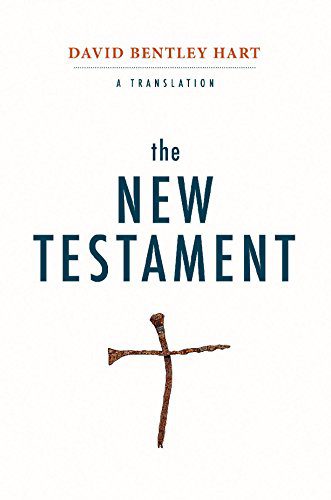
Before we get into the translation itself, let’s briefly discuss the physical copy. The book is a massive hardcover. Though containing only the New Testament, it is far bigger than most complete Bibles. Part of this comes from a slightly larger-than-average font size, part from the extensive footnotes, and part from the generous margins and spacing. It results in a book that looks fantastic, but it takes up a lot of room on the shelf, and it’s just a little cumbersome to handle. I won’t complain too much about it, but I’d love to see a more compact edition. Another minor irritation is the lack of chapter numbers on page headers. Their inclusion would have made it a lot easier to navigate.
Some will ask, why another new translation? I love what Hart has to say on this score. I’ve previously explained that my favorite translations are often the ones completed by a single individual, and Hart hits the nail on the head as to why that is.
… almost all modern translations of the text have been produced not by single scholars with their own particular versions of the texts but by committees. The inevitable consequence of this is that many of the most important decisions are negotiated accommodations, achieved by general agreement, and favoring only those solutions that prove the least offensive to everyone involved. This becomes, in effect, a process of natural selection, in which novel approaches to the text are generally the first to perish, and only the tried and trusted survive. And this can result in the exclusion not only of extravagantly conjectural readings, but often of the most straightforwardly literal as well. …
And in some extreme cases doctrinal or theological or moral ideologies drive translators to distort the text to a discreditable degree. … These may represent the honest zeal of devout translators to communicate what they imagine to be the “correct” theology of scripture, but the preposterous liberties taken to accomplish this end often verge on a kind of pious fraudulence. Moreover, even where ideology does not intrude quite so violently on the work of translation, a kind of inertia has come to hold sway, from generation to generation, over the making of new versions: Where difficult words or syntactical uncertainties or grammatical obscurities appear in the Greek, the solutions favored by earlier translators are generally carried over by their successors, even where there may be more plausible or more interesting alternatives. …
This is not to say that I can pretend to be free of intellectual prejudices; I can only say that I have made every effort not to allow them to interpose themselves between me and the text, even when the result has at some level displeased me. … I am not prompted by any great desire, I hasten to add, to challenge or offend against theological orthodoxies; those, as a rule, can take care of themselves perfectly well, and for the most part would not be threatened by even the most daringly revisionist approach to the text. (pp. xiv–xvi)
As for Hart’s own prejudices, he is an Eastern-Orthodox theologian, and he is as committed to historic Christian orthodoxy as they come. But true to his claims in the introduction, he does not allow this to keep him from honestly portraying the ambiguities of the Greek text. His rendering of John 1:1 provides a great example of this.
In the origin there was the Logos, and the Logos was present with God, and the Logos was god; (p. 168)
Note carefully the capitalization. At first, I thought it was a typo, but that actually is what Hart intended. While he puts the first instance of “God” in small caps, he deliberately leaves uncapitalized the reference to the Logos as “god.” The only other version I’ve seen do something similar here is the Jehovah’s Witnesses’ New World Translation. What then? Is Hart siding with Arianism? Not at all! He is simply acknowledging that the Greek text is less precise in this verse than we orthodox Christians might like to admit. He then devotes a massive footnote to defending this rendering, and he additionally spans five pages of his postscript (pp. 533–537) examining the complexities of this passage in detail.
Speaking of footnotes, they are quite possibly the best thing about this translation. The depth of their explanations is at times astounding. They remind me, in some ways, of the footnotes found in the NET Bible—only without that version’s heavy conservative-Evangelical bias. Considering that Hart’s translation essentially includes a micro-commentary on the text of the New Testament, the aforementioned size becomes a bit more forgivable.
The style of the text, as Hart himself acknowledges, is “an almost pitilessly literal translation” (p. xvii). It is somewhat comparable to Young’s Literal Translation, only without quite as much archaic language. But it isn’t exactly free from archaisms either. A quick scan of the page I happen to be on as I write this (p. 492) reveals such words as impious and wantonness (Jude 4). I suppose Hart made these choices because they are technically more precise, but they aren’t exactly in common use today. None of this is a complaint. Such a precise translation, even if awkward to read, has tremendous value for studying. But don’t confuse this for a popular translation to be used in the pew. That it is not.
Let’s take a look at a few additional passages.
Matthew 5:39 is a verse to which very few translations do justice. Most render the crucial phrase along the lines of “Do not resist an evildoer” (NRSV), which incorrectly implies that we are to do nothing in response to evil. Hart’s translation much more accurately clarifies, “I tell you not to oppose the wicked man by force” (p. 9). It is the violence or the force in the aggressor’s attack that Jesus tells us not to retaliate against. But there are other, non-violent means of resistance, and indeed we must resist if we are not to stand idly by while evil goes unchecked.
I was disappointed but not surprised to see Romans 8:28 follow the standard formula of most translations—that “for those loving God, all things work together for good” (p. 303) rather than that “he co-operates for good with those who love God” (REB).
Hart’s take on 1 Corinthians 6:9 is probably the most accurate I’ve come across. While most translations incorrectly have this verse condemning homosexuality, Hart renders the debated phrases as “feckless sensualists” and “men who couple with catamites”—awkwardly phrased, but much closer to Paul’s likely intended meaning. Hart’s rendering of 1 Timothy 1:10 follows similarly. And he supports his conclusions in extensive footnotes for both passages.
Hart places 1 Corinthians 14:34–35 in brackets, and he asserts (probably correctly) that these verses were added later and are not original to Paul. As always, he provides extensive support for his claim in a footnote.
In his introduction, Hart writes, “I suspect that many readers will be somewhat taken aback by the absence of many terms they are accustomed to finding in the New Testament—‘eternal,’ ‘forever,’ ‘redemption,’ ‘justification,’ ‘repentance,’ ‘predestination,’ ‘world,’ ‘hell,’ and so on—and by the presence of very different terms in their places” (p. xvii). His postscript examines these decisions in detail, and I mostly agree with them. As I wrap up this review, I thought I’d place an example of each of these choices from his translation next to the better-known NRSV for comparison.
“Eternal” (Matthew 25:46)
“And these will go away into eternal punishment, but the righteous into eternal life.” (NRSV)
“And these will go to the chastening of that Age, but the just to the life of that Age.” (Hart, p. 53)
“Forever” (Revelation 20:10)
And the devil who had deceived them was thrown into the lake of fire and sulfur, where the beast and the false prophet were, and they will be tormented day and night forever and ever. (NRSV)
And the Slanderer who led them astray was cast into the marsh of fire and sulfur, where the beast and the false prophet are also, and they will be tormented day and night unto the ages of the ages. (Hart, p. 528)
“Redemption” (Luke 21:28)
“Now when these things begin to take place, stand up and raise your heads, because your redemption is drawing near.” (NRSV)
“And, when these things begin to happen, stand up and lift your heads, because your liberation draws near.” (Hart, p.158)
“Justification” (Galatians 2:21)
I do not nullify the grace of God; for if justification comes through the law, then Christ died for nothing. (NRSV)
I do not reject God’s grace; for if vindication is by Law then the Anointed died for nothing. (Hart, p. 372)
“Repentance” (2 Peter 3:9)
The Lord is not slow about his promise, as some think of slowness, but is patient with you, not wanting any to perish, but all to come to repentance. (NRSV)
The Lord is not delaying what is promised, as some reckon delay, but is magnanimous toward you, intending for no one to perish, but rather for all to advance to a change of heart. (Hart, p. 477)
“Predestination” (Romans 8:29–30)
For those whom he foreknew he also predestined to be conformed to the image of his Son, in order that he might be the firstborn within a large family. And those whom he predestined he also called; and those whom he called he also justified; and those whom he justified he also glorified. (NRSV)
Because those he knew in advance he then marked out in advance as being in conformity to the image of his Son, so that he might be firstborn among many brothers; And those he marked out in advance, these he then called; those he called, these he then proved righteous; and those he proved righteous, these he then glorified. (Hart, pp. 303–304)
“World” (John 3:16–17)
“For God so loved the world that he gave his only Son, so that everyone who believes in him may not perish but may have eternal life. Indeed, God did not send the Son into the world to condemn the world, but in order that the world might be saved through him.” (NRSV)
“For God so loved the cosmos as to give the Son, the only one, so that everyone having faith in him might not perish, but have the life of the Age. For God sent the Son into the cosmos not that he might pass judgment on the cosmos, but that the cosmos might be saved through him.” (Hart, p. 174)
“Hell” (Matthew 10:28)
“Do not fear those who kill the body but cannot kill the soul; rather fear him who can destroy both soul and body in hell.” (NRSV)
“And do not fear those who kill the body but cannot kill the soul; but rather fear the one who can destroy both soul and body in the Vale of Hinnom.” (Hart, p. 19)
In conclusion, The New Testament: A Translation is quirky and awkward, and I love it! David Bentley Hart has gifted us with a meticulously precise examination of the text, and he has corrected many of the errors common to English versions of the Bible. His version is not for casual reading, but it is of incredible value for in-depth study, and I am quite sure I will be returning to it often.
Pick up your own copy as a hardcover or a Kindle eBook.
Previous Post

November 15, 2017
Jacob’s Marriage to Leah, Rachel, Bilhah & Zilpah
Next Post
December 7, 2017 Tantric Jesus by James Hughes Reho (Book Review)
Browse Our Archives
Select a Category Church Personal Reviews Scripture Social Justice Theology
Select a Month August 2021 September 2020 August 2020 July 2019 March 2019 December 2018 November 2018 October 2018 September 2018 August 2018 July 2018 June 2018 May 2018 April 2018 March 2018 January 2018 December 2017 November 2017 October 2017 September 2017 August 2017 July 2017 June 2017 May 2017 April 2017 March 2017 February 2017 January 2017 December 2016 November 2016 October 2016 July 2016 June 2016 April 2016 March 2016 February 2016 January 2016 December 2015 November 2015
Follow Us!
TAKE THE
Religious Wisdom Quiz
Which Christian group is known for door-to-door evangelism and "Watchtower" magazine?
Select your answer to see how you score.
Mennonites Jehovah's Witnesses Lutherans Methodists
Related posts from Hippie Heretic


Yes, Metaxas, Racism Is Still Wrong without God

The Big Book of Hippie Heretics (Daneen Akers'...

Progressives Need to Start Preaching Hell Again
TRENDING AT PATHEOS Progressive Christian

What Being a Modern-Day Apostle Means to Me
In my last column, I discussed the ins and outs of modern-day...

Did Ancient China Once Worship the God of...
Across human history, a common thread weaves through the origins of the...

Love Your Neighbor – Including Earth-Kin: Lev. 19,...
God’s command to love your neighbor means acting in an ethical and...

Lead a Church Study of “Jesus and Lao...
Guest writer Jack Thomas (The Irreverent Reverend) reflects on leading his church...

Pastoral Wisdom for Responding to Sermon Pushback
Getting sermon pushback on your social justice sermon? Learn practical, Proverbs-based strategies...

Principles for Understanding the Apostolic Ministry Today
Whenever people discover that my formal ministry title is "apostle," as in...
view all Progressive Christian blogs
Ad-Free & Subscriber Log-In Subscription Support
- About Us
- 2026 Calendar
- Videos
- Podcasts
- Library of World Religions
- Faith In Media Tracker
- Advertise With Us
- Write for Us
- Privacy Policy
- Terms of Service
- Do Not Sell My Data
- Contact Us
- Radiant Digital
- Manage Newsletter Subscriptions
- Unsubscribe From Notifications
- Sitemap
Copyright 2008-2026, Patheos. All rights reserved.
Subscription Support Ad-Free & Subscriber Log-In
Follow Patheos