
BuddhistCatholicContemplativeEvangelicalGeneral ChristianHinduJewishLatter-day SaintMuslimNew VisionsProgressive Christian
Beliefs
- Buddhist
- Catholic
- Contemplative
- Evangelical
- General Christian
- Hindu
- Jewish
- Latter-day Saint
- More Voices
- Muslim
- New Visions
- Pagan
- Progressive Christian
Topics
- Religion News
- Food and Religion
- Sports and Religion
- Religious Art
- Religious Music and Entertainment
- Religious Events
- History and Religion
- Style and Religion
- Politics and Religion
- Women in Religion
- Recreation Outdoors and Religion
- Business Finance and Religion
- Careers Workplace and Religion
- Education and Religion
- Family Parenting and Religion
- Health Fitness and Religion
- Home and Religion
- Relationships and Religion
- Technology and Religion
- Travel and Religion
Columnists
- Buddhist Columnists
- Business Finance and Religion Columnists
- Careers Workplace and Religion Columnists
- Catholic Columnists
- Contemplative Columnists
- Education and Religion Columnists
- Evangelists Columnists
- Family Parenting and Religion Columnists
- General Christian Columnists
- Health Fitness and Religion Columnists
- Hindu Columnists
- History and Religion Columnists
- Home and Religion Columnists
- Jewish Columnists
- More Voices Columnists
- Latter Day Columnists
- Muslim Columnists
- New Visions Columnists
- Nonreligious Columnists
- Pagan Columnists
- Politics and Religion Columnists
- Progressive Columnists
- Recreation Outdoors and Religion Columnists
- Relationships and Religion Columnists
- Religion News Columnists
- Religious Art Columnists
- Religious Events Columnists
- Religious Music and Entertainment Columnists
- Sports and Religion Columnists
- Style and Religion Columnists
- Technology and Religion Columnists
- Travel and Religion Columnists
- Women in Religion Columnists
Resource Library
- 2026 Calendar
- Library of World Religions
- The 100 Most Holy Places on Earth
- Patheos Answers
- Podcasts
- Videos
- Faith Leaders Database
- Anglican Episcopalian
- Bahai
- Baptist
- Buddhism
- Christianity
- Confucianism
- Eastern Orthodoxy
- Hinduism
- Holiness and Pentecostal
- ISKCON
- Islam
- Judaism
- Lutheran
- Methodist
- The Church of Jesus Christ of Latter-day Saints
- New Age
- Paganism
- Presbytarian and Reformed
- Protestantism
- Religion Behind the Scenes
- Roman Catholic
- Scientology
- Shia Islam
- Sikhism
- Sufism
- Sunni Islam
- Taoism
- Zen
- See all religions
Research Tools
 Ad-Free & Subscriber Log-In Subscription Support
Ad-Free & Subscriber Log-In Subscription Support
Follow Patheos 

- Trending:
- Forgiveness
- |
- Marriage
- |
- Consciousness
- |
- Death Penalty
- |
- Election
- |
- Halloween
 Hippie Heretic
- Home
- Progressive Christian
- Thoughts on the Eucharist: Mystical, Not Magical, and Everyone Is Included
Thoughts on the Eucharist: Mystical, Not Magical, and Everyone Is Included
Last updated on: September 11, 2017 at 9:51 am by Chuck McKnight
Thoughts on the Eucharist: Mystical, Not Magical, and Everyone Is Included 2017-09-11T09:51:56-07:00 Chuck McKnight
Patheos Explore the world's faith through different perspectives on religion and spirituality! Patheos has the views of the prevalent religions and spiritualities of the world.
From time to time, folks ask me about my views on the Eucharist (or communion), particularly the question of who should be allowed to participate. And there’s also been a bit of buzz recently about the Catholic Church’s refusal to allow gluten-free wafers. So I thought I’d share some thoughts on the sacrament in general.
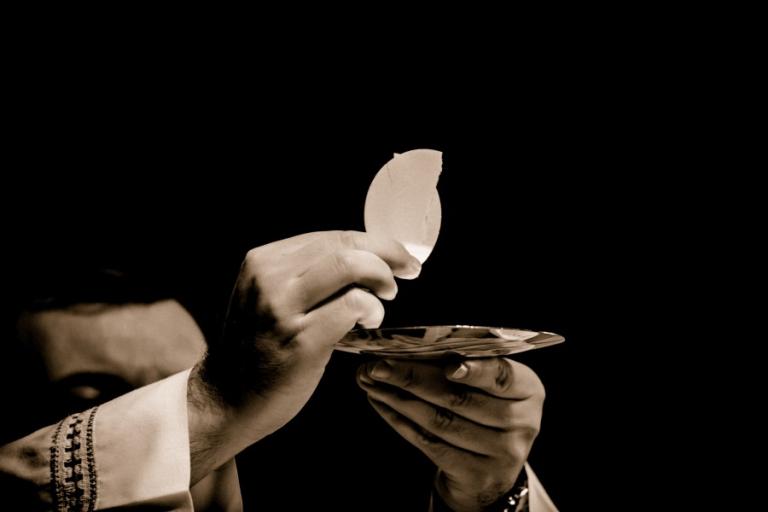
Image credit: RobertCheaib, Pixabay.com.
In my earlier years, I held to an extraordinarily low-church view of all sacraments, including Eucharist. That is, I saw them as merely symbols, reminders, or public declarations. In fact, I would have balked at even using the words Eucharist or sacrament. All such things just sounded to scarily Catholic to me.
However, the longer I’ve walked with Christ, and the more I’ve come to appreciate the universal church, the less I’ve been able to maintain such a low view. This is not something I can necessarily explain, nor certainly do I intend to defend it, but I can simply no longer believe that the sacraments are only symbolic—that nothing else of greater significance is going on behind the scenes.
That said, I also can’t quite accept the way that many (not all) high-church folks present them. Though they would never describe it this way themselves, they end up presenting the sacraments almost as if they were a form of magic.1 Consider, for example, the Eucharist in a Catholic Mass:
- It must be administered by an ordained priest.
- The right ingredients must be used for the bread and wine.
- The right words must be spoken.
- All those partaking must have already been initiated via baptism.
- And if all these things are done correctly, then Christ is really present.
I’m not meaning to pick on my Catholic friends; I just can’t get around this perception. I don’t buy the idea that Jesus has a checklist of requirements that must be met before making himself present. I don’t believe God cares who administers, what ingredients are used, what words are said, or what prerequisites the participants have met.
What I do believe is that the sacraments were made for people, not people for the sacraments. What matters is that we are gathering to celebrate Christ, and that we are choosing to intentionally remember him in the bread and wine. So long as this happens, Christ is present. He is present in a real and mystical sense that transcends our understanding, but not in a magical sense requiring adherence to a formula.
One of the most meaningful celebrations of Eucharist I’ve ever experienced was when my son and daughter (three and two years old at the time) spontaneously decided they were going to administer it, and the wonderful church we’re a part of gladly agreed. The presence of Christ in that room—and in that gluten-free bread and grape juice—could not have been more real if the pope himself had administered it.
The kingdom of God belongs to such as these, and I’m to believe they can’t administer Eucharist because they aren’t priests? No, I can’t believe that.
For Whom?
Then there’s the question of who gets to partake. Do they have to be baptized? Can baptized Christians from other denominations join? Do they have to be rebaptized if they were first baptized in a different denomination? On and on the rules and requirements go.
All these things do is exclude people. But why would we exclude anyone? Even non-Christians—if they wish to celebrate Christ with us, why on earth would we stop them? What a powerful witness it would be, demonstrating that they are already loved and included, and that the body and blood of Christ are for them too.
Is not the Eucharist a continuation of the incarnation? Is it not a reenactment of Jesus’ life, death, and resurrection? And did he not become incarnate, live, die, and rise again for all people?
And when Jesus first introduced the meal with his disciples, did he not dip his bread for the very one he knew would betray him? If even Judas was included, then surely all must be included.
But Paul!
Some confusion has come from 1 Corinthians 11:17–34, wherein Paul discusses how the Corinthian church had been abusing the Lord’s Supper. For reasons that continue to bewilder me, this has passage has long been used as the standard justification for excluding certain people from partaking. But that’s literally the exact opposite of what Paul taught.
He was quite straightforward about the problem at hand, and it had nothing to do with the wrong people taking part. He saw “divisions” and “factions” in the church. These groups went about the supper independently of each other, some getting drunk and others going hungry. In particular, this ended up excluding the poor.
Paul’s solution was simple, “wait for one another” so that everyone may be included. The exclusion of certain people was the very problem Paul addressed. His instruction to “examine yourselves” so that you do not partake “in an unworthy manner” has to be understood in this context of inclusion and exclusion.
Accepting the Eucharist while excluding others is precisely what it means to partake in an unworthy manner. Everyone is included. Everyone is welcome!
1 On using the word magic, I must acknowledge that pagans who actually do refer to their craft as such would not necessarily exhibit the behaviors I’m here describing. My use of the word has much more to do with its association in fantasy than in reality.

Next Post

August 8, 2017 What Do You Think of Patheos’ New Design?
Browse Our Archives
Select a Category Church Personal Reviews Scripture Social Justice Theology
Select a Month August 2021 September 2020 August 2020 July 2019 March 2019 December 2018 November 2018 October 2018 September 2018 August 2018 July 2018 June 2018 May 2018 April 2018 March 2018 January 2018 December 2017 November 2017 October 2017 September 2017 August 2017 July 2017 June 2017 May 2017 April 2017 March 2017 February 2017 January 2017 December 2016 November 2016 October 2016 July 2016 June 2016 April 2016 March 2016 February 2016 January 2016 December 2015 November 2015
Follow Us!
TAKE THE
Religious Wisdom Quiz
According to Ecclesiastes 12, what happens to the human spirit when a person dies?
Select your answer to see how you score.
It is reincarnated It ceases to exist It returns to God It remains on earth
Related posts from Hippie Heretic

It Isn't Scapegoating if You're Guilty


Yes, Metaxas, Racism Is Still Wrong without God

The Big Book of Hippie Heretics (Daneen Akers'...
TRENDING AT PATHEOS Progressive Christian

What Being a Modern-Day Apostle Means to Me
In my last column, I discussed the ins and outs of modern-day...

Did Ancient China Once Worship the God of...
Across human history, a common thread weaves through the origins of the...

Love Your Neighbor – Including Earth-Kin: Lev. 19,...
God’s command to love your neighbor means acting in an ethical and...

Lead a Church Study of “Jesus and Lao...
Guest writer Jack Thomas (The Irreverent Reverend) reflects on leading his church...

Pastoral Wisdom for Responding to Sermon Pushback
Getting sermon pushback on your social justice sermon? Learn practical, Proverbs-based strategies...

Principles for Understanding the Apostolic Ministry Today
Whenever people discover that my formal ministry title is "apostle," as in...
view all Progressive Christian blogs
Ad-Free & Subscriber Log-In Subscription Support
- About Us
- 2026 Calendar
- Videos
- Podcasts
- Library of World Religions
- Faith In Media Tracker
- Advertise With Us
- Write for Us
- Privacy Policy
- Terms of Service
- Do Not Sell My Data
- Contact Us
- Radiant Digital
- Manage Newsletter Subscriptions
- Unsubscribe From Notifications
- Sitemap
Copyright 2008-2026, Patheos. All rights reserved.
Subscription Support Ad-Free & Subscriber Log-In
Follow Patheos