
BuddhistCatholicContemplativeEvangelicalGeneral ChristianHinduJewishLatter-day SaintMuslimNew VisionsProgressive Christian
Beliefs
- Buddhist
- Catholic
- Contemplative
- Evangelical
- General Christian
- Hindu
- Jewish
- Latter-day Saint
- More Voices
- Muslim
- New Visions
- Pagan
- Progressive Christian
Topics
- Religion News
- Food and Religion
- Sports and Religion
- Religious Art
- Religious Music and Entertainment
- Religious Events
- History and Religion
- Style and Religion
- Politics and Religion
- Women in Religion
- Recreation Outdoors and Religion
- Business Finance and Religion
- Careers Workplace and Religion
- Education and Religion
- Family Parenting and Religion
- Health Fitness and Religion
- Home and Religion
- Relationships and Religion
- Technology and Religion
- Travel and Religion
Columnists
- Buddhist Columnists
- Business Finance and Religion Columnists
- Careers Workplace and Religion Columnists
- Catholic Columnists
- Contemplative Columnists
- Education and Religion Columnists
- Evangelists Columnists
- Family Parenting and Religion Columnists
- General Christian Columnists
- Health Fitness and Religion Columnists
- Hindu Columnists
- History and Religion Columnists
- Home and Religion Columnists
- Jewish Columnists
- More Voices Columnists
- Latter Day Columnists
- Muslim Columnists
- New Visions Columnists
- Nonreligious Columnists
- Pagan Columnists
- Politics and Religion Columnists
- Progressive Columnists
- Recreation Outdoors and Religion Columnists
- Relationships and Religion Columnists
- Religion News Columnists
- Religious Art Columnists
- Religious Events Columnists
- Religious Music and Entertainment Columnists
- Sports and Religion Columnists
- Style and Religion Columnists
- Technology and Religion Columnists
- Travel and Religion Columnists
- Women in Religion Columnists
Resource Library
- 2026 Calendar
- Library of World Religions
- The 100 Most Holy Places on Earth
- Patheos Answers
- Podcasts
- Videos
- Faith Leaders Database
- Anglican Episcopalian
- Bahai
- Baptist
- Buddhism
- Christianity
- Confucianism
- Eastern Orthodoxy
- Hinduism
- Holiness and Pentecostal
- ISKCON
- Islam
- Judaism
- Lutheran
- Methodist
- The Church of Jesus Christ of Latter-day Saints
- New Age
- Paganism
- Presbytarian and Reformed
- Protestantism
- Religion Behind the Scenes
- Roman Catholic
- Scientology
- Shia Islam
- Sikhism
- Sufism
- Sunni Islam
- Taoism
- Zen
- See all religions
Research Tools
 Ad-Free & Subscriber Log-In Subscription Support
Follow Patheos 

- Trending:
- Advent
- |
- Forgiveness
- |
- Thanksgiving
- |
- Election
- |
- Seasonal Holidays
- |
- Marriage
 Hippie Heretic
- Home
- Progressive Christian
- Wounded Children (The Beautiful Gospel of WHEAT)
Wounded Children (The Beautiful Gospel of WHEAT)
Last updated on: December 14, 2017 at 9:57 am by Chuck McKnight
Wounded Children (The Beautiful Gospel of WHEAT) 2017-12-14T09:57:56-07:00 Chuck McKnight
Patheos Explore the world's faith through different perspectives on religion and spirituality! Patheos has the views of the prevalent religions and spiritualities of the world.
This is part four of a series on WHEAT—an acronym to describe the Beautiful Gospel in a way that parallels the TULIP of Calvinism, the DAISY of Arminianism, and the ROSES of Molinism. See the previous articles if you haven’t already.
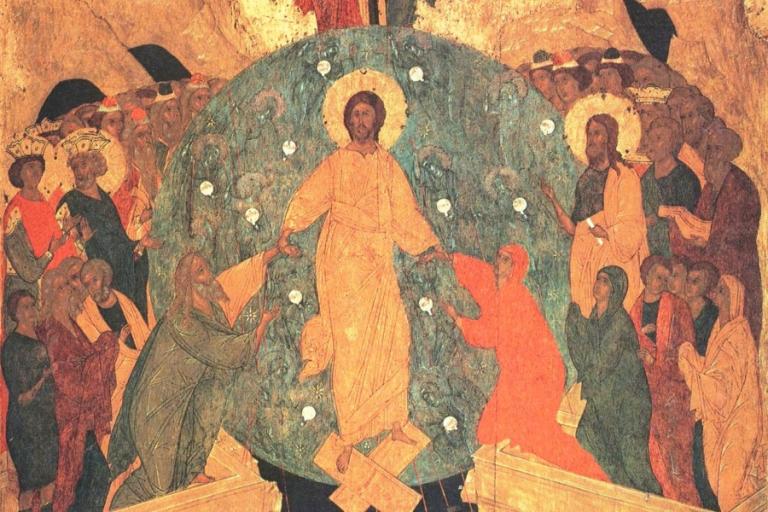
Jesus rescuing Adam and Eve. Image credit: Descent into Hell, icon from the Ferapontov Monastery, Wikimedia Commons.
The TULIP of Calvinism begins its theology with the idea that all humans are totally depraved in every area. The ROSES of Molinism is just barely softer, asserting that humans are radically depraved, if not totally. And Arminianism (if following DAISY) is a little softer yet, suggesting a diminished depravity for humans (though the Arminian FACTS actually agrees with TULIP on total depravity).
Degrees of depravity aside, the first point from each of these theological flowers implies the same two things about humanity. Though they may not say so outright, their focus suggests that 1) our depravity is the most important thing we need to understand about ourselves, and 2) our depravity is the first thing God sees when he looks at us in our fallen state.
This is not only a pessimistic view of the state of humanity, but also a disastrous view of the character of God. I would propose that we instead start with the reality that we are wounded children.
We are all God’s children
It is crucial for us to understand that all humans are God’s children in the truest sense. When God looks at us, he sees not depraved creatures, but his own beloved children. I’m amazed by how controversial this is, yet many people claim that only Christians are God’s children—that we only become God’s children once we believe in Jesus. So let’s take a look at these competing ideas.
Since the Beautiful Gospel is based on the foundational belief that God is perfectly revealed in Jesus, we’ll want start with what Jesus has to say about God. And Jesus, all throughout his teachings, continually refers to God as “Father”—not just as his Father, but as “our Father” and “your Father”—even when he is speaking to those who do not believe in him.
For one example, when Jesus explicitly says, “You have one Father—the one in heaven,” his audience includes the Sadducees and Pharisees who had gathered to test him (Matthew 23:9, NRSV). And for another, Jesus teaches, “Be merciful, just as your Father is merciful,” right after speaking a list of “woes” to portions of his audience (Luke 6:36, NRSV).
Let’s not miss this. In both of these instances, Jesus is speaking to people who actively rejected him, and he is telling them that God is their Father—not potentially their Father some day, but actually their Father right then and there.
We should also consider the genealogy of Jesus found in Luke. It traces Jesus’ lineage all the way back to Adam, referring to him as “the son of God” with the same phrase that describes every other son in the passage (Luke 3:38). If Adam is the son of God in the same way that Jesus is the son of Adam, and if we’re all children of Adam, then we too are all children of God.
For indeed, God created us in his own image. What would that make us if not his children? We must all have a father, and if that father is not God, then it must be some other creator (which would be heresy).
Paul also teaches that we are all God’s children. Speaking to the Athenians, he affirms the saying of the poets that “we too are his offspring” (Acts 17:28–29, NRSV). And he later states that “there is one God, the Father, from whom are all things” (1 Corinthians 8:6, NRSV). And again, “I bow my knees before the Father, from whom every family in heaven and on earth takes its name” (Ephesians 3:14–15, NRSV). And finally, there is “one God and Father of all, who is above all and through all and in all” (Ephesians 4:6, NRSV).
Children of the devil?
So why the controversy? It comes from a handful of verses that seem, at first glance, to contradict this idea. For example, Jesus once said, “If God were your Father, you would love me, for I came from God and now I am here. … You are from your father the devil, and you choose to do your father’s desires” (John 8:42–44, NRSV).
If we were to take these words of Jesus literally and at face value, they would contradict the other words of Jesus that we discussed earlier. So what reason do we have to say that this one passage should invalidate his other teachings? If one must indeed contradict the other, then why not rather say that Jesus’ other teachings—the ones that affirm God as Father of all—invalidate this passage?
But I don’t believe there is a contradiction. While Jesus elsewhere teaches that all people truly are God’s children, he here uses rhetoric to describe how these people are living—as if the devil, rather than God, were their father.
Such people have, for all intents and purposes, rejected God as their Father. They have taken their inheritance early, left their true Father, and made themselves figuratively children of the devil. But they could never literally make themselves anything other than what they are—God’s children. And what is God’s disposition toward his children? Only love, forgiveness, and a desire for reconciliation, as Jesus’ parable of the “prodigal son” also teaches (Luke 15:11–32).
Adopted children?
While a few other verses in the New Testament use similar figurative rhetoric, one additional concept has caused confusion. In Romans 8:15, Paul says that you have received a spirit of huiothesias; Galatians 4:5 similarly speaks of how we might receive the huiothesian; and Ephesians 1:5 speaks of how God destined us to huiothesian. In each case, many English translations (though not all of them) render the Greek word in question as “adoption,” leading to a widespread belief that humans are not born as God’s children, but are rather adopted as such.
Again, we must first realize that if this is the literal sense of the word, then it contradicts the teaching found elsewhere (including in the rest of the Pauline corpus, and even within the the letter to the Ephesians itself) that all humans are indeed the children of God by nature, rather than by adoption. However, I again do not believe that such a contradiction is actually present.
The problem lies with the translational choice to render the Greek word as “adoption.” The intended concept isn’t that we may become God’s children who were not his children previously, but rather that our full status as children of God may be realized. We prodigals may return to our Father and enjoy the blessings that are already rightfully ours as his children.
I won’t take more space to defend this understanding here, but see George MacDonald’s excellent sermon on the topic, titled “Abba, Father!”
We are wounded children
All of this means that when God looks at us, even in our fallen state, the first thing he sees is that we are his children. Let me make this more personal. When God looks at you, no matter who you are or what you may have done, God sees his precious child. And like any good parent, God loves you exactly as you are, simply for being his child.
But we, God’s children, are wounded. Rather than living in the love to which our Father has called us, we have so often chosen to live in fear and pride and selfishness. This is what we call “sin.” Our sin causes great harm to ourselves, to other people, and to the rest of creation around us.
No good parent is unaffected by the suffering of their children. God is grieved to see such harm come to us. His desire is not to punish us for sin—sin is its own punishment. Sin pays its own wages by bringing about death (Romans 6:23). What good would it do for God to add greater pain on top of the suffering we have already inflicted on ourselves? Rather, God’s desire is to heal us from our sin. He wants to restore the relationships we have broken and help us live in love as we were created to do. Ultimately, he wants to free us from our cycle of death, and bring us into life.
To do this, God had to become one of us. And we will examine this further in the next point of WHEAT—“human solidarity.”
All posts in the Beautiful Gospel of WHEAT series:
- The Beautiful Gospel of WHEAT (Not TULIP, DAISY, or ROSES)
- A Clarification on DAISY, Plus a Few Other Acronyms
- The God Jesus Reveals
- W—Wounded Children
- H—Human Solidarity
- E—Exhaustive Reconciliation
- A—Absolute Grace
- T—Transformative Love
- The Beautiful Gospel of WHEAT Distilled (with Danny Prada)
Previous Post
May 16, 2017
The God Jesus Reveals (The Beautiful Gospel of WHEAT)
Next Post
May 21, 2017 Human Solidarity (The Beautiful Gospel of WHEAT)
Browse Our Archives
Select a Category Church Personal Reviews Scripture Social Justice Theology
Select a Month August 2021 September 2020 August 2020 July 2019 March 2019 December 2018 November 2018 October 2018 September 2018 August 2018 July 2018 June 2018 May 2018 April 2018 March 2018 January 2018 December 2017 November 2017 October 2017 September 2017 August 2017 July 2017 June 2017 May 2017 April 2017 March 2017 February 2017 January 2017 December 2016 November 2016 October 2016 July 2016 June 2016 April 2016 March 2016 February 2016 January 2016 December 2015 November 2015
Follow Us!
TAKE THE
Religious Wisdom Quiz
How long did David reign as king?
Select your answer to see how you score.
33 years 40 years 25 years 50 years
Related posts from Hippie Heretic


Yes, Metaxas, Racism Is Still Wrong without God
The Big Book of Hippie Heretics (Daneen Akers'...

Progressives Need to Start Preaching Hell Again
TRENDING AT PATHEOS Progressive Christian

Personal Devotion After Deconstruction
It’s pretty standard for progressive believers to reject aspects of their religious...

The Secret behind A Charlie Brown Thanksgiving
Where Franklin Sat at Charlie Brown's Thanksgiving Table Sparky was sticking to...

Bridging the Gap Between God and Man
From Far Off to the Ultimate Embrace “God is a Spirit: and...

Let Matthew 25 Guide You to a Greater...
With the crisp feel of fall in the air, our minds quickly...

Can a Chatbot Touch Your Soul?
Can a chatbot offer genuine spiritual counsel? One conversation brought me to...

Religion and Politics: How Should We Then Live?
Two cultural axioms get repeated in polite company. Don't mix religion and...
view all Progressive Christian blogs
Ad-Free & Subscriber Log-In Subscription Support
- About Us
- 2026 Calendar
- Videos
- Podcasts
- Library of World Religions
- Faith In Media Tracker
- Advertise With Us
- Write for Us
- Privacy Policy
- Terms of Service
- Do Not Sell My Data
- Contact Us
- Radiant Digital
- Manage Newsletter Subscriptions
- Unsubscribe From Notifications
- Sitemap
Copyright 2008-2026, Patheos, part of the Radiant Digital network of media brands. All rights reserved.
Subscription Support Ad-Free & Subscriber Log-In
Follow Patheos