
BuddhistCatholicContemplativeEvangelicalGeneral ChristianHinduJewishLatter-day SaintMuslimNew VisionsProgressive Christian
Beliefs
- Buddhist
- Catholic
- Contemplative
- Evangelical
- General Christian
- Hindu
- Jewish
- Latter-day Saint
- More Voices
- Muslim
- New Visions
- Pagan
- Progressive Christian
Topics
- Religion News
- Food and Religion
- Sports and Religion
- Religious Art
- Religious Music and Entertainment
- Religious Events
- History and Religion
- Style and Religion
- Politics and Religion
- Women in Religion
- Recreation Outdoors and Religion
- Business Finance and Religion
- Careers Workplace and Religion
- Education and Religion
- Family Parenting and Religion
- Health Fitness and Religion
- Home and Religion
- Relationships and Religion
- Technology and Religion
- Travel and Religion
Columnists
- Buddhist Columnists
- Business Finance and Religion Columnists
- Careers Workplace and Religion Columnists
- Catholic Columnists
- Contemplative Columnists
- Education and Religion Columnists
- Evangelists Columnists
- Family Parenting and Religion Columnists
- General Christian Columnists
- Health Fitness and Religion Columnists
- Hindu Columnists
- History and Religion Columnists
- Home and Religion Columnists
- Jewish Columnists
- More Voices Columnists
- Latter Day Columnists
- Muslim Columnists
- New Visions Columnists
- Nonreligious Columnists
- Pagan Columnists
- Politics and Religion Columnists
- Progressive Columnists
- Recreation Outdoors and Religion Columnists
- Relationships and Religion Columnists
- Religion News Columnists
- Religious Art Columnists
- Religious Events Columnists
- Religious Music and Entertainment Columnists
- Sports and Religion Columnists
- Style and Religion Columnists
- Technology and Religion Columnists
- Travel and Religion Columnists
- Women in Religion Columnists
Resource Library
- 2026 Calendar
- Library of World Religions
- The 100 Most Holy Places on Earth
- Patheos Answers
- Podcasts
- Videos
- Faith Leaders Database
- Anglican Episcopalian
- Bahai
- Baptist
- Buddhism
- Christianity
- Confucianism
- Eastern Orthodoxy
- Hinduism
- Holiness and Pentecostal
- ISKCON
- Islam
- Judaism
- Lutheran
- Methodist
- The Church of Jesus Christ of Latter-day Saints
- New Age
- Paganism
- Presbytarian and Reformed
- Protestantism
- Religion Behind the Scenes
- Roman Catholic
- Scientology
- Shia Islam
- Sikhism
- Sufism
- Sunni Islam
- Taoism
- Zen
- See all religions
Research Tools
 Ad-Free & Subscriber Log-In Subscription Support
Ad-Free & Subscriber Log-In Subscription Support
Follow Patheos 

- Trending:
- Forgiveness
- |
- Marriage
- |
- Consciousness
- |
- Death Penalty
- |
- Election
- |
- Halloween
 Hippie Heretic
- Home
- Progressive Christian
- Human Solidarity (The Beautiful Gospel of WHEAT)
Human Solidarity (The Beautiful Gospel of WHEAT)
Last updated on: December 14, 2017 at 9:58 am by Chuck McKnight
Human Solidarity (The Beautiful Gospel of WHEAT) 2017-12-14T09:58:14-07:00 Chuck McKnight
Patheos Explore the world's faith through different perspectives on religion and spirituality! Patheos has the views of the prevalent religions and spiritualities of the world.
This is part five of a series on WHEAT—an acronym to describe the Beautiful Gospel in a way that parallels the TULIP of Calvinism, the DAISY of Arminianism, and the ROSES of Molinism. See the previous articles if you haven’t already.
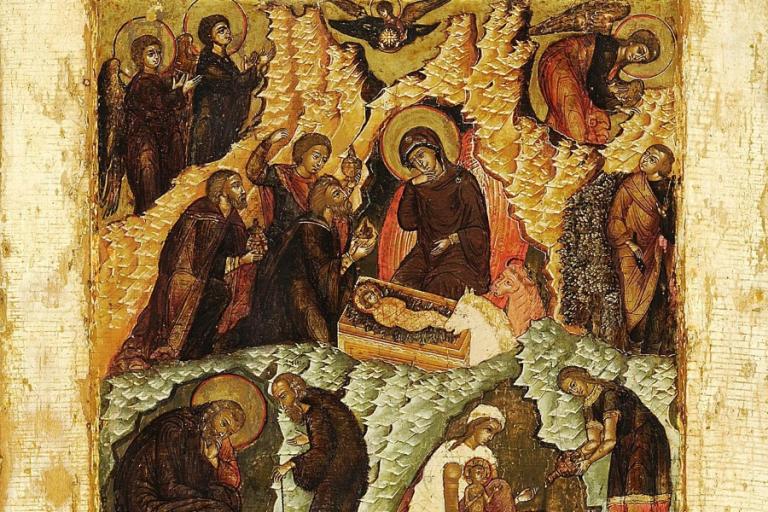
Image credit: The Nativity, eighteenth-century
Russian icon, Wikimedia Commons.
After establishing human depravity, TULIP, DAISY, and ROSES go on to describe how God elects people for salvation. (Though ROSES follows a different order, placing election as the third point.) Calvinism claims that God chooses who will be saved based entirely on his own will. Arminianism asserts that God’s choice is based on his foreknowledge of those who would eventually accept him. And Molinism posits God’s “middle knowledge”—a concept that is frankly more convoluted than would be worth getting into right now.
While the three systems differ on how God makes his choice, they all agree that God has separated individual humans into the elect, who will receive salvation, and the non-elect, who will receive damnation. But the Beautiful Gospel rejects such an individualistic understanding of humanity, salvation, and election.
One human nature
Just as all humans are children of God, so too do we all share in a single human nature. Humanity stands or falls together. Paul makes this clear in both 1 Corinthians 15 and Romans 5:
For since death came through a human being, the resurrection of the dead has also come through a human being; for as all die in Adam, so all will be made alive in Christ. (1 Corinthians 15:21–22, NRSV)
Therefore just as one man’s trespass led to condemnation for all, so one man’s act of righteousness leads to justification and life for all. For just as by the one man’s disobedience the many were made sinners, so by the one man’s obedience the many will be made righteous. (Romans 5:18–19, NRSV)
And the early church taught the same thing. Benjamin Myers makes the following observation:
The view that humanity is essentially one—that there is a universal human nature in which individuals participate—is so widely taken for granted in early Christianity that it is seldom discussed or defended. (Locating Atonement, p. 82)
He goes on to support this claim with examples from Irenaeus, Athanasius, Gregory of Nazianzus, and Gregory of Nyssa (p. 83). If you haven’t yet done so, you really should either watch his presentation or read his essay published in Locating Atonement, as he covers this whole matter much more thoroughly than I’m going to do in this relatively short blog post.
What all this means is that God has not elected any individuals either to salvation or damnation. The salvation that Jesus accomplished was for all humans. He is “the Savior of all people,” not merely of those who believe (1 Timothy 4:10, NRSV).
Jesus accomplished this salvation by uniting his divine nature with our human nature. Here’s how Athanasius puts it:
Naturally also, through this union of the immortal Son of God with our human nature, all men were clothed with incorruption in the promise of the resurrection. For the solidarity of mankind is such that, by virtue of the Word’s indwelling in a single human body, the corruption which goes with death has lost its power over all. … He has come into our country and dwelt in one body amidst the many, and in consequence, the designs of the enemy against mankind have been foiled and the corruption of death, which formerly held them in its power, has simply ceased to be. For the human race would have perished utterly had not the Lord and Savior of all, the Son of God, come among us to put an end to death. (On the Incarnation, 9)
And Jesus put an end to death by experiencing it himself. As darkness is expelled by the presence of light, so death is expelled by the presence of the one who is himself life. By simply entering into death, Jesus disarmed death’s power once and for all. Here again is Athanasius:
Thus, taking a body like our own, because all our bodies were liable to the corruption of death, He surrendered His body to death instead of all, and offered it to the Father. This He did out of sheer love for us, so that in His death all might die, and the law of death thereby be abolished because, having fulfilled in His body that for which it was appointed, it was thereafter voided of its power for men. This He did that He might turn again to incorruption men who had turned back to corruption, and make them alive through death by the appropriation of His body and by the grace of His resurrection. Thus He would make death to disappear from them as utterly as straw from fire.
The Word perceived that corruption could not be got rid of otherwise than through death; yet He Himself, as the Word, being immortal and the Father’s Son, was such as could not die. For this reason, therefore, He assumed a body capable of death, in order that it, through belonging to the Word Who is above all, might become in dying a sufficient exchange for all, and, itself remaining incorruptible through His indwelling, might thereafter put an end to corruption for all others as well, by the grace of the resurrection. It was by surrendering to death the body which He had taken, as an offering and sacrifice free from every stain, that He forthwith abolished death for His human brethren by the offering of the equivalent. For naturally, since the Word of God was above all, when He offered His own temple and bodily instrument as a substitute for the life of all, He fulfilled in death all that was required. (On the Incarnation, 8–9)
And here’s how Benjamin Myers summarizes it:
Human beings are the products of love. They are created in God’s image for the purpose of reciprocating divine love. Human nature, motivated by an internal principle of desire, tends naturally upward toward God. Since God is the source of all life, to be lovingly moving toward God is to be alive. But to turn away from God, even for one second, is to begin to die: to slide downward, away from life, love, and reality.
Since the beginning of history, the whole human race has been locked in a downward slide toward nothingness. But because of his great love for humanity, the Son of God leapt down from heaven and wrapped himself in our plummeting human nature. Because he was human, he participated fully in our perilous slide toward nothingness. But because he was divine, he was able to arrest our downward movement and to reverse it, initiating an upward movement toward the life, love, and reality of God. In the movement of that one human life, the life of Christ, the whole of human nature has undergone death and resurrection. (Locating Atonement, p. 86)
What about election?
So, you may be wondering, if Jesus is the savior of all humans, then what is election all about? And does this mean that everyone is automatically saved? On the latter question, just hold that thought for the moment. We’ll address the concept of salvation further in the later points of WHEAT. But we are now at a place where we can take a quick look at election.
First and foremost, election (as with everything in the Beautiful Gospel) is about Jesus Christ. Jesus is God’s elect, or his “Chosen One” (Luke 9:35). Secondly, because of Jesus’ election, we can also say that the elect are those people who are “in Christ.” God did not pick and choose which individuals would be in Christ—God chose Christ, and he corporately chose those “in Christ” for his service.
We see this, for example, in Ephesians 1, when the author writes of God choosing people before the foundation of the world. He does not say that God selected which individuals would receive salvation. Rather, he states that God chose us “in Christ” to be “holy and blameless before him in love” (Ephesians 1:4, NRSV).
Who then is in Christ?
In one sense, every human—indeed, all of creation—is in Christ. “For ‘In him we live and move and have our being’” (Acts 17:28, NRSV). And “all things have been created through him and for him. He himself is before all things, and in him all things hold together” (Colossians 1:16–17, NRSV).
And in another sense, the realization of all things in Christ is a future state that we look forward to. For in “the fullness of time,” God will “gather up all things in him, things in heaven and things on earth” (Ephesians 1:10, NRSV).
But the most common sense of “in Christ” refers specifically to those of us who presently believe in Christ, who have already been baptized in Christ, and who are seeking to live in Christ. (See Ephesians 1:7–14 and Colossians 2:6–15.)
Our election is not one that blesses us with salvation while cursing the rest of the world to damnation. Rather, God has chosen us in Christ to work with him as a light to the world, to bless the world with our love and good works, and to demonstrate what it looks like to live in Christ.
Furthermore, God has entrusted to us the message of his “exhaustive reconciliation,” which we will consider as the next point of WHEAT.
All posts in the Beautiful Gospel of WHEAT series:
- The Beautiful Gospel of WHEAT (Not TULIP, DAISY, or ROSES)
- A Clarification on DAISY, Plus a Few Other Acronyms
- The God Jesus Reveals
- W—Wounded Children
- H—Human Solidarity
- E—Exhaustive Reconciliation
- A—Absolute Grace
- T—Transformative Love
- The Beautiful Gospel of WHEAT Distilled (with Danny Prada)
Previous Post
May 18, 2017
Wounded Children (The Beautiful Gospel of WHEAT)
Next Post

May 25, 2017 Exhaustive Reconciliation (The Beautiful Gospel of WHEAT)
Browse Our Archives
Select a Category Church Personal Reviews Scripture Social Justice Theology
Select a Month August 2021 September 2020 August 2020 July 2019 March 2019 December 2018 November 2018 October 2018 September 2018 August 2018 July 2018 June 2018 May 2018 April 2018 March 2018 January 2018 December 2017 November 2017 October 2017 September 2017 August 2017 July 2017 June 2017 May 2017 April 2017 March 2017 February 2017 January 2017 December 2016 November 2016 October 2016 July 2016 June 2016 April 2016 March 2016 February 2016 January 2016 December 2015 November 2015
Follow Us!
TAKE THE
Religious Wisdom Quiz
Which Psalm opens with "Blessed is the man"?
Select your answer to see how you score.
Psalm 1 Psalm 51 Psalm 119 Psalm 23
Related posts from Hippie Heretic


Yes, Metaxas, Racism Is Still Wrong without God

The Big Book of Hippie Heretics (Daneen Akers'...

Progressives Need to Start Preaching Hell Again
TRENDING AT PATHEOS Progressive Christian

What Being a Modern-Day Apostle Means to Me
In my last column, I discussed the ins and outs of modern-day...

Did Ancient China Once Worship the God of...
Across human history, a common thread weaves through the origins of the...

Love Your Neighbor – Including Earth-Kin: Lev. 19,...
God’s command to love your neighbor means acting in an ethical and...

Lead a Church Study of “Jesus and Lao...
Guest writer Jack Thomas (The Irreverent Reverend) reflects on leading his church...

Pastoral Wisdom for Responding to Sermon Pushback
Getting sermon pushback on your social justice sermon? Learn practical, Proverbs-based strategies...

Principles for Understanding the Apostolic Ministry Today
Whenever people discover that my formal ministry title is "apostle," as in...
view all Progressive Christian blogs
Ad-Free & Subscriber Log-In Subscription Support
- About Us
- 2026 Calendar
- Videos
- Podcasts
- Library of World Religions
- Faith In Media Tracker
- Advertise With Us
- Write for Us
- Privacy Policy
- Terms of Service
- Do Not Sell My Data
- Contact Us
- Radiant Digital
- Manage Newsletter Subscriptions
- Unsubscribe From Notifications
- Sitemap
Copyright 2008-2026, Patheos. All rights reserved.
Subscription Support Ad-Free & Subscriber Log-In
Follow Patheos