
BuddhistCatholicContemplativeEvangelicalGeneral ChristianHinduJewishLatter-day SaintMuslimNew VisionsProgressive Christian
Beliefs
- Buddhist
- Catholic
- Contemplative
- Evangelical
- General Christian
- Hindu
- Jewish
- Latter-day Saint
- More Voices
- Muslim
- New Visions
- Pagan
- Progressive Christian
Topics
- Religion News
- Food and Religion
- Sports and Religion
- Religious Art
- Religious Music and Entertainment
- Religious Events
- History and Religion
- Style and Religion
- Politics and Religion
- Women in Religion
- Recreation Outdoors and Religion
- Business Finance and Religion
- Careers Workplace and Religion
- Education and Religion
- Family Parenting and Religion
- Health Fitness and Religion
- Home and Religion
- Relationships and Religion
- Technology and Religion
- Travel and Religion
Columnists
- Buddhist Columnists
- Business Finance and Religion Columnists
- Careers Workplace and Religion Columnists
- Catholic Columnists
- Contemplative Columnists
- Education and Religion Columnists
- Evangelists Columnists
- Family Parenting and Religion Columnists
- General Christian Columnists
- Health Fitness and Religion Columnists
- Hindu Columnists
- History and Religion Columnists
- Home and Religion Columnists
- Jewish Columnists
- More Voices Columnists
- Latter Day Columnists
- Muslim Columnists
- New Visions Columnists
- Nonreligious Columnists
- Pagan Columnists
- Politics and Religion Columnists
- Progressive Columnists
- Recreation Outdoors and Religion Columnists
- Relationships and Religion Columnists
- Religion News Columnists
- Religious Art Columnists
- Religious Events Columnists
- Religious Music and Entertainment Columnists
- Sports and Religion Columnists
- Style and Religion Columnists
- Technology and Religion Columnists
- Travel and Religion Columnists
- Women in Religion Columnists
Resource Library
- 2026 Calendar
- Library of World Religions
- The 100 Most Holy Places on Earth
- Patheos Answers
- Podcasts
- Videos
- Faith Leaders Database
- Anglican Episcopalian
- Bahai
- Baptist
- Buddhism
- Christianity
- Confucianism
- Eastern Orthodoxy
- Hinduism
- Holiness and Pentecostal
- ISKCON
- Islam
- Judaism
- Lutheran
- Methodist
- The Church of Jesus Christ of Latter-day Saints
- New Age
- Paganism
- Presbytarian and Reformed
- Protestantism
- Religion Behind the Scenes
- Roman Catholic
- Scientology
- Shia Islam
- Sikhism
- Sufism
- Sunni Islam
- Taoism
- Zen
- See all religions
Research Tools
 Ad-Free & Subscriber Log-In Subscription Support
Ad-Free & Subscriber Log-In Subscription Support
Follow Patheos 

- Trending:
- Forgiveness
- |
- Marriage
- |
- Consciousness
- |
- Death Penalty
- |
- Election
- |
- Halloween
 Hippie Heretic
- Home
- Progressive Christian
- The Beautiful Gospel of WHEAT (Not TULIP, DAISY, or ROSES)
The Beautiful Gospel of WHEAT (Not TULIP, DAISY, or ROSES)
Last updated on: December 14, 2017 at 9:56 am by Chuck McKnight
The Beautiful Gospel of WHEAT (Not TULIP, DAISY, or ROSES) 2017-12-14T09:56:55-07:00 Chuck McKnight
Patheos Explore the world's faith through different perspectives on religion and spirituality! Patheos has the views of the prevalent religions and spiritualities of the world.
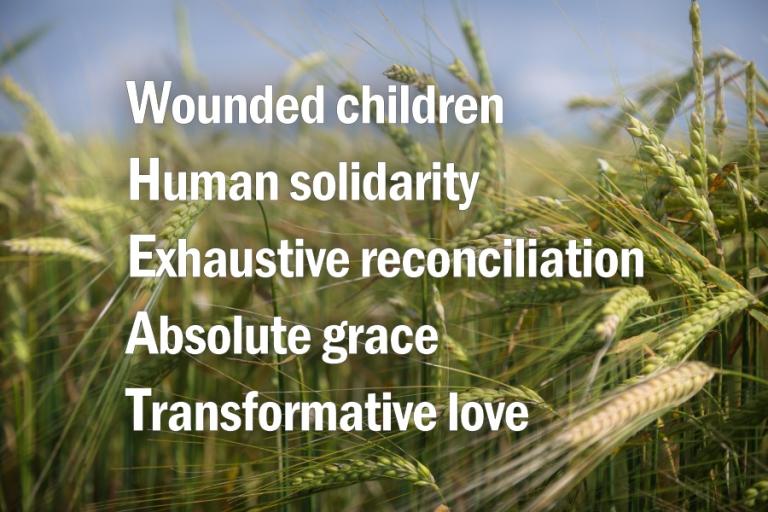
Image credit: Pexels, Pixabay.com.
Acronyms—love ’em or hate ’em. They may be cheesy, but they work. They can summarize complex concepts and make them easy to remember and repeat.
In the realm of Christian theology, perhaps no other acronym is as well known as the infamous TULIP, which aims to describe the “five points of Calvinism.” In response to TULIP, others have come up with DAISY to describe Arminianism and ROSES to describe Molinism.
The explanation of these acronyms can sometimes vary (especially for the latter two), but for our purposes, I’m going to follow the versions summarized by Aaron Earls in his post, “Theological Flower Bed: TULIP, DAISY & ROSES.”
TULIP (Calvinism):
T: Total depravity – Every facet of every person everywhere has been marred by sin.
U: Unconditional election – God chooses those to be saved based solely on His will.
L: Limited atonement – Christ died only for those who are elect.
I: Irresistible grace – The elect cannot resist God’s call to salvation.
P: Perseverance of the saints – The elect cannot lose their salvation.
DAISY (Arminianism):
D: Diminished depravity – Humanity is depraved, but God uses prevenient grace to restore man’s ability to respond to Him.
A: Abrogated election – God bases His election on His foreknowledge of those who freely choose Him.
I: Impersonal atonement – Christ died for everyone, making salvation possible for everyone.
S: Sedentary grace – God calls everyone to salvation, but many freely reject it.
Y: Yieldable justification – The saved can fall from grace and lose their salvation.
ROSES (Molinism):
R: Radical depravity – Every aspect of humanity is depraved, but we are not always as bad as we could be.
O: Overcoming grace – God’s grace is persistent in the life of the believer, but it can be resisted.
S: Sovereign election – God desires the salvation of all, but our salvation is based on His choice not ours.
E: Eternal life – God grants believers eternal security in their salvation.
S: Singular redemption – Christ died sufficiently for all people, but efficiently only for the saved.
[Update: See my post clarifying the above acronyms.]
These are great tools if you happen to agree with one of the above systems. But I don’t. I think they all fall short of the gospel taught by Jesus, the Apostles, and the Early Church Fathers.
I don’t know of a specific name for the view I hold (because unlike Calvinism, Arminianism, or Molinism, it is not attached to the name of any one individual apart from Jesus), but one of the earliest and clearest expositions thereof (after the New Testament teaching itself) is found in Athanasius’ On the Incarnation of the Word, written in the early fourth century. More recently, Benjamin Myers has given a fantastic talk explaining this viewpoint, which he calls the “Patristic Atonement Model”—the predominant understanding of the early church. This is also (as far as I understand it) essentially what the Eastern Orthodox Church has always maintained.
Much of this belief is also reflected the writings of George MacDonald—particularly in his sermon titled “Justice”—though he carefully avoided systematizing his beliefs. You’ll find a simplified visual presentation in what’s called the “Gospel in Chairs,” which originated with Orthodox priest Father Anthony Carbo and has been repeated by non-Orthodox believers such as Brian Zahnd. And you’ll also find it in Brad Jersak’s popular book, A More Christlike God: A More Beautiful Gospel.
All that to say, this way of understanding the gospel is ancient and well established. (It’s hardly something I came up with on my own, in other words.) But since it doesn’t have a standardized name (that I know of), I’m going to borrow a name from Brad Jersak’s subtitle (which he tells me originated with Brian Zahnd) and refer to it as the “Beautiful Gospel.” That’s what I believe it is—the truly good news in all of its beauty, without any of the ugly distortions attached to these other systems.
Introducing WHEAT (the Beautiful Gospel)
As I said, the Beautiful Gospel in no way originates with me. I would merely like to contribute an acronym that summarizes the theology of the Beautiful Gospel in a way that is easy to remember and repeat. While the above sources (and many others like them) are wonderful ways to learn about the Beautiful Gospel, I want to offer WHEAT as a means of succinct explanation, compared and contrasted with TULIP and the other systems mentioned, and not requiring any props or a stage.
Why WHEAT? Why not a flower? The most basic answer is that WHEAT happens to work better than any flower name as an acronym to explain the Beautiful Gospel. But WHEAT also has the benefit of being a plant frequently used in biblical imagery. (You won’t find a single TULIP in scripture.) While I could point to any number of examples, perhaps the one most pertinent to the Beautiful Gospel is John 12:23–24:
Jesus answered them, “The hour has come for the Son of Man to be glorified. Very truly, I tell you, unless a grain of wheat falls into the earth and dies, it remains just a single grain; but if it dies, it bears much fruit. (John 12:23–24, NRSV)
One more thing needs to be said before summarizing the points of WHEAT itself. Though this will not be one of the points (as WHEAT is meant to parallel TULIP), it is actually the foundation behind all of the points. This is the very reason that WHEAT differs so strongly from TULIP, DAISY, and ROSES. The Beautiful Gospel is based on the foundational belief that God is perfectly revealed in Jesus. Or as Brian Zahnd so poetically puts it, “God is like Jesus. God has always been like Jesus. There has never been a time when God was not like Jesus. We have not always known what God is like—but now we do.”
With all that having been said, here is WHEAT:
W—Wounded children
God does not view us as depraved creatures. We are God’s children, and he views us as any good parent would their children. God’s desire is not to punish us for sin, but to heal the wounds our sin causes.
H—Human solidarity
We are not merely individuals. Humanity stands or falls together as a whole. By becoming human, Jesus entered into solidarity with the whole human race. With his death, all of humanity died, and with his resurrection, all of humanity gained new life.
E—Exhaustive reconciliation
God has never needed to be reconciled to us. It is we who have turned away from him, and God’s desire is to reconcile all of creation to himself and to each other. He has done, is doing, and will continue to do everything possible to bring about our reconciliation.
A—Absolute grace
God’s grace is not coercive or manipulative, and it does not override our free will. It is, however, constantly poured out in full measure on all of creation. Though every individual receives God’s grace, some choose to resist, placing themselves at odds with the intended state of humanity.
T—Transformative love
Salvation is neither an irreversible decision nor a status that can be lost. Rather, salvation is a process with some steps taken forward and some taken backward. In as much as we simply submit to God’s love, we are continually transformed into his image.
I hope you find the above summary to be a helpful tool for explaining the Beautiful Gospel. Over the next few weeks, I will be examining and defending each point in greater detail.
Be sure to subscribe (if you haven’t already) in order to keep up with this series as we progress through the points. Use the subscription form at the upper right of this page.
All posts in the Beautiful Gospel of WHEAT series:
- The Beautiful Gospel of WHEAT (Not TULIP, DAISY, or ROSES)
- A Clarification on DAISY, Plus a Few Other Acronyms
- The God Jesus Reveals
- W—Wounded Children
- H—Human Solidarity
- E—Exhaustive Reconciliation
- A—Absolute Grace
- T—Transformative Love
- The Beautiful Gospel of WHEAT Distilled (with Danny Prada)
Previous Post
May 4, 2017
Was George MacDonald an Open Theist?
Next Post

May 11, 2017 A Clarification on DAISY, Plus a Few Other Acronyms
Browse Our Archives
Select a Category Church Personal Reviews Scripture Social Justice Theology
Select a Month August 2021 September 2020 August 2020 July 2019 March 2019 December 2018 November 2018 October 2018 September 2018 August 2018 July 2018 June 2018 May 2018 April 2018 March 2018 January 2018 December 2017 November 2017 October 2017 September 2017 August 2017 July 2017 June 2017 May 2017 April 2017 March 2017 February 2017 January 2017 December 2016 November 2016 October 2016 July 2016 June 2016 April 2016 March 2016 February 2016 January 2016 December 2015 November 2015
Follow Us!
TAKE THE
Religious Wisdom Quiz
What is the collective name of the stories Jesus told?
Select your answer to see how you score.
Proverbs Prayers Parables Psalms
Related posts from Hippie Heretic


Yes, Metaxas, Racism Is Still Wrong without God

The Big Book of Hippie Heretics (Daneen Akers'...

Progressives Need to Start Preaching Hell Again
TRENDING AT PATHEOS Progressive Christian

What Being a Modern-Day Apostle Means to Me
In my last column, I discussed the ins and outs of modern-day...

Did Ancient China Once Worship the God of...
Across human history, a common thread weaves through the origins of the...

Love Your Neighbor – Including Earth-Kin: Lev. 19,...
God’s command to love your neighbor means acting in an ethical and...

Lead a Church Study of “Jesus and Lao...
Guest writer Jack Thomas (The Irreverent Reverend) reflects on leading his church...

Pastoral Wisdom for Responding to Sermon Pushback
Getting sermon pushback on your social justice sermon? Learn practical, Proverbs-based strategies...

Principles for Understanding the Apostolic Ministry Today
Whenever people discover that my formal ministry title is "apostle," as in...
view all Progressive Christian blogs
Ad-Free & Subscriber Log-In Subscription Support
- About Us
- 2026 Calendar
- Videos
- Podcasts
- Library of World Religions
- Faith In Media Tracker
- Advertise With Us
- Write for Us
- Privacy Policy
- Terms of Service
- Do Not Sell My Data
- Contact Us
- Radiant Digital
- Manage Newsletter Subscriptions
- Unsubscribe From Notifications
- Sitemap
Copyright 2008-2026, Patheos. All rights reserved.
Subscription Support Ad-Free & Subscriber Log-In
Follow Patheos