
BuddhistCatholicContemplativeEvangelicalGeneral ChristianHinduJewishLatter-day SaintMuslimNew VisionsProgressive Christian
Beliefs
- Buddhist
- Catholic
- Contemplative
- Evangelical
- General Christian
- Hindu
- Jewish
- Latter-day Saint
- More Voices
- Muslim
- New Visions
- Pagan
- Progressive Christian
Topics
- Religion News
- Food and Religion
- Sports and Religion
- Religious Art
- Religious Music and Entertainment
- Religious Events
- History and Religion
- Style and Religion
- Politics and Religion
- Women in Religion
- Recreation Outdoors and Religion
- Business Finance and Religion
- Careers Workplace and Religion
- Education and Religion
- Family Parenting and Religion
- Health Fitness and Religion
- Home and Religion
- Relationships and Religion
- Technology and Religion
- Travel and Religion
Columnists
- Buddhist Columnists
- Business Finance and Religion Columnists
- Careers Workplace and Religion Columnists
- Catholic Columnists
- Contemplative Columnists
- Education and Religion Columnists
- Evangelists Columnists
- Family Parenting and Religion Columnists
- General Christian Columnists
- Health Fitness and Religion Columnists
- Hindu Columnists
- History and Religion Columnists
- Home and Religion Columnists
- Jewish Columnists
- More Voices Columnists
- Latter Day Columnists
- Muslim Columnists
- New Visions Columnists
- Nonreligious Columnists
- Pagan Columnists
- Politics and Religion Columnists
- Progressive Columnists
- Recreation Outdoors and Religion Columnists
- Relationships and Religion Columnists
- Religion News Columnists
- Religious Art Columnists
- Religious Events Columnists
- Religious Music and Entertainment Columnists
- Sports and Religion Columnists
- Style and Religion Columnists
- Technology and Religion Columnists
- Travel and Religion Columnists
- Women in Religion Columnists
Resource Library
- 2026 Calendar
- Library of World Religions
- The 100 Most Holy Places on Earth
- Patheos Answers
- Podcasts
- Videos
- Faith Leaders Database
- Anglican Episcopalian
- Bahai
- Baptist
- Buddhism
- Christianity
- Confucianism
- Eastern Orthodoxy
- Hinduism
- Holiness and Pentecostal
- ISKCON
- Islam
- Judaism
- Lutheran
- Methodist
- The Church of Jesus Christ of Latter-day Saints
- New Age
- Paganism
- Presbytarian and Reformed
- Protestantism
- Religion Behind the Scenes
- Roman Catholic
- Scientology
- Shia Islam
- Sikhism
- Sufism
- Sunni Islam
- Taoism
- Zen
- See all religions
Research Tools
 Ad-Free & Subscriber Log-In Subscription Support
Follow Patheos 

- Trending:
- Advent
- |
- Forgiveness
- |
- Thanksgiving
- |
- Election
- |
- Seasonal Holidays
- |
- Marriage
 Hippie Heretic
- Home
- Progressive Christian
- Absolute Grace (The Beautiful Gospel of WHEAT)
Absolute Grace (The Beautiful Gospel of WHEAT)
Last updated on: December 14, 2017 at 9:58 am by Chuck McKnight
Absolute Grace (The Beautiful Gospel of WHEAT) 2017-12-14T09:58:53-07:00 Chuck McKnight
Patheos Explore the world's faith through different perspectives on religion and spirituality! Patheos has the views of the prevalent religions and spiritualities of the world.
This is part seven of a series on WHEAT—an acronym to describe the Beautiful Gospel in a way that parallels the TULIP of Calvinism, the DAISY of Arminianism, and the ROSES of Molinism. See the previous articles if you haven’t already.
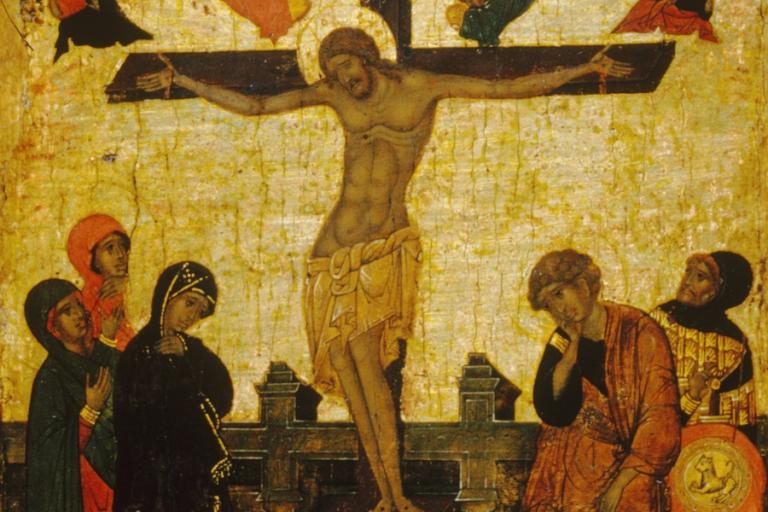
Image credit: Crucifixion, sixteenth-century
Russian icon, Wikimedia Commons.
Calvinism’s TULIP teaches that God’s grace is irresistible. That is, those whom God has elected cannot resist his call to salvation. Molinism’s ROSES asserts an “overcoming grace,” which is a nuanced way to say essentially the same thing. However, Arminianism claims that while God has freed all humans to believe, we also remain free to reject God.
On this point, I have no major objections to the Arminian position, though I’d like to press into it a bit further. But first I want to respond to the position of Calvinism and Molinism.
It’s bad enough that these two systems have God consigning half of humanity to eternal damnation, but irresistible grace makes things equally problematic for the elect. To put it bluntly, if grace were irresistible, then it would be a form of assault. If a “no” is ultimately not possible, then a consenting “yes” is also not possible. And if there is no possibility for consent, then God’s relationship with his elect is just as troubling as his relationship with the damned.
Calvinism and Molinism would claim that in reality, God simply continues to pursue the elect until their wills align with his. But given the unilateral control of God that is presupposed by these systems, along with the inability for humans to resist his “grace,” what this really describes is a form of brainwashing. It cannot be true consenting allegiance if there is no possibility for the elect to say no.
God’s self-giving kenotic love
In contrast to the coercive God of Calvinism and Molinism, the God revealed in Jesus is one of kenosis—a Greek word meaning “emptying” or “self giving” that comes from Philippians 2:7:
Let the same mind be in you that was in Christ Jesus,
who, though he was in the form of God,
did not regard equality with God
as something to be exploited,
but emptied [ekenōsen] himself,
taking the form of a slave,
being born in human likeness.
And being found in human form,
he humbled himself
and became obedient to the point of death—
even death on a cross. (Philippians 2:5–8. NRSV)
No end of speculation surrounds this “emptying” of Jesus. What exactly did he empty himself of? Did it make Jesus less equal to God than he was before the Incarnation?
Any orthodox explanation of kenosis must say that no, Jesus did not become less equal to God. The Word who was in the beginning with God, and who was God, remains fully God when he becomes flesh and dwells among us (John 1:1–14). “For in him all the fullness of God was pleased to dwell” (Colossians 1:19, NRSV).
But the Beautiful Gospel, rooted in the belief that Jesus perfectly reveals God, gives us another way to look at kenosis. Rather than viewing kenosis as a one-time emptying that occurred at the Incarnation, we would say that Jesus’ Incarnation reveals God to be a God who is always engaged in kenosis. God is always giving of himself for the sake of his creation. God is kenotic love at his core.
Here’s how Brad Jersak describes it:
Far from giving up, hiding or hindering God’s nature, we shall see that Christ’s kenotic and cruciform life is the revelation par excellence of God’s glory. Kenosis is not a surrender of the divine attributes; kenosis defined as self-giving or self-donation is the premier expression of God’s nature—of God’s love and grace—seen most clearly on the Cross. (A More Christlike God, p. 99 )
So when I say kenosis, I am talking about love. Cruciform love, as revealed through Christ’s Passion, is none other than authentic, willing consent to ‘otherness.’ Love is, by nature, willing and consensual, self-giving and self-sacrificial. (A More Christlike God, p. 101)
Because God is such kenotic love in his very essence, he cannot violate consent or free will. To do so would be to violate his own nature.
Thus “irresistable” or “overcoming” grace is out of the question. But so is a grace that comes with conditions or an expiration date. God’s grace is absolute. God is constantly giving of himself to all of creation, with no limitations and no strings attached.
Here again is Brad Jersak, using the Bridegroom imagery of Christ to speak about these two pitfalls of a grace that is not based on kenotic love:
Without going into great detail here, might I suggest that because God, by nature, is the eternally consenting Bridegroom, there are two things he cannot and will not do:
- He will not ever make you marry his Son, because an irresistible grace would violate your consent. Your part will always and forever be by consent.
- His consent will never end, because a violent ultimatum would violate your consent. Divine love will always and forever be by consent. Emphasis on forever. “His mercy endures forever” (Psalm 136). “I have loved you with an everlasting love; I have drawn you with unfailing kindness” (Jer. 31:3).
I don’t believe the divine courtship involves wearing you down with his love until you give up. It’s simply that he’ll always love you, with a love that even outlasts and overcomes death (Song of Solomon 8). The Bible at least hints (Rev. 21-22) that the prodigal Father will wait for you, invite you and keep the doors open for you until you’re ready to come home. He’ll wait for you forever. (A More Christlike God, pp. 126–127)
In the previous post, we asked whether we could be certain that every individual would eventually accept God’s reconciliation.
Having now considered the necessity for consent, I would have to say no. We cannot be certain. But we can certainly hope! We can hope in the strongest sense of the word, having complete assurance that the God who is love will exhaust the full power of love to draw everyone to himself, yet without ever violating consent.
And what happens when we do submit to God’s love and accept his reconciliation? In other words, what does salvation look like? We’ll address this question in the final point of WHEAT—“transformative love.”
All posts in the Beautiful Gospel of WHEAT series:
- The Beautiful Gospel of WHEAT (Not TULIP, DAISY, or ROSES)
- A Clarification on DAISY, Plus a Few Other Acronyms
- The God Jesus Reveals
- W—Wounded Children
- H—Human Solidarity
- E—Exhaustive Reconciliation
- A—Absolute Grace
- T—Transformative Love
- The Beautiful Gospel of WHEAT Distilled (with Danny Prada)
Previous Post

May 25, 2017
Exhaustive Reconciliation (The Beautiful Gospel of WHEAT)
Next Post
June 6, 2017 Transformative Love (The Beautiful Gospel of WHEAT)
Browse Our Archives
Select a Category Church Personal Reviews Scripture Social Justice Theology
Select a Month August 2021 September 2020 August 2020 July 2019 March 2019 December 2018 November 2018 October 2018 September 2018 August 2018 July 2018 June 2018 May 2018 April 2018 March 2018 January 2018 December 2017 November 2017 October 2017 September 2017 August 2017 July 2017 June 2017 May 2017 April 2017 March 2017 February 2017 January 2017 December 2016 November 2016 October 2016 July 2016 June 2016 April 2016 March 2016 February 2016 January 2016 December 2015 November 2015
Follow Us!
TAKE THE
Religious Wisdom Quiz
What river did Jesus get baptized in?
Select your answer to see how you score.
Euphrates Jordan Nile Tigris
Related posts from Hippie Heretic


Yes, Metaxas, Racism Is Still Wrong without God
The Big Book of Hippie Heretics (Daneen Akers'...

Progressives Need to Start Preaching Hell Again
TRENDING AT PATHEOS Progressive Christian

Personal Devotion After Deconstruction
It’s pretty standard for progressive believers to reject aspects of their religious...

The Secret behind A Charlie Brown Thanksgiving
Where Franklin Sat at Charlie Brown's Thanksgiving Table Sparky was sticking to...

Bridging the Gap Between God and Man
From Far Off to the Ultimate Embrace “God is a Spirit: and...

Let Matthew 25 Guide You to a Greater...
With the crisp feel of fall in the air, our minds quickly...

Can a Chatbot Touch Your Soul?
Can a chatbot offer genuine spiritual counsel? One conversation brought me to...

Religion and Politics: How Should We Then Live?
Two cultural axioms get repeated in polite company. Don't mix religion and...
view all Progressive Christian blogs
Ad-Free & Subscriber Log-In Subscription Support
- About Us
- 2026 Calendar
- Videos
- Podcasts
- Library of World Religions
- Faith In Media Tracker
- Advertise With Us
- Write for Us
- Privacy Policy
- Terms of Service
- Do Not Sell My Data
- Contact Us
- Radiant Digital
- Manage Newsletter Subscriptions
- Unsubscribe From Notifications
- Sitemap
Copyright 2008-2026, Patheos, part of the Radiant Digital network of media brands. All rights reserved.
Subscription Support Ad-Free & Subscriber Log-In
Follow Patheos