
BuddhistCatholicContemplativeEvangelicalGeneral ChristianHinduJewishLatter-day SaintMuslimNew VisionsProgressive Christian
Beliefs
- Buddhist
- Catholic
- Contemplative
- Evangelical
- General Christian
- Hindu
- Jewish
- Latter-day Saint
- More Voices
- Muslim
- New Visions
- Pagan
- Progressive Christian
Topics
- Religion News
- Food and Religion
- Sports and Religion
- Religious Art
- Religious Music and Entertainment
- Religious Events
- History and Religion
- Style and Religion
- Politics and Religion
- Women in Religion
- Recreation Outdoors and Religion
- Business Finance and Religion
- Careers Workplace and Religion
- Education and Religion
- Family Parenting and Religion
- Health Fitness and Religion
- Home and Religion
- Relationships and Religion
- Technology and Religion
- Travel and Religion
Columnists
- Buddhist Columnists
- Business Finance and Religion Columnists
- Careers Workplace and Religion Columnists
- Catholic Columnists
- Contemplative Columnists
- Education and Religion Columnists
- Evangelists Columnists
- Family Parenting and Religion Columnists
- General Christian Columnists
- Health Fitness and Religion Columnists
- Hindu Columnists
- History and Religion Columnists
- Home and Religion Columnists
- Jewish Columnists
- More Voices Columnists
- Latter Day Columnists
- Muslim Columnists
- New Visions Columnists
- Nonreligious Columnists
- Pagan Columnists
- Politics and Religion Columnists
- Progressive Columnists
- Recreation Outdoors and Religion Columnists
- Relationships and Religion Columnists
- Religion News Columnists
- Religious Art Columnists
- Religious Events Columnists
- Religious Music and Entertainment Columnists
- Sports and Religion Columnists
- Style and Religion Columnists
- Technology and Religion Columnists
- Travel and Religion Columnists
- Women in Religion Columnists
Resource Library
- 2026 Calendar
- Library of World Religions
- The 100 Most Holy Places on Earth
- Patheos Answers
- Podcasts
- Videos
- Faith Leaders Database
- Anglican Episcopalian
- Bahai
- Baptist
- Buddhism
- Christianity
- Confucianism
- Eastern Orthodoxy
- Hinduism
- Holiness and Pentecostal
- ISKCON
- Islam
- Judaism
- Lutheran
- Methodist
- The Church of Jesus Christ of Latter-day Saints
- New Age
- Paganism
- Presbytarian and Reformed
- Protestantism
- Religion Behind the Scenes
- Roman Catholic
- Scientology
- Shia Islam
- Sikhism
- Sufism
- Sunni Islam
- Taoism
- Zen
- See all religions
Research Tools
 Ad-Free & Subscriber Log-In Subscription Support
Ad-Free & Subscriber Log-In Subscription Support
Follow Patheos 

- Trending:
- Forgiveness
- |
- Marriage
- |
- Consciousness
- |
- Death Penalty
- |
- Election
- |
- Halloween
 Hippie Heretic
- Home
- Progressive Christian
- The Divine Dance by Richard Rohr & Mike Morrell (Book Review)
The Divine Dance by Richard Rohr & Mike Morrell (Book Review)
Last updated on: September 20, 2017 at 11:32 am by Chuck McKnight
The Divine Dance by Richard Rohr & Mike Morrell (Book Review) 2017-09-20T11:32:42-07:00 Chuck McKnight
Patheos Explore the world's faith through different perspectives on religion and spirituality! Patheos has the views of the prevalent religions and spiritualities of the world.
This is a book about the Trinity, but it’s not your average exposition of the Athanasian Creed. There is very little in the way of formulaic explanation. And perhaps that’s how it should be when we speak of the Trinity. Much more mystical than theological—more practical than dogmatic.
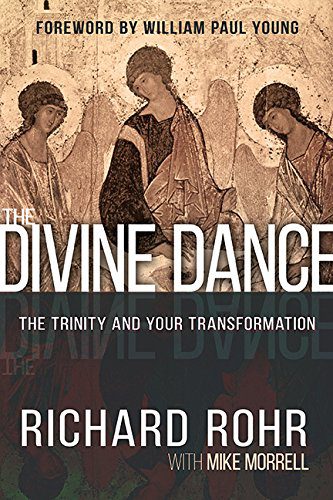
The Divine Dance started out as a series of talks by Richard Rohr, which Mike Morrell used as the foundation for the book. This resulted in an unusual format that is worth noting up front. There are no chapters. Rather, the book is split into three large sections, each of which is broken up into a multitude of short blog-post-length segments.
This is not necessarily a bad thing, and some may like this style more than others. But for myself, chapter breaks allow me a moment to stop and compose my thoughts, giving me a place to consider the main points of that chapter. Without these divisions, I had a harder time picking out the major themes that were addressed. The segments came across more like a collection of loosely related thoughts—and they are wonderful, inspiring, and important thoughts—but I struggled to see them all as a unified whole.
Nonetheless, I did make note of some segments that particularly stood out to me, so I’ll share a few glimpses of them here.
I love how the authors frame the Trinity in terms of relationship. They focus on how the persons of the Trinity relate with one another (and with us), more so than on the individual persons themselves.
The energy in the universe is not in the planets, or in the protons or neutrons, but in the relationship between them. Not in the particles but in the space between them. Not in the cells of organisms but in the way the cells feed and give feedback to one another. Not in any precise definition of the three persons of the Trinity as much as in the relationship between the Three! This is where all the power for infinite renewal is at work:
The loving relationship between them.
The infinite love between them.
The dance itself.
In other words, it is an entirely relational universe. If, at any time, we try to stop this flow moving through us, with us, and in us, we fall into the true state of sin—and it is truly a state more than a momentary behavior. (p. 56)
In considering the need for three, they summarize Richard of St. Victor this way:
For God to be good, God can be one. For God to be loving, God has to be two. Because love is always a relationship, right? But for God to “share excellent joy” and “delight”—and this is where [Richard of St. Victor’s] real breakthrough is—God has to be three, because supreme happiness is when two persons share their common delight in a third something—together. …
Two people excited about the same thing are the beginning of almost everything new, creative, and risky in our world. (pp. 98–99)
Though they do not draw this conclusion in The Divine Dance, I can’t help but think how even the book itself reflects such a trinity. Richard’s passion met with Mike’s passion to create something beautiful, yet the truest joy and delight of this book is found when they share their passion with a reader. Richard, Mike, and I (or you) as the reader together form our own trinity of sorts.
As an Anabaptist, I’m all about looking for a “Third Way” approach to controversial topics. So I particularly enjoyed seeing a Catholic (Rohr) advocate the same.
Stridently taking sides in a binary system has nothing to do with truth. The gospel itself is neither liberal nor conservative but severely critiques both sides of this false choice. The true good news of Jesus will never fill stadiums, because dualistic masses can never collectively embrace an enlightened “Third Way,” which, contemplatively speaking, always feels a bit like nothing, because in this position you are indeed like Jesus—you have “no place to lay your head.” (p. 100)
I appreciated the view of scripture they articulated.
Scripture, as Peter Enns so artfully put it, is also fully human and fully divine. Scripture is always, always written by humans from a human perspective. We call it the “word of God,” but the only Word of God unequivocally endorsed in the Bible’s pages is Jesus, the eternal Logos. The words on our inspired pages are the words of men and women. (p. 136)
And their take on the incarnation and crucifixion is spot on.
You see, Incarnation, rightly appreciated, is already redemption—Jesus doesn’t need to die on the cross to convince us that God loves us, although I surely admit that the dramatic imagery has convinced and convicted many a believer. The cross corrected our serious nearsightedness in relation to the Father, buying the human soul a good pair of glasses to clearly see the Father’s love.
The Mystery of the Incarnation is already revealing God’s total embrace. The baby in the crib already proclaims, I like you; I want to be one with you. But you know what? It wasn’t enough for our psyche. The cross did not change the mind of the Father. Father was totally given from all eternity. The cross was needed as a dramatic, earth-shaking icon to change your mind about God, and it still serves that purpose. …
If you believe that the Son’s task is merely to solve some cosmic problem the Father has with humanity, that the Son’s job is to do that, then once the problem is solved, there’s apparently no need for the concrete imitation of Jesus or his history-changing teachings. Yes, we continue to thank him for solving this problem, but we’ve lost the basis for an ongoing communion, a constant love affair, not to mention the wariness we now have about the Father and the lack of an active need for a dynamic Holy Spirit.
The idea of God as Trinity largely fell apart once we pulled Jesus out of the One Flow and projected our problem onto God. We needed convincing, not God. (pp. 175–176)
Suffice it to say, despite my struggle with the format of the book, I loved just about everything Richard and Mike had to say. The Divine Dance is full of gems, and I would not hesitate to recommend it.
I did, however, have one major disagreement. I’m going to spend a little time on this point because I think it’s important, but I don’t want you to feel like it takes away from the book as a whole. Take what I have to say as some hopefully constructive criticism on a work that I truly appreciate.
Here is the section I’d like to address.
But if you stay on this path of allowing and trusting, the Spirit in you will allow you to confidently surrender: There’s a reason for this. I’m living as the River flows, carried by the surprise of its/my unfolding. I am being led. Cool it. It’s okay!
Please don’t hear me as adopting a fatalistic approach, as though you can’t work to change or improve your situation. In fact, it’s quite the contrary—you can. But I am saying that what first comes to your heart and soul must be a yes and not a no, trust instead of resistance. And when you can lead with your yeses, and allow yourself to see God in all moments, you’ll recognize that such energy is never wasted but always generates life and light. The saints often called this trust in Divine Providence. (p. 98)
In the life of the Trinity, you can always rest inside a certain kind of deep contentment: it’s all foundationally good and okay. This moment is as perfect as it can be, and I do not need to state my preferences moment by moment, make my judgments or demands, or write my commentary on everything. (p. 102)
The phrase Richard Rohr uses for this concept is “everything belongs.” And as a philosophy for personal contentment, I don’t have much of a problem with it. If the authors had been more specific and clarified that this only works in the context of one’s own personal struggles, then I wouldn’t bother to mention it.
However, I cannot personally separate these things from the broader problem of suffering, and especially that of marginalized peoples. I fear that without explicit warnings to the contrary, such notions may lead not only to the intended personal peacefulness, but also to an unconcerned complacency toward matters of injustice.
This is especially important for me to note given the fact that I am a white male reading a book written by two white males to an audience that includes no shortage of other white males. The “trinity” of relationship formed by the reading of this book is one of immense privilege. It would be so easy to lose ourselves in this place of rest. But I must not do so.
I have to look outside of my place of privilege, and when I do, I cannot and must not say that “everything belongs.”
When I learn of the racial injustices in this country and in the world, “what first comes to [my] heart and soul” must emphatically be a no and not a yes.
When I hear how my LGBTQ friends are abused and mistreated, I have to insist that this is not “foundationally good and okay.”
When I think of the immigrants in our country who want nothing more than to stay with their families, or the Muslims who want nothing more than to practice their religion in peace, or the women who want nothing more than to be treated as fully equal to men, I must speak up.
I have to “state my preferences moment by moment, make my judgments [and] demands, [and] write my commentary on everything,” because silence is violence in the face of oppression.
Yes, the authors say that we can “work to change or improve [our] situation,” but they seem to want our initial reaction to be one of acceptance. No! Our first and most primal reaction to injustice must always be one of outrage, of holy indignation, of prophetic protest.
Yes, in an ultimate sense, we can rest in the knowledge that God is working with us to bring good out of all things, but that does not mean that all things are happening for good. Much of what goes on in this world happens only for evil and represents nothing but a distortion of God’s will, no matter how God may eventually be able to redeem it for good.
Now I must offer some clarification. Mike Morrell is a friend of mine, and I know that he does not advocate the passivity I’ve here described. Quite the opposite, I know him to be actively engaged in seeking justice for the oppressed and marginalized. And while I do not know Richard Rohr personally, nothing I do know of him would lead me to believe that he intends this sort of passivity either.
The problem is that these words in their book, taken by themselves and without the context of the authors’ lives, could easily allow privileged individuals such as myself to feel as if I am bravely enduring my own practically nonexistent “sufferings” with peace and calmness, while completely shutting down to the grave injustice all around me.
I’ve often heard it said that all theology must stand or fall at the gates of Auschwitz. If we could not preach it there, we must not preach it anywhere. And the idea that I could stand outside a gas chamber and say, “This moment is as perfect as it can be,” is ludicrous, offensive, dangerous—words fail to describe how truly horrible this would be.
That said, I have not yet read Rohr’s full treatment of this subject, by the title of Everything Belongs. Perhaps (hopefully) he qualifies more fully therein. For now, I can only go by the words found in The Divine Dance.
As I said before beginning my critique, I don’t want readers to feel that my disagreement applies to the whole book. The references to this “everything belongs” concept were relatively few, and where they appear, they do not take away from the many wonderful insights and truths to be found throughout the rest of the text. My intention here is not to attack the book or the authors, but rather to provide the important qualification to their words that did not appear in the text. With this qualification in place, I would absolutely recommend that you read it for yourself.
Pick up your own copy of The Divine Dance as a hardcover or a Kindle eBook.
Disclosure: I received a free copy of this book from SpeakEasy in exchange for an honest review.
Previous Post

December 18, 2016
Patmos by C. Baxter Kruger (Book Review)
Next Post

January 11, 2017 No Marriage in the Resurrection? Here’s What Jesus Really Said
Browse Our Archives
Select a Category Church Personal Reviews Scripture Social Justice Theology
Select a Month August 2021 September 2020 August 2020 July 2019 March 2019 December 2018 November 2018 October 2018 September 2018 August 2018 July 2018 June 2018 May 2018 April 2018 March 2018 January 2018 December 2017 November 2017 October 2017 September 2017 August 2017 July 2017 June 2017 May 2017 April 2017 March 2017 February 2017 January 2017 December 2016 November 2016 October 2016 July 2016 June 2016 April 2016 March 2016 February 2016 January 2016 December 2015 November 2015
Follow Us!
TAKE THE
Religious Wisdom Quiz
Jesus raised whose daughter from the dead?
Select your answer to see how you score.
Darius Jairus Thaddeus Bartholomew
Related posts from Hippie Heretic

It Isn't Scapegoating if You're Guilty


Yes, Metaxas, Racism Is Still Wrong without God

The Big Book of Hippie Heretics (Daneen Akers'...
TRENDING AT PATHEOS Progressive Christian

What Being a Modern-Day Apostle Means to Me
In my last column, I discussed the ins and outs of modern-day...

Did Ancient China Once Worship the God of...
Across human history, a common thread weaves through the origins of the...

Love Your Neighbor – Including Earth-Kin: Lev. 19,...
God’s command to love your neighbor means acting in an ethical and...

Lead a Church Study of “Jesus and Lao...
Guest writer Jack Thomas (The Irreverent Reverend) reflects on leading his church...

Pastoral Wisdom for Responding to Sermon Pushback
Getting sermon pushback on your social justice sermon? Learn practical, Proverbs-based strategies...

Principles for Understanding the Apostolic Ministry Today
Whenever people discover that my formal ministry title is "apostle," as in...
view all Progressive Christian blogs
Ad-Free & Subscriber Log-In Subscription Support
- About Us
- 2026 Calendar
- Videos
- Podcasts
- Library of World Religions
- Faith In Media Tracker
- Advertise With Us
- Write for Us
- Privacy Policy
- Terms of Service
- Do Not Sell My Data
- Contact Us
- Radiant Digital
- Manage Newsletter Subscriptions
- Unsubscribe From Notifications
- Sitemap
Copyright 2008-2026, Patheos. All rights reserved.
Subscription Support Ad-Free & Subscriber Log-In
Follow Patheos