
BuddhistCatholicContemplativeEvangelicalGeneral ChristianHinduJewishLatter-day SaintMuslimNew VisionsProgressive Christian
Beliefs
- Buddhist
- Catholic
- Contemplative
- Evangelical
- General Christian
- Hindu
- Jewish
- Latter-day Saint
- More Voices
- Muslim
- New Visions
- Pagan
- Progressive Christian
Topics
- Religion News
- Food and Religion
- Sports and Religion
- Religious Art
- Religious Music and Entertainment
- Religious Events
- History and Religion
- Style and Religion
- Politics and Religion
- Women in Religion
- Recreation Outdoors and Religion
- Business Finance and Religion
- Careers Workplace and Religion
- Education and Religion
- Family Parenting and Religion
- Health Fitness and Religion
- Home and Religion
- Relationships and Religion
- Technology and Religion
- Travel and Religion
Columnists
- Buddhist Columnists
- Business Finance and Religion Columnists
- Careers Workplace and Religion Columnists
- Catholic Columnists
- Contemplative Columnists
- Education and Religion Columnists
- Evangelists Columnists
- Family Parenting and Religion Columnists
- General Christian Columnists
- Health Fitness and Religion Columnists
- Hindu Columnists
- History and Religion Columnists
- Home and Religion Columnists
- Jewish Columnists
- More Voices Columnists
- Latter Day Columnists
- Muslim Columnists
- New Visions Columnists
- Nonreligious Columnists
- Pagan Columnists
- Politics and Religion Columnists
- Progressive Columnists
- Recreation Outdoors and Religion Columnists
- Relationships and Religion Columnists
- Religion News Columnists
- Religious Art Columnists
- Religious Events Columnists
- Religious Music and Entertainment Columnists
- Sports and Religion Columnists
- Style and Religion Columnists
- Technology and Religion Columnists
- Travel and Religion Columnists
- Women in Religion Columnists
Resource Library
- 2026 Calendar
- Library of World Religions
- The 100 Most Holy Places on Earth
- Patheos Answers
- Podcasts
- Videos
- Faith Leaders Database
- Anglican Episcopalian
- Bahai
- Baptist
- Buddhism
- Christianity
- Confucianism
- Eastern Orthodoxy
- Hinduism
- Holiness and Pentecostal
- ISKCON
- Islam
- Judaism
- Lutheran
- Methodist
- The Church of Jesus Christ of Latter-day Saints
- New Age
- Paganism
- Presbytarian and Reformed
- Protestantism
- Religion Behind the Scenes
- Roman Catholic
- Scientology
- Shia Islam
- Sikhism
- Sufism
- Sunni Islam
- Taoism
- Zen
- See all religions
Research Tools
 Ad-Free & Subscriber Log-In Subscription Support
Ad-Free & Subscriber Log-In Subscription Support
Follow Patheos 

- Trending:
- Forgiveness
- |
- Marriage
- |
- Consciousness
- |
- Death Penalty
- |
- Election
- |
- Halloween
 Hippie Heretic
- Home
- Progressive Christian
- Does This Make Me a Bad Anabaptist?
Does This Make Me a Bad Anabaptist?
Last updated on: March 31, 2017 at 11:16 pm by Chuck McKnight
Does This Make Me a Bad Anabaptist? 2017-03-31T23:16:53-07:00 Chuck McKnight
Patheos Explore the world's faith through different perspectives on religion and spirituality! Patheos has the views of the prevalent religions and spiritualities of the world.
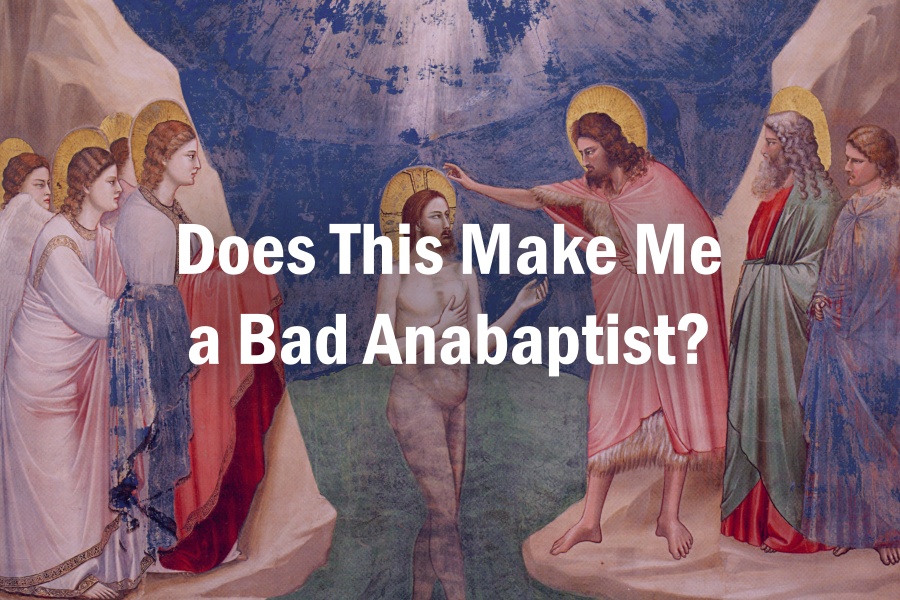
I have a confession to make. I don’t care very much about baptism. Does this make me a bad Anabaptist?
But I guess I should clarify: I actually care a lot about baptism; I just don’t care about baptism.
It is of incredible importance to me that we share in Christ’s death and resurrection. It is imperative that we unite ourselves with other believers to help one another as we seek to follow Jesus together. And I believe it is essential to begin our journey with a public affirmation of our belief that Jesus is Lord.
All of these things are baptism, and I care immensely about them. But I don’t really care about baptism.
I don’t care if you get sprinkled, doused, or dunked. I don’t care if it’s done one time or three. I don’t really even care if you’re baptized as an infant or an adult.
That’s not to say I don’t have an opinion on these matters. I do, and my opinion aligns with Anabaptism. But these things don’t define Anabaptism for me, despite the name.
The technically inaccurate label of Anabaptist (or “re-baptizer”) was given as a pejorative to those sixteenth-century Reformers of a Radical bent, who reserved baptism for individuals who could make the decision for themselves.
This is the “what” of so-called Anabaptism (and I agree with it), but in my opinion, the “why” is so much more important.
There are at least four major reasons the earliest Anabaptists held this position:
- The church of the day taught that children were automatically damned if they died without having been baptized. This belief stemmed from Augustine’s notion of original sin—the idea that we’re born already guilty of Adam’s sin. Naturally, this made infant baptism a pretty big deal. Who would want to risk their children’s eternal destiny? Anabaptists, however, disagreed with this belief. Some rejected original sin altogether, while others taught that Jesus’ sacrifice was sufficient to cover original sin, at least until children were capable of making a choice for themselves.
- Anabaptists understood baptism as initiation into a life of discipleship. They viewed it as the public declaration of an individual’s repentance and commitment to follow Jesus. But since infants could not make such choices, Anabaptists were concerned that children whose faith was defaulted to them would grow into nominal Christian adults who would never truly follow Jesus.
- Because the church and state were so closely fused in those days, baptism had political implications in addition to spiritual significance. The state essentially used infant baptism as a means to register its citizens. Baptism placed people on the records for such things as taxation and military service. But Anabaptists were deeply opposed to this union. They advocated the separation of church and state centuries before Thomas Jefferson.
- Finally, Anabaptists believed that the teaching of the New Testament agreed with their position. They saw no precedent for infant baptism therein. Rather, they saw that the instruction to baptize was usually preceded by a call to repentance. So how could they baptize their children who had not yet repented?
With these historic reasons in mind, I’d like to offer a few reflections of my own:
- I wholeheartedly reject the teaching of original sin. Though we may inherit the effects of sin and even a tendency toward sin, we absolutely are not born guilty of sin our ancestors committed. That said, few today who hold to original sin still teach that children are damned if they die without baptism. Rather, they generally baptize infants in order to welcome them into the covenant community of faith. Though it may have a more sacramental emphasis, this practice is not entirely dissimilar from child dedication, to which few Anabaptists or Baptists would object.
- I agree with the Anabaptist emphasis on discipleship, and I also believe it’s important to make a public declaration of one’s intent to follow Jesus. However, we begin discipling our children long before they make that commitment for themselves. Additionally, it strikes me that while infant baptism is parallel to child dedication, confirmation is in many ways parallel to adult baptism. Regardless of which practice we view as the sacrament, most Christians today agree that children should be welcomed immediately into church and that they should also make a public profession of faith once they are old enough to choose it for themselves.
- Nearly all churches today are separated from the state, at least to a much greater degree than they were in the days of the Protestant Reformation. Anabaptists still tend to emphasize a further separation than other branches of the church, but since infant baptism is no longer used to register citizens, this particular objection is no longer relevant.
- While I agree with the Anabaptist understanding of baptism in the New Testament, I have to acknowledge that it is far from a clear-cut case. Those who teach infant baptism have decently sound exegetical arguments they can make as well. If we’re honest, we all tend to read our ideas about baptism into the New Testament, more than the other way around.
In conclusion, whatever else we might believe about baptism, it is certainly a sacrament. And whatever else we might believe about sacraments, they are certainly intended to create unity within the church, not division.
So while I care deeply about baptism, for all the reasons outlined above, I don’t care one bit about baptism if it is being used as a source of division among believers. We’re not nearly so far apart as we may at times believe.
Previous Post

October 26, 2016
A New Verse to a Favorite Hymn
Next Post

November 23, 2016 Help Mark Van Steenwyk Buy Back The unKingdom of God
Browse Our Archives
Select a Category Church Personal Reviews Scripture Social Justice Theology
Select a Month August 2021 September 2020 August 2020 July 2019 March 2019 December 2018 November 2018 October 2018 September 2018 August 2018 July 2018 June 2018 May 2018 April 2018 March 2018 January 2018 December 2017 November 2017 October 2017 September 2017 August 2017 July 2017 June 2017 May 2017 April 2017 March 2017 February 2017 January 2017 December 2016 November 2016 October 2016 July 2016 June 2016 April 2016 March 2016 February 2016 January 2016 December 2015 November 2015
Follow Us!
TAKE THE
Religious Wisdom Quiz
On the day of God, what is to become of the earth?
Select your answer to see how you score.
It will continue as it always has It will explode It will be burned up It will freeze
Related posts from Hippie Heretic

“Christmas Heresy” by Andrew Robinson (Guest Poem)

The 4 Jesuses I Love (And I Don‘t...

An Open Letter to Brian Zahnd: On Full...
TRENDING AT PATHEOS Progressive Christian

Why Christians Have a Sacred Duty to Vote:...
The Bible offers strong support for the sacred duty to vote. Here...

What Being a Modern-Day Apostle Means to Me
In my last column, I discussed the ins and outs of modern-day...

Did Ancient China Once Worship the God of...
Across human history, a common thread weaves through the origins of the...

Love Your Neighbor – Including Earth-Kin: Lev. 19,...
God’s command to love your neighbor means acting in an ethical and...

Lead a Church Study of “Jesus and Lao...
Guest writer Jack Thomas (The Irreverent Reverend) reflects on leading his church...

Principles for Understanding the Apostolic Ministry Today
Whenever people discover that my formal ministry title is "apostle," as in...
view all Progressive Christian blogs
Ad-Free & Subscriber Log-In Subscription Support
- About Us
- 2026 Calendar
- Videos
- Podcasts
- Library of World Religions
- Faith In Media Tracker
- Advertise With Us
- Write for Us
- Privacy Policy
- Terms of Service
- Do Not Sell My Data
- Contact Us
- Radiant Digital
- Manage Newsletter Subscriptions
- Unsubscribe From Notifications
- Sitemap
Copyright 2008-2026, Patheos. All rights reserved.
Subscription Support Ad-Free & Subscriber Log-In
Follow Patheos