
BuddhistCatholicContemplativeEvangelicalGeneral ChristianHinduJewishLatter-day SaintMuslimNew VisionsProgressive Christian
Beliefs
- Buddhist
- Catholic
- Contemplative
- Evangelical
- General Christian
- Hindu
- Jewish
- Latter-day Saint
- More Voices
- Muslim
- New Visions
- Pagan
- Progressive Christian
Topics
- Religion News
- Food and Religion
- Sports and Religion
- Religious Art
- Religious Music and Entertainment
- Religious Events
- History and Religion
- Style and Religion
- Politics and Religion
- Women in Religion
- Recreation Outdoors and Religion
- Business Finance and Religion
- Careers Workplace and Religion
- Education and Religion
- Family Parenting and Religion
- Health Fitness and Religion
- Home and Religion
- Relationships and Religion
- Technology and Religion
- Travel and Religion
Columnists
- Buddhist Columnists
- Business Finance and Religion Columnists
- Careers Workplace and Religion Columnists
- Catholic Columnists
- Contemplative Columnists
- Education and Religion Columnists
- Evangelists Columnists
- Family Parenting and Religion Columnists
- General Christian Columnists
- Health Fitness and Religion Columnists
- Hindu Columnists
- History and Religion Columnists
- Home and Religion Columnists
- Jewish Columnists
- More Voices Columnists
- Latter Day Columnists
- Muslim Columnists
- New Visions Columnists
- Nonreligious Columnists
- Pagan Columnists
- Politics and Religion Columnists
- Progressive Columnists
- Recreation Outdoors and Religion Columnists
- Relationships and Religion Columnists
- Religion News Columnists
- Religious Art Columnists
- Religious Events Columnists
- Religious Music and Entertainment Columnists
- Sports and Religion Columnists
- Style and Religion Columnists
- Technology and Religion Columnists
- Travel and Religion Columnists
- Women in Religion Columnists
Resource Library
- 2026 Calendar
- Library of World Religions
- The 100 Most Holy Places on Earth
- Patheos Answers
- Podcasts
- Videos
- Faith Leaders Database
- Anglican Episcopalian
- Bahai
- Baptist
- Buddhism
- Christianity
- Confucianism
- Eastern Orthodoxy
- Hinduism
- Holiness and Pentecostal
- ISKCON
- Islam
- Judaism
- Lutheran
- Methodist
- The Church of Jesus Christ of Latter-day Saints
- New Age
- Paganism
- Presbytarian and Reformed
- Protestantism
- Religion Behind the Scenes
- Roman Catholic
- Scientology
- Shia Islam
- Sikhism
- Sufism
- Sunni Islam
- Taoism
- Zen
- See all religions
Research Tools
 Ad-Free & Subscriber Log-In Subscription Support
Ad-Free & Subscriber Log-In Subscription Support
Follow Patheos 

- Trending:
- Forgiveness
- |
- Marriage
- |
- Consciousness
- |
- Death Penalty
- |
- Election
- |
- Halloween
 Hippie Heretic
- Home
- Progressive Christian
- A King of the Jews, Pagan Magi, and God’s Radical Inclusivity
A King of the Jews, Pagan Magi, and God’s Radical Inclusivity
Last updated on: April 1, 2017 at 7:23 am by Chuck McKnight
A King of the Jews, Pagan Magi, and God’s Radical Inclusivity 2017-04-01T07:23:01-07:00 Chuck McKnight
Patheos Explore the world's faith through different perspectives on religion and spirituality! Patheos has the views of the prevalent religions and spiritualities of the world.
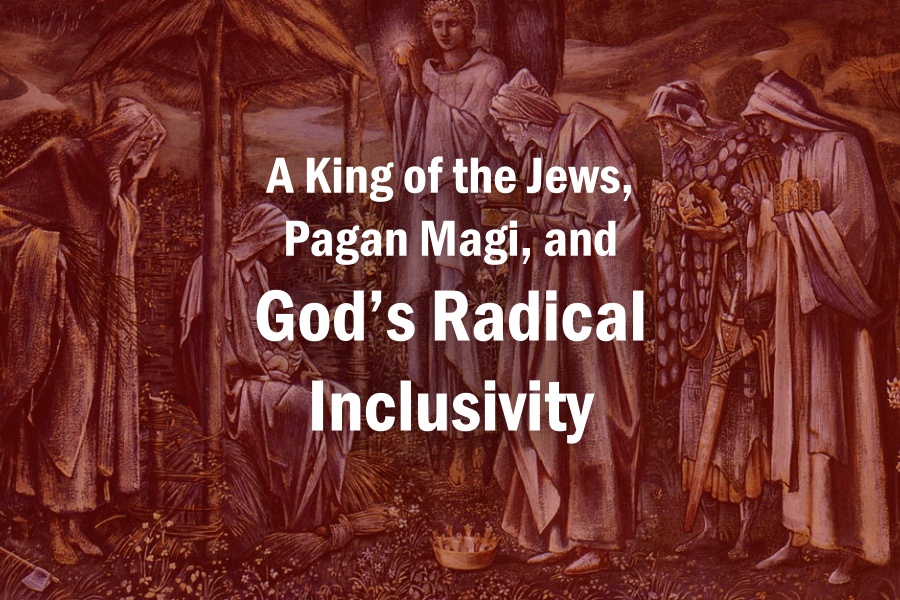
Now when Jesus was born in Bethlehem of Judea in the days of King Herod, behold, wise men from the east came to Jerusalem, saying, “Where is he who is born King of the Jews? For we saw his star in the east, and have come to worship him.” (Matthew 2:1–2, WEB)
We’ve heard this story so many times, it’s tempting to just skim over it. King Herod is the bad guy. The wise men are the good guys. On to the next part! But if we do that, we’ll be missing something important. Let’s take a closer look at these characters.
King Herod gets a pretty bad rap, and understandably so. He was paranoid about maintaining his position of authority, and that drove him to do some truly horrendous things. But he wasn’t always a bad king. Here’s how William Barclay describes him in The New Daily Study Bible: The Gospel of Matthew:
He was called Herod the Great, and in many ways he deserved the title. He was the only ruler of Palestine who ever succeeded in keeping the peace and in bringing order to a situation of disorder. He was a great builder; he was indeed the builder of the Temple in Jerusalem. He could be generous. In times of difficulty he cancelled the taxes to make things easier for the people; and in the famine of 25 BC he had actually melted down his own gold plate to buy corn for the starving people.
Furthermore, as a king of the Jews, Herod had immediate access to best Jewish theologians of his day. There was nothing keeping him from a knowledge of Yahweh God. Indeed, when the wise men arrived, Herod’s first action was to call in the religious experts.
When King Herod heard it, he was troubled, and all Jerusalem with him. Gathering together all the chief priests and scribes of the people, he asked them where the Christ would be born. They said to him, “In Bethlehem of Judea, for this is written through the prophet,
‘You Bethlehem, land of Judah,
are in no way least among the princes of Judah:
for out of you shall come a governor,
who shall shepherd my people, Israel.’”Then Herod secretly called the wise men, and learned from them exactly what time the star appeared. He sent them to Bethlehem, and said, “Go and search diligently for the young child. When you have found him, bring me word, so that I also may come and worship him.” (Matthew 2:3–8, WEB)
Of course we already know how this ends—we know Herod’s true intentions. But try to imagine you’re reading this story for the first time. Forget what you know Herod is planning, and just look at what we’ve read so far. He’s a generous king of the Jews who seeks counsel from the religious authorities and wants to worship the newborn king. From all appearances, Herod is the good guy.
By contrast, let’s consider the wise men—or “Magi” as the Greek term is more properly rendered. The Magi were magicians and astrologers. They were pagans, most likely Zoroastrians from Persia. Here’s what F.D. Bruner has to say in his Matthew: A Commentary:
[In] the opinion of people in Israel … Magi were idolaters, short and simple. … Magi were officially considered people who looked, and taught others to look, to beggarly creatures rather than to the Creator and his Torah for guidance; they looked to their own calculations, “wisdom,” and mental creations (e.g., zodiacs) to deliver the meanings of things. Official Israel deeply despised the magicians and astrologers of the Gentiles and felt that God had rescued his people from the tyranny of the stars and from those who claimed to know their secrets.
Magi appear only once in the Bible before this—they were the magicians who failed to interpret Nebuchadnezzar’s dream (Daniel 2:2, 10). So they weren’t generally viewed as the best of characters.
As first-time readers from a Jewish perspective, we’d be having some serious doubts about these pagan Magi. But we’re about to learn what’s really going to happen. Matthew is setting us up for a surprise reversal.
They, having heard the king, went their way; and behold, the star, which they saw in the east, went before them, until it came and stood over where the young child was. When they saw the star, they rejoiced with exceedingly great joy. They came into the house and saw the young child with Mary, his mother, and they fell down and worshiped him. Opening their treasures, they offered to him gifts: gold, frankincense, and myrrh. Being warned in a dream that they shouldn’t return to Herod, they went back to their own country another way.
Now when they had departed, behold, an angel of the Lord appeared to Joseph in a dream, saying, “Arise and take the young child and his mother, and flee into Egypt, and stay there until I tell you, for Herod will seek the young child to destroy him.”
He arose and took the young child and his mother by night, and departed into Egypt, and was there until the death of Herod; that it might be fulfilled which was spoken by the Lord through the prophet, saying, “Out of Egypt I called my son.”
Then Herod, when he saw that he was mocked by the wise men, was exceedingly angry, and sent out, and killed all the male children who were in Bethlehem and in all the surrounding countryside, from two years old and under, according to the exact time which he had learned from the wise men. Then that which was spoken by Jeremiah the prophet was fulfilled, saying,
“A voice was heard in Ramah,
lamentation, weeping and great mourning,
Rachel weeping for her children;
she wouldn’t be comforted,
because they are no more.”But when Herod was dead, behold, an angel of the Lord appeared in a dream to Joseph in Egypt, saying, “Arise and take the young child and his mother, and go into the land of Israel, for those who sought the young child’s life are dead.”
He arose and took the young child and his mother, and came into the land of Israel. But when he heard that Archelaus was reigning over Judea in the place of his father, Herod, he was afraid to go there. Being warned in a dream, he withdrew into the region of Galilee, and came and lived in a city called Nazareth; that it might be fulfilled which was spoken through the prophets: “He will be called a Nazarene.” (Matthew 2:9–23, WEB)
The pagan Magi turn out to be righteous. King Herod is revealed as a murderous fraud. The outsiders are welcomed in, while the insiders reject their true king. N.T. Wright in his Lent for Everyone: Matthew Year A writes the following:
Matthew seems to be saying, to his resurrection-based church, that their mission will remain rooted in the Jewish scriptures, and that they will be able with their help to draw the wisdom of the world into homage to the world’s rightful king. But he is also warning them that they must not expect all the Jewish people to join in.
Finally, it’s interesting to note that the Magi did not cease being Magi. That is, they did not change religions. They did not convert to Judaism, and Christianity didn’t even exist yet. They did not understand that Jesus was God, nor even that he was the Son of God. They only knew that Jesus was the true King of the Jews.
The Magi followed what light they were given, and that was enough. As far as we know, they never became Christians in any formal sense. But do you think we’ll be seeing these earliest worshipers in eternity? I certainly do.
This is the fifth post in my “Blogging through Matthew” series. If you missed the previous post, be sure to check out “When Joseph Chose to Bear Mary’s ‘Sin.’”
Previous Post

March 14, 2016
Trouble I’ve Seen by Drew Hart (Book Review)
Next Post
April 2, 2016 My Long Fight to Defend Inerrancy & Why I Finally Accepted the Bible We Have
Browse Our Archives
Select a Category Church Personal Reviews Scripture Social Justice Theology
Select a Month August 2021 September 2020 August 2020 July 2019 March 2019 December 2018 November 2018 October 2018 September 2018 August 2018 July 2018 June 2018 May 2018 April 2018 March 2018 January 2018 December 2017 November 2017 October 2017 September 2017 August 2017 July 2017 June 2017 May 2017 April 2017 March 2017 February 2017 January 2017 December 2016 November 2016 October 2016 July 2016 June 2016 April 2016 March 2016 February 2016 January 2016 December 2015 November 2015
Follow Us!
TAKE THE
Religious Wisdom Quiz
Who said, "The just shall live by faith"?
Select your answer to see how you score.
Peter Jesus John Paul
Related posts from Hippie Heretic


Yes, Metaxas, Racism Is Still Wrong without God

Progressives Need to Start Preaching Hell Again
“Christmas Heresy” by Andrew Robinson (Guest Poem)
TRENDING AT PATHEOS Progressive Christian

What Being a Modern-Day Apostle Means to Me
In my last column, I discussed the ins and outs of modern-day...

Did Ancient China Once Worship the God of...
Across human history, a common thread weaves through the origins of the...

Love Your Neighbor – Including Earth-Kin: Lev. 19,...
God’s command to love your neighbor means acting in an ethical and...

Lead a Church Study of “Jesus and Lao...
Guest writer Jack Thomas (The Irreverent Reverend) reflects on leading his church...

Pastoral Wisdom for Responding to Sermon Pushback
Getting sermon pushback on your social justice sermon? Learn practical, Proverbs-based strategies...

Principles for Understanding the Apostolic Ministry Today
Whenever people discover that my formal ministry title is "apostle," as in...
view all Progressive Christian blogs
Ad-Free & Subscriber Log-In Subscription Support
- About Us
- 2026 Calendar
- Videos
- Podcasts
- Library of World Religions
- Faith In Media Tracker
- Advertise With Us
- Write for Us
- Privacy Policy
- Terms of Service
- Do Not Sell My Data
- Contact Us
- Radiant Digital
- Manage Newsletter Subscriptions
- Unsubscribe From Notifications
- Sitemap
Copyright 2008-2026, Patheos. All rights reserved.
Subscription Support Ad-Free & Subscriber Log-In
Follow Patheos