
BuddhistCatholicContemplativeEvangelicalGeneral ChristianHinduJewishLatter-day SaintMuslimNew VisionsProgressive Christian
Beliefs
- Buddhist
- Catholic
- Contemplative
- Evangelical
- General Christian
- Hindu
- Jewish
- Latter-day Saint
- More Voices
- Muslim
- New Visions
- Pagan
- Progressive Christian
Topics
- Religion News
- Food and Religion
- Sports and Religion
- Religious Art
- Religious Music and Entertainment
- Religious Events
- History and Religion
- Style and Religion
- Politics and Religion
- Women in Religion
- Recreation Outdoors and Religion
- Business Finance and Religion
- Careers Workplace and Religion
- Education and Religion
- Family Parenting and Religion
- Health Fitness and Religion
- Home and Religion
- Relationships and Religion
- Technology and Religion
- Travel and Religion
Columnists
- Buddhist Columnists
- Business Finance and Religion Columnists
- Careers Workplace and Religion Columnists
- Catholic Columnists
- Contemplative Columnists
- Education and Religion Columnists
- Evangelists Columnists
- Family Parenting and Religion Columnists
- General Christian Columnists
- Health Fitness and Religion Columnists
- Hindu Columnists
- History and Religion Columnists
- Home and Religion Columnists
- Jewish Columnists
- More Voices Columnists
- Latter Day Columnists
- Muslim Columnists
- New Visions Columnists
- Nonreligious Columnists
- Pagan Columnists
- Politics and Religion Columnists
- Progressive Columnists
- Recreation Outdoors and Religion Columnists
- Relationships and Religion Columnists
- Religion News Columnists
- Religious Art Columnists
- Religious Events Columnists
- Religious Music and Entertainment Columnists
- Sports and Religion Columnists
- Style and Religion Columnists
- Technology and Religion Columnists
- Travel and Religion Columnists
- Women in Religion Columnists
Resource Library
- 2026 Calendar
- Library of World Religions
- The 100 Most Holy Places on Earth
- Patheos Answers
- Podcasts
- Videos
- Faith Leaders Database
- Anglican Episcopalian
- Bahai
- Baptist
- Buddhism
- Christianity
- Confucianism
- Eastern Orthodoxy
- Hinduism
- Holiness and Pentecostal
- ISKCON
- Islam
- Judaism
- Lutheran
- Methodist
- The Church of Jesus Christ of Latter-day Saints
- New Age
- Paganism
- Presbytarian and Reformed
- Protestantism
- Religion Behind the Scenes
- Roman Catholic
- Scientology
- Shia Islam
- Sikhism
- Sufism
- Sunni Islam
- Taoism
- Zen
- See all religions
Research Tools
 Ad-Free & Subscriber Log-In Subscription Support
Ad-Free & Subscriber Log-In Subscription Support
Follow Patheos 

- Trending:
- Forgiveness
- |
- Marriage
- |
- Consciousness
- |
- Death Penalty
- |
- Election
- |
- Halloween
 Hippie Heretic
- Home
- Progressive Christian
- The Jihad of Jesus by Dave Andrews (Book Review)
The Jihad of Jesus by Dave Andrews (Book Review)
Last updated on: April 1, 2017 at 7:23 am by Chuck McKnight
The Jihad of Jesus by Dave Andrews (Book Review) 2017-04-01T07:23:39-07:00 Chuck McKnight
Patheos Explore the world's faith through different perspectives on religion and spirituality! Patheos has the views of the prevalent religions and spiritualities of the world.
What comes to mind when you see the word jihad? A so-called holy war? The Crusades? ISIS? These are the sorts of things I’ve always related to jihad. But as it turns out, I had no idea what jihad really means.
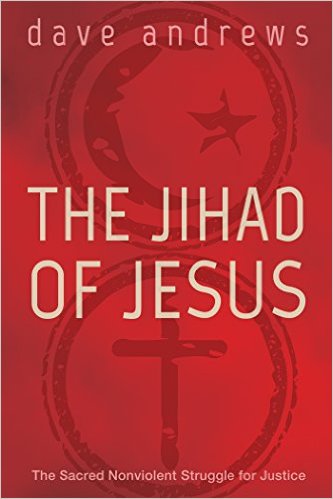
In The Jihad of Jesus: The Sacred Nonviolent Struggle for Justice, Dave Andrews reclaims the true meaning of jihad, which is good news for Christians and Muslims alike.
He introduces the book with a clarification of the term, taken from Diane Morgan’s Essential Islam:
In Arabic, the word jihad translates as a noun meaning “struggle.”
A person engaged in jihad is called a mujahid, the plural (of which) is mujahideen.
There are two commonly accepted meanings of jihad: an inner spiritual struggle and an outer physical struggle.
The “greater jihad” is the inner struggle by a believer to fulfill his or her religious duties. This non-violent meaning is stressed by both Muslim and non-Muslim religious authors.
The “lesser jihad” is the physical struggle against oppressors, including enemies of Islam. This physical struggle can take a violent form or a non-violent form. The proponents of the violent form (of the struggle) translate (or, rather, interpret) jihad as “holy war.” (p. 1, quoting Morgan p. 87)
The book is then divided into two parts: “The Jihad of Dajjal” (dajjal is Arabic for “deceiver”) and “The Jihad of Isa” (Isa is Arabic for “Jesus”).
The Jihad of Dajjal
In part one, Andrews surveys the violent histories of both Christianity and Islam. A minor critique here is that he cites some less-than-reliable sources in his presentation of Christian history, thus making a few questionable assertions. But individual points aside, there’s no question that our history is filled to the brim with inexcusable bloodshed. We Christians must acknowledge and repent from our past if we are to have any hope for a peaceful future.
Andrews then reflects on these histories, weighing multiple theories as to why both religions have been so filled with violence. He concludes that “the religion we are devoted to is the reason that so many Christians and Muslims act in such a disgraceful manner” (p. 71), but he further clarifies that it has more to do with how we hold our religious beliefs than it does with the beliefs themselves. He contrasts what he calls the “closed set perspective” with the “open set perspective.”
In a closed set perspective,
People who subscribe to a certain set of circumscribed beliefs and behaviors are “in.” … People who don’t subscribe to a certain set of circumscribed beliefs and behaviors are “out.” … It is through defending these boundaries of belief and behavior that religious people define their religious identity. Hence Christians and Muslims have tended to fight to not only to [sic] define but also defend these boundaries of belief and behavior to the death, because not only their religious identity, but also their eternal destiny, depends on it. (p. 72)
By contrast,
According to the open set perspective, a “set” is defined by a center, which is “free,” and “cannot ever be confined or enclosed,” … From this perspective, a set of people who have a connection to God, show they are part of the set, not simply by choosing to subscribe to a certain set of beliefs and behaviors within certain set boundaries, but by choosing to overcome any boundary of belief or behavior that might prevent them from moving towards the compassionate spirit of God, exemplified in Isa and the Bismillah, which they have made the center of their lives. (p. 75)
Isa, as I mentioned earlier, is the Arabic word for “Jesus,” but the Bismillah requires some more explaining. For that, we have to wait until partway through the second part of the book.
The Jihad of Isa
Part two begins with a fascinating psychological analysis of killing. Andrews here relies on military paratrooper psychologist Lieutenant Colonel Dave Grossman’s book On Killing.
Grossman quotes Brigadier S. L. A. Marshall, whose study of soldiers’ conduct in World War II suggests “that the average healthy individual has such a resistance toward killing a fellow man that he will not of his own volition take life if it is possible to turn away from that responsibility.” … According to Brigadier Marshall, “At the vital point [when a soldier has to decide to fire or not] the normal healthy human being becomes a conscientious objector.” (pp. 81–83, quoting Grossman p. 1)
Continuing to rely on Grossman, Andrews goes on to explain how the US military conditions previously healthy individuals to be able to kill other humans. He then shows how these methods parallel the same methods used by terrorist organizations to recruit and train their own killers.
We then finally reach Andrews’ definition of the Bismillah, which he earlier placed alongside Jesus as the ideal center of an open set perspective.
The Bismillah stands for the Arabic phrase Bismillah ir-Rahman ir-Rahim, a poetic phrase my Muslim friends say contains the true essence of the Qur’an, indeed the true essence of all religions. … [It] is most commonly translated, “In the name of God, most Gracious, most Compassionate.” … Bismillah or bismi Allah means “in the name of Allah.” “Allah” is not the Muslim name for God, still less the name of a Muslim God, but the Arabic name of the One True God. … To recite the Bismillah is to recall there are not many gods but One God and that One God is not Muslim or Christian, but the One whom we belong to and who belongs to us all, whether Muslim or Christian or Jew. (p. 91)
Andrews goes on to show how we can (and must) reframe jihad as non-violent peacemaking. In the next chapter, he outlines the non-violent teaching and example of Jesus. In the final chapter, he provides four more examples—two Christian and two Muslim—of non-violent peacemakers: Francis of Assisi, Khan Abdul Ghaffar Khan, Leymah Gbowee, and Muhammad Ashafa. Andrews concludes the book with an examination of the Beatitudes (or the Be-Attitudes as he calls them) and a call to live the non-violent jihad of Jesus.
My thoughts on The Jihad of Jesus
I found this to be an incredibly insightful book. There’s no doubt in my mind that Dave Andrews is moving us toward the right direction. I commend his unflinching examination of religious violence, and his willingness to include his own tribe as equally guilty. I furthermore agree with his understanding of Jesus’ non-violence. And I’m right there with him in the desire to build these bridges with our Muslim brothers and sisters. The church needs more voices like Andrews speaking about such things.
But the book did leave me with some reservations. I want to frame my critique not as a disagreement with Andrews so much as a refinement of what he’s saying. I don’t think we’re too far off from each other, but I’m not entirely comfortable with the way he put a few things.
My primary reservation has to do with how Andrews frames the open set perspective. I’m familiar with a very similar concept. My friend Jeremy Myers has blogged about it before, referring to the differing perspectives as “Bounded Sets and Centered Sets.” I’d encourage readers to take a look at his post.
On the one hand, I completely agree with the problems Andrews and Myers both see in “closed” or “bounded” sets. This way of thinking has caused no end of trouble for the church, and it needs to be replaced. On the other hand, I’m much more comfortable with the idea of a “centered” set than I am with an “open” set.
Part of this is just terminology. To me, an “open” set seems to imply that anything goes; it doesn’t matter what folks believe or how they live, they can still be Christians. In fairness, this is not at all what Andrews seems to mean by the term, but I do think the term itself is misleading. By contrast, a “centered” set implies that the group is centered around or oriented toward something or someone in particular; while individuals may disagree on all manner of specifics, they are united by their singular focus. Again, this latter definition is probably much closer to what Andrews means by an “open” set, but “open” does not communicate that idea very well.
Terminology aside, my biggest problem with Andrews’ open set has to do with the things he would have us centered on. According to Andrews, Christians and Muslims would all do better to have an open set that is centered on both Jesus and the Bismillah.
I don’t have any initial problems with the idea of the Bismillah as Andrews defines it. In fact I’d say that it is probably a good thing that Christians could benefit from. I have no reservations about taking that which is good from other religions and using it in service of Christ.
However, I have a huge problem with taking anything—no matter how good it may be—and placing it equally alongside Jesus Christ. This is the same problem I have with Christians who place the Bible on equal authority with Jesus. And it’s the same problem I have with Christians who place church tradition on equal authority with Jesus.
Jesus himself must be the only center of our faith. These other things are good. We need the Bible. We need church tradition. And I’m sure we could benefit from the Bismillah. But we dare not place any of them on equal footing with Jesus. That’s the surest way to turn something good into an idol.
With this caveat in place, I’m happy to recommend Andrews’ book as a whole. The Jihad of Jesus is a wonderful step in the right direction toward reconciliation between Christians and Muslims.
Pick up your own copy of The Jihad of Jesus as a paperback or a Kindle eBook.
Disclosure: I received a free copy of this book from SpeakEasy in exchange for an honest review.
Previous Post

February 6, 2016
Water to Wine by Brian Zahnd (Book Review)
Next Post

March 14, 2016 Trouble I’ve Seen by Drew Hart (Book Review)
Browse Our Archives
Select a Category Church Personal Reviews Scripture Social Justice Theology
Select a Month August 2021 September 2020 August 2020 July 2019 March 2019 December 2018 November 2018 October 2018 September 2018 August 2018 July 2018 June 2018 May 2018 April 2018 March 2018 January 2018 December 2017 November 2017 October 2017 September 2017 August 2017 July 2017 June 2017 May 2017 April 2017 March 2017 February 2017 January 2017 December 2016 November 2016 October 2016 July 2016 June 2016 April 2016 March 2016 February 2016 January 2016 December 2015 November 2015
Follow Us!
TAKE THE
Religious Wisdom Quiz
Which writer besides Solomon and David contributed to Proverbs?
Select your answer to see how you score.
Moses Nathan Agur Asaph
Related posts from Hippie Heretic

It Isn't Scapegoating if You're Guilty


Yes, Metaxas, Racism Is Still Wrong without God

The Big Book of Hippie Heretics (Daneen Akers'...
TRENDING AT PATHEOS Progressive Christian

Why Christians Have a Sacred Duty to Vote:...
The Bible offers strong support for the sacred duty to vote. Here...

What Being a Modern-Day Apostle Means to Me
In my last column, I discussed the ins and outs of modern-day...

Did Ancient China Once Worship the God of...
Across human history, a common thread weaves through the origins of the...

Love Your Neighbor – Including Earth-Kin: Lev. 19,...
God’s command to love your neighbor means acting in an ethical and...

Lead a Church Study of “Jesus and Lao...
Guest writer Jack Thomas (The Irreverent Reverend) reflects on leading his church...

Principles for Understanding the Apostolic Ministry Today
Whenever people discover that my formal ministry title is "apostle," as in...
view all Progressive Christian blogs
Ad-Free & Subscriber Log-In Subscription Support
- About Us
- 2026 Calendar
- Videos
- Podcasts
- Library of World Religions
- Faith In Media Tracker
- Advertise With Us
- Write for Us
- Privacy Policy
- Terms of Service
- Do Not Sell My Data
- Contact Us
- Radiant Digital
- Manage Newsletter Subscriptions
- Unsubscribe From Notifications
- Sitemap
Copyright 2008-2026, Patheos. All rights reserved.
Subscription Support Ad-Free & Subscriber Log-In
Follow Patheos