
BuddhistCatholicContemplativeEvangelicalGeneral ChristianHinduJewishLatter-day SaintMuslimNew VisionsProgressive Christian
Beliefs
- Buddhist
- Catholic
- Contemplative
- Evangelical
- General Christian
- Hindu
- Jewish
- Latter-day Saint
- More Voices
- Muslim
- New Visions
- Pagan
- Progressive Christian
Topics
- Religion News
- Food and Religion
- Sports and Religion
- Religious Art
- Religious Music and Entertainment
- Religious Events
- History and Religion
- Style and Religion
- Politics and Religion
- Women in Religion
- Recreation Outdoors and Religion
- Business Finance and Religion
- Careers Workplace and Religion
- Education and Religion
- Family Parenting and Religion
- Health Fitness and Religion
- Home and Religion
- Relationships and Religion
- Technology and Religion
- Travel and Religion
Columnists
- Buddhist Columnists
- Business Finance and Religion Columnists
- Careers Workplace and Religion Columnists
- Catholic Columnists
- Contemplative Columnists
- Education and Religion Columnists
- Evangelists Columnists
- Family Parenting and Religion Columnists
- General Christian Columnists
- Health Fitness and Religion Columnists
- Hindu Columnists
- History and Religion Columnists
- Home and Religion Columnists
- Jewish Columnists
- More Voices Columnists
- Latter Day Columnists
- Muslim Columnists
- New Visions Columnists
- Nonreligious Columnists
- Pagan Columnists
- Politics and Religion Columnists
- Progressive Columnists
- Recreation Outdoors and Religion Columnists
- Relationships and Religion Columnists
- Religion News Columnists
- Religious Art Columnists
- Religious Events Columnists
- Religious Music and Entertainment Columnists
- Sports and Religion Columnists
- Style and Religion Columnists
- Technology and Religion Columnists
- Travel and Religion Columnists
- Women in Religion Columnists
Resource Library
- 2026 Calendar
- Library of World Religions
- The 100 Most Holy Places on Earth
- Patheos Answers
- Podcasts
- Videos
- Faith Leaders Database
- Anglican Episcopalian
- Bahai
- Baptist
- Buddhism
- Christianity
- Confucianism
- Eastern Orthodoxy
- Hinduism
- Holiness and Pentecostal
- ISKCON
- Islam
- Judaism
- Lutheran
- Methodist
- The Church of Jesus Christ of Latter-day Saints
- New Age
- Paganism
- Presbytarian and Reformed
- Protestantism
- Religion Behind the Scenes
- Roman Catholic
- Scientology
- Shia Islam
- Sikhism
- Sufism
- Sunni Islam
- Taoism
- Zen
- See all religions
Research Tools
 Ad-Free & Subscriber Log-In Subscription Support
Ad-Free & Subscriber Log-In Subscription Support
Follow Patheos 

- Trending:
- Forgiveness
- |
- Marriage
- |
- Consciousness
- |
- Death Penalty
- |
- Election
- |
- Halloween
 Hippie Heretic
- Home
- Progressive Christian
- 25 Views on Hell? 2 Questions to Reframe the Debate
25 Views on Hell? 2 Questions to Reframe the Debate
Last updated on: March 31, 2017 at 8:32 am by Chuck McKnight
25 Views on Hell? 2 Questions to Reframe the Debate 2017-03-31T08:32:03-07:00 Chuck McKnight
Patheos Explore the world's faith through different perspectives on religion and spirituality! Patheos has the views of the prevalent religions and spiritualities of the world.
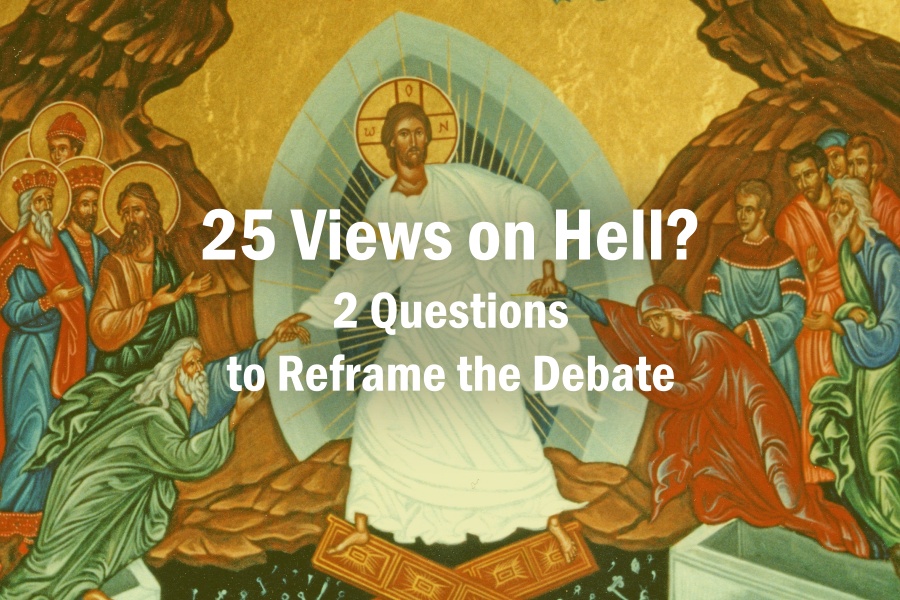
The Christian church has always agreed that there will be a final judgment of the living and the dead. This judgment leads to blessing for those who are in Christ (the righteous), along with punishment1 for those who are not in Christ (the sinners). In today’s vocabulary, the common word for that punishment is hell.
Though the church agrees on the reality of hell, it has never agreed on the nature of hell. From the earliest Christians on, at least three major views have always been present: eternal conscious torment (also called “infernalism” or “traditionalism”), annihilation (also called “conditional immortality” or “conditionalism” or “terminal punishment”), and universal reconciliation (also called “universal salvation” or “universalism”).
I’m going to argue that these three classifications, while helpful to an extent, are insufficient to adequately describe the diversity of opinion within the Christian tradition regarding the nature of hell. Furthermore, I’m going to argue that these three views exist primarily in answer to the same question, but that a different and more important question should have been asked first.
Let’s first consider the fundamental difference between the three major views. As I stated above, each view provides a different answer to the same implied question: “What is the duration of the punishment?”
Eternal conscious torment answers, “The punishment, which is an ongoing process, will continue for all of eternity.” Annihilation answers, “The punishment, which is destruction, will not be reversed for all of eternity.” And universal reconciliation answers, “The punishment, which is an ongoing process, will come to an end once the individual repents.”
But we already have a problem, as (at least) two possible answers remain.
While many annihilationists would say that a person’s fate is sealed at death (we’ll call this “inescapable destruction”), some would say that people are still able to repent after death—thus offering additional possibility for escape from the punishment of destruction (we’ll call this “escapable destruction”).
And while many universalists feel assured that everyone will be saved in the end (we’ll call this “assured escape”), others believe that the process of punishment in hell allows for the possibility of escape but does not guarantee it (we’ll call this “escapable process”).
For consistency with these other views, I’m now going to refer to the answer of eternal conscious torment as “inescapable process.”
To review, we’ve now moved from three views of hell, to five views of hell, giving the following answers to the question, “What is the duration of the punishment?”
- Inescapable process: “The punishment, which is an ongoing process, will continue for all of eternity.”
- Inescapable destruction: “The punishment, which is destruction, will not be reversed for all of eternity.”
- Escapable destruction: “The punishment, which results in destruction, may be reversed if the individual repents.”
- Escapable process: “The punishment, which is an ongoing process, may come to an end if the individual repents.”
- Assured escape: “The punishment, which is an ongoing process, will come to an end once the individual repents.”
So now we have five views—all different ways to answer one question. But again, I don’t believe this is the most important question we should be asking. I’m much more interested to know, “What is the purpose of the punishment?”
This should be the first question we ask because it gets to the heart of who God is, what he is like, and how he carries out justice.
Does God enforce retributive justice—the requirement that sinners pay for their sins? Or does God believe in restorative justice—the desire to heal sinners from their sins? Or does God simply allow people to make their own choices and to reap the consequences thereof? Or is it a combination?
There are (at least) five ways to answer the question, “What is the purpose of the punishment?”
- Retributive: “The punishment is applied because sinners must pay for sins.”
- Retributive but healing: “The punishment is applied because sinners must pay for sins, but it is also intended to bring about healing.”
- Healing: “The punishment is applied because sinners must be healed from sins.”
- Consequential but healing: “The punishment is self-inflicted as a natural consequence of sins, but it is also used to bring about healing.”
- Consequential: “The punishment is self-inflicted as a natural consequence of sins.”
As I said, this is the more important question because it has to do with the nature of God himself. Those who answer that the punishment of hell is in some way retributive have a drastically different picture of God from those who reject the notion of retributive punishment.
In my mind, this is the real dividing line in the discussion about hell. Does God demand retribution? The debate surrounding the duration of punishment pales in comparison.
In our discussion on the nature of hell, we now have 5 views on the purpose of the punishment, multiplied by 5 views on the duration of the punishment, equaling 25 potential views on hell.
If we wanted to classify each view, it might look something like this:
Retributive Retributive but Healing Healing Consequential but Healing Consequential Inescapable Process RIP RHIP HIP CHIP CIP Inescapable Destruction RID RHID HID CHID CID Escapable Destruction RED RHED HED CHED CED Escapable Process REP RHEP HEP CHEP CEP Assured Escape RAE RHAE HAE CHAE CAE
Some of these variants (RHIP, RHID, HIP, HID, CHIP, and CHID) are unlikely to find supporters due to a logical dilemma. If the punishment of hell is intended to be healing, why would there be no chance of escape? But then again, whole branches of Christian theology have been built on logical contradictions, so I can’t rule out the possibility that someone might try to make sense of them.
But let’s look at some examples of known views on hell to see where they fit in this classification.
Eternal conscious torment is generally viewed as retributive with no chance of escape, so it would be RIP. (Ha!) By contrast, the dehumanization view of folks like N.T. Wright would agree that hell is eternal and inescapable, but the process of dehumanization is just a natural consequence of rejecting God, so it would be CIP.
I’m actually not positive whether Wright believes it possible to reverse dehumanization, but some from that persuasion do, so that would be CEP. On the other hand, C.S. Lewis’ The Great Divorce not only offers the possibility of escape, but it also presents God as actively seeking people to bring them out from hell, so that would be CHEP.
Many annihilationists believe in an inescapable destruction, but opinion is split over whether that destruction is retributive, which would make it RID, or simply the consequence of rejecting one’s source of life, which would make it CID.
Universalists generally understand the purpose of hell to be healing (or purifying or restorative). While some are convinced that all will be saved, which would be HAE, others remain unsure that absolutely everyone will repent, which would be HEP.
I’m no expert on Catholic theology, so I want to speak tentatively here, but my understanding is that they view purgatory2 as a place of paying for sins and ultimately being cleansed from them. If my understanding is correct, that would make it RHEP.
For one final example, I’m going to quickly walk through my own current understanding of hell,3 briefly demonstrating why I answer the two questions the way that I do, and classifying my view accordingly.
“What is the purpose of the punishment?”
I must immediately eliminate any form of retribution from my understanding of hell. There are three main reasons for this.
- Retribution is not how God does justice. Though retribution was permitted for a time (Exodus 21:23–25; Leviticus 24:19–20; Deuteronomy 19:21), Jesus brought it to an end (Matthew 5:38–42). Likewise, Israel’s sacrificial system was built largely around the idea of retribution via substitute, but Jesus sided with the prophets who taught that God never wanted sacrifices, only mercy (Hosea 6:6; Jeremiah 7:22; Matthew 9:13; 12:7).
- Even if God did administer retributive punishment, there would be no need for it in hell, because Jesus has already paid the full price of redemption for all people. His sacrifice on the cross was for everyone (1 Timothy 2:6; 4:10; 2 Peter 2:1; 1 John 2:2).
- God’s desire is for all people to be saved (1 Timothy 2:4; 2 Peter 3:9). To suggest that God’s desire will be thwarted because he is bound by retributive justice is to suggest that retribution is a power greater than God. God is bound by nothing but love, for he is love (1 John 4:8).
So if God does not send people to hell for retribution, why will anyone go there? I believe that we send ourselves to hell. To move toward God is to move toward life; to move away from God is to move toward death.
God’s love is an unquenchable fire, intended to refine and purify us. In the resurrection and the judgment, God’s love will be poured out in full measure on everyone. But those who fight against God’s love, clinging to their impurities, will be unable to experience his love as intended. The hell we face is one of our own making.
But at the same time, because God does desire to save everyone, I am convinced that he will continue actively seeking the lost for as long as any hope of repentance remains. God steps into our self-inflicted hell to bring healing.
So in answer to the first question, I would respond, “The punishment is self-inflicted as a natural consequence of sins, but it is also used to bring about healing.”
“What is the duration of the punishment?”
As I stated above, I believe that we send ourselves to hell but that God will continue seeking to save us for as long as any hope remains. This means I must rule out any view of hell as inescapable.
If hell is escapable, then two questions remain. Is escape assured? And if not, what will happen to those who never repent?
On the one hand, the New Testament is filled with passages that offer hope for the ultimate reconciliation of all people (Romans 5:18–19; 1 Corinthians 15:28; Philippians 2:9–11; Ephesians 1:10; Colossians 1:19–20). On the other hand, both testaments are filled with warnings of destruction for those who reject God (Malachi 4:1; John 3:16–18; Romans 6:23; 2 Thessalonians 1:9; Hebrews 10:27). Rather than using one set of passages to explain away the other, I want to acknowledge that both sets teach very real possibilities.
As much as I’d like to affirm the ultimate reconciliation of all, the warning passages keep me from certainty. But no matter how strong those warnings may be, the other passages allow me to hope. And given the reality of human free will, this is exactly what I’d expect—real possibility in either direction.
If people continue on the path away from God and toward death for long enough, I believe it is possible for them to bring about their own complete destruction. But I am hopeful—in the strongest sense of the word—that the God who seeks to save the lost will bring everyone to repentance before anyone can reach that point of destruction.
So in answer to the second question, I would respond, “The punishment, which results in destruction, may be reversed if the individual repents.”
My view of hell would thus be classified as CHED.
What about you? What is your understanding of hell? How would you classify it here? What are some other known views on hell, and how would they be classified?
1 The word punishment can itself be somewhat problematic. Some would say that it is a poor translation for certain Greek words, such as kolasin in Matthew 25:46. For the purpose of this article, I am using punishment simply because it is the word that has traditionally been used in our English New Testaments.
2 I do understand that purgatory in Catholic theology is not the same thing as hell. I’m drastically oversimplifying something I don’t fully understand to offer one additional—albeit very tentative—example. Probably not my best idea.
3 Note that I am providing an overview of my understanding, not a defense thereof. I’m not trying to prove my perspective; I’m just explaining it. The scripture references I include are simply that—references. They are not intended as standalone proof texts, and they should not be read as such.
Previous Post

January 16, 2016
Job Update
Next Post

February 6, 2016 Water to Wine by Brian Zahnd (Book Review)
Browse Our Archives
Select a Category Church Personal Reviews Scripture Social Justice Theology
Select a Month August 2021 September 2020 August 2020 July 2019 March 2019 December 2018 November 2018 October 2018 September 2018 August 2018 July 2018 June 2018 May 2018 April 2018 March 2018 January 2018 December 2017 November 2017 October 2017 September 2017 August 2017 July 2017 June 2017 May 2017 April 2017 March 2017 February 2017 January 2017 December 2016 November 2016 October 2016 July 2016 June 2016 April 2016 March 2016 February 2016 January 2016 December 2015 November 2015
Follow Us!
TAKE THE
Religious Wisdom Quiz
Which Christian tradition celebrates "Holy Week," including Maundy Thursday and Good Friday?
Select your answer to see how you score.
Only Baptists Only Pentecostals Only Quakers Many (Catholic, Orthodox, Anglican)
Related posts from Hippie Heretic

It Isn't Scapegoating if You're Guilty


Yes, Metaxas, Racism Is Still Wrong without God

The Big Book of Hippie Heretics (Daneen Akers'...
TRENDING AT PATHEOS Progressive Christian

What Being a Modern-Day Apostle Means to Me
In my last column, I discussed the ins and outs of modern-day...

Did Ancient China Once Worship the God of...
Across human history, a common thread weaves through the origins of the...

Love Your Neighbor – Including Earth-Kin: Lev. 19,...
God’s command to love your neighbor means acting in an ethical and...

Lead a Church Study of “Jesus and Lao...
Guest writer Jack Thomas (The Irreverent Reverend) reflects on leading his church...

Pastoral Wisdom for Responding to Sermon Pushback
Getting sermon pushback on your social justice sermon? Learn practical, Proverbs-based strategies...

Principles for Understanding the Apostolic Ministry Today
Whenever people discover that my formal ministry title is "apostle," as in...
view all Progressive Christian blogs
Ad-Free & Subscriber Log-In Subscription Support
- About Us
- 2026 Calendar
- Videos
- Podcasts
- Library of World Religions
- Faith In Media Tracker
- Advertise With Us
- Write for Us
- Privacy Policy
- Terms of Service
- Do Not Sell My Data
- Contact Us
- Radiant Digital
- Manage Newsletter Subscriptions
- Unsubscribe From Notifications
- Sitemap
Copyright 2008-2026, Patheos. All rights reserved.
Subscription Support Ad-Free & Subscriber Log-In
Follow Patheos